
Surv-IPTB: An Attention-Based Model for Estimating Individual Probability of Treatment Benefit with Survival Data
Source: arXiv:2608.06288 · Published 2026-08-06 · By Lev V. Utkin, Stanislav K. Kogan, Andrei V. Konstantinov
TL;DR
Surv-IPTB addresses the challenge of estimating the Individual Probability of Treatment Benefit (IPTB) in survival analysis, where outcomes are censored. Unlike conventional Conditional Average Treatment Effect (CATE) estimation, which provides average treatment effects, IPTB estimates the probability that a given patient will experience extended survival due to treatment. The paper introduces a novel attention-based model that reframes IPTB as a binary classification problem over pairwise patient comparisons between treatment and control cohorts. To handle right-censored survival data, it employs imprecise probability intervals and soft labels for uncertain cases.
Surv-IPTB leverages an attention mechanism parameterized by learnable query and key transformations to flexibly aggregate pairwise comparisons weighted by kernel functions over patient features. It simultaneously estimates class probabilities for censored pairs via survival functions (Kaplan-Meier, Beran, Cox). The model is extensively evaluated on synthetic datasets with complex nonlinear feature distributions (spiral, bell-shaped, circular), demonstrating robust performance across varying censoring rates and effect sizes. It consistently outperforms standard meta-learner approaches (T-learner, S-learner) combined with survival forest, Cox, and Beran estimators, especially under challenging nonlinear data and censorship scenarios. The approach thus establishes a statistically principled, scalable framework for individualized treatment benefit estimation with survival data.
Key findings
- Surv-IPTB achieves higher ROC-AUC scores than six meta-learner baselines (T-learner and S-learner combined with RSF, Cox, Beran) on diverse synthetic datasets exhibiting nonlinear and complex feature structures.
- The model robustly handles up to 30% right censoring by incorporating soft class probabilities for uncertain pairs, avoiding discarding censored information.
- Attention weights are parameterized by learnable query-key matrices transforming concatenated treatment-control features, enabling flexible patient similarity aggregation.
- Soft label probabilities for censored observations are derived from survival functions as imprecise intervals between 0 and 1 (equations 14, 16), improving loss function expressiveness.
- Validation scheme 1 evaluates generalization across unmatched treatment-control pairs with global feature combinations, while Validation scheme 2 evaluates matched covariate pairs, showing consistent advantage.
- The model remains stable under varying treatment effect strength parameters (TP = 0.1 to 0.6) and treatment group sizes.
- Pairwise construction of IPTB estimation bypasses direct joint distribution modeling of counterfactual survival times, sidestepping copula identification challenges.
- Soft label regularization and parameter norms (L(π), L(W)) aid training convergence in presence of censored soft class assignments.
Methodology — deep read
The paper tackles estimating the individual probability that treatment prolongs survival (IPTB), formulated as Pr(H* > Y* | X = x), where H* and Y* are potential survival times under treatment and control respectively.
Threat Model & Assumptions: The setting assumes observational survival data with treatment assignment and right censoring; consistency, conditional ignorability, and positivity permit identification of marginal conditional survival distributions but not the joint potential outcome distribution. Dependence between H* and Y* is not identified and treated with independence copula as baseline. Adversarial scenarios are not considered.
Data: Observed datasets are triplets (features, observed survival or censoring times, censoring indicators) for treatment and control groups. Synthetic datasets with 7 to 10 dimensional complex nonlinear features are generated via linear, spiral, bell-shaped, and circular functions. Outcomes are generated from Weibull distributions conditioned on features with censoring rate fixed at 30%. Sample sizes and train/test splits are specified for 5-fold stratified cross-validation repeated 10x.
Architecture / Algorithm: The estimation reduces IPTB to a binary classification task on pairwise differences ∆ij = hi - yj between treatment and control patients. Because many ∆ij are censored, class labels are either hard (1 or 0 if both times uncensored) or soft probabilities in [0,1] derived using survival functions capturing censoring uncertainty. An attention mechanism computes weights over all pairs for a query pair (z,x) using learnable query and key linear projections WQ and WK applied to concatenated feature pairs. Value vectors are hard or soft class labels π(i,j). Attention outputs a probability p+(z,x) estimating P(∆>0|z,x). Loss combines log-likelihood terms over well-defined and soft label pairs plus regularization on WQ, WK and soft label entropy.
Training: Hyperparameters γ and η control regularization of soft labels and parameters. Optimization minimizes the composite loss over all pairs. Details on optimizer, learning rates, epochs, and hardware are not explicitly stated. Multiple splits and random seeds ensure robustness.
Evaluation: Two validation schemes measure (1) prediction over arbitrary treatment-control pairs testing generalization across joint covariate space and (2) prediction for matched covariate pairs evaluating model performance in well-defined controlled scenario. Main metric is ROC-AUC with statistical averaging over folds and runs. Baselines include T- and S-learners combined with Random Survival Forests, Cox proportional hazards, and Beran estimators.
Reproducibility: The authors provide public code for the method and experiments at their GitHub repository. The synthetic data generation process is described in detail, but real clinical datasets are not used.
Technical innovations
- Reformulating IPTB estimation from survival data as a binary classification problem on pairwise patient differences with soft probabilistic labeling for censored pairs.
- Introducing an attention mechanism with learnable query and key feature transformations to flexibly aggregate information from all pairwise treatment-control comparisons weighted by similarity kernels.
- Principled handling of right-censored survival times by representing uncertain treatment effect class probabilities as interval-valued soft labels derived from survival functions, integrated into the loss function.
- Combining kernel-based weighting with attention for modeling complex nonlinear interactions in heterogeneous treatment benefit estimation.
Datasets
- Synthetic linear features — size unspecified (multiple experiments) — generated using uniform sampling and Weibull outcomes with censoring
- Synthetic spiral features — size unspecified — generated with Archimedean spiral construction
- Synthetic bell-shaped features — size unspecified — Gaussian mixtures over uniform parameters
- Synthetic circular features — size unspecified — constructed from multidimensional circles
Baselines vs proposed
- T-RSF: ROC-AUC = baseline lower than Surv-IPTB; Surv-IPTB improves ROC-AUC by several percentage points on nonlinear datasets
- S-RSF: ROC-AUC = baseline lower than Surv-IPTB; Surv-IPTB shows consistent gains
- T-Cox: ROC-AUC = baseline ; Surv-IPTB outperforms especially in spiral and circular feature settings
- S-Cox: ROC-AUC = baseline; Surv-IPTB performs better under censoring
- T-Beran: ROC-AUC = baseline lower; Surv-IPTB surpasses in nonlinear data
- S-Beran: ROC-AUC = baseline lower; Surv-IPTB consistently higher
Figures from the paper
Figures are reproduced from the source paper for academic discussion. Original copyright: the paper authors. See arXiv:2608.06288.
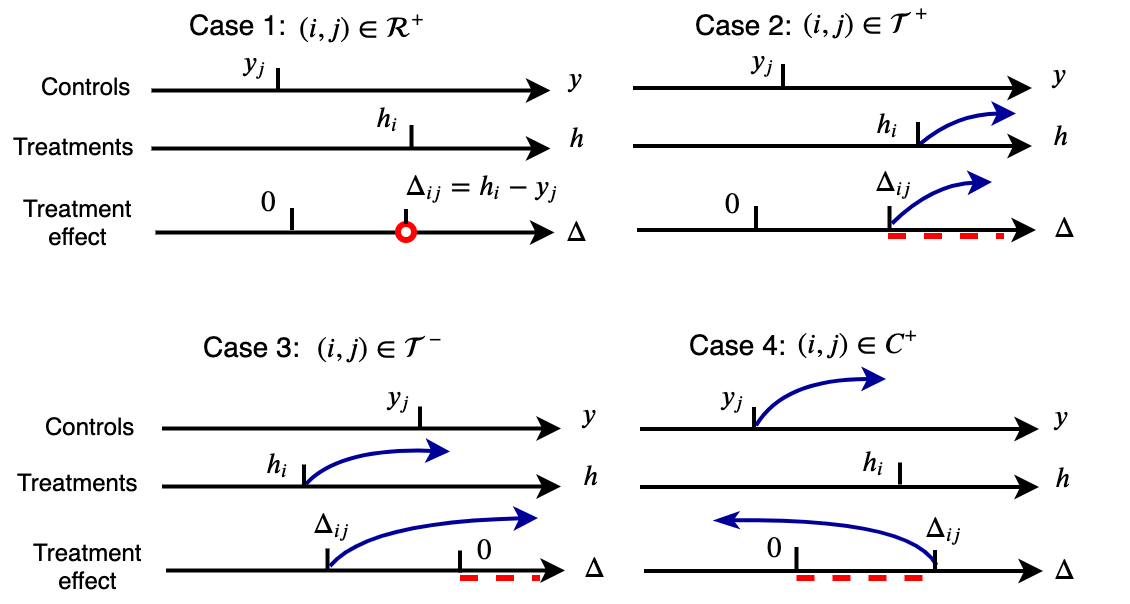
Fig 1: Four cases of subsets where ∆> 0
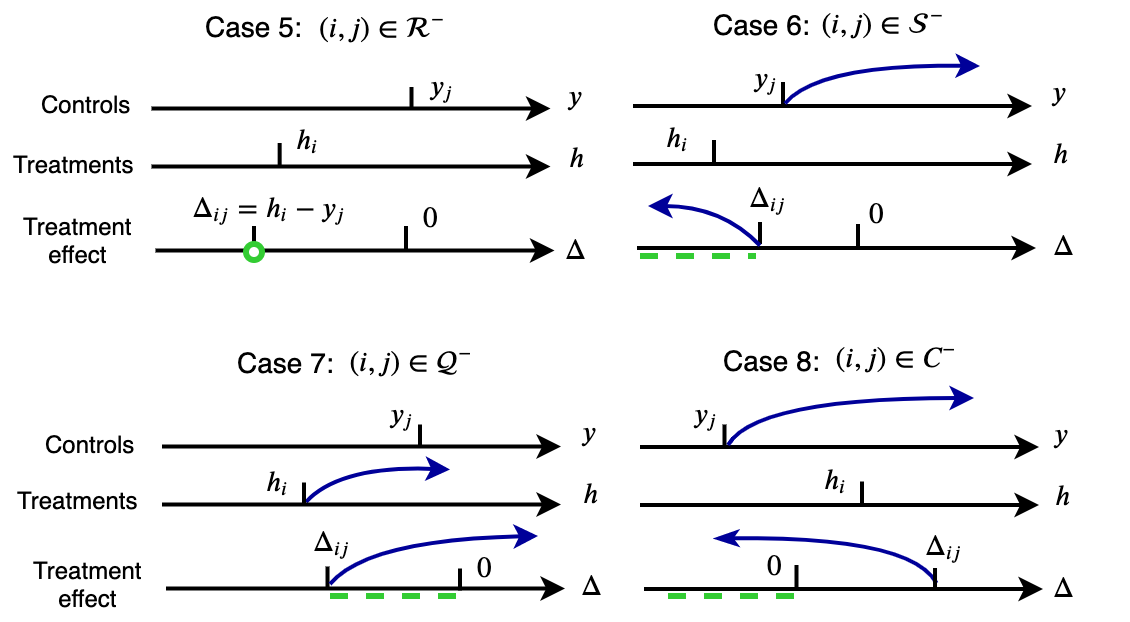
Fig 2: Four cases of subsets where ∆≤0
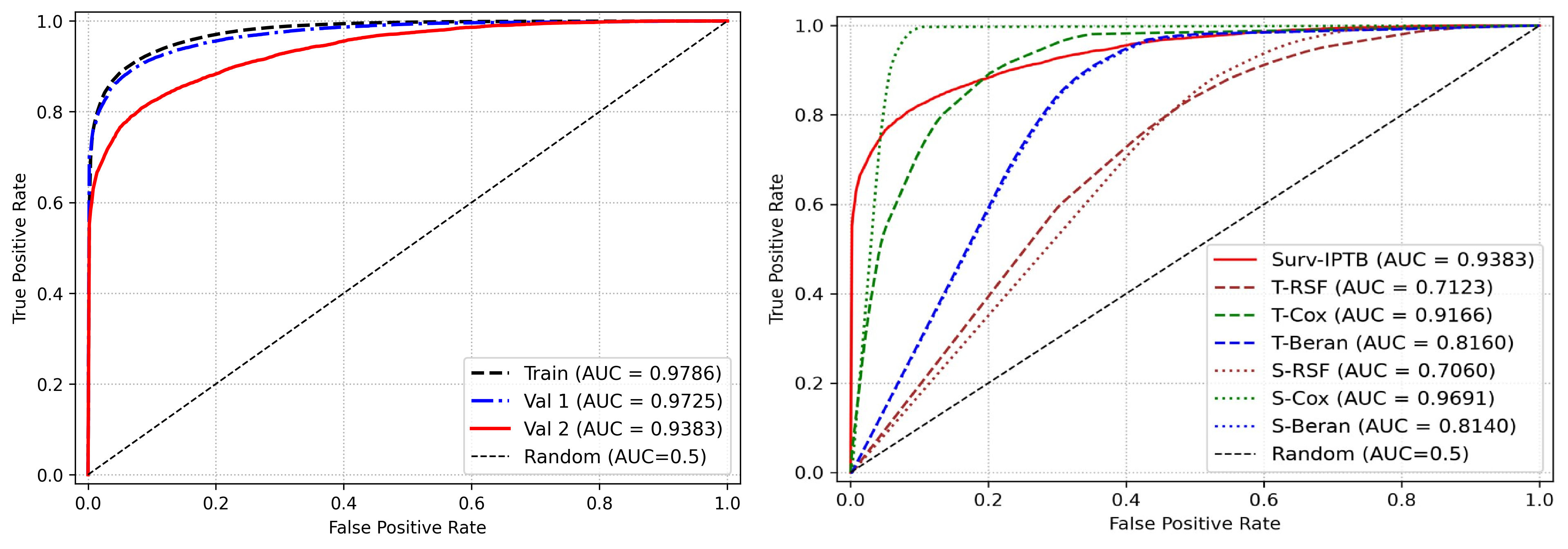
Fig 3: Left plot: The ROC curves and ROC-AUC scores obtained on the training set and
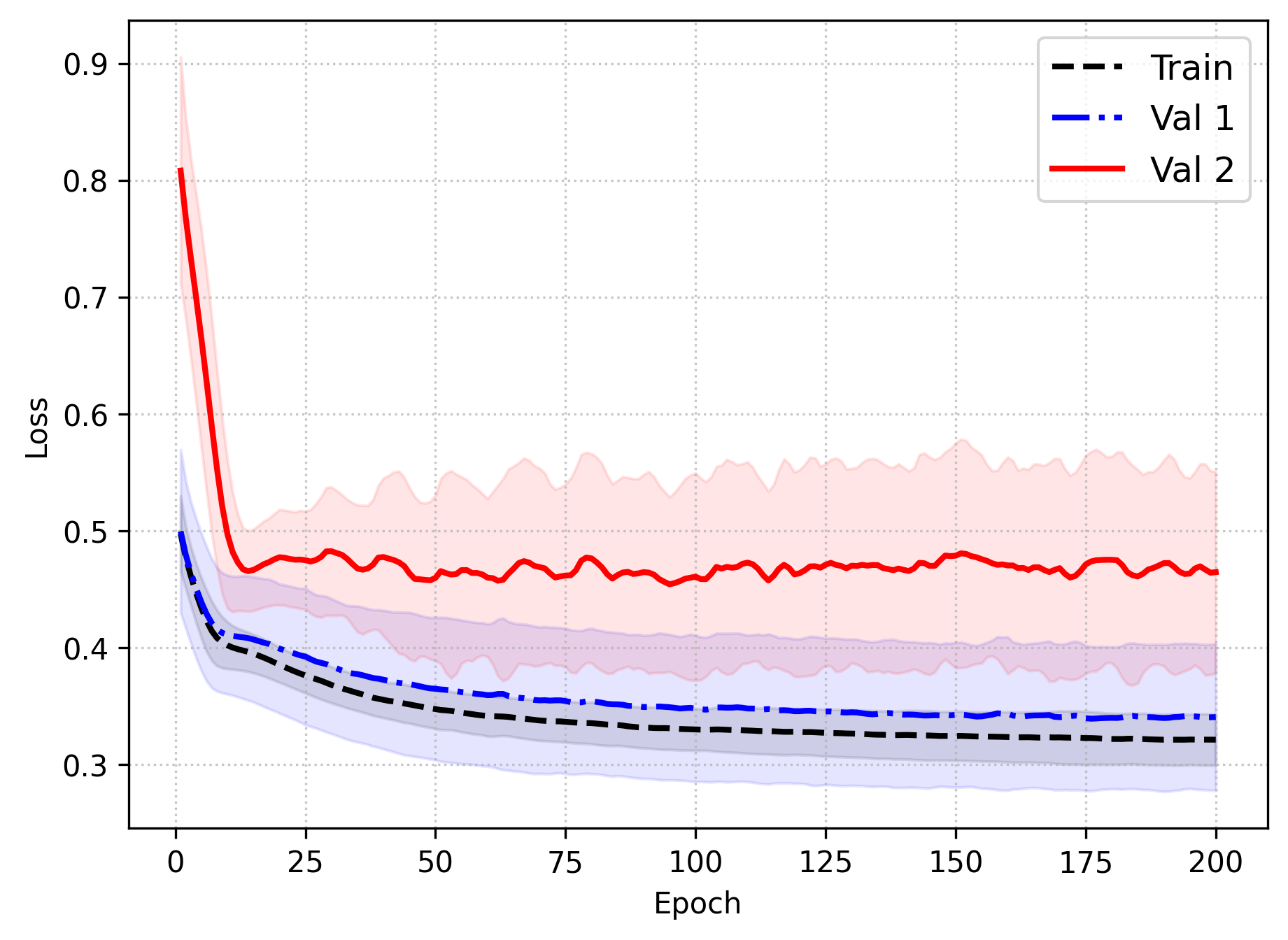
Fig 4: Training and validation loss functions for the linear dataset
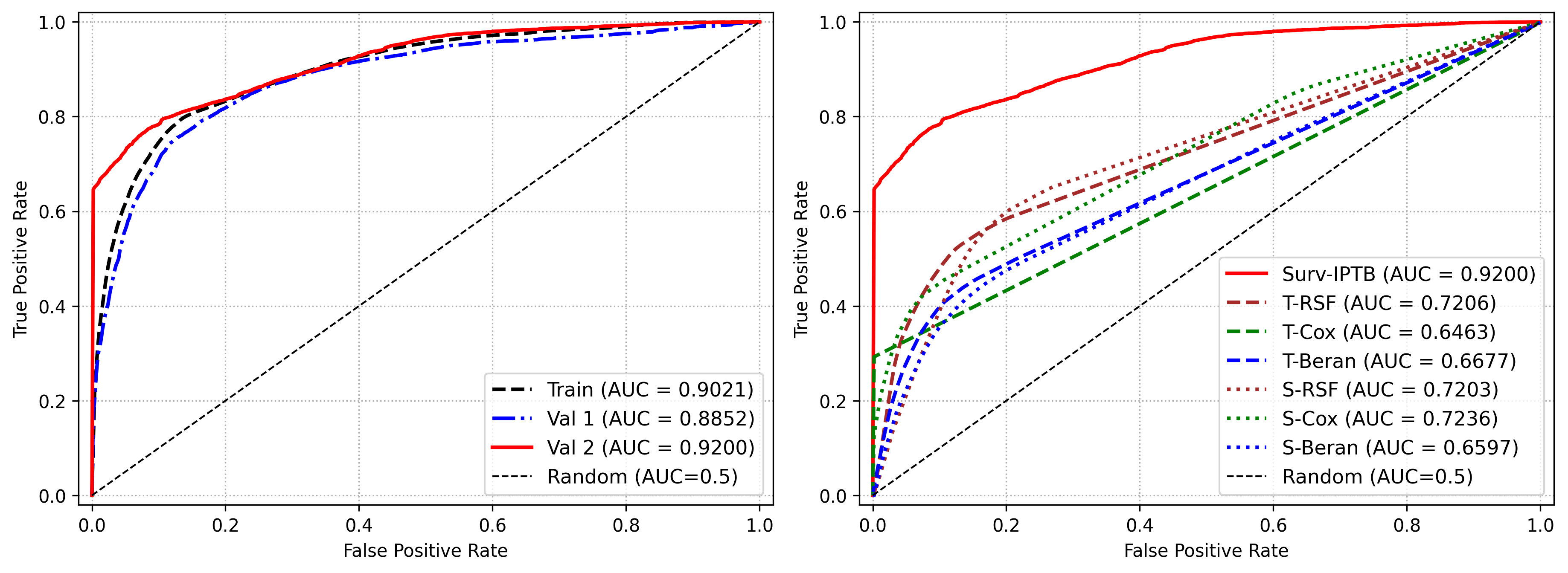
Fig 5: Left plot: The ROC curves and ROC-AUC scores obtained on the training set
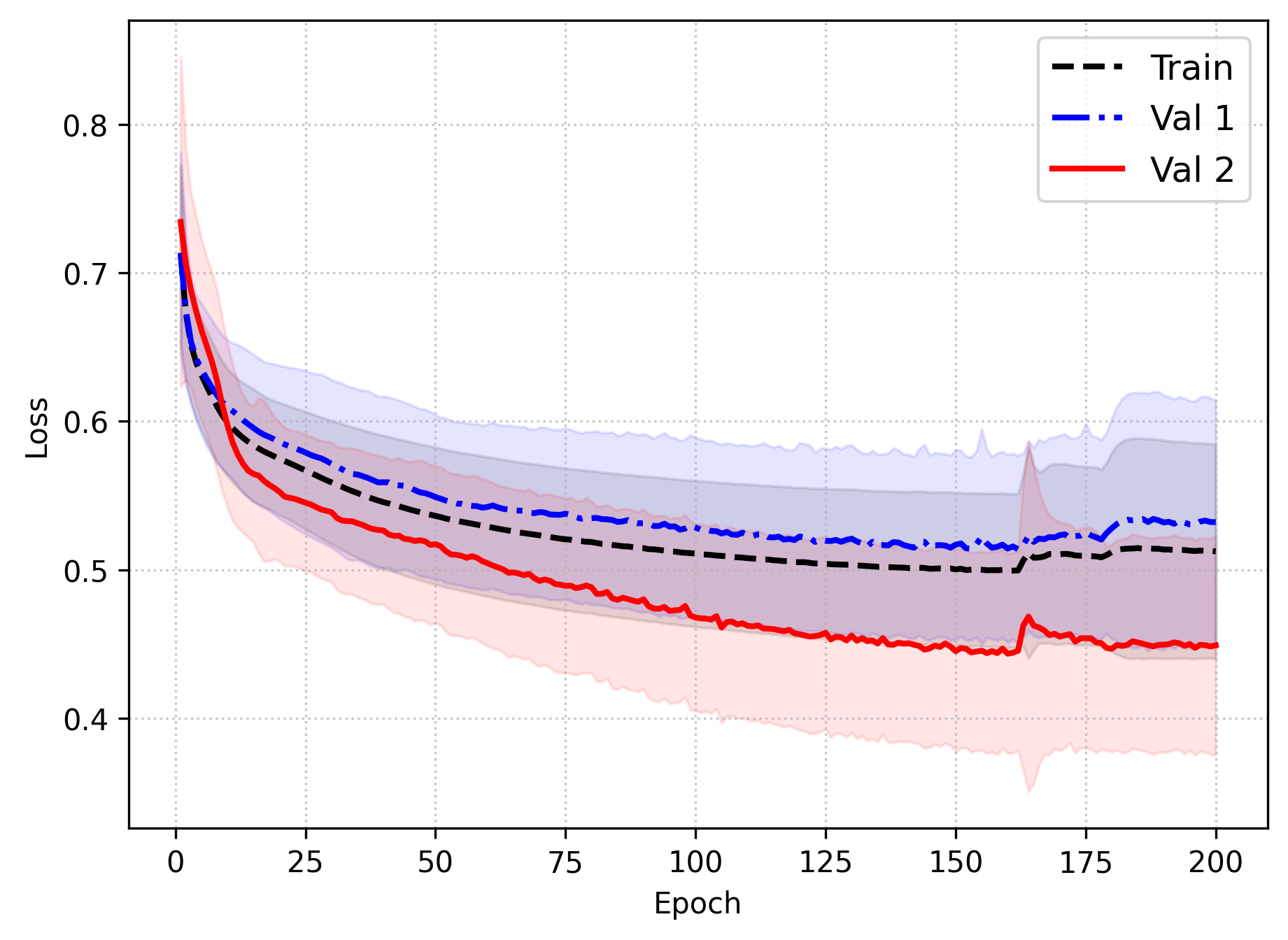
Fig 6: Training and validation loss functions for the Bell-shaped dataset
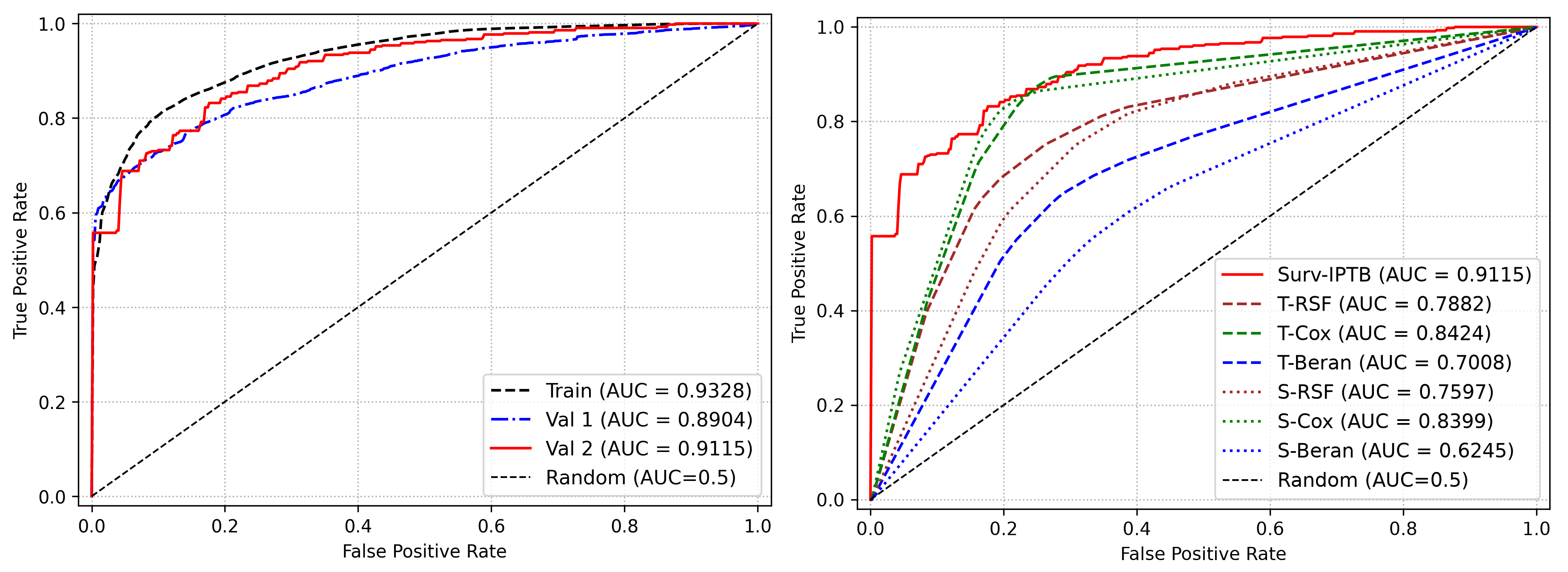
Fig 7: Left plot: The ROC curves and ROC-AUC scores obtained on the training set and
Limitations
- Evaluation is limited to synthetic and semi-synthetic datasets; no real-world clinical data validation provided.
- The independence copula assumption between potential outcomes may not hold; dependence modeling is left for future sensitivity analysis.
- Computing conditional survival functions dependent on both treatment and control features was approximated using unconditional survival functions, potentially reducing precision.
- Details on optimization hyperparameters, convergence, and training stability are sparse, limiting reproducibility insights.
- Adversarial robustness or sensitivity to covariate shifts is not analyzed.
- Scalability to very large datasets or high-dimensional covariates beyond synthetic settings is not empirically demonstrated.
Open questions / follow-ons
- How can dependence between potential outcomes be incorporated, e.g., via copula models, to improve IPTB estimation accuracy?
- Can the framework be extended to real-world clinical datasets with high-dimensional, noisy, and heterogeneous covariates?
- What are the effects of distributional shifts and adversarial perturbations on the stability of the IPTB estimates?
- How efficient and scalable is the attention-based approach in very large observational datasets with thousands or millions of patients?
Why it matters for bot defense
While this paper does not address bot-detection or CAPTCHA directly, its core methodology informs how to model heterogeneous individual event probabilities under censoring and uncertainty. Bot-defense systems that rely on sequential interaction data or time-to-event behaviors (e.g., human engagement durations vs bots) might draw inspiration from this approach to estimate whether an intervention (e.g., a CAPTCHA challenge) effectively improves user engagement or security outcomes on an individual basis. The principled treatment of censored observations and the attention-based aggregation of pairwise comparisons could inspire novel machine-learning defenses that assess probabilities of success or failure per entity interaction rather than average effects. Moreover, modeling soft probabilistic labels under uncertain observation may be useful for bot detection where ground truth labels are ambiguous or noisy. Overall, survival analysis techniques like Surv-IPTB enrich the toolbox for personalized risk or benefit estimation under uncertainty, a concept translatable to adaptive bot-defense workflows.
Cite
@article{arxiv2608_06288,
  title={ Surv-IPTB: An Attention-Based Model for Estimating Individual Probability of Treatment Benefit with Survival Data },
  author={ Lev V. Utkin and Stanislav K. Kogan and Andrei V. Konstantinov },
  journal={arXiv preprint arXiv:2608.06288},
  year={ 2026 },
  url={https://arxiv.org/abs/2608.06288}
}