
A Six-Dimensional Taxonomy of Post-Training Adaptation Techniques with Applications in AI Governance
Source: arXiv:2608.06246 · Published 2026-08-06 · By Fardin Afdideh, Fernando Seoane, Farhad Abtahi
TL;DR
This paper addresses the fragmented landscape of post-training adaptation techniques for machine learning models. It systematically organizes 48 distinct methods into a novel six-dimensional taxonomy that characterizes each technique by its adaptation mechanism, goal, data requirements, persistence, structural scope, and the type of model targeted. This multi-axis framework resolves common terminological ambiguities and conflations among adaptation strategies used across traditional ML, deep learning, foundation models, large language models, and multimodal large language models. By mapping these dimensions to key regulatory frameworks such as the EU AI Act, FDA PCCP, and NIST AI Risk Management Framework, the authors provide a structured vocabulary to support transparent technical documentation, model-change tracking, and governance-aware workflows. The taxonomy highlights the evolving nature of model adaptation methods and challenges in compliance, reproducibility, and evaluation, especially in inference-time adaptations and multimodal settings.
Key findings
- The taxonomy identifies 48 distinct post-training adaptation techniques profiled along six independent dimensions: mechanism, goal, data requirement, persistence, scope, and model type.
- Parameter-Updating adaptations (e.g., fine-tuning, PEFT, RLHF) dominate the mechanism dimension but inference-time adaptations (e.g., prompt engineering, retrieval augmentation, activation steering) scale independently of model size.
- The taxonomy clarifies terminological ambiguities—for example, 'fine-tuning' can mean full parameter updates, partial freezing, or adapter tuning, which differ in data need, persistence, and scope.
- A governance mapping ties taxonomy dimensions to regulatory obligations, e.g., the EU AI Act’s 'substantial modification' clause aligns with adaptation mechanisms involving parametric updates with large compute footprints.
- Across model types from traditional ML to multimodal LLMs, feasible adaptation techniques vary drastically, preventing straightforward technique-to-technique comparisons without considering model type.
- Many current regulatory proxies, such as the EU AI Act’s compute-based threshold for change, may fail to capture impactful but low-compute adaptations like knowledge editing or activation steering.
- Pipeline-mediated adaptations (e.g., curriculum learning, data augmentation applied posttraining) differ fundamentally from direct model modifications and require separate documentation attention.
- Open challenges include persistent inference-time adaptation, multimodal adaptation integration, unlearning evaluation, and reproducible governance-aware post-training workflows.
Methodology — deep read
The authors performed a multivocal literature review combining traditional academic sources with gray literature including framework documentation and industrial analyses to capture the fast-evolving landscape of post-training adaptation techniques. Starting from 12 canonical academic clusters seeded with 18 key papers, backward and forward snowballing identified 48 independently selectable adaptation techniques characterized by materially distinct six-dimensional profiles. The six dimensions were identified based on core questions about what changes (mechanism), why (goal), what data are required, how persistent the change is, how structurally extensive, and which model types are targeted. The taxonomy avoids simple hierarchical categorization by assigning a coordinate in this 6D space for each technique, allowing navigation based on data availability, governance needs, or mechanism focus. For example, LoRA-based parameter-efficient fine-tuning is positioned as a parametric update with task specialization goals, small labeled data requirements, permanent persistence, partial modular scope, and applicability across DL, FM, and LLM models. The authors exclude foundational training and deployment-layer output controls from the taxonomy as out of scope since these do not modify model parameters or inference context directly. Regulatory documentation relevance for each dimension is discussed, e.g., parameter updates consume FLOPs relevant for EU AI Act compute-based substantial modification assessments, whereas inference-time context injection may not. The taxonomy’s centerpiece is Table 8, mapping all 48 techniques across the six dimensions with prototype profiles, supported by appendices providing detailed methodology chains, structural analyses, and governance mappings. The approach includes recognizing boundary cases where a technique spans multiple categories or has foundational and adaptation roles. The paper contrasts this taxonomy with previous single-axis or more limited taxonomies that either omit governance mapping or model-type modulation. The study does not present empirical experiments but is a thorough synthesis and conceptual structuring of literature relevant for both practitioners and regulators, emphasizing explainability, trust, lifecycle, and knowledge-operation goals in adaptation workflows.
Technical innovations
- Introduction of a six-dimensional taxonomy characterizing post-training adaptation techniques across mechanism, goal, data requirements, persistence, scope, and model type to resolve terminology ambiguities.
- Modulating dimension (model type) that filters feasible combinations and prevents misapplication of adaptation terms across traditional ML, deep learning, foundational models, and multimodal LLMs.
- Explicit governance mapping linking taxonomy dimensions to regulatory frameworks such as the EU AI Act, FDA PCCP, and NIST AI Risk Management Framework.
- Separation of adaptation mechanism from training protocols and deployment-layer controls, focusing only on post-training parameter or inference-context modifications.
- Identification and classification of inference-time, zero-weight-update adaptation methods (e.g., context injection, activation steering, inference-time search) distinct from parametric updates.
Figures from the paper
Figures are reproduced from the source paper for academic discussion. Original copyright: the paper authors. See arXiv:2608.06246.
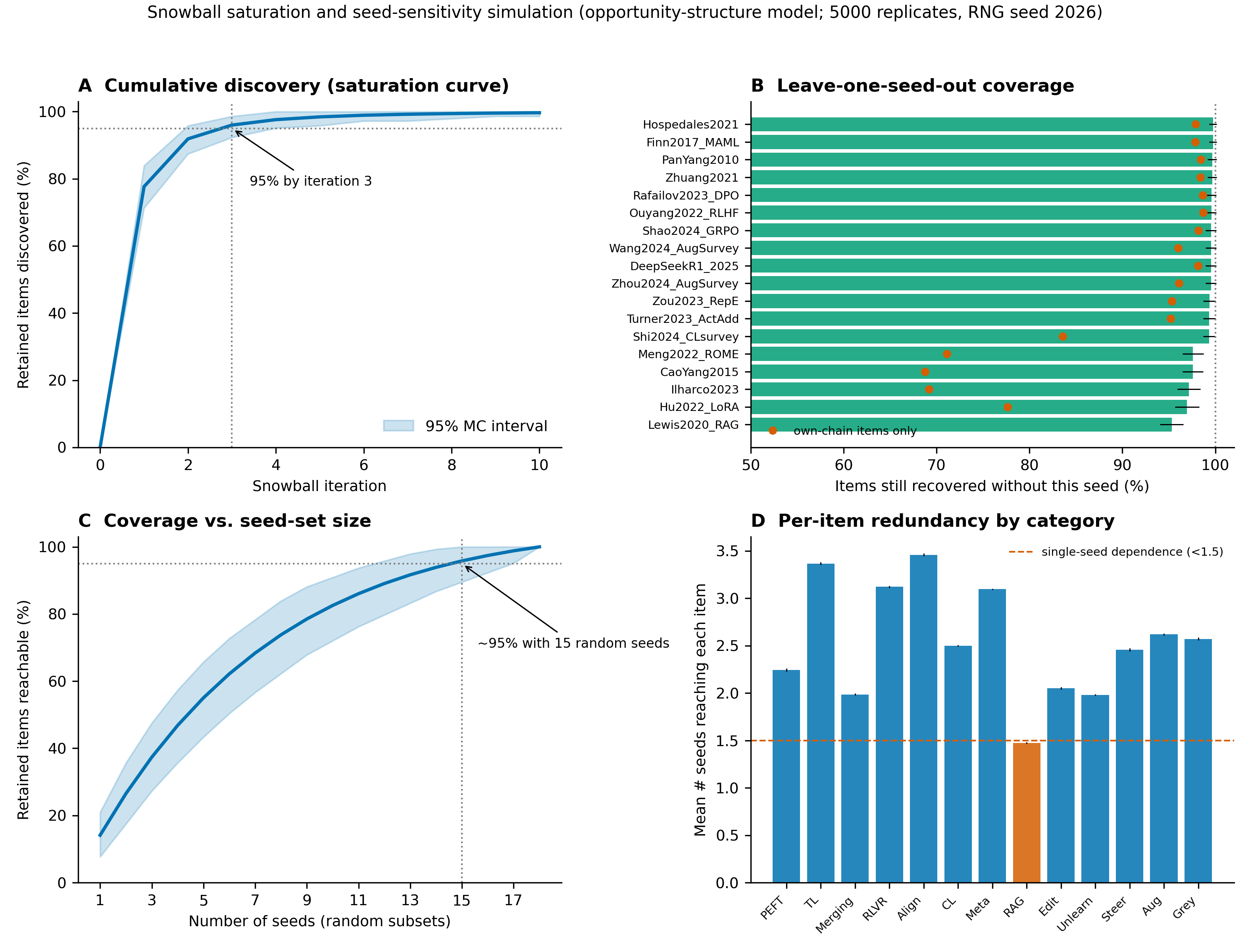
Fig 1: Snowball sampling saturation and seed-sensitivity simulation. MC analysis (5,000 replicates)
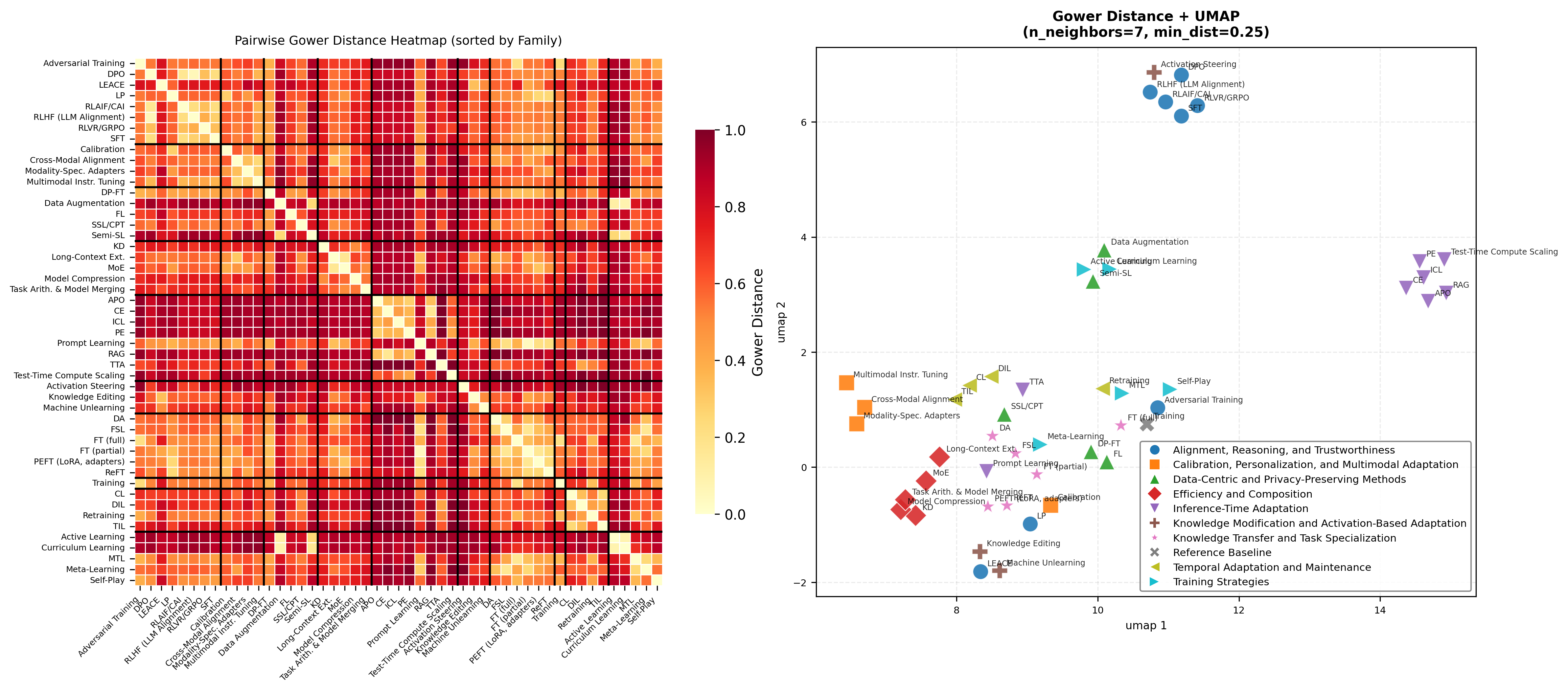
Fig 2: Structural consistency analysis of the adaptation taxonomy. (Left) Pairwise Gower distance
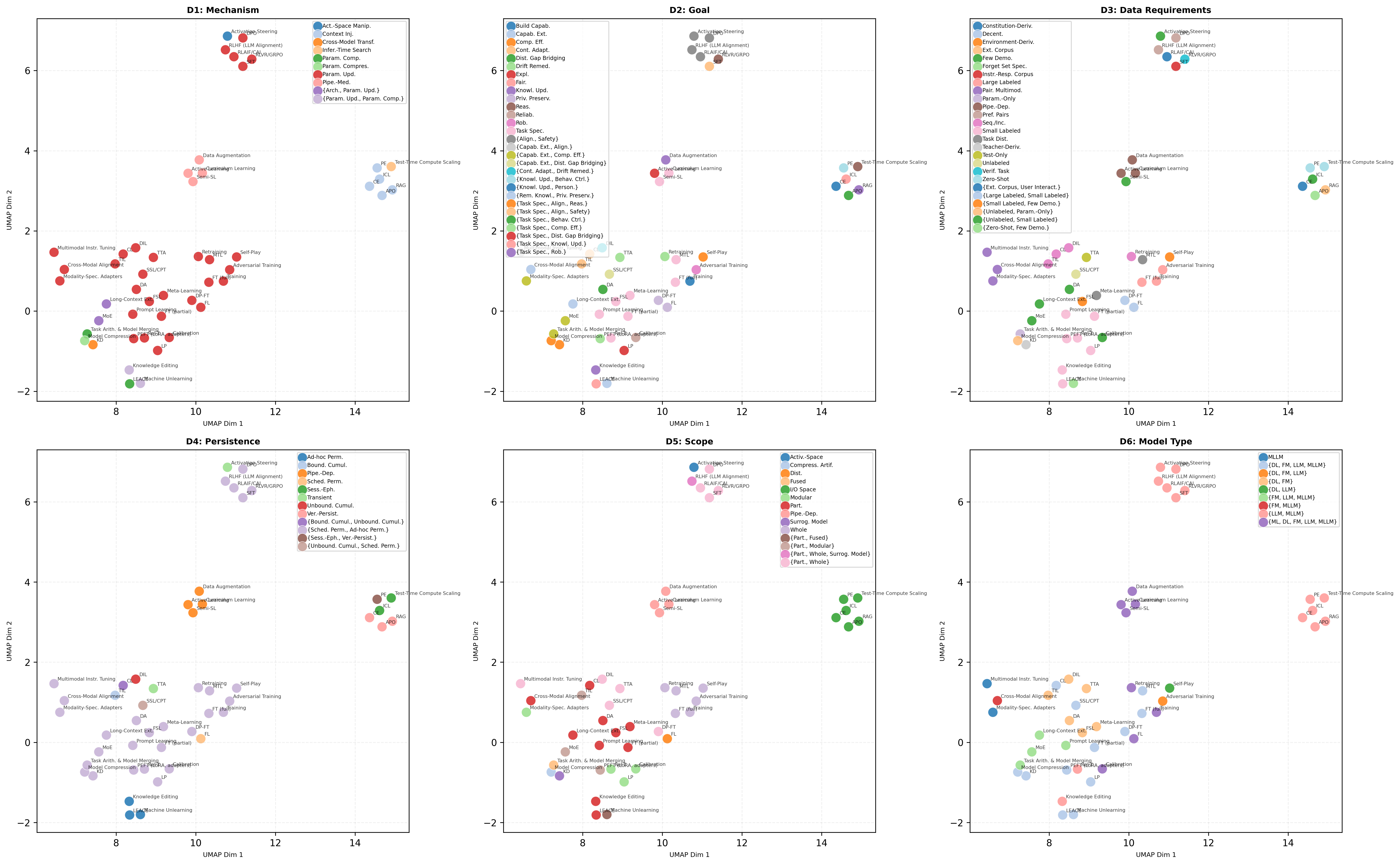
Fig 3: UMAP projection of the latent space, with each panel colored by an individual dimension D1–D6.
Limitations
- The taxonomy is conceptual and synthesizes existing literature; it does not provide empirical validation or quantitative benchmarking of techniques.
- Rapidly evolving techniques may outpace taxonomy updates, especially in experimental or hybrid approaches that do not fit canonical profiles.
- Excluded deployment-layer controls and training protocol modifications may interact with post-training adaptation but lie outside this taxonomy’s scope.
- The approach relies on public and gray literature; some industrial or proprietary adaptations may be underrepresented or undocumented.
- Boundary cases require conditional interpretation, and specific implementations may deviate from canonical profiles assigned.
- The governance mapping identifies potential regulatory considerations but does not establish legal status or compliance outcomes.
Open questions / follow-ons
- How to standardize evaluation protocols for persistent and inference-time adaptation techniques to ensure reproducibility and reliability under distribution shift?
- What frameworks and tooling can support governance-aware workflows that dynamically track and document multiaxial post-training modifications in production systems?
- How to extend the taxonomy and regulatory mapping robustly to multimodal adaptation scenarios where multiple modalities interact with different techniques?
- What are effective unlearning methods that guarantee data provenance and privacy compliance while integrating into the taxonomy's multi-dimensional framework?
Why it matters for bot defense
For bot-defense and CAPTCHA practitioners managing AI or ML components, this taxonomy provides a granular vocabulary and structured framework to precisely classify and document any post-deployment model modifications. In contexts where CAPTCHA systems rely on ML models that require updating for drift remediation, task specialization, or robustness, understanding the mechanism, persistence, and data needs aids in predicting operational impact and compliance risk. Particularly relevant are inference-time adaptations (e.g., prompt engineering, retrieval augmentation) that can modify behavior without costly retraining, supporting scalable deployment without triggering compute-based regulatory thresholds. From a governance perspective, practitioners can leverage the taxonomy to better track substantial modifications, maintain audit trails, and design change control plans aligned with evolving legal requirements such as the EU AI Act or FDA PCCP. The taxonomy also aids in navigating technical trade-offs among adaptation strategies including efficiency, explainability, and trust constraints essential to deploy secure and reliable bot-defense models.
Cite
@article{arxiv2608_06246,
  title={ A Six-Dimensional Taxonomy of Post-Training Adaptation Techniques with Applications in AI Governance },
  author={ Fardin Afdideh and Fernando Seoane and Farhad Abtahi },
  journal={arXiv preprint arXiv:2608.06246},
  year={ 2026 },
  url={https://arxiv.org/abs/2608.06246}
}