
Exploring Privacy Leakage and Data Disclosure Violations in the MacOS Application Ecosystem
Source: arXiv:2608.05474 · Published 2026-08-05 · By Jyotirmay Chauhan, Kostas Solomos, Mir Masood Ali, Jason Polakis
TL;DR
This paper addresses the understudied area of privacy leakage and data disclosure violations in the macOS desktop application ecosystem. While prior privacy research focused primarily on web, mobile, and IoT platforms, desktop environments remain overlooked despite significant user data access and potential tracking risks. The authors present a comprehensive exploration of macOS app privacy mechanisms, including system-level controls, developer disclosure requirements, and runtime enforcement. They develop NutriScan, a novel analysis framework combining static inspection of app bundles and manifests with dynamic runtime hooking and network traffic interception to detect discrepancies between actual data accesses and developer-declared Privacy Nutrition Labels.
Using NutriScan, the authors analyze 1,000 macOS apps from the official App Store and find that 85% access user data APIs without full disclosure in their labels. Nearly half (49.7%) of the apps exfiltrate data to advertising and tracking domains, with 12.5% of those lacking any matching user-facing disclosure. The study also reveals how desktop apps contribute to enriched device fingerprinting and cross-device tracking beyond traditional browser-based ecosystems. The fragmented and divergent macOS permission and disclosure mechanisms complicate developers’ compliance and facilitate undisclosed privacy-invasive behavior. The paper concludes with detailed mitigations targeting the disclosure process and app review to strengthen privacy protections in the macOS ecosystem.
Key findings
- 85% of analyzed macOS apps access user-data APIs without corresponding disclosure on their Privacy Nutrition Labels.
- 49.7% of apps exfiltrate collected data to advertising entities and hosting providers; 12.5% of these do so without any disclosure.
- Only ~15% of apps fully and correctly disclose all data categories they access, including both first-party and embedded third-party SDK data.
- Over 80% of apps with manifest files fail to account for data collected by embedded third-party SDKs in their privacy declarations.
- NutriScan detected sharing of immutable user and device identifiers with major advertising networks such as Google and Facebook.
- macOS apps leverage native APIs exposing extensive device and user information to enable advanced fingerprinting beyond browser capabilities.
- The macOS app ecosystem exhibits disjoint and inconsistent mechanisms (e.g., entitlements, manifests, privacy labels) that complicate developer compliance verification.
- Apps change behavior under System Integrity Protection (SIP) disabled for analysis; thus, the reported privacy-invasive behaviors represent a lower bound.
Threat model
The threat model encompasses adversarial macOS app developers and embedded third-party SDKs that attempt to collect and share sensitive user and device data without user consent or accurate disclosure. The adversary has full control of their app’s code, including native APIs, and can perform advanced fingerprinting and cross-device tracking. The defense assumes Apple’s permission prompts, code signing, and disclosure mechanisms are in place but may be incomplete or unenforced. The adversary cannot stealthily bypass system-level mandatory consent dialogs or modify Apple’s OS-level privacy controls, but can exploit gaps in mechanisms for tracking disclosure and data labeling.
Methodology — deep read
The study focuses on privacy-invasive practices by first-party and third-party code in macOS desktop apps, emphasizing user and device-specific data obtained via native APIs for tracking and profiling. The threat model assumes adversarial app developers embedding undisclosed tracking code, with users relying on Apple's disclosure mechanisms but unable to detect hidden data leaks.
Data provenance includes 1,000 apps directly downloaded from the official Mac App Store, ensuring authenticity. Each app's static bundle components—Info.plist metadata, Privacy Manifest (.xcprivacy) files, entitlements—are extracted and parsed to enumerate declared data practices and permissions. Corresponding user-facing Privacy Nutrition Labels visible in the App Store listings are collected.
NutriScan’s architecture integrates multiple components as illustrated in Figure 2 of the paper. It first statically analyzes the app bundle to create an enriched profile mapping entitlements and manifest data types to Apple’s Nutrition Label taxonomy. For dynamic analysis, the framework uses Frida to hook macOS native APIs at runtime, intercept key system calls related to sensitive data access, and applies heuristic UI automation via Apple’s Accessibility APIs to simulate user interactions thoroughly. Runtime interception is complemented by a man-in-the-middle network proxy (mitmproxy) with certificate-unpinning to capture all outgoing HTTP/HTTPS traffic, detecting exfiltration of sensitive data and device fingerprint attributes.
To handle the overhead and reliability issues of Frida API hooking, hooks detach after capturing 10 calls to balance detail and performance. System Integrity Protection (SIP) is disabled on test devices to allow process memory modification and API interception, acknowledging that malicious or privacy-conscious apps may detect this and alter behavior, so results are a lower bound of actual leakage.
NutriScan dynamically populates app UIs with synthetic inputs to trigger data collection code paths, while continuously collecting logs of API calls and mapped data types. Network traffic undergoes multiple layered hashing and encoding searches to detect obfuscated identifiers being transmitted to tracking domains.
Evaluation involves comparing the union of all detected data collection signatures—static and dynamic—against the declared categories in each app’s Privacy Nutrition Label to flag discrepancies as violations. The authors also analyze the presence and accuracy of disclosures related to embedded third-party SDKs' data behaviors documented in Privacy Manifest files.
No explicit cross-validation or attacker adaptation is tested beyond the disabled SIP environment. The study relies on open-source NutriScan (link provided), with code and public app samples, enabling reproducibility. However, exact coverage of all entitlements and manifests is limited by undocumented Apple APIs and incomplete mappings, as acknowledged by the authors.
A concrete example: Upon app launch, NutriScan injects Frida hooks on sensitive macOS API calls (e.g., address book access) and concurrently drives UI interactions to trigger data access. Captured API usage is mapped to specific data labels, while outgoing network requests are decrypted and scanned for hashed user/device identifiers. The aggregated data types are then compared against the app’s declared Apple Nutrition Label to identify missing disclosures or undeclared tracking activity.
Technical innovations
- NutriScan combines static bundle analysis (including Privacy Manifests and entitlements) with dynamic API hooking and network interception tailored for macOS apps, a novel approach for desktop app privacy auditing.
- The framework develops mappings to cross-reference Apple’s privacy manifest files and entitlements against user-facing Privacy Nutrition Labels to detect disclosure discrepancies systematically.
- Use of Frida trampoline hooking with heuristic UI automation via Apple Accessibility API enables comprehensive runtime coverage of data-access code paths in a macOS environment.
- Multi-layered hashing and encoding search mechanisms in intercepted network traffic enable identification of fingerprinting data exfiltration, even when obfuscated or hashed.
Datasets
- 1,000 macOS apps — official Mac App Store — collected at time of study
Baselines vs proposed
- Prior mobile app studies (Android/iOS) report ~15% accurate privacy label disclosures; this macOS study finds similar low compliance (~15%), extending desktop app measurement to new territory.
- Existing Apple app review processes do not cross-verify Privacy Nutrition Labels against privacy manifests or runtime behaviors; NutriScan found 85% of apps with undisclosed data API access.
- Network data exfiltration to advertising entities detected in 49.7% of apps, whereas Apple’s Privacy Nutrition Labels included tracking declarations in far fewer (~37%) – indicative of incomplete reporting.
Figures from the paper
Figures are reproduced from the source paper for academic discussion. Original copyright: the paper authors. See arXiv:2608.05474.

Fig 1: Application bundle structure and components.

Fig 2: An overview of NutriScan’s components and workflow for evaluating macOS apps.

Fig 3 (page 4).
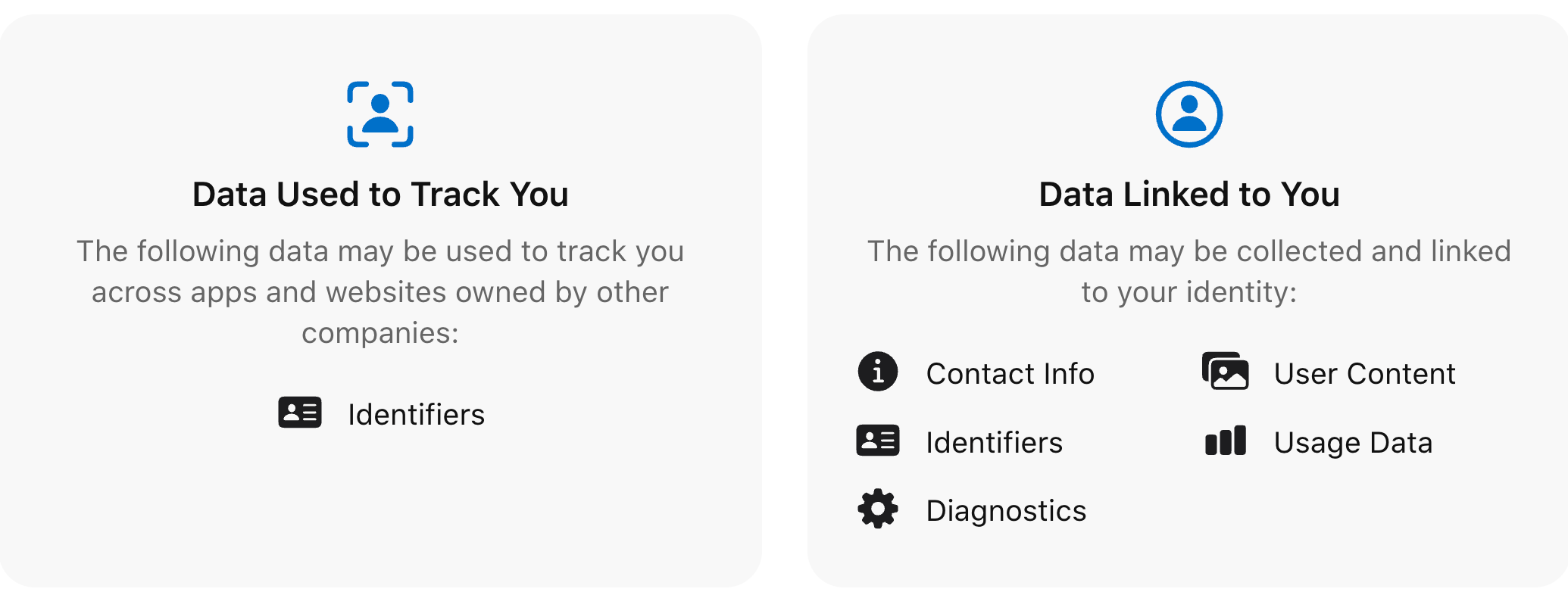
Fig 9: The Privacy Nutrition Label of CapCut.
Limitations
- Disabling System Integrity Protection (SIP) to enable dynamic instrumentation may cause some apps to alter behavior, so results represent a lower bound on privacy violations.
- Incomplete knowledge of undocumented entitlements and APIs could miss some data access vectors or misclassify permissions.
- Network proxy interception cannot bypass all app-specific SSL pinning, potentially missing some data exfiltration.
- UI automation heuristics, while more sophisticated than random monkey testing, may still fail to exercise all privacy-sensitive functionality, leading to under-reporting.
- The analysis focuses on macOS App Store apps and excludes unsigned or externally distributed apps, limiting generalizability to all desktop apps.
- No adversarial evaluation against actively evasive apps or attackers attempting to hide tracking behaviors was conducted.
Open questions / follow-ons
- How can Apple enforce consistency and correctness across Privacy Manifests, Privacy Nutrition Labels, and runtime app behaviors in an automated, scalable manner?
- What mechanisms can detect or prevent apps from using obfuscated or novel fingerprinting attributes beyond current known techniques?
- How do unsigned or externally distributed macOS apps compare in privacy compliance and tracking behaviors to App Store apps?
- What user-centric controls or transparency tools can effectively empower desktop users to audit app data usage proactively?
Why it matters for bot defense
For bot-defense and CAPTCHA practitioners, this study highlights that desktop applications contribute significantly to cross-device and user profiling through native data access and undisclosed tracking, extending the threat surface beyond browsers and mobile apps. Understanding the macOS ecosystem’s fragmented privacy controls informs the design of detection strategies that account for desktop-originated tracking signals. Practitioners should consider how desktop app behaviors can assist or confound fingerprinting and fraud detection models, especially when apps exfiltrate stable device identifiers or user attributes. Furthermore, the identified gaps in macOS data disclosure mechanisms suggest opportunities for integrating user transparency and automated compliance checks into broader anti-fraud defenses.
While CAPTCHAs primarily target bot detection on web or mobile endpoints, the insights into macOS apps’ ability to enrich device fingerprints and enable cross-device correlation underline the importance of holistic, multi-platform bot-defense strategies that incorporate desktop telemetry. The NutriScan methodology combining static and dynamic analysis, API hooking, and network monitoring may inspire advanced detection tools detecting hidden tracking or suspicious app behaviors in desktop contexts relevant to CAPTCHA risk assessments.
Cite
@article{arxiv2608_05474,
  title={ Exploring Privacy Leakage and Data Disclosure Violations in the MacOS Application Ecosystem },
  author={ Jyotirmay Chauhan and Kostas Solomos and Mir Masood Ali and Jason Polakis },
  journal={arXiv preprint arXiv:2608.05474},
  year={ 2026 },
  url={https://arxiv.org/abs/2608.05474}
}