
DeepConnect: A Visual Analytics System for Bridging Interdisciplinary Research Collaborations
Source: arXiv:2608.05134 · Published 2026-08-05 · By Yingchaojie Feng, Zekai Shao, Yiqun Sun, Yixuan Tang, Anthony K. H. Tung
TL;DR
DeepConnect addresses the practical challenges of initiating interdisciplinary research collaborations, a process hindered by domain boundaries, terminology gaps, and static profiling methods that do not adapt to new project contexts. The system uniquely integrates a large language model (LLM) with visual analytics to translate broad, domain-specific collaboration goals into actionable, methodologically focused tasks. It grounds these tasks in relevant scholarly literature, enabling evidence-based cross-domain researcher discovery and comparison. To bridge semantic and communication gaps, DeepConnect visualizes terminology overlaps and differences and supports publication-grounded conversation rehearsals to prepare researchers for effective outreach.
This approach was evaluated through two case studies, a user study with 12 participants, and focused component analyses. Results demonstrated that DeepConnect helps users refine collaboration ideas, discover complementary expertise beyond traditional network proximity, and gain confidence in cross-domain communication. The multi-view interface facilitates exploration from goal decomposition to researcher profiling and terminology comparison, delivering a structured and interactive process that supports meaningful interdisciplinary team formation at the initiation stage of collaboration.
Key findings
- Using OpenAlex data subset, DeepConnect decomposes collaboration goals into up to five diverse tasks via GPT-5.1 for semantic coverage.
- The time-aware task match scoring integrates paper relevance (cosine similarity) with a temporal decay weighting (α=0.5, λ tuned) to rank researchers by recent task alignment.
- The terminology comparison visualizes term usage using domain-specific TF-IDF and relative frequency ratio metrics, mapping terms along a [0,1] scale to highlight domain-specific vs shared vocabulary.
- User study (n=12) indicated increased transparency in early-stage candidate evaluation and enhanced confidence in cross-domain communication preparation.
- Expert interviews revealed that existing academic search platforms impose cognitive burdens due to terminological mismatch and require manual literature synthesizing, which DeepConnect alleviates.
- Component evaluations showed the conversation rehearsal module constrains LLM outputs to a researcher's publication context, reducing hallucinations and enabling evidence-grounded communication practice.
- Interactive researcher comparison dot matrix highlights task-level expertise complementarity, supporting team assembly by visualizing expertise coverage and gaps across candidates.
- Case studies showed iterative goal refinement and targeted candidate selection facilitated by coordinated views of tasks, publications, researcher trajectories, and terminology.
Threat model
Non-adversarial scenario focused on semantic and structural barriers to interdisciplinary collaboration. The main challenge is overcoming domain-specific terminology mismatches, fragmented publication records, and static profiles that impede discovery and communication. There is no assumption of malicious actors or security threats.
Methodology — deep read
Threat Model & Assumptions: The adversary in this context can be seen as the inherent semantic and disciplinary fragmentation that hinders researcher discovery and initial collaboration. There is no malicious actor assumed, but the system assumes researchers start with broad, domain-specific goals and need help to translate and ground them for cross-domain collaboration.
Data: The system uses a curated local-university subset of OpenAlex data, including researchers affiliated with the institution and their publications. Each publication links to authors and domains, comprising metadata like title, abstract, keywords, and publication year. The data undergoes embedding and terminology extraction preprocessing.
Architecture / Algorithm: The core modules are: (a) Goal Translation uses GPT-5.1 to decompose user input collaboration goals into up to five distinct methodological tasks; (b) paper retrieval ranks OpenAlex papers by embedding similarity using all-MiniLM-L6-v2 embeddings, grounding tasks in literature; (c) Researcher Analysis computes a time-weighted task match score aggregating the top 5 most relevant papers per candidate, balancing semantic similarity and publication recency with parameters α=0.5 and a decay rate λ; (d) Terminology Analysis extracts domain-specific terms using a lightweight GPT-4.1-mini model on the top 1000 papers per domain, scored by domain TF-IDF and relative frequency ratio to visualize term specificity vs commonality; (e) Conversation Rehearsal employs a constrained LLM conditioned on a researcher’s publication abstracts and metadata to simulate dialogue and prevent hallucinations.
Training Regime: Not applicable as LLMs used are pre-trained; no additional training reported. Hyperparameters such as top-k=5 papers for scoring and embedding models selection are specified.
Evaluation Protocol: Conducted a formative study including qualitative archival data analysis and six expert interviews to identify requirements; then implemented case studies demonstrating system usage scenarios; a controlled user study with 12 researchers evaluated usability and utility in candidate evaluation and communication confidence; component-level analysis assessed quality of LLM outputs in task decomposition, terminology extraction, and conversation simulation. No explicit statistical significance tests or cross-validation described. The evaluation primarily focused on qualitative feedback and task-based efficacy evidence.
Reproducibility: The system uses public data source OpenAlex but the curated local university subset used in evaluations is not public. The authors provide a project website (https://deepconnect.sg) but code availability is not specified. The LLMs leveraged (GPT-5.1, GPT-4.1-mini) are proprietary or experimental versions not openly released, reducing full reproducibility.
Technical innovations
- LLM-augmented goal decomposition translates broad, domain-specific collaboration goals into actionable methodological tasks, enabling cross-domain semantic exploration.
- Time-aware task match scoring integrates semantic relevance and publication recency to robustly rank candidate researchers by evolving expertise alignment.
- Terminology comparison visualizes cross-domain terminology gaps and overlaps using a quantitative relative frequency ratio, supporting semantic bridging pre-contact.
- Publication-grounded LLM conversation rehearsal constrains dialogue simulation within a candidate's verified publications, mitigating hallucinations for realistic outreach preparation.
Datasets
- OpenAlex local-university subset — thousands of researchers and publications — curated from OpenAlex, not publicly released
Baselines vs proposed
- Traditional academic search engines: identified as limited due to keyword matching and document-centric views vs DeepConnect's task-grounded retrieval and multi-view analytics enabling improved cross-domain candidate exploration (qualitative user study evidence).
- Text-based LLM conversational search: limited exploration and lack of macro researcher landscape visualization vs DeepConnect's integrated visual analytics and LLM task decomposition (user feedback).
Figures from the paper
Figures are reproduced from the source paper for academic discussion. Original copyright: the paper authors. See arXiv:2608.05134.
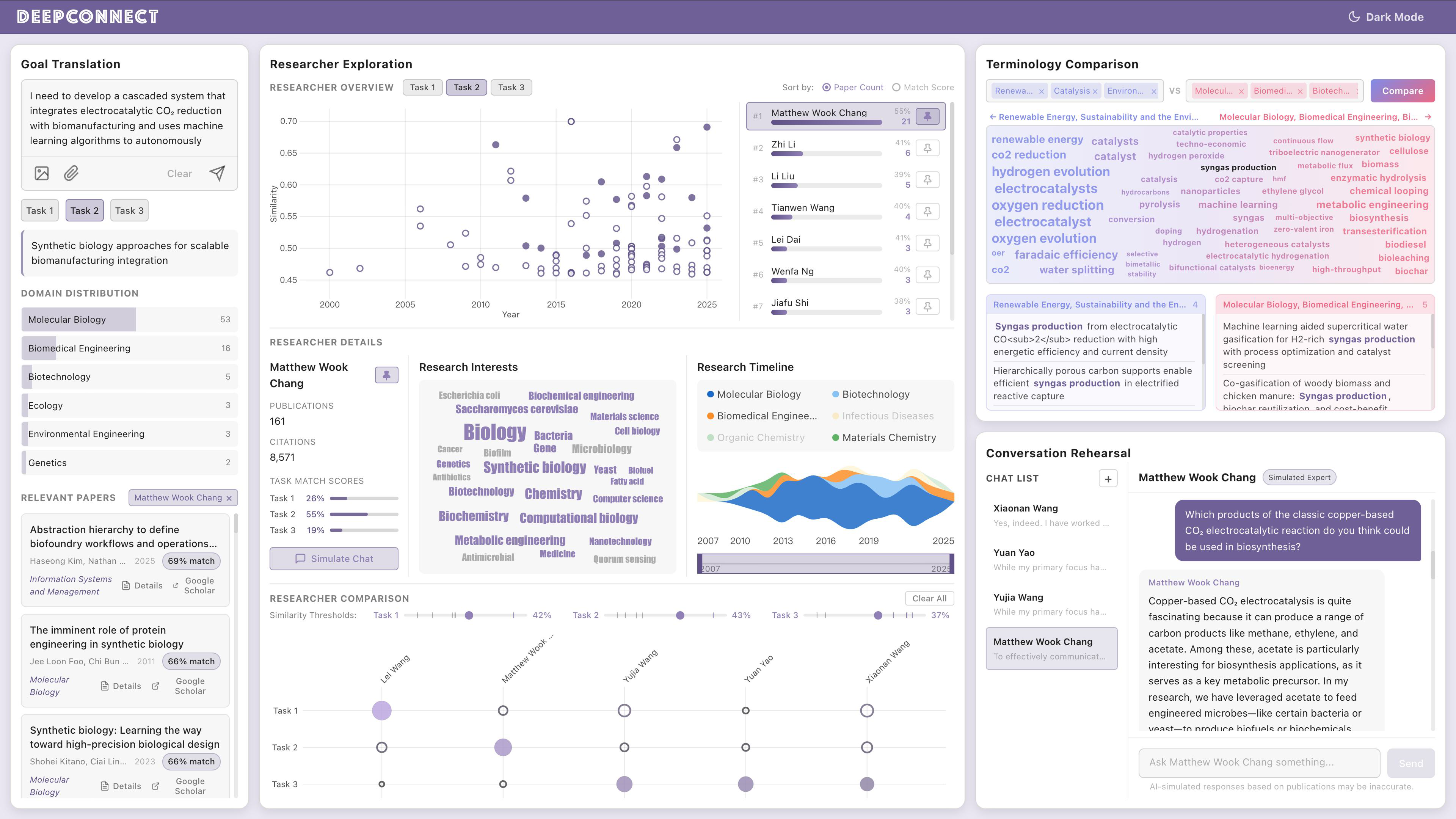
Fig 1: DeepConnect is a visual analytics system designed to bridge interdisciplinary research collaboration. The interface features

Fig 2: The visual analytics framework of DeepConnect. The system comprises four coordinated modules: (A) Goal Translation decomposes
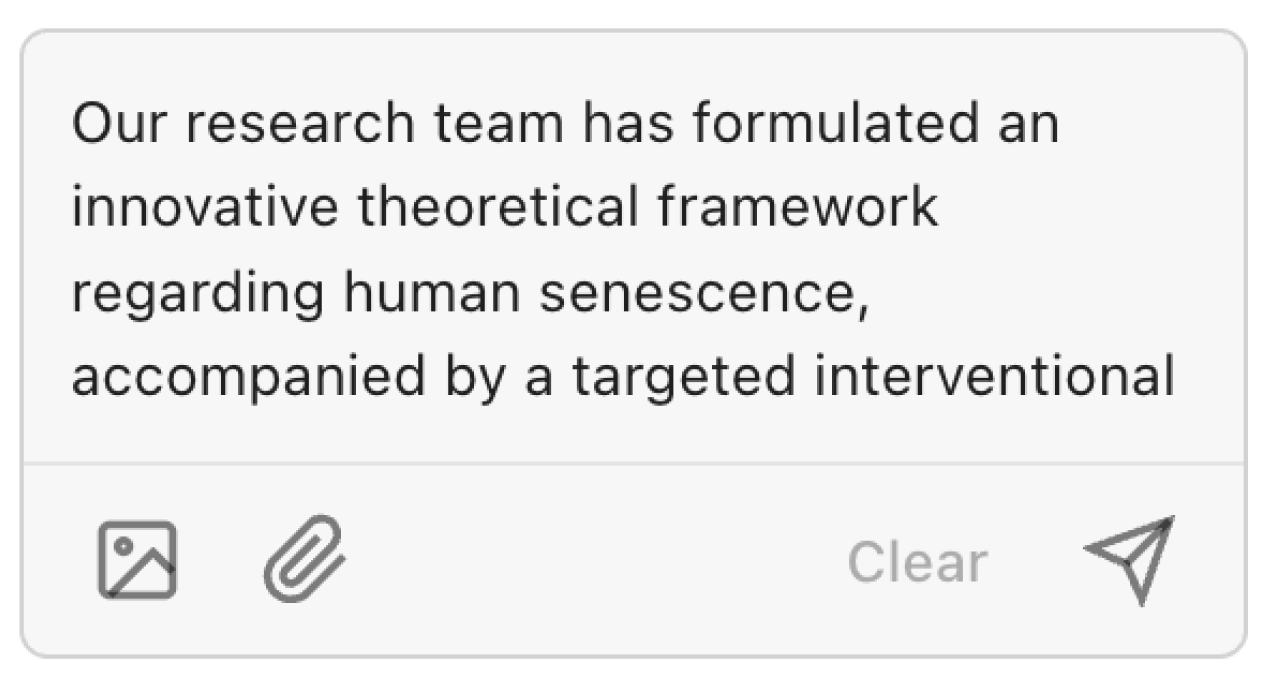
Fig 3: Case 1: The Researcher Details panel illustrates Prof. Lei Wang’s

Fig 4: Case 1: Temporal filtering within the Researcher Overview for

Fig 5 (page 4).
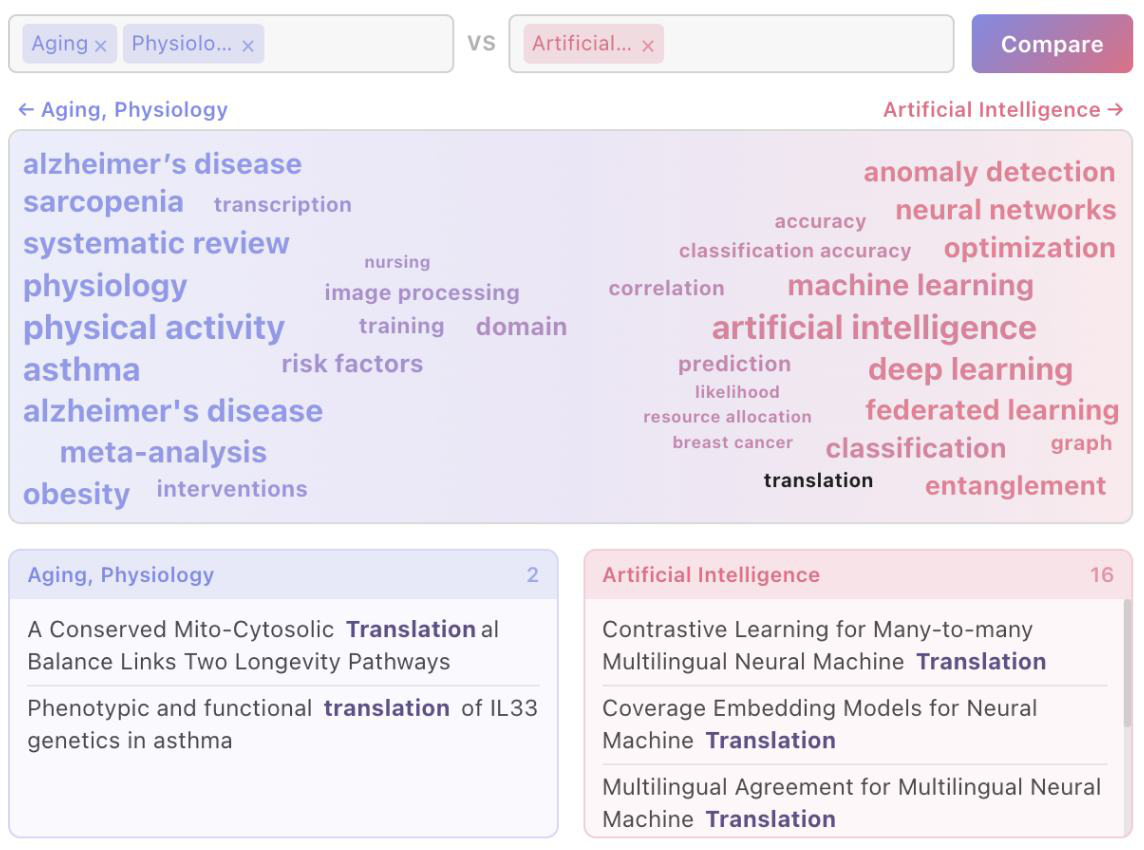
Fig 6 (page 4).

Fig 7 (page 4).
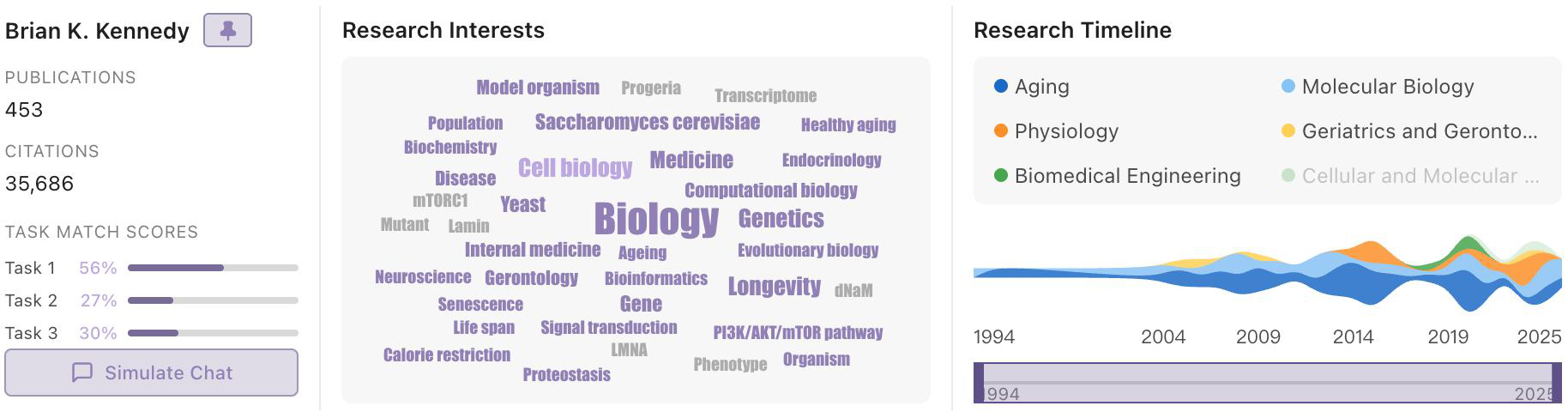
Fig 8 (page 4).
Limitations
- Evaluation limited to a local university dataset; generalizability to broader academic corpora remains untested.
- User study small (12 participants) and qualitative; lacks quantitative statistical significance measurements or control groups.
- Conversation rehearsal relies on LLMs constrained by publication context but potential for hallucinations or mismatch still exists in complex queries.
- Terminology extraction excludes proper nouns and generic verbs but may omit nuanced domain-specific terms critical for some disciplines.
- No adversarial evaluation, e.g., robustness to deliberately misleading researcher profiles or noisy input goals.
- System depends on proprietary or unreleased LLM versions (GPT-5.1, GPT-4.1-mini), limiting reproducibility and deployment accessibility.
Open questions / follow-ons
- How does DeepConnect scale and perform on much larger, multi-institutional datasets spanning diverse disciplines?
- Can the system dynamically adapt terminology extraction and task decomposition for rapidly evolving scientific fields?
- What quantitative impact does DeepConnect have on actual collaboration formation rates and research outcomes over time?
- How robust is the LLM-based conversation rehearsal under adversarial or ambiguous user queries?
Why it matters for bot defense
DeepConnect is primarily targeted at facilitating interdisciplinary researcher discovery rather than bot detection or CAPTCHA challenges. However, the principles of bridging semantic gaps and translating high-level goals into structured tasks could inspire improvements in user intent understanding for bot defense systems. For CAPTCHA engineers, the paper underscores the value of combining domain knowledge, grounded evidence, and interactive visual analytics to reduce ambiguity and enhance transparency in complex human-in-the-loop workflows. While not directly related to bot detection, its methodology exemplifies how augmented intelligence systems can aid difficult cross-domain understanding problems that also arise in bot behavior analysis and human verification tasks.
Cite
@article{arxiv2608_05134,
  title={ DeepConnect: A Visual Analytics System for Bridging Interdisciplinary Research Collaborations },
  author={ Yingchaojie Feng and Zekai Shao and Yiqun Sun and Yixuan Tang and Anthony K. H. Tung },
  journal={arXiv preprint arXiv:2608.05134},
  year={ 2026 },
  url={https://arxiv.org/abs/2608.05134}
}