
string2string Studio: An Interactive, In-Browser Platform for String-to-String Algorithms
Source: arXiv:2608.03984 · Published 2026-08-04 · By Mirac Suzgun, James Zou, Stuart M. Shieber, Dan Jurafsky
TL;DR
string2string Studio is a unified, browser-based interactive platform for diverse string-to-string algorithms used in natural language processing, computational biology, and the digital humanities. It consolidates six core modules: alignment, distance, similarity, search, generation metrics, and BLAST homology search, all running locally in a browser via a high-performance C++ engine compiled to WebAssembly. This allows zero-installation use while preserving privacy since data stays local by default. The interface emphasizes transparency by exposing not only scores but detailed evidence like alignments, edit paths, matched spans, and homology traces, making results inspectable, comparable, and reproducible across domains. Benchmarks demonstrate speed gains from 100× to 2,500× over their prior Python library, outperforming or matching native C tools on standard alignment tasks. The system also achieves near parity with NCBI BLAST+ on homology search accuracy while enabling scoped client-side queries. Finally, curated showcases and a Learn mode provide interactive demos for education and debugging, reinforcing cross-disciplinary applicability.
Key findings
- The C++/WebAssembly engine runs 100× to 2,500× faster than the previous Python string2string library, with 2,500× speedup on global alignment of length 2048 sequences.
- The global alignment module outperforms Biopython’s general-purpose C aligner by 6.2× at length 2048 on an Apple M1 Pro CPU.
- The local alignment implementation runs within a factor of 1.8 of the SIMD-optimized SSW library on length 16,384 sequences with identical scores.
- Client-side blastn homology search returns hit rankings identical to NCBI BLAST+ 2.17 on a 6-sequence 16S rRNA benchmark, with bit-score differences under 0.43% and percent identity differences below 0.18 percentage points.
- The full dynamic programming matrix visualization is limited by WebAssembly heap size to inputs below approximately length 12,000, though linear-space algorithms scale to length 40,000+ with identical optimal scores.
- The platform supports multiple input granularities (character, word, token, line, residue), maintaining consistent output schemas enabling cross-domain analysis and direct method comparison on shared inputs.
- The interface integrates inspectable evidence objects supporting interactive parameter adjustment with no server round-trips, preserving privacy and responsiveness.
- All core algorithms produce bit-for-bit identical results to declared reference implementations across character and token levels, ensuring correctness.
Threat model
The adversary is anyone attempting to intercept or exfiltrate users' input data or sensitive sequences, which must remain private. The system assumes no data leaves the client device unless the user explicitly opts into remote BLAST database search. Network adversaries cannot access or observe input data during local computations. There is no assumption of adversarial attempts to manipulate or spoof algorithm outputs, as this is primarily a research/analysis tool rather than a deployed security guard. The major capability protected against is unintended data leakage via uploads or server-side computation.
Methodology — deep read
The string2string Studio project addresses the fragmentation of string-to-string algorithm tools across NLP, biology, and humanities by creating an integrated browser-based workbench containing six modules: alignment, distance, similarity, search, generation metrics, and BLAST homology search. The threat model assumes an adversary who should not access users' sensitive data, motivating all computation to be local by default with no data uploads except when remote BLAST search is explicitly requested. Data provenance includes canonical texts, nucleotide/protein sequences (e.g. SARS spike genes, 16S rRNA landmark databases), and standard evaluation corpora used in NLP metrics. The platform supports multiple granularity levels (character, word, token, line, residue), allowing inputs from different domains to be analysed consistently. Core algorithms were implemented in C++ and compiled to WebAssembly with SIMD support, plus a scalar fallback selected at runtime. An independent TypeScript implementation serves as a documentation and verification reference. Algorithms include classical global/local/semi-global alignments (Needleman-Wunsch, Smith-Waterman), bit-parallel Levenshtein distance, Damerau-Levenshtein, Hamming, Jaro-Winkler distances, set-based and vector similarity measures, approximate lexical search with k-mismatch and IUPAC degeneracy support, and generation metrics (BLEU, chrF, ROUGE variants). The homology search follows the BLAST seed-and-extend paradigm, reporting bit-scores and E-values computed via Karlin-Altschul statistics. The system uses a shared result schema capturing input level, parameters, score scalars, and evidence objects like alignment paths, edit scripts, matched spans, or BLAST seeds/extensions to enable rich visualization and export. Training per se is not applicable, but algorithms were benchmarked on randomized sequence pairs of increasing length (up to 16K or 40K for linear-space alignments) on Apple M1 Pro hardware. Runtime benchmarks compare against the original string2string Python library and native C libraries like edlib, RapidFuzz, Biopython, and SSW, using median timings over 30 runs per length. Reference correctness is verified against independent implementations at both character and token levels. For homology, a client-side blastn was validated against NCBI BLAST+ 2.17 on a small 6-sequence 16S rRNA database with identical parameters, confirming ranking, bit-score, and E-value agreement within tight margins. Visualization links computation outputs to interactive views and inspectors with export formats including FASTA, CLUSTAL, CIGAR, PAF, VCF, PDF, CSV, JSON, SVG, and LaTeX. Curated public showcases and a Learn mode provide reusable, annotated examples that make algorithm internals explorable via step-through dynamic programming and parameter adjustment. The entire platform is open-source with computation localized in WebAssembly-loaded browser clients by default, preserving user data privacy and enabling rapid, low-latency interaction without server dependency. Overall, the methodology combines classical algorithms reimplemented in highly optimized C++/WebAssembly with a uniform, inspectable data schema and web-native interaction design to enable cross-disciplinary string analysis accessible to domain experts without programming or software installation.
Technical innovations
- A verified C++ core compiled to SIMD-optimized WebAssembly enabling broad classes of string-to-string algorithms to run locally in-browser with up to 2,500× speedup over the Python predecessor.
- A unified result schema that encapsulates scores, parameters, and richly linked evidence (alignments, edit paths, seeds, extensions) enabling interactive inspection, debugging, and multi-method comparison within one environment.
- Integration of classical string comparison, distance, similarity, search, generation metrics, and BLAST homology search into one browser platform switchable across semantic levels (character, token, residue, line) and domains.
- A scoped client-side blastn implementation with Karlin-Altschul statistics and bit-score/E-value calculation validated against NCBI BLAST+, providing offline homology search respecting privacy constraints.
- Dynamic, exportable visualizations tightly linked to computation outputs supporting interactive parameter modification and real-time re-computation without server round-trips.
Datasets
- 6-sequence 16S rRNA database — small curated biological database used for blastn concordance testing — bundled and user-loadable within the platform
- SARS-CoV-1 and SARS-CoV-2 spike gene sequences — length ~269 nucleotides — used as showcase alignment examples
- Textual data from English philosophy prose (Tractatus translations, 524 propositions) — demonstration and evaluation examples
- Randomly generated sequence pairs ranging from length 27 to 16,384 nucleotides/characters — used for runtime benchmarking
Baselines vs proposed
- string2string Python predecessor: global alignment runtime at length 2048 = baseline; string2string Studio WebAssembly = ~1/2500th of baseline time
- Biopython general C aligner: global alignment at length 2048 = baseline; string2string Studio WebAssembly = 6.2× faster
- SSW SIMD C library: local alignment at length 16,384 = baseline runtime; string2string Studio WebAssembly runs within 1.8× runtime with identical scores
- NCBI BLAST+ 2.17: homology search hit rankings = identical; bit-score difference ≤ 0.43%; percent identity difference ≤ 0.18 percentage points; E-values agree to order of magnitude
Figures from the paper
Figures are reproduced from the source paper for academic discussion. Original copyright: the paper authors. See arXiv:2608.03984.
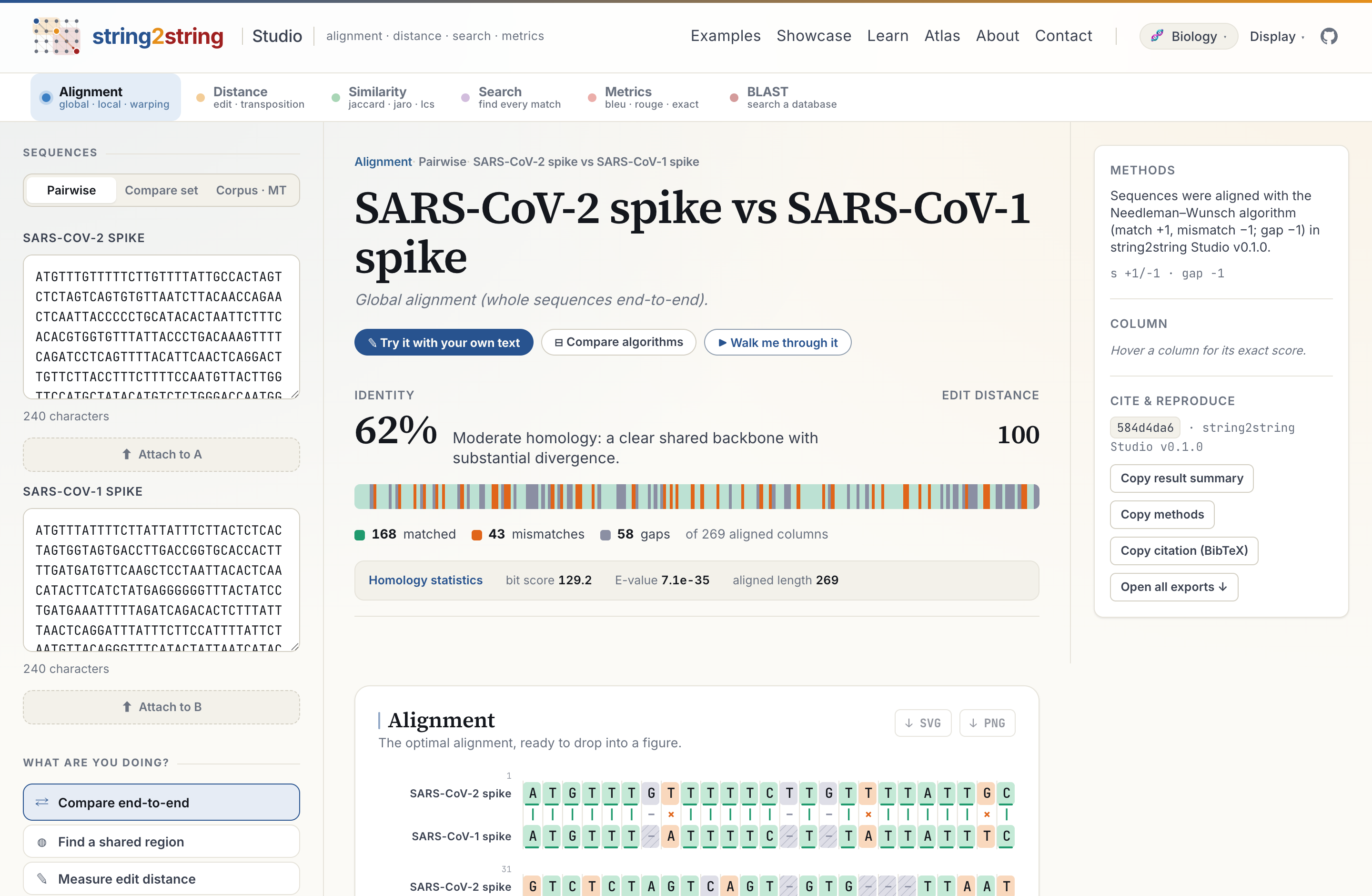
Fig 1: The string2string Studio workbench. The algorithm family is selectable across the top (alignment,

Fig 3: The same verified engine, rendered in the idiom of three disciplines. (a) Biology: a human β-globin

Fig 4: Homology search in depth. One human β-globin query, searched entirely in the browser against a 29-
Limitations
- Full dynamic programming matrix visualization is constrained by WebAssembly heap limits to input lengths below ~12,000; above that only linear-space methods provide optimal alignments without full matrix access.
- Metric suite excludes neural or semantic similarity metrics like BERTScore, limiting to lexical and symbolic metrics; no current integration of neural methods.
- Homology search evaluation only compares client-side blastn to NCBI BLAST+ on a small curated 16S rRNA database; no evaluation on large-scale databases or protein/protein BLAST variants.
- No formal user studies or assessments of the educational efficacy and usability of the curated showcase and Learn mode are reported.
- The provided examples and benchmarks are predominantly English and Latin-script focused; multilingual and more diverse data evaluations remain future work.
Open questions / follow-ons
- How to extend the platform to support neural and semantic similarity metrics such as BERTScore in a privacy-preserving, client-side manner?
- Can the client-side BLAST approach be scaled and optimized for larger databases, longer sequences, or protein homology while preserving responsiveness?
- What is the impact of interactive visualization and inspectable evidence on user understanding and productivity in real-world NLP, biology, or humanities analysis workflows?
- How would multilingual and broader script-support affect performance, algorithmic choices, and interface design in string2string Studio?
Why it matters for bot defense
For bot-defense and CAPTCHA practitioners, string2string Studio offers a highly accessible environment to explore and compare string similarity, distance, and search algorithms interactively and at multiple granularity levels—including character and token sequences. This can aid algorithm developers in debugging and benchmarking the core string operations underlying CAPTCHA evaluation, spam detection, or adversarial input analysis without local install or programming expertise. The client-side execution model aligns well with privacy requirements pertinent to live CAPTCHA interactions or sensitive user data scenarios. Although not focused on security per se, the platform’s inspectable intermediate representations and multi-method comparison can illuminate failure modes or subtle differences in string metric behavior, critical for robust bot detection systems that rely on nuanced string input analysis or generation metrics. The integration of homology search models techniques that could inspire approximate matching against complex corpora or large adversarial datasets within a fully interactive, reproducible interface.
Cite
@article{arxiv2608_03984,
  title={ string2string Studio: An Interactive, In-Browser Platform for String-to-String Algorithms },
  author={ Mirac Suzgun and James Zou and Stuart M. Shieber and Dan Jurafsky },
  journal={arXiv preprint arXiv:2608.03984},
  year={ 2026 },
  url={https://arxiv.org/abs/2608.03984}
}