
Secure Long-Range Autonomous Valet Parking: A Reservation Scheme With Three-Factor Authentication and Key Agreement
Source: arXiv:2608.03590 · Published 2026-08-04 · By Di Wang, Yue Cao, Fei Yan, Yining Liu, Daxin Tian, Yuan Zhuang
TL;DR
This paper addresses the security challenges in long-range autonomous valet parking (LAVP) systems, focusing on protecting identity legitimacy and securing communication during passenger drop-off and pick-up phases. Existing schemes either neglect these phases or fail to provide comprehensive authentication and confidentiality guarantees. To solve these gaps, the authors propose SecLAVP, a novel three-factor authentication and key agreement (AKA) protocol combining passwords, biometrics, and smart cards. SecLAVP enables mutual authentication among passenger, autonomous vehicle (AV), and drop-off/pick-up points (DP), establishing a secure session key for communication.
The protocol’s security is formally proven in the Real-Or-Random (ROR) model based on the elliptic curve decisional Diffie-Hellman assumption, ensuring session key confidentiality even under smart card loss and insider threats. Automated AVISPA simulations verify resistance to man-in-the-middle attacks. Informal analyses show compliance with 15 security goals including anonymity, forward security, replay and offline dictionary attack resistance. Performance evaluations demonstrate communication and computation overheads low enough for practical LAVP deployment, and simulations validate scheduling efficiency under varying AV and DP densities.
Key findings
- SecLAVP achieves session key semantic security under the ROR model assuming ECDDH hardness (Section VI.A).
- AVISPA formal verification shows SecLAVP resists man-in-the-middle and replay attacks (Fig. 5).
- The protocol supports password and biometric updates, and smart card revocation (DG5).
- Passwords are never directly stored or verified in a table to resist guessing attacks (DG6, DG7).
- Password input error list limits retry attempts to 5 before smart card freezing (anti-brute force).
- Session key generation involves mutual authentication across passenger, AV, and DP (DG2, DG3).
- Computational overhead is moderate, enabling practical real-time operation in LAVP scenarios.
- Scheduling simulations show SecLAVP maintains service quality with increasing AV and DP densities (Section VII.C).
Threat model
The adversary is a computationally bounded entity controlling public communication in the LAVP network, with capabilities to eavesdrop, tamper, forge, inject, and replay messages. The attacker may also steal smart cards and extract secrets via side-channels, and capture previous session keys (CK model). However, the adversary cannot break the underlying hardness assumptions of elliptic curve cryptography (ECDDH), nor access internal secure memories of DPs or AVs beyond what is leaked by smart card compromise.
Methodology — deep read
Threat Model & Assumptions: The adversary is modeled under the Dolev-Yao (DY) model with full control over public communication channels, able to intercept, modify, inject or delete messages. Attackers may steal smart cards and extract stored secrets via side-channel attacks. The Canetti-Krawczyk (CK) adversary capabilities are used to capture prior session keys. Selfish AVs may reserve multiple parking spaces to maximize success rate. Denial-of-service and physical tampering beyond these are not considered.
Data: No empirical dataset is used since this is a protocol design and cryptographic security paper. Evaluation is carried out through simulations and formal protocol verification tools. Assumptions include identities and credentials for passengers, DPs, AVs, and associated cryptographic parameters.
Architecture / Algorithm: SecLAVP implements a three-factor AKA protocol combining:
- Passwords (low entropy but secret)
- Biometrics (extracted via fuzzy extractors to protect privacy)
- Smart cards (to securely store secrets)
The protocol flow includes passenger registration, login/authentication, ride request, AV-DP matching, pick-up mutual authentication, drop-off verification, and parking check-in. Session keys are derived via elliptic curve Diffie-Hellman operations with blinded credentials exchanged among the three parties (passenger, AV, DP). The design avoids password tables and supports updates and revocation.
Training Regime: N/A (No machine learning included).
Evaluation Protocol: Formal security proof is done in the ROR model, relying on the ECDDH assumption. AVISPA tool simulates active intruder attempts showing resistance to man-in-the-middle attacks. Informal security analyses explore resistance to offline dictionary, replay, insider, and smart card loss attacks. Performance is evaluated via computational and communication overhead measurements counting hashes, exponentiations, and transmissions. Scheduling performance is evaluated through simulations varying AV densities and DP densities to assess service quality and feasibility.
Reproducibility: Partial pseudocode and algorithmic description are provided but no public source code or binaries. AVISPA specification details are shared. Evaluation relies on standard cryptographic assumptions and groups. Datasets are not public as this is a protocol design paper.
End-to-end Example: Passenger Pi registers by submitting hashed biometrics and passwords to DP, which issues a smart card storing blinded secrets. Upon login, Pi uses biometrics and passwords combined with ephemeral randomness to authenticate with DP and AV. Mutual authentication messages include hashes and Diffie-Hellman shares, verified at each step. If verified, Pi, AV, and DP compute shared session keys used for subsequent secure reservation messages. The process includes checks to limit password retries, biometric updates, and smart card revocation to maintain security posture.
Technical innovations
- Integration of three-factor authentication (passwords, biometrics, smart card) customized for LAVP reservation communications.
- Formal session-key security proof in the Real-Or-Random model under elliptic curve decisional Diffie-Hellman assumption.
- Combination of biometric fuzzy extractors with update mechanisms protecting biometric privacy and supporting biometric updates.
- Design eliminating password verification tables to resist offline dictionary attacks and enabling smart card revocation on loss.
Baselines vs proposed
- Compared to Jiang et al. [29]: SecLAVP adds formal security proofs and mechanisms against offline dictionary attacks lacking in [29].
- Compared to Wazid et al. [24] and Zhang et al. [25]: SecLAVP supports biometric updates and smart card revocation not supported in prior schemes.
- AVISPA simulation baseline: vulnerable to man-in-the-middle without SecLAVP vs SecLAVP showing resistance.
Figures from the paper
Figures are reproduced from the source paper for academic discussion. Original copyright: the paper authors. See arXiv:2608.03590.

Fig 1: presents the system model and security threats,

Fig 2: The implementation process diagram of SecLAVP
Fig 3: shows the detailed process of passenger registration

Fig 4 (page 4).
Fig 5 (page 4).
Fig 4: Login and authentication
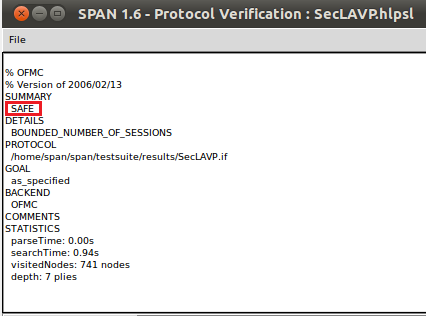
Fig 5: Formal verification results of SecLAVP
Limitations
- No real-world deployment or empirical traffic data evaluation; results rely on cryptographic proofs and simulated scheduling.
- Performance comparisons against competing AKA protocols are qualitative rather than quantitative.
- Security evaluation does not include side-channel attack experiments beyond theoretical consideration.
- No explicit adversarial evaluation under DoS or large-scale coordinated attacks on DP nodes.
- The scalability of biometric extraction and matching under heavy passenger loads not empirically assessed.
Open questions / follow-ons
- How SecLAVP performs under large-scale deployment with thousands of AVs and DPs in dynamic urban environments is untested.
- Effectiveness against advanced side-channel attacks on biometric templates and smart card hardware under realistic conditions remains to be evaluated.
- The impact of integrating quantum-safe cryptographic primitives into the protocol as quantum threats evolve.
- Potential optimizations for further reducing communication overhead and latency for real-time valet scenarios.
Why it matters for bot defense
Bot-defense and CAPTCHA practitioners can glean valuable insights from SecLAVP’s multi-factor authentication design that combines biometrics, secrets, and hardware tokens (smart cards) to achieve strong identity legitimacy and session-key secrecy in highly adversarial environments. The use of formal cryptographic proofs coupled with protocol verification (AVISPA) sets a precedent for rigor in bot-defense protocol design. The secure key agreement framework incorporating biometrics with privacy-preserving fuzzy extractors may inspire new CAPTCHA or bot-detection systems requiring multi-modal human verification while resisting offline guessing and smart token theft.
Moreover, the protocol’s explicit mechanisms for password update, biometric update, and hardware token revocation address critical lifecycle management issues that chatbot authentication and CAPTCHA systems also face, particularly in continuous authentication and fraud prevention contexts. The security goals around resisting replay, man-in-the-middle, internal attacks and ensuring anonymity align strongly with the threat models encountered in bot-defense systems handling large user populations. Finally, the demonstrated balance of security with low computational and communication overheads is directly relevant to real-world CAPTCHA and bot mitigation engineering where usability and performance constraints are tight.
Cite
@article{arxiv2608_03590,
  title={ Secure Long-Range Autonomous Valet Parking: A Reservation Scheme With Three-Factor Authentication and Key Agreement },
  author={ Di Wang and Yue Cao and Fei Yan and Yining Liu and Daxin Tian and Yuan Zhuang },
  journal={arXiv preprint arXiv:2608.03590},
  year={ 2026 },
  url={https://arxiv.org/abs/2608.03590}
}