
LiveEvalBench: Toward Open-World Evaluation for Web Generation
Source: arXiv:2608.03689 · Published 2026-08-04 · By Yiyao Wang, Zhen Wen, Yinghao Tang, Yixiao Fu, Lin Yuan, Xiaolau Zhang et al.
TL;DR
LiveEvalBench addresses the critical gap in evaluating large language model (LLM)-generated frontend web projects by moving beyond traditional static evaluation. Existing benchmarks tend to assess web generation via fixed code or visual criteria, neglecting the inherently interactive, diverse, and evolving nature of frontend artifacts. LiveEvalBench introduces a novel, agentic and adaptive evaluation framework involving multiple specialized agents—Build Engineer, Code Engineer, and UI Tester—that collectively assess deployment, source code quality, and runtime behavior including user interaction. This framework couples a shared rubric for cross-model comparability with implementation-grounded criteria tailored dynamically per artifact, enabling fair assessment of open-ended generation where multiple valid implementations exist.
The authors build a benchmark of 100 diverse, real-world web generation queries spanning varying difficulty levels and functional categories. They evaluate 11 state-of-the-art LLMs on this benchmark using LiveEvalBench and find that runtime UI interaction remains the most challenging aspect for current models. Validation experiments demonstrate strong human alignment with UI Tester judgments (85.7% agreement, AC1=0.793) and improved score stability with repeated evaluations. Comparison against a single-evaluator ablation shows the benefit of separate role perspectives for finer diagnostic insight. Overall, LiveEvalBench provides a rigorous, extensible, and extensible open-world evaluation protocol that better captures modern LLMs’ frontend synthesis capabilities than prior static benchmarks.
Key findings
- LiveEvalBench’s total score (range 0-90) decomposes into Build (15 points), Code (30 points), and UI (45 points) sub-scores, with UI showing the largest performance variance across 11 tested frontier models.
- Top-performing models reach scores above 70 (Claude Opus 4.7: 70.7), while lower-tier models score around 54 (Qwen3.5-27B: 54.6), showing clear model performance tiers.
- UI interaction and behavior cause the largest point losses, indicating runtime functionality remains the main bottleneck for web generation LLMs.
- Aggregate scores decrease with difficulty: Level-1 tasks average 63.8, Level-2 59.8, and Level-3 55.5, validating the benchmark’s difficulty stratification.
- LiveEvalBench’s UI Tester agent has 85.7% agreement and Gwet’s AC1=0.793 with human annotators on visual quality, interaction experience, and query-specific criteria.
- Ablation removing role separation collapses scores into a bimodal distribution (either 0 or 90) versus a continuous score range in the full design, indicating role-based experts provide richer discrimination.
- Repeated evaluations reduce per-query score standard deviation from 23.8 to 17.6 and coefficient of variation from 0.59 to 0.39, improving reliability.
- Evaluator-model agreement between Kimi K2.6 and Qwen3.7-Plus reaches 90.1% with Cohen’s κ=0.641, suggesting assessment generalizes across evaluator designs.
Threat model
The adversary is a large language model tasked with generating frontend web projects from user queries, potentially producing diverse implementations. They have knowledge limited to the query and model capabilities but do not have adversarial intent or capabilities beyond producing code. The evaluation framework cannot be manipulated by the model at runtime and assumes truthful execution of deployment and UI interaction steps.
Methodology — deep read
The paper tackles the evaluation problem for LLM-generated frontend projects characterized by interactivity, implementation diversity, and rapid evolution. The high-level approach is to replace static one-shot scoring pipelines with a collaborative workflow of specialized evaluation agents.
Threat model & assumptions: The evaluation assumes generated frontend projects as the artifact and evaluates their deployability, code quality, and runtime UI behavior. The adversary is a model generating frontend code to meet user queries. The framework assumes access to executable projects and the ability to interact with the deployed webpage via a browser interface.
Data: The benchmark consists of 100 web generation queries derived from real-world seeds from public tutorials, social media posts, and ArtifactsBench samples. Queries cover 6 categories (Data Visualization, UI Component, Game, Web App, Website, 3D Design) and 3 difficulty levels (L1-L3). Role-conditioned rewrites by LLMs yield 4,000 candidate specs from which 100 were carefully curated for clarity and feasibility. Each query has adaptive evaluation criteria crafted manually.
Architecture/Algorithm: LiveEvalBench employs three specialized agents:
- Build Engineer: deploys, repairs, and launches projects, documenting effort beyond provided instructions.
- Code Engineer: inspects source code for implementation quality (readability, robustness) and strict adherence to instruction requirements.
- UI Tester: interacts with the running project in-browser to assess visual correctness, interaction experience, and query-specific functional checks. The adaptive evaluation protocol combines fixed rubric criteria shared across all models with dynamic implementation-grounded tests generated per artifact. This allows fair scoring even with diverse valid implementations. Scoring is weighted: Build (15 pts), Code (30 pts), UI (45 pts).
Training regime: Not applicable—this is an evaluation framework, not a model training paper.
Evaluation protocol: Each query-model pair is evaluated three times independently and aggregated by majority vote. Metrics include a 90-point total score and sub-scores. Agreement with human raters on 70 generated projects is computed using percent agreement and Gwet’s AC1. Ablations compare multi-role evaluation with a single combined evaluator. Reliability tested by score variance across repeated runs and agreement between different evaluator models.
Reproducibility: The benchmark queries, code, and evaluation framework are publicly released under a research license. Project generation uses 11 named commercial and open LLMs queried in a single turn with default settings.
Concrete example: Given a user query specifying a frontend project, a model produces project code and instructions. The Build Engineer extracts and deploys the app, noting any manual repairs needed. The Code Engineer runs static and dynamic checks on code structure and adherence to the query. The UI Tester drives the deployed web app through browser tests checking usable interactions, visual polish, and query-specific features. These phased observations produce partial scores that combine into a final evaluation metric, which can be compared across models on the same query and aggregated across queries.
Technical innovations
- An agentic multi-evaluator framework for web generation evaluation encompassing deployment, source, and runtime UI perspectives.
- An adaptive evaluation protocol that grounds fixed shared rubric criteria into implementation-aware, executable checks tailored to each generated frontend project.
- An extensible evaluation infrastructure abstracting evaluators as configurable triples of persona, criteria, and evidence-gathering tools, enabling incremental addition of new evaluation roles without pipeline redesign.
- A novel benchmark construction pipeline synthesizing diverse, multi-granularity frontend queries sourced from real developer briefs, social media, tutorials, and role-conditioned rewrites.
Datasets
- LiveEvalBench Benchmark — 100 frontend project queries across 6 categories, curated from public tutorials, social media, and ArtifactsBench samples
Baselines vs proposed
- Single-evaluator ablation: 70-case subset bimodal score distribution (21 cases at 0, 49 at 90) vs LiveEvalBench multi-agent: smooth score distribution
- Repeated evaluation pass: mean per-query score SD 23.81 vs repeated evaluation: 17.62; mean CV 0.591 vs 0.395
- Evaluator agreement Kimi K2.6 vs Qwen3.7-Plus: 90.1% agreement, Cohen’s κ=0.641
Figures from the paper
Figures are reproduced from the source paper for academic discussion. Original copyright: the paper authors. See arXiv:2608.03689.

Fig 1: LiveEvalBench versus prior web coding benchmarks.

Fig 6: Score by difficulty × model on the 90-point scale. Cells annotated with the per-cell sample size n. Difficulty levels
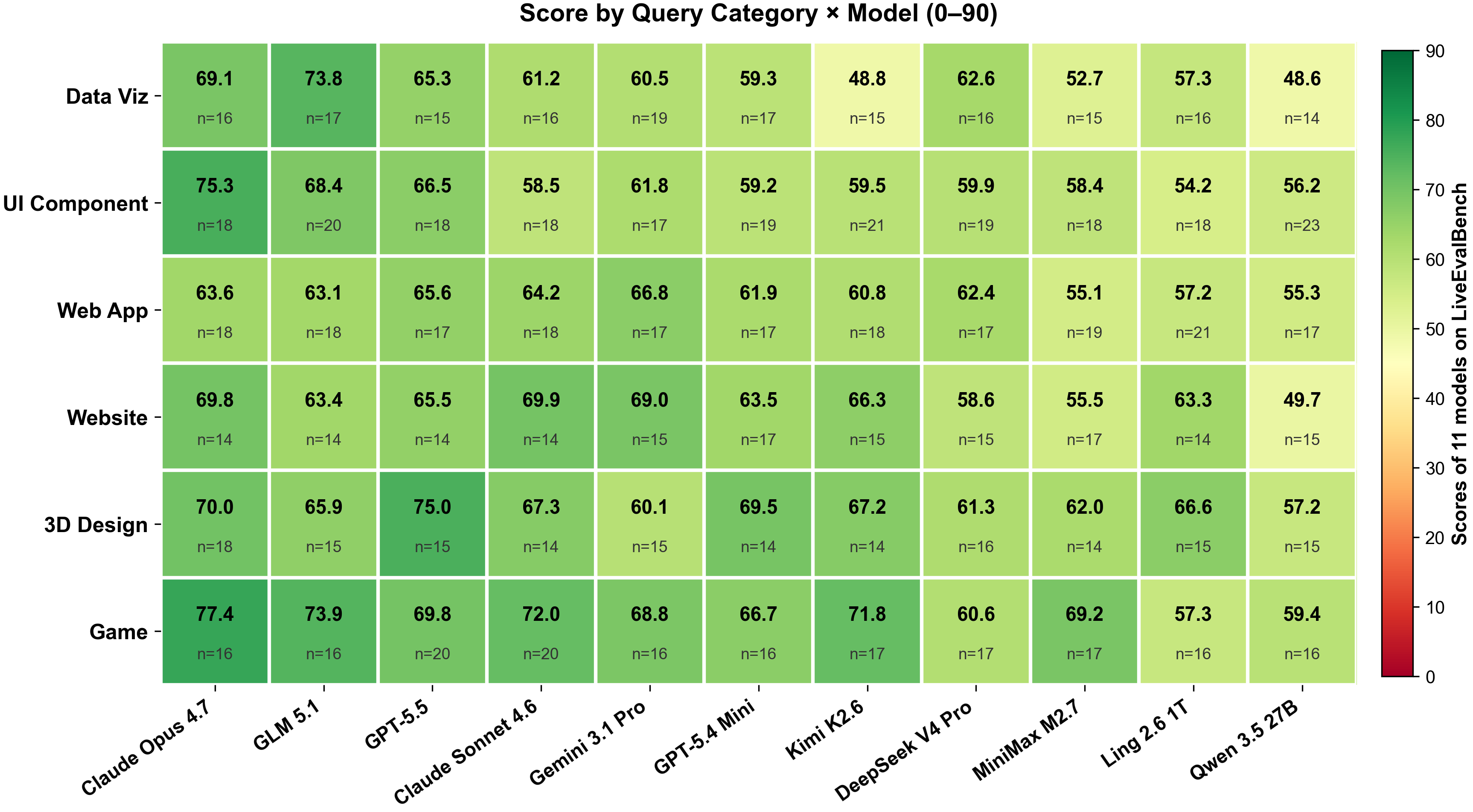
Fig 7: Score by query category × model on the 90-point scale. Categories are sorted top-to-bottom by aggregate score
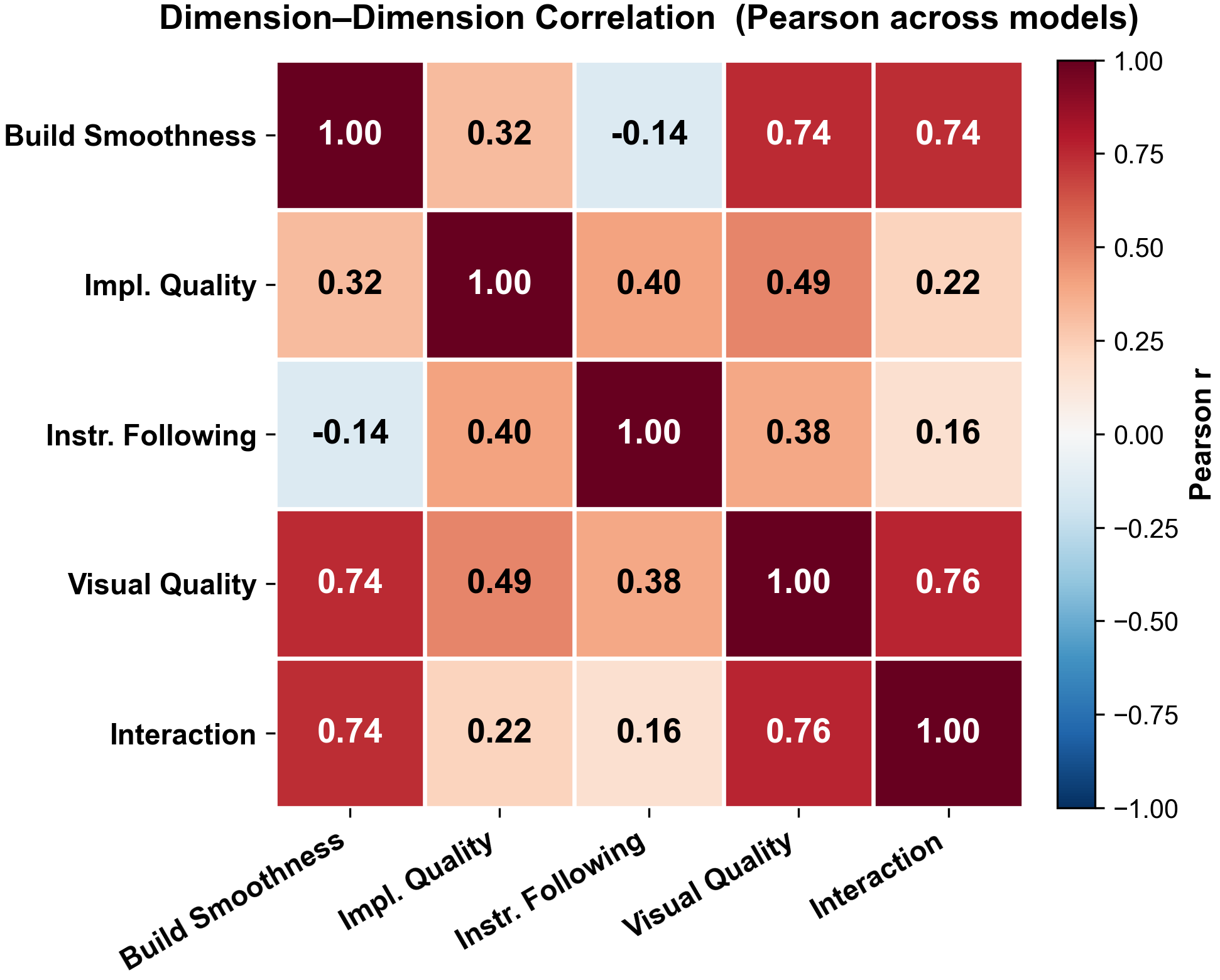
Fig 8: Dimension–dimension correlation, Pearson across

Fig 10: Successful case of evaluation agent judging web function.

Fig 11: Failure case of evaluation agent judging web function.

Fig 9: Example query (left) and its accompanying evaluation checklist (right). The checklist contains fixed criteria shared

Fig 12: Prompt template for the adaptive evaluation protocol that dynamically selects evaluation actions based on project
Limitations
- Benchmark is limited to 100 curated web generation queries; may not capture full real-world diversity or long-tail scenarios.
- Evaluation assumes availability of executable project artifacts and stable deployment, which may not generalize to all generated code.
- Human agreement experiments focus mainly on UI Tester role; less data on agreement for Build and Code engineer judgments.
- Adaptive protocol’s implementation-grounded check synthesis relies on heuristics and partially manual review, potentially limiting scalability or introducing bias.
- The framework currently targets frontend web projects and may not extend directly to backend or full-stack code gen evaluation.
- Score aggregation weights are heuristically chosen; alternative weighting schemes could impact overall leaderboard rankings.
Open questions / follow-ons
- How can LiveEvalBench scale to evaluate multi-modal, full-stack web applications or backend code?
- Could automated synthesis of implementation-grounded checks be further improved by semi-supervised or learned methods to reduce manual curation?
- How well does LiveEvalBench evaluate adversarial or intentionally obfuscated frontend code generated by models?
- What additional evaluator roles (e.g., accessibility experts, security auditors) could be incorporated to enrich evaluations?
Why it matters for bot defense
For bot-defense and CAPTCHA practitioners, LiveEvalBench represents a significant advance in evaluating AI-generated web content in realistic, interactive settings. Its multi-agent approach, combining build verification, source inspection, and dynamic UI interaction evaluation, enables more nuanced detection of frontend artifacts' quality and behavioral fidelity than static code or screenshot analyses alone. This could inform frameworks for differentiating automated web generation bots from legitimate user-generated content by exposing typical weaknesses in runtime UI behavior or deployment robustness exhibited by current generative models.
Furthermore, the extensible evaluator infrastructure supports adding specialized perspectives, such as accessibility or sensory impairments, which can be paralleled in CAPTCHA designs requiring subtle UI interaction or responsiveness tests. LiveEvalBench’s adaptive protocol also highlights that many valid implementations exist for the same functional request, cautioning against rigid, fixed-rule bot detection systems and motivating more context-aware, implementation-agnostic evaluation techniques relevant to bot-defense systems.
Cite
@article{arxiv2608_03689,
  title={ LiveEvalBench: Toward Open-World Evaluation for Web Generation },
  author={ Yiyao Wang and Zhen Wen and Yinghao Tang and Yixiao Fu and Lin Yuan and Xiaolau Zhang and Jun Zhou and Wei Chen },
  journal={arXiv preprint arXiv:2608.03689},
  year={ 2026 },
  url={https://arxiv.org/abs/2608.03689}
}