
Behaviorally Adaptive Visual Diversion for Inclusive and Resilient Digital Assessment Delivery
Source: arXiv:2608.03531 · Published 2026-08-04 · By Gupta Lovi Raj, kaur Kamalpreet, Dama Sriram, Parali Prajithaa
TL;DR
This paper addresses the challenge of securing high-stakes digital assessments against unauthorized screen capture or sharing, while maintaining inclusivity and accessibility for diverse learner populations. Traditional safeguards such as browser lockdowns, webcam monitoring, and behavioral analytics are typically designed and evaluated individually, often neglecting the combined user experience and accessibility concerns. The authors propose Behaviorally-Adaptive Visual Diversion (BAVD), a novel theoretical framework that dynamically overlays a synthetic, non-semantic visual field onto assessment content. This diversion field adapts in real time to candidate behavior—intensifying only when suspicious behaviors arise—thereby minimizing nuisance for legitimate users. Importantly, the original assessment content remains unchanged; only its visual presentation is modulated to degrade the effectiveness of unauthorized capture or sharing.
The framework also incorporates an accessibility-aware mechanism to attenuate or eliminate this diversion for candidates with registered visual-processing accommodations. The model formalizes the system using coupled dynamical systems comprising components such as a Diversion Field Generator, Rendering Tensor, Behaviour Tensor, and Composite Integrity Functional, supporting guarantees for content fidelity, rendering stability, and bounded entropy. The security rests on a per-session secret key, not on obscurity of the diversion design. By explicitly modeling the tradeoffs between capture resistance and accessibility, BAVD provides a foundation for equitable, learner-centered digital assessment security. While the contribution is primarily theoretical, it establishes critical principles and constraints needed for future empirical validation and practical integration into adaptive assessment platforms.
Key findings
- Behaviorally-adaptive diversion intensity rises only under behavioral evidence of elevated risk, lowering baseline diversion to minimize impact on legitimate candidates.
- The diversion field composite maintains content fidelity: a client with the session key recovers content at fidelity ρ or above, while an unauthorized capture channel sees fidelity at ρ' where ρ' < ρ (Equations 4,5).
- The diversion field is keyed per session via a pseudorandom function, preventing adversaries from regenerating and subtracting the diversion without the session key.
- The diversion operates as a convex alpha blend with contrast bounded below masking thresholds to ensure imperceptibility to the candidate (Eq. 3a, 3b).
- Temporal properties exploit the difference between the eye’s integration and capture pipelines’ sampling, with frequencies shaped to produce flicker-fusion and aliasing effects benefiting security.
- Duty cycles and flicker frequencies are bounded by accessibility standards (WCAG 2.1), limiting flicker to avoid photosensitive epilepsy risks (Eq. 7b).
- Inclusion of an accessibility coefficient ai ∈ [0,1] attenuates diversion intensity multiplicatively, allowing tailored reduction or elimination of diversion for candidates needing accommodation (Eq. 14).
- Theoretical analysis proves closed-loop stability of the behavioral intensity adaptation (Theorem 2), boundedness and gamut safety of rendering, and monotone degradation of capture resistance with attenuation (Proposition 1).
Threat model
Adversaries possess software or hardware enabling unauthorized screen capture or screen sharing (A1 and A2), including frame sampling at rate fs and real-time lossy streaming. They cannot compromise the rendering client to extract true assessment content pre-compositing nor break the per-session key governing diversion field parameters. Out-of-band optical attacks (A3) are considered but only partially mitigated. The model assumes an authenticated channel delivering the secret session key to the legitimate client, and security rests on the secrecy of this key rather than obscurity of the diversion construction.
Methodology — deep read
Threat Model and Assumptions: The adversaries are threefold: (A1) screen-capture software sampling the framebuffer at rate fs; (A2) screen-sharing adversaries who stream in real time under lossy compression constraints; and (A3) optical adversaries filming the screen externally. The system is designed against A1 and A2, with partial consideration of A3. It assumes the institution controls the rendering client (lockdown browser or instrumented web client) which receives a unique session key over an authenticated channel. Attacks involving a compromised client reading plaintext content before compositing or post-session memorization attacks are out of scope.
Data: No empirical dataset is used in this theoretical paper. The authors frame the assessment session as a dynamical system state tuple M = <S(t), T(t), D(t), B(t), R(t), I(t)>, encompassing spatial, temporal, diversion, behavioral, rendering, and integrity states.
Architecture / Algorithm: The Diversion Field Generator Ψ synthesizes a non-semantic, per-frame diversion field δ(x,y,t) as a sum of sinusoidally oscillating localized spatial kernels with parameters (amplitude, position, bandwidth, frequency, phase) derived from a keyed pseudorandom function of the session ID and frame index. This field is alpha blended with the true content Rc at an intensity coefficient αeff(t) that adapts to candidate behavior B(t) and accessibility attenuation ai. The Behavioral Coupling maps multi-modal normalized behavioral signals (keyboard, mouse, tab transitions, focus, environmental) into a dynamic diversion intensity α(t) via a Lipschitz continuous function g and a first-order lag differential equation to enforce smoothness and stability, avoiding perceptually disturbing flashes.
Computation of session integrity is performed via a Composite Integrity Functional I(t), a weighted sum of behavioral evidence Eb, diversion efficacy Ed, and rendering consistency Er. Weights are institutionally tuned and accounted for conditional dependencies between streams.
The system is also formulated as a discrete-time state-space model for session evolution, though with noted nonlinearities limiting full state reconstructibility from observations.
Training Regime: Not applicable; framework is theoretical without empirical training or model fitting.
Evaluation Protocol: The paper derives four formal theorems establishing content fidelity for authorized clients (Theorem 1), rendering stability and gamut safety (Theorem 2), entropy decomposition bounding system randomness (Theorem 3), and integrity convergence (Theorem 4). It also introduces propositions quantifying trade-offs between accessibility attenuation and security degradation.
Reproducibility: No code or data release; no empirical experiments conducted. Readers must rely on the theoretical constructions and proofs provided.
Concrete Example Walkthrough: Consider a candidate taking a digital assessment on a 120 Hz display with no visual accommodation. The rendering client receives a session key κ. The Diversion Field Generator produces a synthetic visual field comprising multiple sinusoidal elements whose parameters are pseudorandomly keyed per frame and spatial location. The composite rendering blends this field with the true question content at a low baseline intensity α0. As candidate behavior shows elevated focus shifts or suspicious mouse/keyboard events, the behavioral tensor B(t) triggers an increase in α(t) through the adaptation law, intensifying the diversion visually but still remaining below contrast masking thresholds to prevent user distraction. The candidate perceives nearly unchanged content due to the temporal integration of their visual system and the keyed synchronization of the diversion field, but an unauthorized screen-capture device sampling at fs sees aliasing artifacts and beat frequencies that degrade capture fidelity, to ≤ ρ'. If the candidate has a registered visual-processing accommodation with attenuation coefficient ai=0.8, the effective intensity αeff(t) is correspondingly reduced, preserving user accessibility but increasing residual capture risk. The institution may compensate by weighting other evidence streams higher in the Composite Integrity Functional for final integrity decisions.
Technical innovations
- Integration of a behaviorally-adaptive intensity controller for a synthetic visual diversion field keyed per assessment session, enabling dynamic modulation in response to candidate behavior.
- A coupled dynamical-systems framework formalizing assessment session state across spatial, temporal, diversion, behavioral, rendering, and integrity domains with stability guarantees.
- An accessibility-aware attenuation mechanism directly incorporated into the adaptation law to balance capture resistance against sensory burden on candidates with visual-processing accommodations.
- Use of temporal integration and aliasing principles in the diversion field design, exploiting differences between the human visual system and screen-capture sampling to degrade unauthorized captures while minimizing user disruption.
Figures from the paper
Figures are reproduced from the source paper for academic discussion. Original copyright: the paper authors. See arXiv:2608.03531.
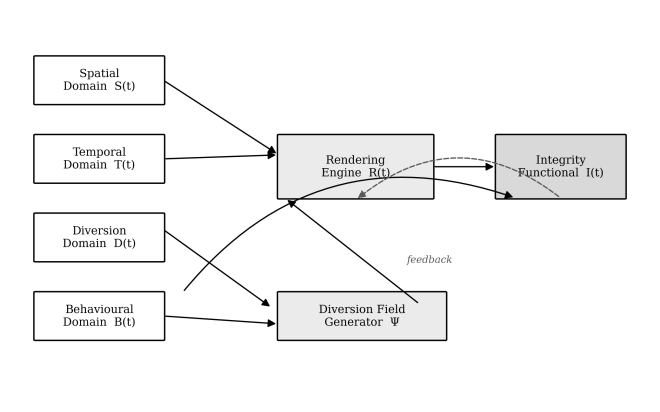
Fig 1: Architecture of the behaviourally-adaptive
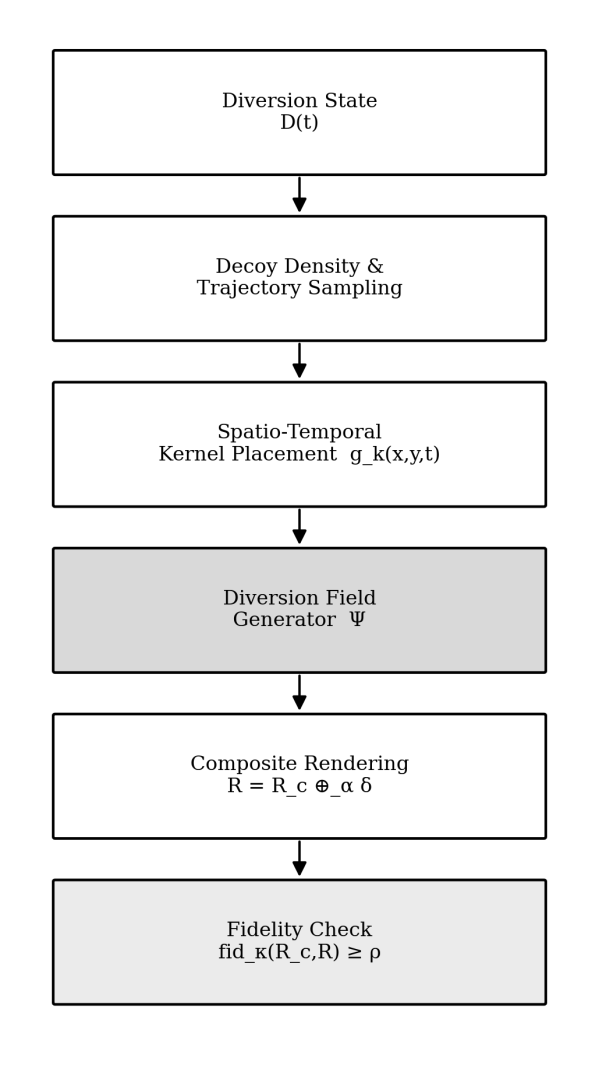
Fig 2: traces the pipeline from decoy statistics
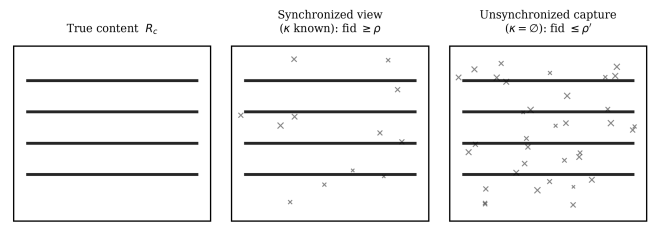
Fig 3: Composite rendering as perceived by a
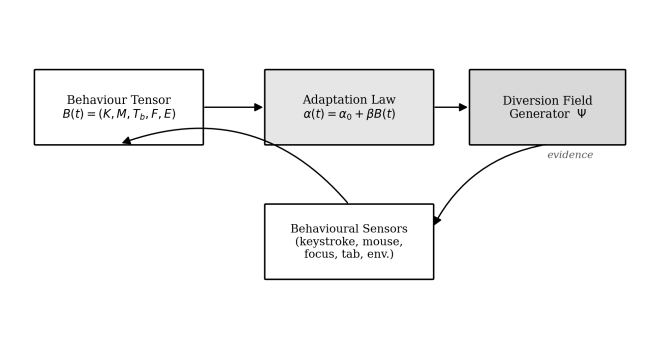
Fig 4: Closed-loop coupling between behavioural
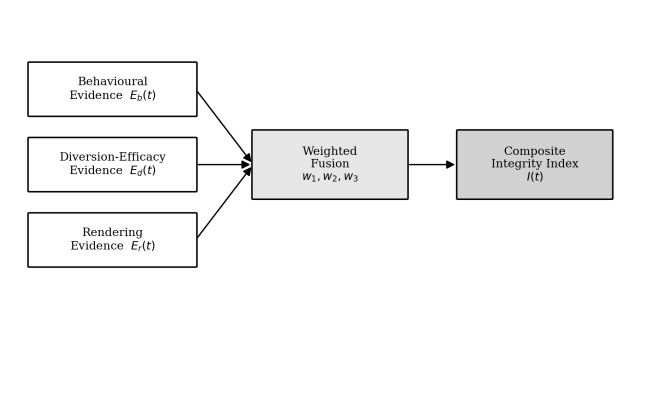
Fig 5: Multi-modal evidence fusion for computation
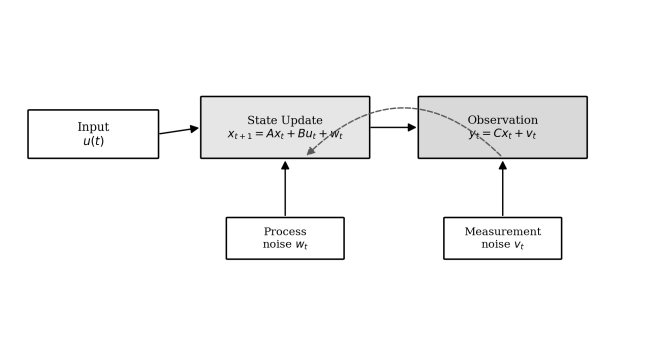
Fig 6: Dynamical state-space representation of the
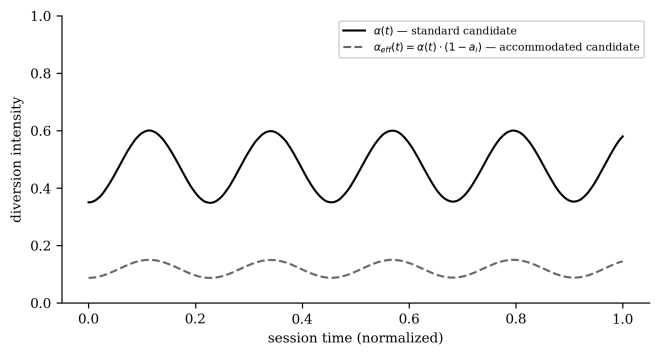
Fig 7: Diversion intensity over a session for a
Limitations
- The paper is purely theoretical without empirical validation or user studies confirming the perceptual imperceptibility or efficacy of the diversion mechanism.
- Security guarantees rest on assumptions that the rendering client and session key remain uncompromised; client-side compromises break the defense.
- The temporal component of capture resistance is limited on commodity 60 Hz displays, which lack frequencies above flicker fusion thresholds, weakening the mechanism to relying on spatial decoys alone.
- The correlation between behavioral and diversion-efficacy evidence streams is acknowledged but not empirically modeled, complicating accurate integrity estimation.
- The accessibility attenuation introduces a quantifiable tradeoff by reducing capture resistance that institutions must actively manage, rather than a free enhancement.
- Out-of-band adversaries (A3), such as optical recording of screens, are only partially addressed and represent an unresolved threat vector for this approach.
Open questions / follow-ons
- How does the behaviorally-adaptive diversion mechanism perform empirically in realistic deployment with diverse candidates, including those with accommodations and under different hardware constraints?
- What are the best strategies to quantify and mitigate the increased residual risk introduced by accessibility attenuation, and how can institutions optimally reweight integrity evidence channels?
- How resilient is the diversion mechanism against adaptive adversaries who might attempt to synchronize capture pipelines or exploit hardware refresh rate characteristics?
- Can extensions of the model incorporate multi-modal behavioral signals (e.g., webcam or environmental sensors) more deeply into the diversion adaptation law to improve security and reduce false positives?
Why it matters for bot defense
This work contributes a mathematically principled, behaviorally-adaptive mechanism to increase the difficulty of unauthorized screen capture in high-stakes digital assessments while accounting for accessibility needs. For bot-defense or CAPTCHA practitioners, the insight that adaptive visual noise keyed per session can be modulated in real time based on user behavior echoes adaptive challenge generation in bot detection. The explicit modeling of how temporal integration by humans differs from sampling by capture devices highlights an avenue to tailor defenses that degrade automated captures without burdening legitimate users.
Moreover, the framework's joint treatment of accessibility and security trade-offs is particularly relevant for CAPTCHA systems striving to be inclusive to users with disabilities. The paper’s approach to quantifying and explicitly bounding these trade-offs rather than ignoring them sets a valuable precedent. However, since the approach relies on coordination between rendering clients and secure key distribution, direct translation to publicly deployed CAPTCHA challenges may require adapted architectures. Still, the theoretical constructs and stability analyses provide a foundation for building more adaptive, accessible challenge presentations in bot-defense technologies.
Cite
@article{arxiv2608_03531,
  title={ Behaviorally Adaptive Visual Diversion for Inclusive and Resilient Digital Assessment Delivery },
  author={ Gupta Lovi Raj and kaur Kamalpreet and Dama Sriram and Parali Prajithaa },
  journal={arXiv preprint arXiv:2608.03531},
  year={ 2026 },
  url={https://arxiv.org/abs/2608.03531}
}