
NeuroInspector: A Local-First Environment for Inspecting and Annotating Hierarchical Neuroscience Datasets
Source: arXiv:2608.02465 · Published 2026-08-03 · By Zihan Yang
TL;DR
NeuroInspector addresses the increasing challenges faced by neuroscience researchers in inspecting and understanding large, hierarchical datasets stored in HDF5 and NWB formats before performing scientific analysis. Existing workflows for dataset inspection remain fragmented, relying heavily on ad hoc scripts, manual notes, and repeated navigation of complex file structures, which leads to inefficiencies and loss of provenance. NeuroInspector introduces a lightweight, browser-based, local-first environment that enables researchers to open and interactively explore these datasets without uploading files or installing software. The tool combines hierarchical navigation, structural metadata inspection, sampled data previews, and path-level annotation into a portable, fingerprinted project pack that records all inspection decisions without modifying the original data files.
Key findings
- NeuroInspector runs entirely client-side in the browser using WebAssembly-based HDF5 parsing with no file-upload endpoint, enhancing privacy and suitability for sensitive data.
- The application supports browsing full HDF5/NWB hierarchies including shape, dtype, chunking, compression, and attributes of 349 groups and 680 datasets in a 16.8 MB electrophysiology NWB file in real-time.
- Sampled previews are capped to approximately 32,000 elements for overviews and 250,000 elements for dataset views to maintain responsiveness while providing meaningful visual summaries.
- Annotations and inspection selections are exported as a .neuroinspector.json project pack recording the original file's SHA-256 hash along with selected paths and free-text notes, enabling traceable, verifiable inspection provenance.
- Reopening a project pack verifies that it corresponds to the current file version by comparing the stored fingerprint and restores prior selections and annotations.
- The project pack format is machine-readable and can be ingested directly by analysis tools such as Python, MATLAB, or R to bootstrap downstream workflows.
- NeuroInspector requires no software installation or remote data transfer and supports all major desktop browsers with WebAssembly support.
- The tool emphasizes separating inspection from analysis: it does not modify or analyze data but streamlines the understanding and documentation stage before formal processing.
Threat model
The adversary is a potential attacker who could intercept or access sensitive neuroscience datasets. NeuroInspector assumes that dataset confidentiality must be preserved, so it forbids any remote file uploads or cloud processing to avoid data leakage. The user retains local control of files, and the system processes them entirely within the browser sandbox. The tool prevents silent acceptance of changed or different files by verifying SHA-256 fingerprints of inspected datasets. However, the adversary is not assumed to have control over the user's local machine or browser environment.
Methodology — deep read
The authors first establish the threat model around protecting dataset confidentiality and provenance during inspection. Since neuroscience datasets are often large, sensitive, and institutionally managed, they emphasize zero file upload and local-first execution to keep data private and reduce compliance concerns.
The input data supported include hierarchical datasets stored in HDF5 and NWB formats, with datasets comprising multimodal neurophysiological recordings. The demonstration uses a 16.8 MB patch-clamp electrophysiology NWB file containing 349 groups and 680 datasets from the DANDI Archive.
The NeuroInspector system is implemented as a React-based single-page web application in TypeScript, running entirely client-side within modern browsers supporting WebAssembly. It leverages h5wasm, a WebAssembly port of the HDF5 C library, for in-browser parsing of native HDF5 and NWB files loaded directly from local disk. No server-side file upload or processing is performed.
The hierarchical structure of groups and datasets is fully traversed without sampling, exposing structural metadata such as shape, dtype, chunking, compression, and attributes. Sampled data previews provide bounded views of large numeric arrays (up to ~32,000 elements overview, ~250,000 elements in detailed views) rendered as time series or heatmaps depending on dimensionality and size. This balances responsiveness with meaningful data inspection.
A key novel feature is path-level annotation and selection, where users mark specific dataset or group paths as relevant and attach free-text notes. These choices are exported as a project pack JSON file maintaining the SHA-256 fingerprint of the source file to ensure traceable provenance. The project pack schema includes versioning, timestamps, source file metadata, selected paths, and annotation arrays. On reloading the source file, the project pack's fingerprint is verified to detect any file modifications.
The application state is managed via Zustand for React, visualizations employ Recharts and a canvas-based heatmap component. The workflow is designed to be zero-install: users open the hosted web application in a compatible browser and open local files via drag-and-drop or file picker. The entire inspection and annotation process occurs in the browser memory.
Evaluation is demonstrated through detailed exploration of the electrophysiology NWB file example, showcasing the structural summary panel, hierarchical file tree navigation, metadata inspection, sampled previews of large datasets, path selection, annotation, and project pack export and reload. This walkthrough exemplifies how the tool reduces friction in the dataset familiarization step preceding computational analysis.
The tool is open-source, with source code and live deployment available. The evaluation focuses on functional correctness and usability for the inspection stage rather than quantitative performance metrics. No adversarial testing or large-scale user study is reported. The current version (0.1.0) limits file sizes to what browser memory permits and foregoes validation or modification capabilities.
Technical innovations
- Local-first WebAssembly-based HDF5 and NWB file parsing entirely in a browser environment with zero file upload.
- Integration of structural navigation, sampled data preview, and path-level annotation combined into a portable, fingerprinted project pack preserving inspection provenance.
- Source-content-based SHA-256 fingerprinting of datasets to verify project pack integrity despite file renaming or relocation.
- A zero-install, hosted web application workflow enabling immediate dataset inspection from local disk without software or code dependencies.
Datasets
- Patch-seq recordings from mouse visual cortex (DANDI Archive Dandiset 000020) — 16.8 MB electrophysiology NWB file — public
Figures from the paper
Figures are reproduced from the source paper for academic discussion. Original copyright: the paper authors. See arXiv:2608.02465.
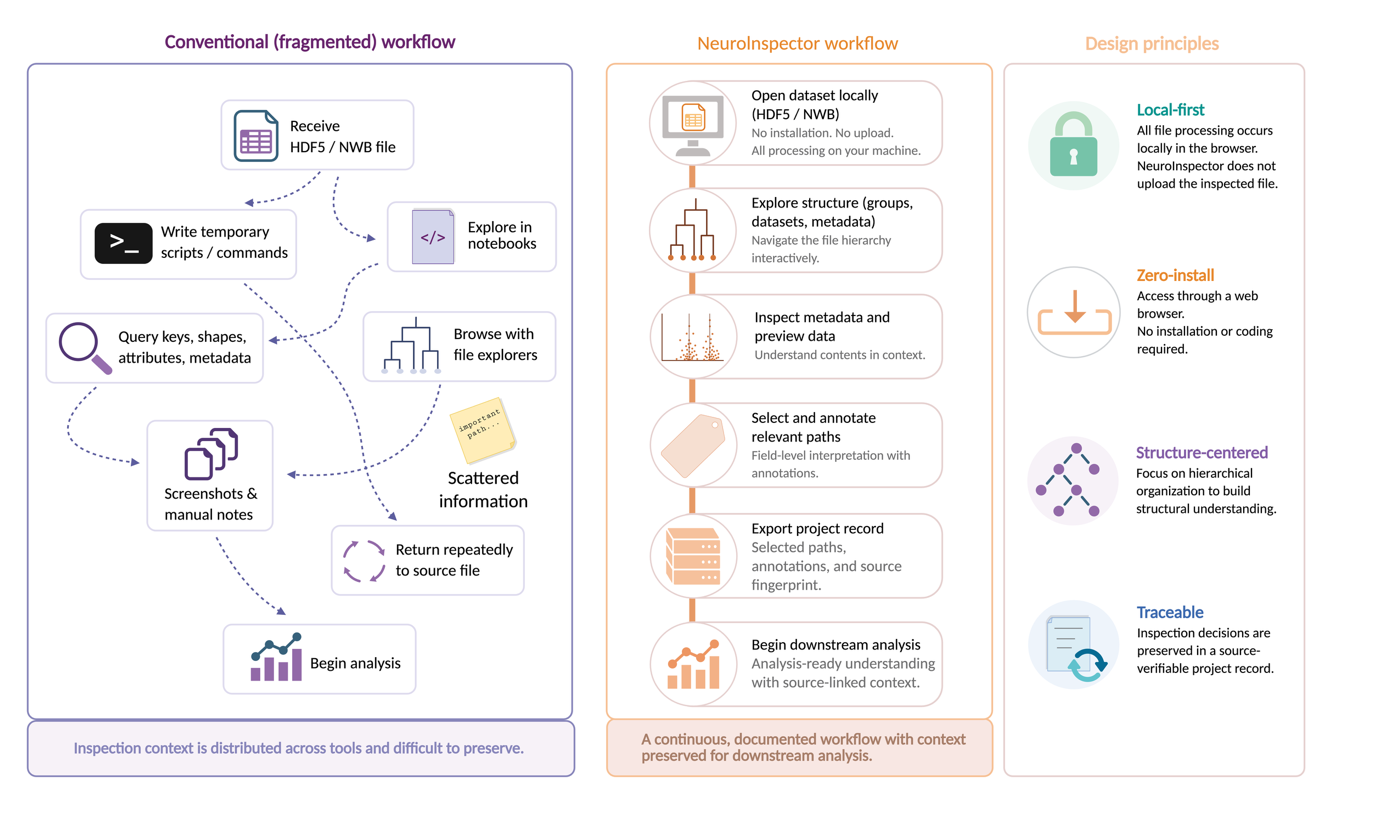
Fig 1: From a fragmented inspec4on process to a con4nuous, traceable workflow. Le<, conven(onal
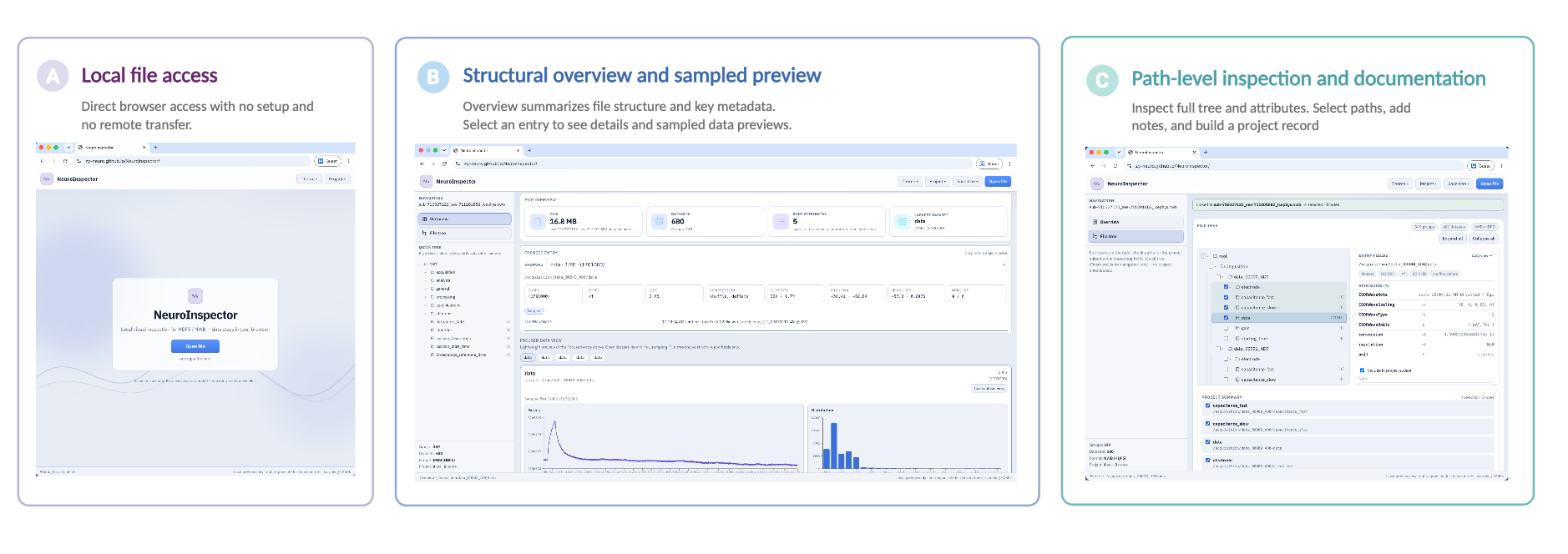
Fig 2: The NeuroInspector interface applied to a public intracellular electrophysiology dataset. (A) Local
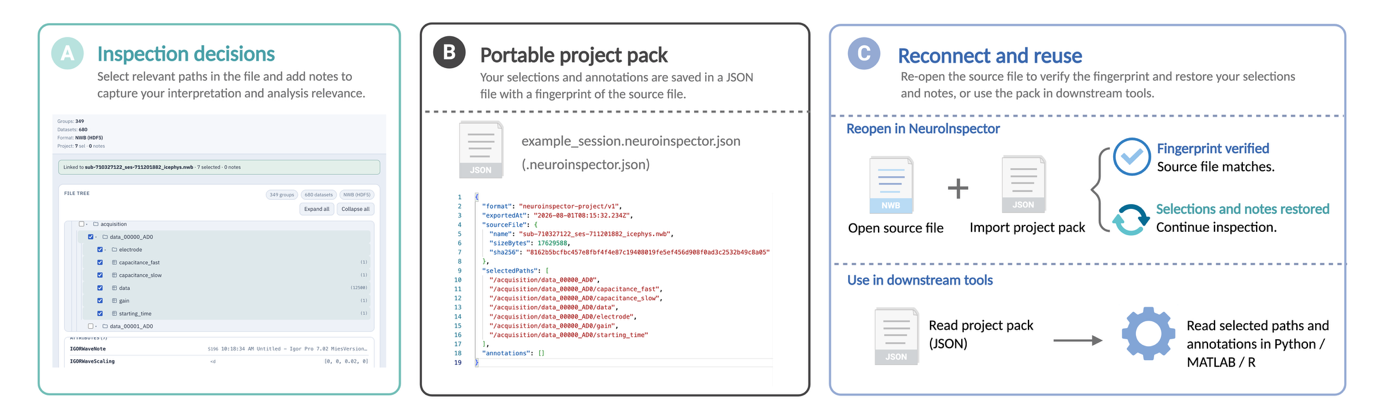
Fig 3: The portable project pack, from selec4on to reuse. (A) Inspec(on decisions: relevant paths are
Limitations
- Currently limited by browser memory for file size; very large datasets may not fully load or preview.
- No integrated validation, cleaning, or analysis features—focuses solely on inspection and annotation.
- Does not support executable subset export or NWB best-practice validation, planned for future releases.
- Only supports desktop browsers with WebAssembly; no mobile support mentioned.
- No user study or quantitative usability evaluation, so efficacy beyond demonstration is unknown.
- The sampled data previews are approximations and do not replace full data reads in analysis.
Open questions / follow-ons
- How well does NeuroInspector scale to very large datasets beyond typical browser memory limits?
- Can the project pack format be extended to support executable subset export or integrate validation feedback?
- What is the user impact on reproducibility and collaboration when using structured inspection records?
- How might the tool integrate with automated downstream analysis pipelines or interactive computational notebooks?
Why it matters for bot defense
For bot-defense and CAPTCHA researchers, NeuroInspector provides a compelling example of applying zero-trust, local-first design principles to secure and privacy-respecting data workflows. Although focused on neuroscience, the architectural choice to process hierarchical, sensitive datasets entirely within the client browser without remote upload parallels privacy-preserving principles desirable in threat-sensitive applications. The approach to traceable inspection provenance using content-based fingerprints addresses data integrity and reproducibility challenges relevant to security-critical data inspection tasks. A bot-defense engineer might draw inspiration from NeuroInspector’s seamless combination of complex structural navigation, sampled previews, and annotation within a zero-install, browser-native environment. This contrasts with typical fragmented or script-based workflows and offers a design pattern for local-first inspection tools that do not expose raw data externally, thus reducing attack surfaces and compliance risks. While it is not a direct counter-bot or CAPTCHA solution, the platform’s mitigation of remote data transfer and tight provenance tracking could inform enhancements in secure, auditable inspection systems within adversarial environments.
Cite
@article{arxiv2608_02465,
  title={ NeuroInspector: A Local-First Environment for Inspecting and Annotating Hierarchical Neuroscience Datasets },
  author={ Zihan Yang },
  journal={arXiv preprint arXiv:2608.02465},
  year={ 2026 },
  url={https://arxiv.org/abs/2608.02465}
}