
Quantum tomography of inelastic electron scattering \emph{via} orbital angular momentum states
Source: arXiv:2607.29565 · Published 2026-07-31 · By Amir H. Tavabi, Alessio D'Errico, Paolo Rosi, Giovanni Bertoni, Enzo Rotunno, Luca Belsito et al.
TL;DR
This paper addresses the longstanding challenge of performing quantum state tomography (QST) for inelastic electron scattering in transmission electron microscopy (TEM). Traditional tomography requires scanning a high-dimensional continuous phase space, making characterization of electron states after inelastic scattering difficult due to the quadratic growth in required measurements with dimensionality. The authors introduce a novel approach by restricting tomography to the discrete electron orbital angular momentum (OAM) subspace, leveraging an electron optical device known as an OAM sorter. This device maps the continuous azimuthal phase space onto a finite set of measurable OAM eigenstates, greatly simplifying the experimental and computational burden necessary to reconstruct the density matrix of scattered electrons. They demonstrate this technique experimentally by analyzing volume plasmon excitations in an amorphous carbon film, using a coherent superposition "petal" beam with OAM = ±4 as the input probe.
Their results show that inelastic scattering broadens the OAM spectrum and degrades quantum coherence, reducing purity of the electron state from 0.54 (elastic) to 0.21 (inelastic). The reconstructed density matrix exhibits both coherence-preserving and coherence-breaking features, with eigenstate decomposition revealing dipole-allowed transitions consistent with plasmon excitation. A Monte Carlo momentum-exchange model supports and elucidates these findings. This work presents a practical pathway for full quantum tomography of electron scattering states by capitalizing on the discrete OAM subspace, opening doors to richer characterization of decoherence and symmetry breaking in structured electron beams after inelastic interactions.
Key findings
- Quantum state tomography in the OAM subspace drastically reduces measurement complexity by restricting analysis to a finite d = 2ℓ + 1 dimensional Hilbert space (ℓ = 5 used here, d = 11).
- Purity of the electron state drops from P = 0.54 in elastic scattering to P = 0.21 after inelastic plasmon excitation, indicating significant but incomplete loss of coherence.
- The experimentally reconstructed density matrix ˆρ (11×11) shows dominant eigenstates including the initial petal beam state and dipole-allowed transitions with Δm = ±1 consistent with selection rules in electron-plasmon interaction.
- The off-diagonal elements of ˆρ reveal coherence and rotational symmetry breaking in the scattered electron state, confirmed by altered angular intensity distributions.
- Use of an OAM sorter enables simultaneous OAM and energy-loss resolved spectroscopy (OAM-EELS), mapping angular momentum redistribution across a 10 eV energy window.
- Monte Carlo simulation of random momentum exchange reproduces key features of ˆρ and explains degeneracies and rotations of eigenstates as preserving overall rotational symmetry despite OAM exchange.
- Fine angular modulations persist in elastic scattering but are suppressed in inelastic case, suggesting decoherence impacts higher spatial frequencies.
- The study demonstrates feasibility of measuring full quantum density matrices for electron beams post-inelastic scattering using feasible electron optical elements.
Methodology — deep read
The authors frame the problem of characterizing the quantum state of an electron beam after inelastic scattering in TEM. The central difficulty is that full quantum tomography requires reconstructing a density matrix with d² parameters, where d is the Hilbert space dimension. For spatial and momentum degrees of freedom, this dimension is effectively continuous and infinite, making direct tomography infeasible.
They propose restricting tomography to the discrete orbital angular momentum (OAM) degree of freedom of electrons, indexed by integer topological charge m ∈ [−ℓ, +ℓ]. This reduces the problem to estimating an (2ℓ+1)×(2ℓ+1) density matrix ˆρ with finite dimension d = 2ℓ+1. This subspace neglects radial modes (traced over) and energy loss transitions outside a finite window, averaging over these degrees of freedom in the effective density matrix.
Experimentally, an electron beam with an initial prepared structured state (a coherent petal beam with OAM m = ±4) is transmitted through an amorphous carbon film, exciting volume plasmons causing inelastic scattering.
The measurement setup uses a recently developed electron orbital angular momentum sorter, realized with electrostatic phase elements including a needle electrode, which applies a conformal log-polar mapping converting azimuthal phase into linear position on the detector. This device spatially separates electrons with different OAM values, enabling projective measurements onto the discrete OAM eigenbasis.
Simultaneously, an electron energy loss spectrometer allows measurement of the energy distribution of scattered electrons, enabling OAM-resolved energy-loss spectroscopy (OAM-EELS). Energy filtering with a 10 eV window is applied to select electrons within a specific inelastic scattering range.
Density matrix reconstruction leverages /i/ diagonal elements directly measured as OAM occupation probabilities and /ii/ off-diagonal coherence terms inferred by projecting onto superpositions of OAM modes. These projective measurements are achieved experimentally via different configurations of the OAM sorter and energy filter, and mathematically by fitting data to parameterized density matrices.
Because the inverse problem is underdetermined (number of measurements < number of free parameters), constraints are introduced: positivity and trace-normalization of ˆρ, approximate symmetry with respect to ±m modes (based on probe and sample symmetry), and a soft constraint encouraging closeness to the elastic scattering density matrix (assumed nearly pure).
An iterative maximum likelihood estimation (MLE) reconstruction algorithm with Lagrange multipliers optimizes ˆρ to fit measured OAM spectra and angular intensity profiles respecting these constraints.
The reconstructed density matrix reveals coherence degradation and redistribution of OAM states induced by the plasmon interaction. Diagonalization of ˆρ extracts eigenstates interpreted as possible post-scattering pure states with associated probabilities.
To interpret results, the authors develop a Monte Carlo simulation model treating inelastic scattering as a random momentum exchange with plasmons characterized by a momentum cutoff linked to energy loss. The simulated ˆρ reproduces key features of the experimental density matrix, including degenerate eigenstates related by azimuthal rotations and dipole selection rule transitions with Δm = ±1.
Overall, the method successfully performs quantum tomography restricted to the OAM subspace by combining an OAM sorter for discretization, energy-filtered measurements, constrained statistical reconstruction, and simulation to interpret physical scattering mechanisms.
Code and data reproducibility are not explicitly stated. Details of hologram fabrication, sorter configuration, and reconstruction parameters are found in supplementary materials.
Technical innovations
- Use of an electron orbital angular momentum (OAM) sorter to discretize continuous azimuthal phase space into a finite set of measurable OAM eigenstates in TEM quantum tomography.
- Application of restricted QST in the OAM subspace to characterize inelastic electron scattering-induced mixed states, simplifying the inverse problem complexity.
- Simultaneous OAM- and energy-loss-resolved electron spectroscopies (OAM-EELS) enable comprehensive mapping of angular momentum redistribution across energy windows.
- Development of a maximum-likelihood estimation algorithm incorporating physical constraints (positivity, symmetry, elastic proximity) to reconstruct physically valid mixed-state density matrices from underdetermined data.
Datasets
- OAM-EELS experimental data — finite-dimensional OAM subspace (d=11) measurements over 10 eV energy loss window — from structured electron beam scattering on amorphous carbon film
Baselines vs proposed
- Elastic scattering state purity: P = 0.54 vs inelastic scattering state purity: P = 0.21
- Measured OAM spectrum dominated by |m|=4 in elastic case broadens to include intermediate m modes after inelastic scattering
Figures from the paper
Figures are reproduced from the source paper for academic discussion. Original copyright: the paper authors. See arXiv:2607.29565.
Fig 1: (A) Schematic illustration of the two microscope configurations used for independent measurement of the OAM spectrum and its

Fig 2: (A) Experimental OAM spectrum after inelastic scattering, obtained by integrating the energy-resolved data from Fig. 1-C over a
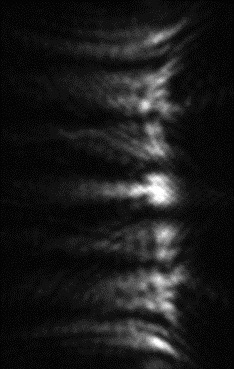
Fig 3 (page 3).
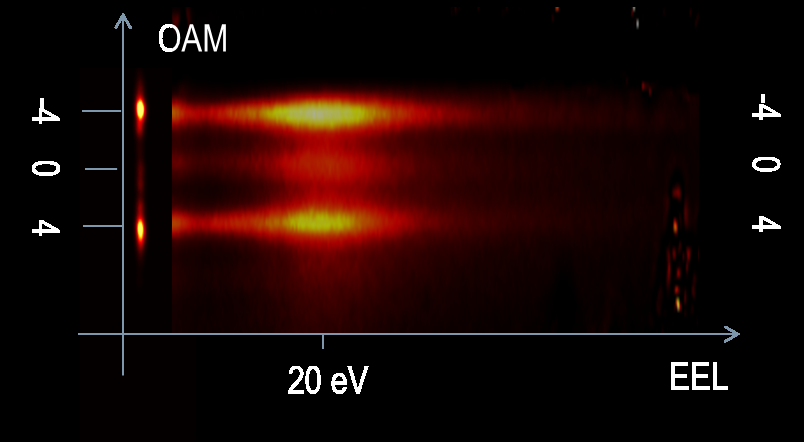
Fig 4 (page 3).
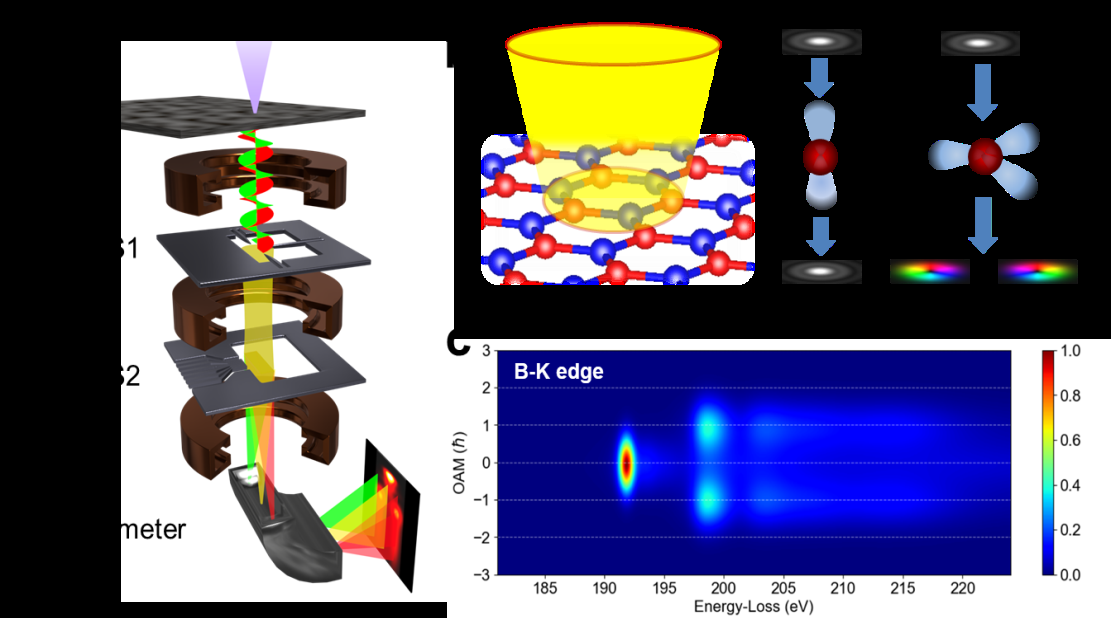
Fig 5 (page 3).
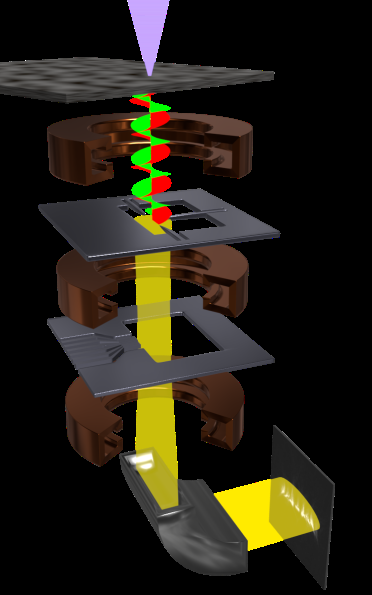
Fig 6 (page 3).
Fig 7 (page 3).
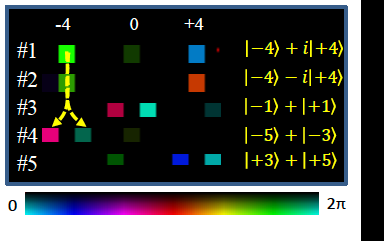
Fig 3: (A) Simulated density matrix obtained using the Monte Carlo model of momentum exchange, with inelastic scattering treated as a
Limitations
- Density matrix reconstruction restricted to OAM subspace with |ℓ| ≤ 5; radial and energy modes traced over, resulting in partial averaging and loss of full quantum information.
- Inverse problem underdetermined with fewer measurements than density matrix parameters, mitigated only by physical priors and soft constraints, potentially biasing reconstruction.
- Limited OAM resolution due to experimental constraints of the electron OAM sorter, including spatial discontinuity from needle electrode causing cross-talk between modes.
- Energy window selection (10 eV) restricts observation to partial inelastic scattering processes; full energy-resolved tomography not demonstrated.
- Reconstruction assumes approximate symmetry in OAM distributions; deviations could arise from experimental imperfections or algorithm convergence issues.
- Modeling simplifications in Monte Carlo simulation exclude delocalization and detailed plasmon spatial structure, limiting accuracy in describing complex scattering dynamics.
Open questions / follow-ons
- How can radial and energy degrees of freedom be incorporated into full quantum tomography to capture complete electron scattering states beyond the OAM subspace?
- Can improved OAM sorter designs further reduce cross-talk and enhance resolution, enabling reconstruction in higher-dimensional OAM spaces?
- What are the decoherence mechanisms and timescales specifically responsible for partial loss of quantum coherence in inelastic electron-plasmon scattering?
- How generalizable is this OAM-based tomography approach to other materials and inelastic scattering processes with different symmetry properties?
Why it matters for bot defense
While the paper does not directly address CAPTCHA or bot-defense applications, the core concept of reducing a high-dimensional quantum tomography problem to a discrete subspace with manageable dimensionality may inspire similar dimensionality reduction approaches in bot detection algorithm design, where complex high-dimensional behavioral patterns need to be characterized with limited measurements. The demonstrated use of structured probes and projective measurements in physically meaningful subspaces can analogously inform the design of feature extraction or state characterization mechanisms for distinguishing legitimate users from adversarial bots.
Furthermore, the statistical reconstruction methods enforcing physical constraints to solve underdetermined inverse problems may find parallels in bot detection systems that require reconstructing latent user states or intentions from limited, noisy telemetry. However, direct technical applications to CAPTCHA or bot-defense would require substantial adaptation and are not explicitly explored in the paper.
Cite
@article{arxiv2607_29565,
  title={ Quantum tomography of inelastic electron scattering \emph{via} orbital angular momentum states },
  author={ Amir H. Tavabi and Alessio D'Errico and Paolo Rosi and Giovanni Bertoni and Enzo Rotunno and Luca Belsito and Alberto Roncaglia and Stefano Frabboni and Gian Carlo Gazzadi and Peter Tiemeijer and Rafal E. Dunin-Borkowski and Ebrahim Karimi and Vincenzo Grillo },
  journal={arXiv preprint arXiv:2607.29565},
  year={ 2026 },
  url={https://arxiv.org/abs/2607.29565}
}