
Data Visualization Style Guides in Practice: Why They Emerge, How They Work, and When They Bend
Source: arXiv:2607.29645 · Published 2026-07-31 · By Alvitta Ottley, Jonathan Schwabish
TL;DR
This paper investigates data visualization style guides as socio-technical systems that organizations develop to coordinate visual communication practices under various pressures. Through semi-structured interviews with nine experienced style guide authors across journalism, government, industry, and the public sector—who collectively oversaw 26 style guides—the authors explore why style guides emerge, how they operate in practice, and how flexible or rigid they are in real organizational settings. The study finds that style guides address challenges beyond purely design aesthetics, including consistency, capacity constraints, accountability, governance, and tool integration. To conceptualize these dynamics, the authors propose PRISM, a novel four-dimensional framework capturing Purpose, Rules & Mechanisms, Institutional Enforcers, and Situated Flexibility. Additionally, analysis of 50 publicly available guides reveals that most expose only rules and mechanisms, leaving governance structures and flexibility implicit. This work thus extends visualization research from isolated style rules toward understanding the organizational ecosystems that shape how data visuals “look right” and are trusted in practice.
Key findings
- Style guides commonly arise in response to organizational pressures including output inconsistency, brand alignment, capacity limitations, platform/tool constraints, maintenance needs, and accountability demands.
- A multi-mechanism approach is typical, layering audits, explicit standards, illustrative examples, reusable templates, automation in tooling, and training initiatives to ensure adoption and quality.
- Accountability contexts, such as government and regulated domains, correlate with stricter enforcement and more explicit guidance to manage legal, reputational, and ethical risk.
- Templates and embedded automation in software tools reduce cognitive load and increase consistency but can trade off flexibility and expert judgment.
- Training and sustained community engagement are essential to interpret and apply style guidance effectively, beyond what documentation alone can achieve.
- The PRISM framework characterizes style guides along four interacting dimensions: Purpose (why), Rules & Mechanisms (how), Institutional Enforcers (who enforces), and Situated Flexibility (when/where rules bend).
- Publicly available style guide documents tend to emphasize rules and mechanisms but rarely document enforcement structures or contextual flexibility explicitly.
- Interview subjects described style guides as “living” documents requiring ongoing updates tied to organizational shifts such as rebrands, platform changes, and team growth.
Methodology — deep read
The study uses qualitative semi-structured interviews with nine practitioners who have authored or maintained 26 visualization style guides across multiple sectors including journalism, government, technology, and consulting. Participants were selected via professional networks and guided by experience producing multiple guides or longitudinal involvement. Interviews lasted about 60 minutes, conducted via Zoom, audio-recorded, and transcribed verbatim. Interview protocols explored motivations for style guide creation, organizational context, rule enforcement, updates/maintenance, tooling integration, training approaches, and flexibility in application. Analysis was done using Reflexive Thematic Analysis (RTA), an iterative qualitative approach emphasizing identification of patterns of shared meaning rather than frequency counts. The authors undertook six iterative phases of familiarization, coding, theme generation, review, definition, and write-up. The resulting analytic framework (PRISM) organizes style guide practice into Purpose, Rules & Mechanisms, Institutional Enforcers, and Situated Flexibility. This socio-technical lens shifts focus from isolated documented rules to understanding style guides as organizational artifacts embedded within governance and culture. The study also included a secondary analysis of 50 publicly available style guide documents to assess how well these reveal the institutional and flexibility dimensions. The methodology emphasizes nuanced interpretation over statistical generalization and aims to surface tacit knowledge and organizational dynamics that public documents omit. However, it does not include direct measurement of guide efficacy or adversarial testing.
Technical innovations
- The PRISM framework conceptualizes visualization style guides as socio-technical systems through four interacting dimensions: Purpose, Rules & Mechanisms, Institutional Enforcers, and Situated Flexibility.
- Empirical linkage of different organizational pressures (e.g., accountability, capacity) to characteristic style guide formation and governance regimes.
- Identification and categorization of multiple intervention mechanisms in style guides, including audits, standards, examples, templates, automation, and training.
- Demonstration that publicly available style guide documents only partially reveal the full socio-technical ecosystem, omitting enforcement and flexibility aspects.
Figures from the paper
Figures are reproduced from the source paper for academic discussion. Original copyright: the paper authors. See arXiv:2607.29645.
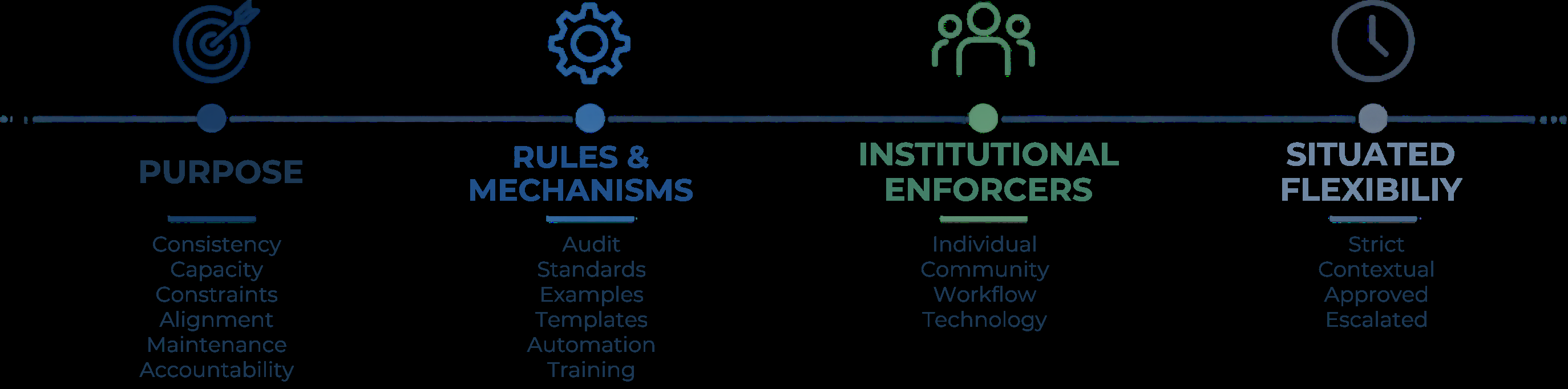
Fig 1: An overview of the PRISM framework used to characterize the Purpose, Rule & mechanisms, Institutional enforcers, and the
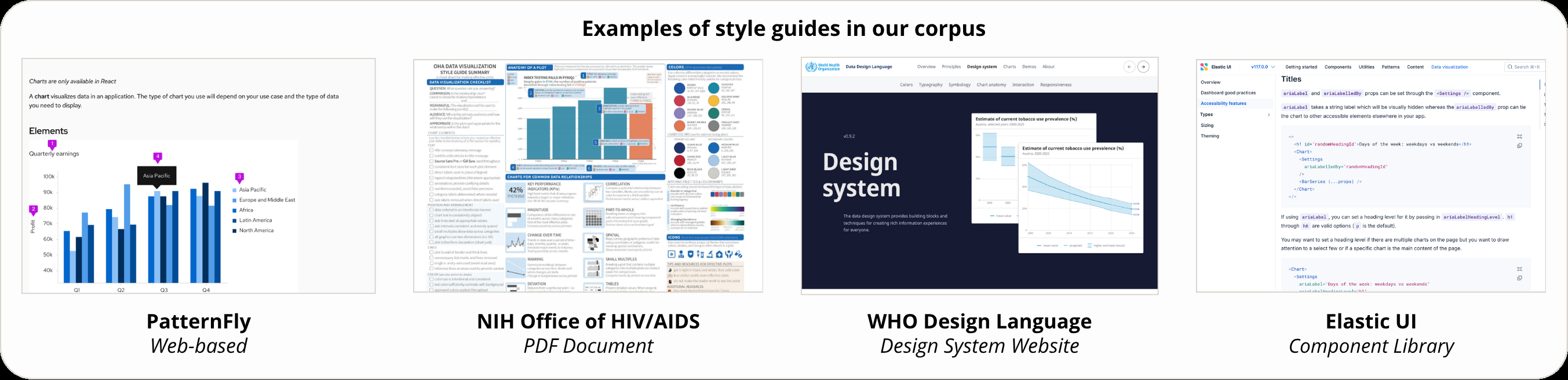
Fig 2: Representative visualization style guides analyzed in this study, illustrating the diversity of publication formats, including websites, PDF
Limitations
- Small sample of nine interviewees limits breadth and generalizability of findings; participants mostly from U.S. and European contexts.
- Reliance on self-reported experiences may introduce recall bias or self-selection bias toward successful styles guides.
- No direct quantitative evaluation of style guide effectiveness on visualization quality or user trust was conducted.
- Study focuses on organizational and governance aspects rather than adversarial robustness or security-related constraints.
- Public document analysis limited to 50 guides selected based on availability rather than systematic sampling.
- Interpretations hinge on qualitative thematic analysis which is inherently subjective and interpretive rather than statistical.
Open questions / follow-ons
- How do different enforcement regimes in style guides (strict vs flexible) quantitatively impact visualization quality, consistency, and user trust?
- Can automated tooling fully replace human institutional enforcers while maintaining flexibility and accountability in visualization design?
- How do organizational culture and structure influence the adoption and evolution of style guide governance models?
- How might style guides adapt to emerging visualization modalities (e.g. VR/AR or interactive dashboards) that challenge traditional tooling and templates?
Why it matters for bot defense
While this paper does not directly address bot defense or CAPTCHA systems, the socio-technical perspective on visualization style guides offers valuable lessons for bot-defense engineers and CAPTCHA practitioners focused on interface design and human-computer interaction. Visualization style guides function as organizational artifacts that embed norms, governance, and flexibility into visual output workflows, critical for establishing user trust and consistent interpretation under constraints. Similarly, CAPTCHA designs require balanced enforcement mechanisms, allowances for human judgment, and consideration of user capacity and accessibility. The PRISM framework highlights the importance of institutional enforcers and situated flexibility—concepts that could translate to CAPTCHA systems needing adaptable challenge difficulties and governance. Moreover, the layered approach combining explicit rules, automation, templates, and training suggests parallels in CAPTCHA ecosystem design, including tooling for automated bot detection coupled with human moderation protocols. In short, the work extends beyond visual design into how sociotechnical systems manage trade-offs between rigidity and discretion, automation and oversight, which are central challenges in CAPTCHA development.
Cite
@article{arxiv2607_29645,
  title={ Data Visualization Style Guides in Practice: Why They Emerge, How They Work, and When They Bend },
  author={ Alvitta Ottley and Jonathan Schwabish },
  journal={arXiv preprint arXiv:2607.29645},
  year={ 2026 },
  url={https://arxiv.org/abs/2607.29645}
}