
Topology optimization of conduction-radiation problems based on a ray-tracing approach
Source: arXiv:2607.28534 · Published 2026-07-30 · By Shun Noguchi, Naoyuki Ishida, Jike Han, Kazuhiro Izui, Shinji Nishiwaki
TL;DR
This paper addresses the challenge of topology optimization (TO) for combined conduction-radiation heat transfer problems, which is critical for designing compact and efficient thermal management devices in space systems where radiation dominates. Existing TO methods either simplify radiative transfer or cannot fully capture multidirectional mutual radiation within implicit structures, limiting their accuracy and design potential. The authors propose a novel density-based TO framework integrating a zonal-method radiation analysis enhanced by a differentiable ray-tracing approach for accurately evaluating multidirectional radiation exchanges within intermediate-density (gray) media that arise during optimization. Analytical sensitivities computed via an adjoint method enable efficient gradient-based optimization. Numerical examples demonstrate optimized radiative heat sinks and radiation shields that balance conduction and radiation effects to produce innovative designs not achievable by prior approaches. Results confirm the accuracy and physical consistency of the method, expanding the design space for radiation-critical thermal devices.
Key findings
- Introduced a density-based TO method that treats intermediate material densities as participating media, enabling physically consistent evaluation of conduction-radiation coupling.
- Developed a differentiable ray-tracing formulation to calculate zonal exchange factors accounting for attenuation by intermediate densities, supporting analytical sensitivity derivation.
- Validated analytical design sensitivities via adjoint method against finite difference numerical sensitivities, confirming accuracy.
- Optimization examples showed that as the conduction-radiation parameter NR varies, the heat sink designs transition between conduction-dominated and radiation-dominated morphologies.
- Radiation shield design cases yielded multilayer insulation structures exhibiting features not obtained by conventional TO ignoring radiation or treating it with boundary simplifications.
- Compared to prior radiation analyses integrated with TO, the proposed method uniquely balances exact sensitivity, computational efficiency, and intermediate density handling.
- The artificial attenuation model based on density interpolation avoids ray path-length dependency, ensuring thermodynamic consistency without excessive ray sampling.
Methodology — deep read
Threat Model & Assumptions: The problem is a conduction-radiation steady-state heat transfer design under vacuum conditions typical for space applications. The model assumes black body emissivity for solid materials and vacuum in void regions, with multidirectional mutual thermal radiation exchanges. Adversarial considerations are not applicable since the focus is on physical system design rather than security.
Data & Mesh: The spatial domain is discretized by a structured finite element mesh with Nelem elements and Nnode nodes. Design variables ψ_f ∈ [0,1] represent element densities, smoothed by a linear filter with radius R_min to suppress physically unrealistic patterns. Filtered density ϕ_e indicates material distribution, where ϕ=0 is void, ϕ=1 is solid, and intermediate values represent porous participating media.
Problem Formulation & Algorithm: Governing equations couple conduction via standard FEM for heat diffusion with volumetric radiative heat transfer evaluated per element using a zonal method framework. Each element acts as an isothermal radiative zone, exchanging radiation computed via element-wise exchange factors FeE including attenuation effects.
Radiative power emission follows Stefan-Boltzmann law E_e=σT_e^4, with volumetric radiative heat source Q_rad,e constructed from exchange factors, element temperatures, and ambient environment values. The conduction-radiation parameter NR nondimensionalizes radiation strength relative to conduction.
Exchange Factor Computation: The key innovation is computing FeE using a differentiable ray-tracing method that traces rays from finite element faces and accounts for attenuation by intermediate-density elements along ray paths. Attenuation is modeled as a product of (1 - f(ϕ_d)) for elements d on the path, where f(ϕ) is the density-based absorptivity interpolation function. Rays that escape the domain transfer residual energy to a virtual ambient or self-exchange factors, maintaining energy conservation.
Numerical Implementation: Nonlinear algebraic system from FEM discretization is solved by Newton-Raphson iteration with global tangent matrix including radiative Jacobian K_rad derived by differentiating radiative terms w.r.t. nodal temperatures. Design sensitivities needed for gradient-based TO are computed analytically using adjoint methods leveraging the differentiable radiation formulation.
Optimization Setup: The objective functions include minimization of maximum temperature or thermal compliance subject to volume constraints. Design variables are updated iteratively using gradient-based solvers integrating the smooth density filter and adjoint sensitivities.
Validation & Examples: Sensitivity verification shows close agreement between analytical adjoint derivatives and finite difference approximations. Numerical examples include 2D and 3D radiative heat sink designs and radiation shield design producing multilayer insulation. Optimization histories and final structures demonstrate the influence of radiation-conduction balance parameter NR on resulting topologies.
Reproducibility: The paper does not explicitly indicate released code or datasets. The method is described in sufficient mathematical detail to enable implementation by specialists. Computational demands depend on ray discretization and mesh size but are reduced compared to full angular PDE methods.
Technical innovations
- Integration of a zonal-method radiative heat transfer analysis with density-based topology optimization via differentiable ray-tracing to evaluate exchange factors in intermediate-density media.
- Formulation of an artificial attenuation model treating intermediate densities as participating media ensuring thermodynamic consistency without ray path length dependency.
- Derivation of analytical design sensitivities for coupled conduction-radiation heat transfer using the adjoint method enabled by the differentiable radiation analysis.
- Use of a density filtering process to stabilize topology optimization while enabling physically meaningful radiative transfer across gray regions.
Baselines vs proposed
- Net-radiation method used in prior studies: did not support intermediate density or exact sensitivity; proposed method supports both with comparable computational efficiency.
- Monte Carlo ray tracing from [34]: high accuracy but plagued by statistical noise preventing exact sensitivities and scaling; proposed method avoids these issues via deterministic differentiable ray-tracing.
- Discrete ordinates / Finite volume methods [39-41]: exact sensitivities possible but computationally prohibitive; proposed method achieves a better tradeoff.
- Boundary condition simplifications [30-32]: computationally efficient but ignore multidirectional mutual radiation; proposed method fully accounts for it.
Figures from the paper
Figures are reproduced from the source paper for academic discussion. Original copyright: the paper authors. See arXiv:2607.28534.

Fig 6: Concept of the view factor evaluation using a ray tracing.
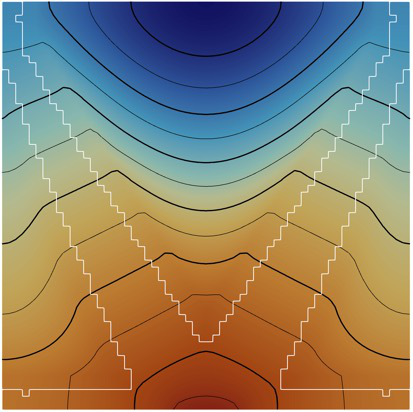
Fig 10: Optimized two-dimensional radiative heat sink structure for NR = 1.

Fig 11: plots the optimization histories of the objective function J and dimensionless volume

Fig 12: shows the optimized structures for various values of the conduction-radiation parameter
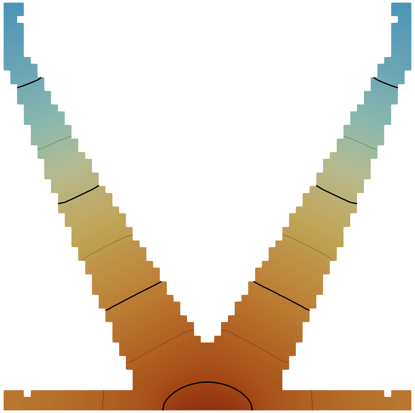
Fig 13: Problem settings for the three-dimensional radiative heat sink design, illustrating the
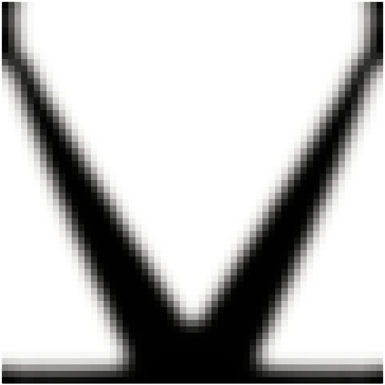
Fig 14: Optimized three-dimensional radiative heat sink structure for NR = 1.

Fig 7 (page 19).
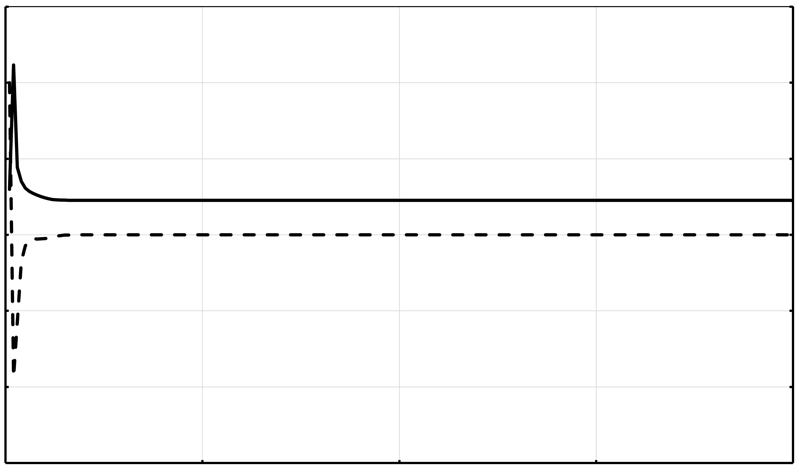
Fig 15: Problem settings for the radiation shield design, illustrating (a) the design domain,
Limitations
- Attenuation model neglects ray path length dependency causing mesh dependency in intermediate density regions; explicit surface representation equivalence argues minor impact.
- Computational cost is still nontrivial due to the ray tracing evaluations, potentially limiting large-scale or very high-resolution problems.
- No explicit adversarial or robustness evaluation since focus is on physical heat transfer design rather than security.
- Lack of released source code or datasets may limit immediate reproducibility.
- Validation is mostly via numerical sensitivity comparisons and optimal structures but lacks experimental or physical prototype testing.
- Only steady-state thermal conditions were considered; transient conduction-radiation coupling remains unaddressed.
Open questions / follow-ons
- How to extend the methodology to transient conduction-radiation coupled heat transfer for dynamic thermal management scenarios?
- Can the attenuation model be improved to reduce or eliminate mesh dependency while maintaining computational efficiency?
- What are the scalability limits of the proposed differentiable ray-tracing approach for very large 3D optimization problems?
- How would incorporating spectral variations in material emissivity and radiative properties affect optimization outcomes and analysis complexity?
Why it matters for bot defense
While this work is focused on physics-based thermal management rather than bot-defense or CAPTCHA systems, the underlying contribution—a differentiable ray-tracing technique that enables gradient-based optimization over complex spatial representations—may inspire methods in other fields where multidirectional interactions must be modeled accurately and differentiably. For bot-defense practitioners, the key takeaway is how introducing differentiability in physically complex simulations can support efficient gradient-based optimization for structural design. If CAPTCHAs or bot-defenses rely on physical simulations or multidimensional interaction modeling (e.g., visual distortions or waveform synthesis), adopting differentiable and physically consistent forward models paired with adjoint sensitivity algorithms could enhance training and adversarial robustness evaluation. However, direct applications from this thermal topology optimization study to CAPTCHA security are limited.
Cite
@article{arxiv2607_28534,
  title={ Topology optimization of conduction-radiation problems based on a ray-tracing approach },
  author={ Shun Noguchi and Naoyuki Ishida and Jike Han and Kazuhiro Izui and Shinji Nishiwaki },
  journal={arXiv preprint arXiv:2607.28534},
  year={ 2026 },
  url={https://arxiv.org/abs/2607.28534}
}