
TCA-SIR: Learning Target-Conditioned Abstractions for Scientific Inspiration Retrieval
Source: arXiv:2607.28498 · Published 2026-07-30 · By Yuto Suzuki, Farnoush Banaei-Kashani
TL;DR
This paper addresses the problem of Scientific Inspiration Retrieval (SIR), a key first step in AI-driven scientific hypothesis generation. Existing SIR methods typically rank candidate papers based on topical similarity to the target problem, which fails to capture transferable problem-solving principles especially for remote inspirations from different domains. To overcome this limitation, the authors reformulate SIR as Target-Conditioned Abstraction (TCA), where the retrieval object is a transferable abstract principle extracted specifically conditioned on the target problem. They propose TCA-SIR, a method that jointly learns to generate a target-conditioned Reasoning/Abstraction (R/A) intermediate to summarize the candidate inspiration in a way tailored to the target, and to score its transferability. On the ResearchBench benchmark covering 12 scientific domains, TCA-SIR improves hit rate at top 4% by over 10 percentage points versus the state-of-the-art MOOSE-Chem method and direct large language model (LLM) retrieval. Qualitative analyses confirm that learned abstractions recover target-relevant mechanisms (e.g., chemical levers for battery design) rather than superficial topical similarity, enabling interpretable retrieval rationales. This work reframes inspiration retrieval in a way that explicitly exposes the reusable core principle connecting source and target, which partially explains TCA-SIR’s superior scientific utility.
Key findings
- TCA-SIR improves HitRate@top4% on ResearchBench test set from 0.379 (Direct LLM pair score baseline) to 0.481 (±0.045 CI), a >10 percentage point absolute gain.
- TCA-SIR also achieves best scores on HitRate@top20% (0.85 ±0.031), MRR (0.601 ±0.054), and NDCG@3 (0.472 ±0.045) versus all baselines.
- Untrained abstraction-based baselines (Idea-Catalyst, Gen-level, Prompt-TCA) underperform direct LLM retrieval methods, indicating abstraction helps only if learned.
- Ablation shows moving from binary BCE transfer labels to 5-level graded scoring improves HitRate@top4% from 0.417 to 0.481, highlighting nuance in transfer strength is important.
- Removing reasoning generation or training the score head alone reduces effectiveness, indicating both target-conditioned abstraction generation and scoring contribute to gains.
- Qualitative examples show TCA-SIR’s abstractions capture specific transferable mechanisms (e.g. chemical binding groups or cooling bottlenecks) whereas untrained prompting yields generic or irrelevant summaries.
- Target conditioning enables selecting relevant facet and abstraction depth of transferable ideas in multi-faceted inspirations, rather than summarizing candidate papers holistically.
- Computational cost is a limitation since TCA-SIR must generate an abstraction for every target-candidate pair, limiting scalability.
Methodology — deep read
The authors first formalize Scientific Inspiration Retrieval (SIR) as learning a retrieval policy to rank scientific papers that can inspire hypotheses for a target problem. Prior formulations treat papers as atomic retrieval units, comparing raw text or general embeddings to the target. They propose to instead retrieve a transferable principle extracted from the candidate conditioned on the target, called Target-Conditioned Abstraction (TCA). This involves generating a Reasoning / Abstraction (R/A) intermediate that explains how some abstract core of the inspiration maps to the target problem.
To implement this, they build a supervised dataset from the ResearchBench benchmark, which has 75 candidate papers per target with ground-truth inspirations indicated. They generate training pairs by pairing each target problem with candidate inspirations labeled positive or negative. Then a label-aware "teacher" LLM (Llama 3.1 8B-Instruct) is prompted to produce target-conditioned reasoning and abstractions with prompts conditioned on the label. A frozen generative judge filters the teacher generations to keep only those whose transferability polarity matches the label, ensuring data quality. A second grader LLM assigns 5-level transferability scores (0.1 to 0.9) to provide nuanced supervision beyond binary labels.
The model architecture fine-tunes the same Llama 3.1 8B-Instruct backbone using LoRA (low rank adaptation) on the query and value projection weights. It generates the R/A textual sequence from (target, candidate) pairs, with special tokens marking "Reasoning:" and "Abstraction:" sections. A trainable linear score head reads the last layer hidden state at a dedicated "Transfer score:" token embedded in the sequence and predicts a scalar transferability score. The model is trained jointly to minimize the language modelling loss on generating the R/A tokens and mean squared error loss against the graded transferability scores. The objective balances emitted abstraction quality and accurate transferability scoring.
At inference, given a target and candidate pool, the model generates target-conditioned R/A for each pair, scores them, and ranks candidates accordingly. Evaluation uses the ResearchBench test split with domain-balanced holdouts to measure HitRate@top4% (top 3/75 recall of ground-truth inspirations), MRR, and NDCG@3.
Baselines include direct LLM retrieval methods without explicit abstraction, prior abstraction approaches from literature (Idea-Catalyst, Gen-level, SourceAbs), and an untrained prompt-based TCA control. All use the same Llama backbone to isolate retrieval formulation effects.
Ablations compare variants with/without reasoning generation, with binary vs continuous transfer scoring, and score-only training without R/A generation. Qualitative case studies inspect the relevance and specificity of generated abstractions.
Overall, TCA-SIR leverages supervised target-conditioned abstraction generation and scoring as explicit intermediate representations to better retrieve transferable scientific inspirations for hypothesis generation.
Technical innovations
- Reformulating scientific inspiration retrieval as a target-conditioned abstraction generation and scoring problem, rather than ranking raw documents.
- Jointly learning to produce target-conditioned Reasoning/Abstraction textual intermediates and to predict continuous graded measures of transferability.
- Use of a label-aware teacher and generative judge to filter high-quality supervision pairs from LLM-generated reasoning/abstractions, enabling training without human annotations.
- A model architecture that integrates fine-tuned LLM generation with a trainable linear transformer score head reading contextual embeddings for transfer prediction.
- Demonstration that learned abstractions select relevant facets and abstraction depths tailored to the target, improving retrieval performance and interpretability.
Datasets
- ResearchBench — ~240 test targets / ~120 validation targets — publicly described benchmark covering 12 scientific domains, constructed from 2024+ papers
Baselines vs proposed
- SourceAbs (target-agnostic abstraction): HitRate@top4% = 0.189 vs TCA-SIR: 0.481
- Prompt-TCA (untrained target-conditioned abstraction): HitRate@top4% = 0.219 vs TCA-SIR: 0.481
- Gen-level (aligned): HitRate@top4% = 0.263 vs TCA-SIR: 0.481
- Gen-level (max): HitRate@top4% = 0.289 vs TCA-SIR: 0.481
- Idea-Catalyst: HitRate@top4% = 0.299 vs TCA-SIR: 0.481
- Direct LLM: HitRate@top4% = 0.371 vs TCA-SIR: 0.481
- Direct LLM pair score: HitRate@top4% = 0.379 vs TCA-SIR: 0.481
Figures from the paper
Figures are reproduced from the source paper for academic discussion. Original copyright: the paper authors. See arXiv:2607.28498.
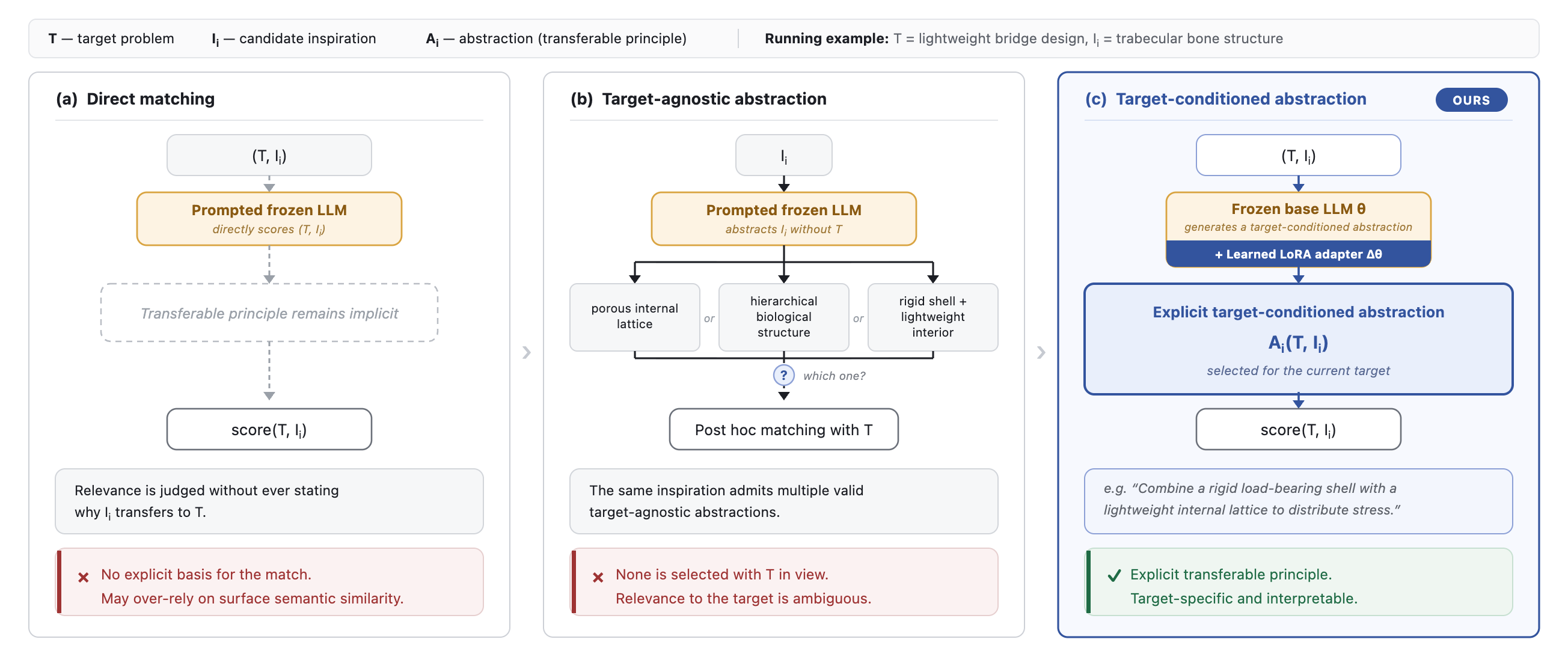
Fig 1: Three formulations of scientific inspiration retrieval. (a) direct matching leaves the transferable principle implicit (Yang
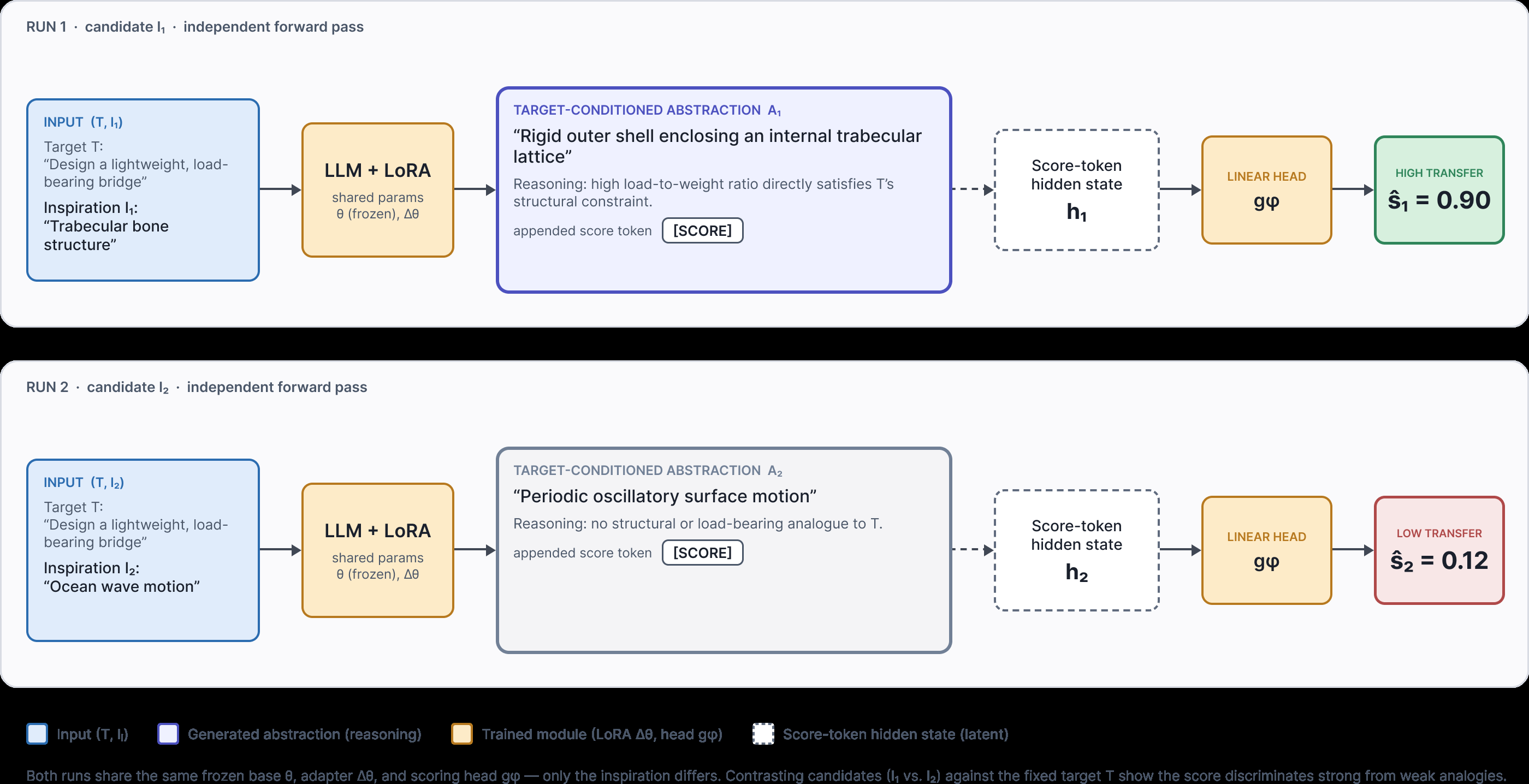
Fig 2: Overview of TCA-SIR. Given a target problem and an inspiration candidate, an LLM fine-tuned with LoRA generates

Fig 6: reports HitRate@top4% by ResearchBench domain
Limitations
- Inference is computationally expensive as TCA-SIR must generate a target-conditioned abstraction for each target-candidate pair individually, limiting scaling to large candidate pools.
- All training and evaluation depend on a single LLM backbone (Llama 3.1 8B-Instruct) and prompt engineering; generalization to other models or domains is unverified.
- The proposed transferability scores and training supervision rely on LLM-generated pseudo-labels filtered by heuristics, which may introduce biases or errors.
- Evaluation is limited to the ResearchBench benchmark; real-world adoption and impact on downstream hypothesis composition remain to be tested.
- No adversarial evaluation under potential model gaming or intentionally misleading abstractions to fool retrieval is reported.
- Target conditioning assumes availability of a clear target background/problem statement; less structured or ambiguous targets may be problematic.
Open questions / follow-ons
- How to scale target-conditioned abstraction retrieval to large candidate pools efficiently without per-pair generation?
- Can the approach generalize beyond the ResearchBench dataset and 12 domains to broader scientific literature with varying target formulations?
- How do generated abstractions and transfer scores influence the downstream hypothesis composition and validation stages in AI for Science pipelines?
- What robustness guarantees or adversarial defenses are needed against manipulated inspirations or deceptive transfer signals?
Why it matters for bot defense
For practitioners in bot defense and CAPTCHA-like challenges, this paper provides a novel perspective on retrieving context-conditioned abstractions rather than relying on surface similarity. Although not about CAPTCHAs directly, the principle of identifying transferable underlying mechanisms rather than superficial matches could analogously inform defenses that differentiate genuine human problem-solving hints from superficial bot responses. The TCA formulation explicitly models relevance conditioned on a target problem, which might inspire adaptive challenge generation or evaluation strategies conditioned on the interaction context. However, computational cost and inference latency are practical hurdles for real-time applications like CAPTCHA verification. Integrating interpretable intermediate representations (Reasoning/Abstractions) might also inspire improved human-in-the-loop validation or explainability in challenge-response systems. Overall, the work deepens understanding of abstraction-based retrieval and transferability scoring in complex inference tasks relevant to automated reasoning and defense systems.
Cite
@article{arxiv2607_28498,
  title={ TCA-SIR: Learning Target-Conditioned Abstractions for Scientific Inspiration Retrieval },
  author={ Yuto Suzuki and Farnoush Banaei-Kashani },
  journal={arXiv preprint arXiv:2607.28498},
  year={ 2026 },
  url={https://arxiv.org/abs/2607.28498}
}