
ReGenVC: End-to-End Real-Time Generative Video Coding at Ultra-Low Bitrate
Source: arXiv:2607.28144 · Published 2026-07-30 · By Zheyuan Zhang, Johnson Wu
TL;DR
ReGenVC addresses the dual challenge in generative video coding of achieving ultra-low bitrate compression for talking-head videos while delivering real-time decoding. Traditional codecs like x264/x265 degrade severely at bitrates low enough to matter in bandwidth-limited scenarios, exhibiting blocking artifacts and poor perceptual quality. ReGenVC innovates by transmitting only a neurally compressed single reference frame (~10 kB), per-frame pose keypoints (~15.8 kB), and minimal metadata, totaling about 26 kB for a 77-frame clip, roughly one tenth the size needed by traditional codecs for artifact-free reconstruction. The decoder uses a novel four-step distilled diffusion transformer conditioned on pose and the reference frame to regenerate sharp video at ultra-low bitrate. The key advancement is overcoming the prohibitive latency of diffusion-based decoders through a combination of model distillation, multi-GPU parallelism, spatial splitting of the VAE, and an overlapped three-stage pipeline, enabling sustained 24 fps decoding on an 8-GPU consumer-class node.
Key findings
- ReGenVC compresses a 77-frame talking-head clip to about 26 kB, roughly 10x smaller than x264/x265’s ~250–280 kB artifact-free bitrate (Sec. 5.2).
- At matched ultra-low bitrate (~26 kB), x264/x265 collapse with severe 8x8 blocking and PSNR drops to ~36 dB, while ReGenVC reconstructs perceptually sharp frames leveraging a strong generative prior.
- A four-step distilled diffusion transformer reduces the sampling calls from ~20 to 4, the dominant latency reduction enabling real-time decoding (Sec. 3.4).
- Unified sequence parallelism (USP) across 8 GPUs shards the diffusion transformer sequence dimension (Ulysses×Ring = 4×2), shrinking diffusion latency (Sec. 3.5).
- Spatially splitting VAE decoding/encoding tiles computation across 8 GPUs with halo overlaps, substantially reducing per-GPU VAE cost (Sec. 3.6).
- A three-stage overlapped pipeline runs pose preparation (CPU), diffusion+decode/anchor encode (GPU), and CPU postprocessing concurrently, achieving steady-state decoding within a 1000 ms budget per 25-frame window (Sec. 3.7).
- CPU offloading of large one-shot conditioning models (CLIP and T5 encoders) reduces per-GPU memory peak from 21.1 GB to ~7.7 GB (Sec. 3.9).
- Measured steady-state decoding latency is 972 ms per 25-frame window (~24 fps) on an 8-GPU node, satisfying the real-time constraint (Sec. 5.1).
Threat model
The system assumes a network-limited streaming environment with bandwidth constraints. The adversary is limited to passive eavesdropping or causing bitrate constraints; no model poisoning, active adversarial manipulation of pose or reference frame inputs, or decoder-side compromise is considered. The generative model’s strong prior is assumed trustworthy and untampered.
Methodology — deep read
The threat model assumes a bandwidth-limited streaming scenario where the adversary is a network with constrained capacity; no adversarial manipulation or impersonation is considered. The system targets talking-head videos with fixed camera and single subject to leverage pose-driven video generation.
Data for distillation consists of ~7,181 short person-motion video/control pairs from publicly available human-motion clips, enabling training of a distilled 4-step diffusion student model from a 20-step Wan2.1-Fun-Control teacher. The student model architecture matches the teacher exactly to preserve capacity and enable parallelism.
The encoder extracts a neurally compressed first frame (using CompressAI's cheng2020 attn model), per-frame pose keypoints extracted by DWPose serialized as quantized coordinates, and minimal metadata, totaling ~26 kB for a 77-frame clip. The encoder runs entirely on CPU, sustaining 24 fps on 32 cores.
The decoder pipeline reconstructs video windows of F=25 frames with overlap S=24 frames. Decoding steps per window include conditioning encode of pose/control signals, four-step diffusion denoising with a transformer backbone, VAE decoding to pixels, and encoding the anchor frame to condition the next window. The diffusion transformer is distilled via a distribution-matching distillation (DMD2) combined with an x0-latent regression loss to prevent color drift. Training ran for 500 steps with batch size 1 (effectively 4), learning rate 1e-5, on a single GPU.
To meet real-time constraints (maximum 1000 ms per window for 24 fps), the decoder utilizes multi-GPU parallelism via Unified Sequence Parallelism (USP). USP combines Ulysses (all-to-all reshuffling of sequence into attention heads) and Ring attention (streaming KV blocks around GPUs) to shard the transformer sequence dimension across 8 GPUs (U=4, R=2). The VAE decoder/encoder is spatially split into 8 tiles, processed in parallel with halo overlaps to avoid seams.
A three-stage overlapped pipeline schedules conditioning encode (CPU), diffusion plus VAE decode and anchor encode (GPU), and CPU post-processing concurrently on independent threads and CUDA streams. This arrangement breaks serialization and overlaps compute to fit the per-window budget.
Torch.compile graph compilation reduces launch and Python overhead surrounding diffusion. CPU offloading of the large one-shot conditioning models (CLIP and T5 encoders) further reduces GPU memory usage from 21.1 GB to ~7.7 GB, leaving room for diffusion and VAE.
The evaluation protocol involves steady-state measurement of per-window latency on an 8× RTX 5090D GPU node paired with a 32-core Intel Xeon CPU. Two test clips (77 frames and 240 frames) of talking-head videos without scene cuts are used to evaluate compression, latency, and visual quality. Comparisons to x264/x265 codecs are on the same clip at matched bitrates, focusing on perceptual sharpness and artifact collapse rather than pixel-wise metrics at low bitrate.
All main system components and hyperparameters are fully detailed, and the distillation training procedure is reproducible from the provided references and described training corpus. No code release or frozen snapshots are mentioned.
Technical innovations
- A four-step distilled diffusion transformer sampler combining DMD2 distillation with an x0-latent regression loss to preserve color fidelity in control-video generation.
- Multi-GPU unified sequence parallelism (Ulysses×Ring) to shard the transformer’s sequence dimension, preserving exact attention and numerical equivalence.
- Spatial splitting of the VAE for parallel encode/decode tiles with halo overlapping to avoid seams, reducing per-device compute.
- A three-stage overlapped pipeline that executes conditioning encode, diffusion denoising + VAE decode + anchor encode, and CPU postprocessing concurrently to break serialization bottlenecks in real-time video generation.
- Hybrid CPU-GPU deployment that offloads the large one-shot conditioning CLIP and T5 models to CPU, freeing GPU memory for critical diffusion path without lossy model compression.
Datasets
- Distillation corpus: ~7,181 short person-motion video/control pairs (mp4) derived from publicly-available human-motion clips
Baselines vs proposed
- x264 crf 18: PSNR ~49 dB at ~250-280 kB bitrate vs. ReGenVC: same clip at ~26 kB bitrate
- x264 crf 41: PSNR ~36 dB at ~26 kB bitrate (blocking artifacts) vs. ReGenVC: perceptually sharp frames at same ~26 kB bitrate
- x265 crf 18: PSNR ~49 dB at ~250-280 kB bitrate vs. ReGenVC: same clip at ~26 kB bitrate
- x265 crf 40: PSNR ~36 dB at ~26 kB bitrate (blocking artifacts) vs. ReGenVC: perceptually sharp frames at same ~26 kB bitrate
- Single GPU 20-step diffusion sampling: [inferred latency > 1000 ms, exact figure not given] vs ReGenVC 4-step distilled sampling with 8-GPU USP: 972 ms per 25-frame window
Figures from the paper
Figures are reproduced from the source paper for academic discussion. Original copyright: the paper authors. See arXiv:2607.28144.
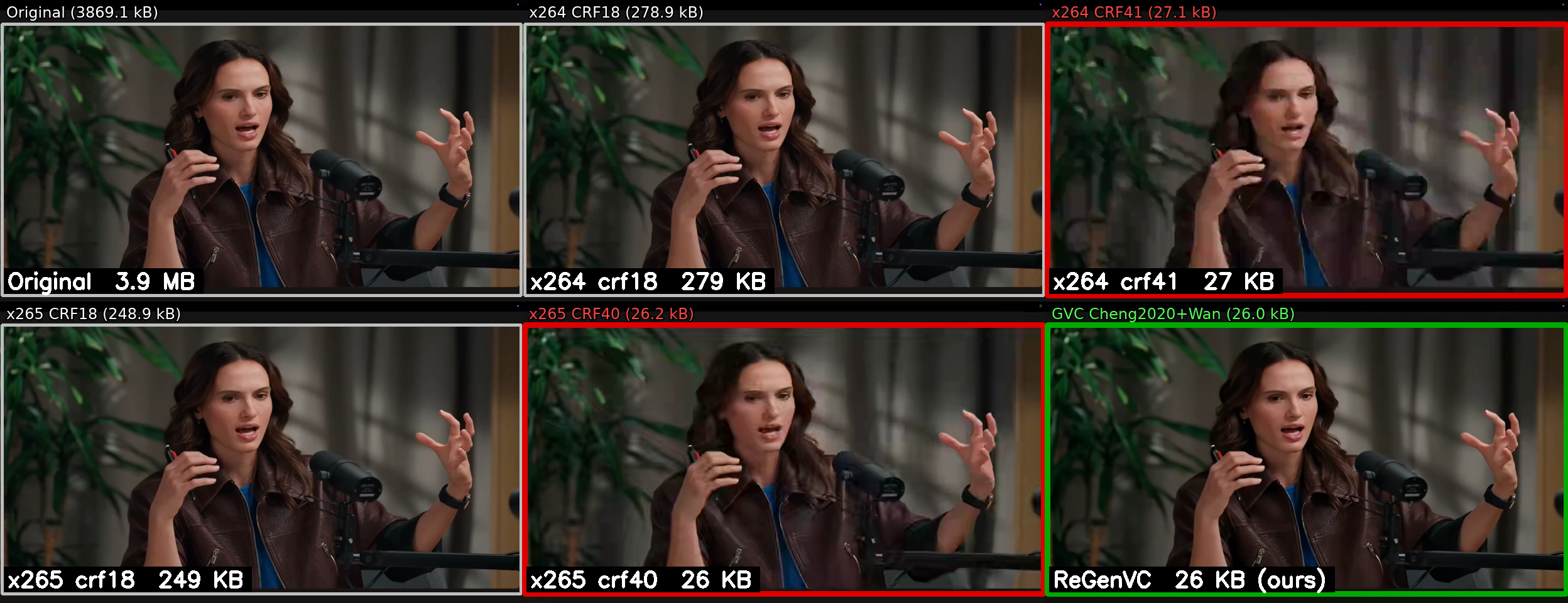
Fig 3: Qualitative comparison on a talking-head frame. Top: original, x264 crf 18, x264 crf 41. Bottom: x265 crf 18, x265 crf 40,
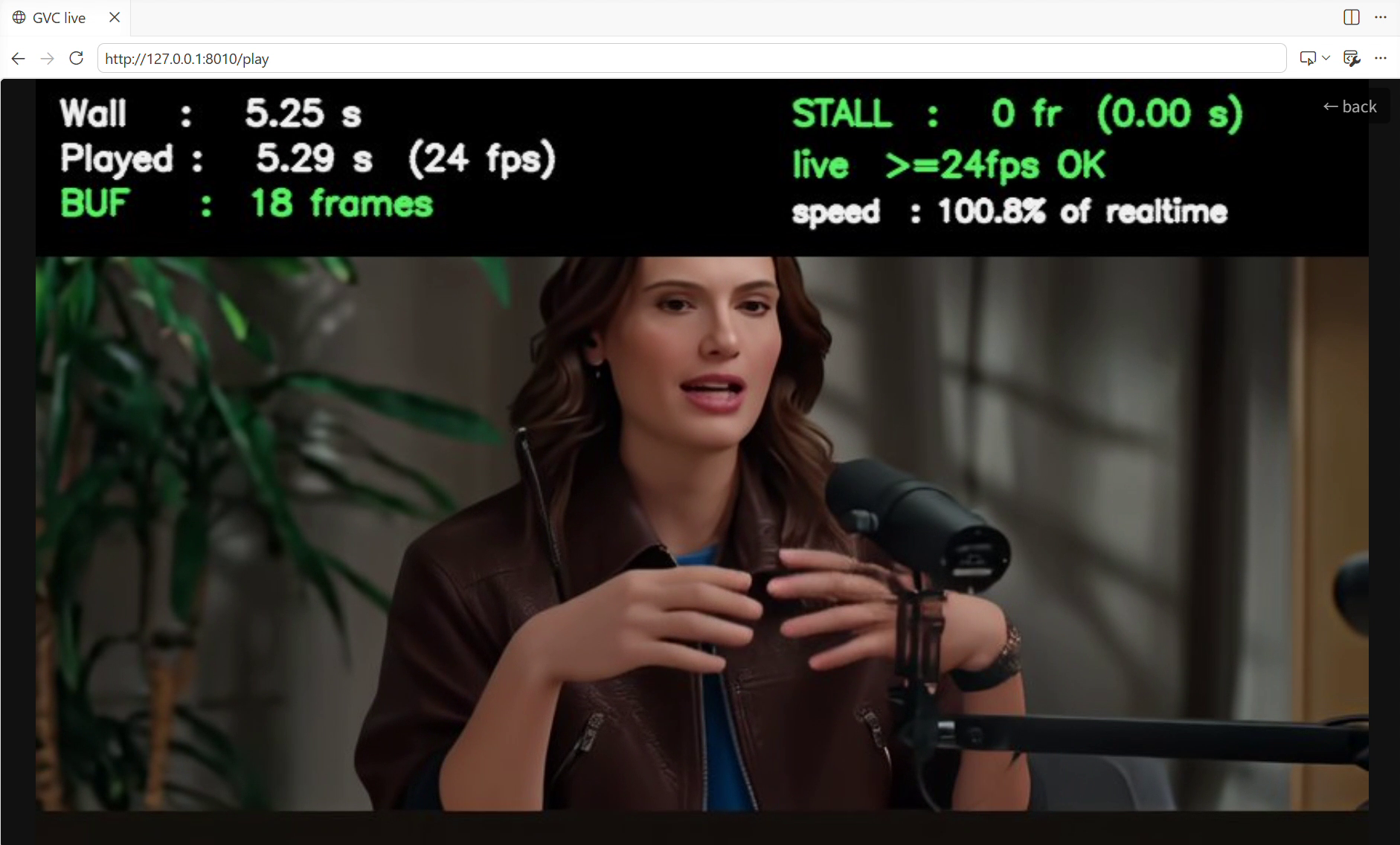
Fig 4: Live browser demo: ReGenVC decoding and streaming

Fig 5: Reconstruction fidelity across the ∼10 s (240-frame) demo clip (Sec. 3.3). Top row: original input frames; bottom row: ReGenVC
Limitations
- The approach is specialized to talking-head / human video with controlled pose signals; not general-purpose video coding.
- Compression and latency evaluations are limited to two fixed-camera single-subject clips; no large-scale benchmark or diversity testing.
- No adversarial robustness or security analysis against manipulation or poisoning attacks on conditioning signals.
- Lack of evaluation under network packet loss, bitstream corruption, or general streaming impairments.
- The method requires a high-end 8-GPU node with substantial CPU core count, limiting deployment feasibility on more constrained hardware.
- Pixel-fidelity metrics are less meaningful for this generative codec; evaluation focuses primarily on perceptual sharpness and artifact absence.
Open questions / follow-ons
- Can the four-step distilled diffusion approach and multi-GPU parallelism scale to more general video domains beyond talking heads with pose control?
- What robustness guarantees or defense mechanisms can be built against adversarial or corrupted conditioning signals in generative video coding?
- How will ReGenVC’s latency and bitrate scale with higher resolution videos or longer temporal windows?
- Is it possible to reduce hardware requirements (less than 8 GPUs) while retaining real-time performance via model compression or improved parallelism?
Why it matters for bot defense
While ReGenVC is not a bot defense or CAPTCHA system itself, its methods and design insights are highly relevant to CAPTCHA practitioners focused on video-based challenges or bot detection that rely on video signals. The paper demonstrates that generative priors conditioned on compact control signals (pose keypoints, reference frames) can reconstruct high-quality video at ultra-low bitrates efficiently, overcoming traditional pixel-based compression limits. This suggests avenues for video CAPTCHA design that rely on generating or verifying realistic dynamic faces or motions from minimal inputs, potentially reducing bandwidth and latency for interactive challenges.
Additionally, the technical innovations in diffusion distillation, multi-GPU parallelism, and pipeline overlap are informative for implementing real-time generative models in production settings where latency and computational cost are critical. Bot-defense engineers seeking to incorporate or defend against generative video synthesis may find the architectural and system-level tradeoffs here an important reference, particularly the hybrid CPU-GPU deployment and careful scheduling strategies needed to achieve feasible throughput without sacrificing fidelity.
Cite
@article{arxiv2607_28144,
  title={ ReGenVC: End-to-End Real-Time Generative Video Coding at Ultra-Low Bitrate },
  author={ Zheyuan Zhang and Johnson Wu },
  journal={arXiv preprint arXiv:2607.28144},
  year={ 2026 },
  url={https://arxiv.org/abs/2607.28144}
}