
Joint measurement of cosmic-ray muons and seismic w av es at laboratory scale
Source: arXiv:2607.28547 · Published 2026-07-30 · By J. Matsushima, M. Kodama, M. Y. Ali, F. Bouchaala, M. Kodama, H. K. M. Tanaka et al.
TL;DR
This study addresses a key limitation in geophysical exploration: the difficulty of accurately resolving gas saturation and elastic constants in rock formations using seismic wave velocity alone, due to its entanglement of density and elastic moduli. The authors introduce a novel method that integrates cosmic-ray muon detection with seismic wave measurements to decouple P- and S-wave velocities into bulk modulus, shear modulus, and density. Using a fluid substitution model based on Gassmann’s equation, they demonstrate theoretically how explicitly incorporating density improves predictions of gas saturation within porous media. To validate the approach experimentally, they deploy a laboratory-scale muon detector system alongside ultrasonic P- and S-wave measurements on acrylic and aluminum blocks. Muon flux data is translated into density length through a calibration that accounts for the building environment and muon arrival angles. Results confirm the feasibility of independently determining density and elastic constants at the lab scale, paving the way for enhanced resolution of pore fluid properties and geomechanical parameters.
Key findings
- Fluid substitution modelling shows P-wave velocity sharply decreases then slowly increases with rising gas saturation, while S-wave velocity steadily increases (Fig. 5a,b).
- Saturated bulk modulus decreases sharply with initial gas increase then stabilizes; shear modulus remains constant regardless of gas saturation (Fig. 5c,d).
- Bulk density decreases linearly with increasing gas saturation, supporting density’s role in pore fluid discrimination (Fig. 5f).
- Muon count rates correlate inversely with water depth in a tank, enabling linear approximation of density length to muon flux with chi-squared 1.688 (Fig. 7).
- Muon-based density estimates for acrylic block show ±18-30% error, while aluminum block estimates are more accurate within 0-8.8% error (Table 2).
- Ultrasonic measurements yield P-wave velocity ~2670 m/s and S-wave velocity ~1468 m/s for acrylic, and ~6314 m/s and ~3151 m/s for aluminum, closely matching catalog values (Table 4).
- Combined muon density and ultrasonic velocity data allow calculation of bulk and shear moduli consistent with expected values (Table 5).
- Meteorological variations (barometric pressure, temperature) cause fluctuations in muon counts, necessitating correction for improved accuracy.
Methodology — deep read
Threat model & assumptions: The authors assume a standard geophysical exploration scenario where seismic velocities reflect combined influences of density, bulk modulus, and shear modulus. The adversary or measurement challenge originates from the inseparability of these parameters in traditional seismic datasets without independent density information. The approach aims to independently measure density via cosmic-ray muon flux, assuming muons travel roughly straight paths and that building structure and orientation effects can be calibrated for.
Data: Laboratory-scale experiments used two solid blocks—acrylic and aluminum—each 20 cm per side. Muon flux data were recorded hourly over multiple 24-hour sessions and repeated three times at various water depths and for each block target. Ultrasonic data were acquired using piezoelectric transducers (Panametrics V103-RM) producing 1 MHz sinusoidal pulses transmitting P- and S-waves. Velocity data were obtained through travel-time slope analysis from multiple source/receiver positions. Catalogue density and velocity values for these materials were used for comparison.
Architecture/algorithm: For seismic parameters, the P-wave velocity (V_P), S-wave velocity (V_S) relate to bulk modulus (K), shear modulus (G), and density (ρ) via known elastic wave formulas (eqs. 1-3). Gassmann’s fluid substitution model (eqs. 4-8) was employed to link gas saturation with changes in bulk modulus and density, considering porosity as constant. Muon flux-to-density length conversion utilized an empirical linear approximation derived from water tank measurements, adjusted for average muon zenith angle (6.1 degrees), and building shielding effects.
Training regime: Not applicable; this is an experimental physics and modeling study rather than machine learning. Experimental measurements lasted 24 hours per run, repeated three times, with averaging over time to handle statistical fluctuations.
Evaluation protocol: Muon count stability and correlation with density length were analyzed using linear regression with reduced chi-squared statistics (1.688) to evaluate model fit. Ultrasonic waveforms were compared against catalog velocities to assess measurement accuracy. Errors in density estimation were quantified as percent deviations from known material densities. The combined elastic parameters from muon and seismic data were cross-checked for physical consistency.
Reproducibility: The paper does not explicitly mention public code release or frozen data. Experimental setups, measurement protocols, and analytical equations are detailed sufficiently to allow reproduction by specialized geophysics labs. The use of commercial piezoelectric transducers and GEANT4 simulation software for muon modeling is noted.
Concrete example: For an acrylic block, muon counts were measured over three 24-hr periods yielding an average density estimate of 1.27±0.29 g/cm³ against a true 1.2 g/cm³. Concurrently, ultrasonic P- and S-wave velocities were measured as ~2670 m/s and ~1468 m/s. Using eqs. (1) and (2), bulk and shear moduli were calculated, demonstrating the ability to separate density from elastic components experimentally.
Technical innovations
- Integration of cosmic-ray muon detection with seismic wave measurements to decompose seismic velocities into independent density and elastic constant components.
- Application and experimental validation of a fluid substitution approach incorporating muon-based density estimates to improve gas saturation level predictions in pores.
- Development of a laboratory-scale muon measurement system calibrated for building-induced attenuation and directional muon incidence angles.
- Use of combined ultrasonic P- and S-wave data with muon-derived densities to independently calculate bulk modulus and shear modulus at lab scale.
Datasets
- Acrylic block — 20 cm x 20 cm x 20 cm — laboratory-scale physical target
- Aluminium block — 20 cm x 20 cm x 20 cm — laboratory-scale physical target
Baselines vs proposed
- Catalog density vs Muon-estimated density: Acrylic catalog 1.2 g/cm³ vs measured 1.27±0.29 g/cm³ (error ±18-30%)
- Catalog density vs Muon-estimated density: Aluminium catalog 2.7 g/cm³ vs measured 2.58±0.12 g/cm³ (error 0-8.8%)
- Catalog P-wave velocity vs Ultrasonic measured: Acrylic ~2680 m/s vs ~2670 m/s; Aluminium ~6400 m/s vs ~6314 m/s
- Catalog S-wave velocity vs Ultrasonic measured: Acrylic ~1450 m/s vs ~1468 m/s; Aluminium ~3090 m/s vs ~3151 m/s
Figures from the paper
Figures are reproduced from the source paper for academic discussion. Original copyright: the paper authors. See arXiv:2607.28547.
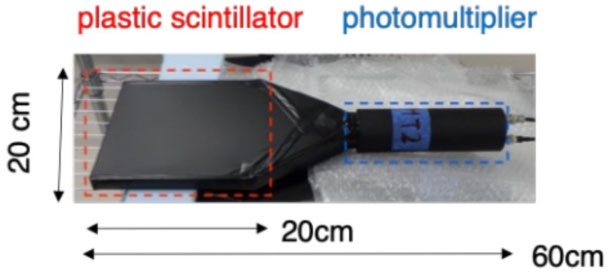
Fig 1: A laboratory-scale prototype of a muon measurement system.
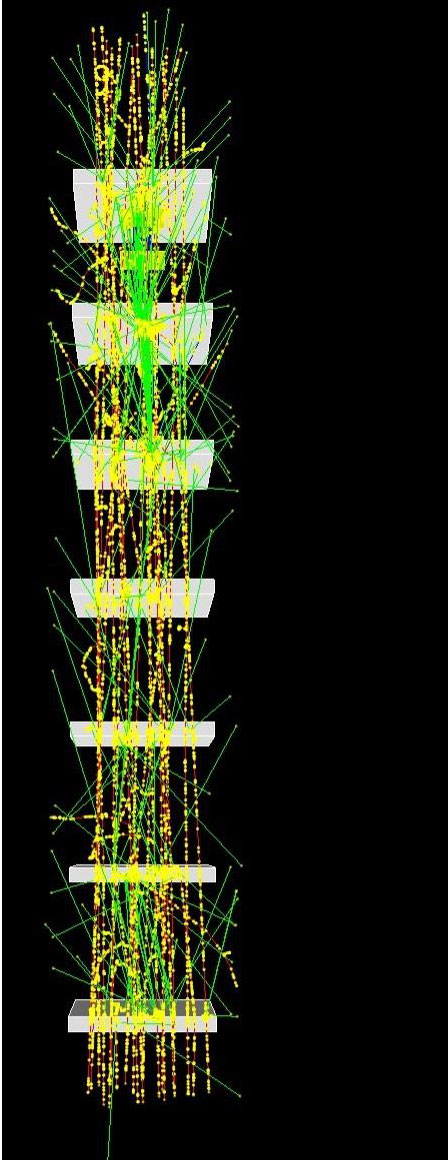
Fig 2: Simulation of 100 000 vertically incident muons with energies
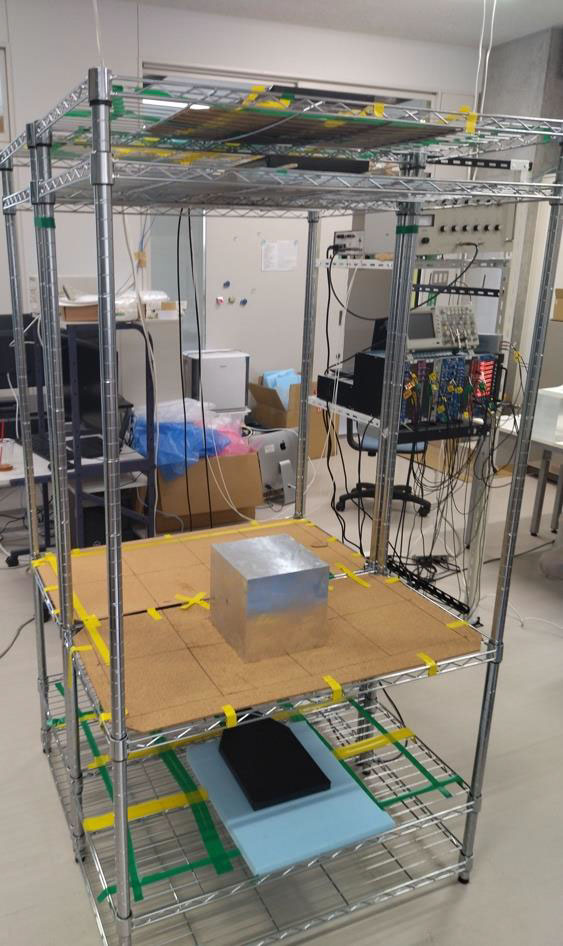
Fig 3: Muon count measurement for two distinct targets: (a) acrylic block and (b) aluminium block (20 cm × 20 cm × 20 cm).
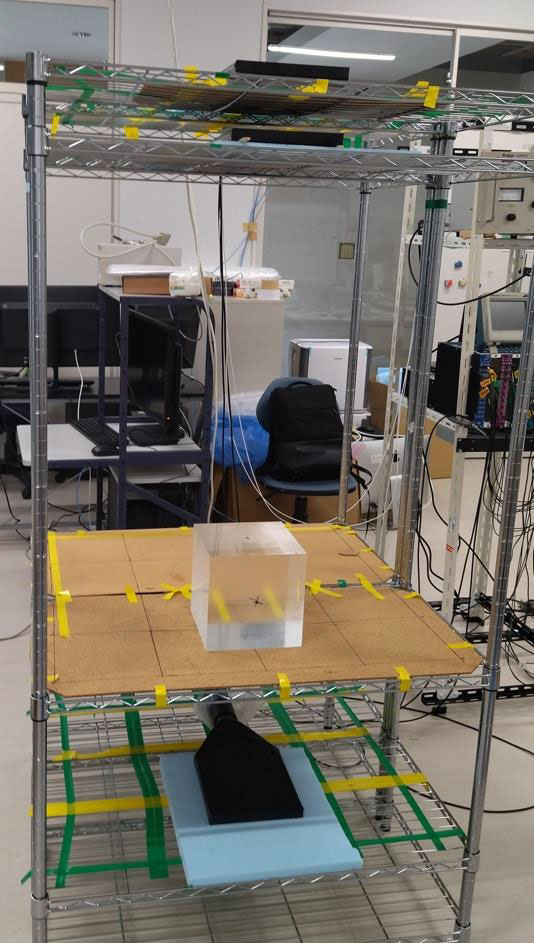
Fig 4: Ultrasonic measurements were conducted by positioning two piezoelectric elements specifically designed for P -wave generation, with both the
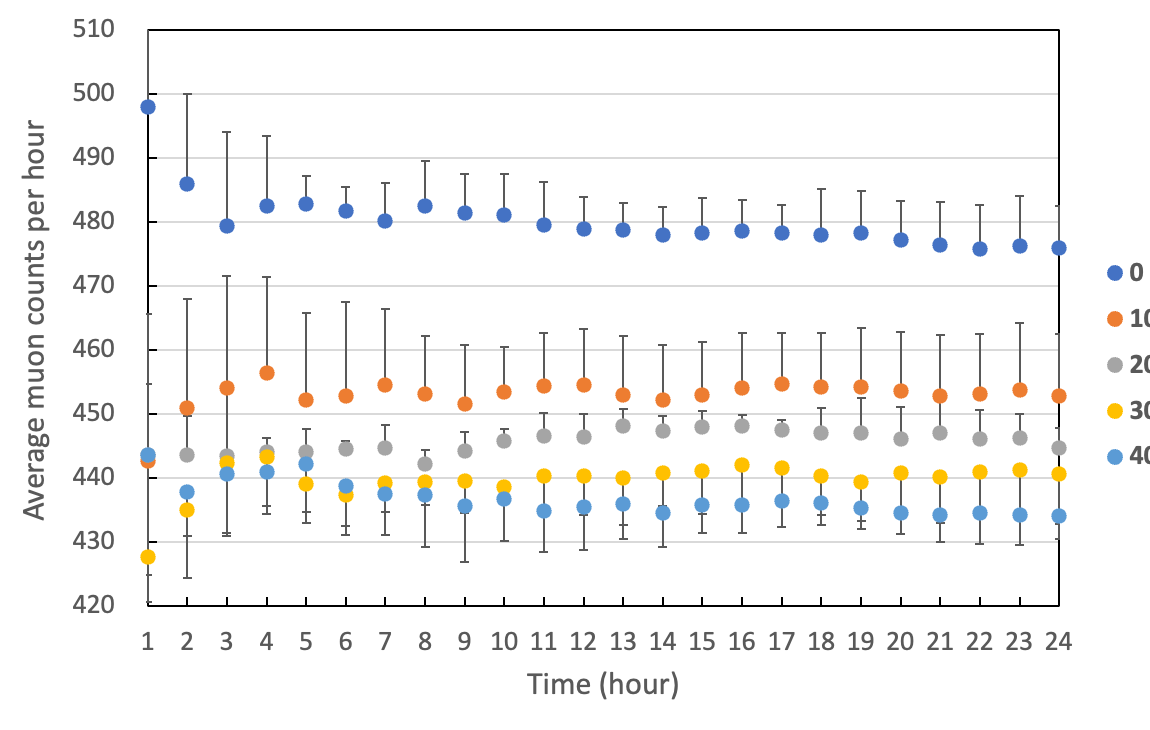
Fig 6: Hourly averages of muon counts from three repeated measurements for each of the five different water depths are shown, with their standard
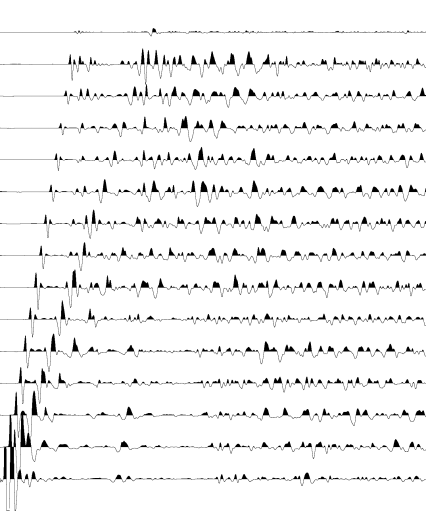
Fig 8: Observed ultrasonic data for P and S waves on two targets: (a) acrylic block and (b) aluminium block. Relative amplitude is maintained in each
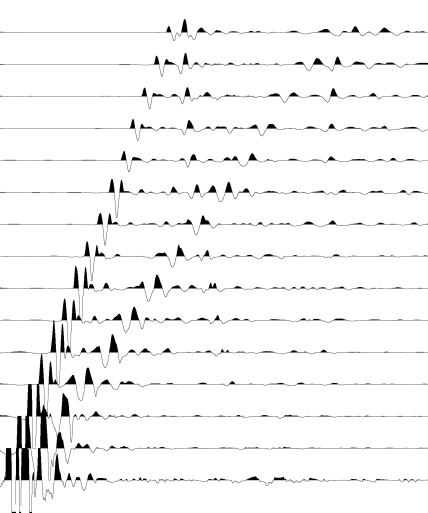
Fig 7 (page 10).
Limitations
- Muon-derived density estimates exhibit notable error margins (up to ±30% for acrylic) largely due to meteorological and environmental noise.
- Calibration of muon flux to density length depends heavily on laboratory building structure and requires re-calibration if instrument position changes.
- The experiments are limited to homogeneous laboratory materials; applicability to complex heterogeneous geological formations remains to be demonstrated.
- Pore geometry effects, wave-induced fluid flow, and gas bubble oscillations complicate seismic wave interactions and are not fully addressed by this model.
- Long duration (24 hr+) measurements needed to stabilize muon counts limit temporal resolution for real-time monitoring.
- Static parameters were derived from dynamic seismic data, but conversion to static geomechanical parameters was not explicitly implemented.
Open questions / follow-ons
- How can the muon detection measurement accuracy be improved in field settings to reduce density estimation errors caused by environmental and meteorological factors?
- What is the performance and scalability of this integrated muon-seismic approach in heterogeneous and layered geological formations with complex pore structures?
- How can real-time or time-lapse monitoring be achieved given the long integration times required for stable muon count statistics?
- What are the practical challenges and benefits of deploying muon detectors in boreholes for combined muon-seismic subsurface exploration?
Why it matters for bot defense
This work demonstrates a unique multi-physics integration strategy for disentangling elastic parameters from composite seismic velocities by leveraging cosmic-ray muon flux measurements for independent density estimation. From a bot-defense or CAPTCHA practitioner perspective, the relevance lies in the methodological rigor of combining distinct sensor modalities to resolve intertwined signal components. While the domain is geophysics rather than cybersecurity, the underlying principle—fusing orthogonal measurement data to improve parameter identifiability—provides a conceptual analogy useful in complex system monitoring or anomaly detection. Practitioners designing CAPTCHA or bot defense schemes might draw inspiration about improving classification reliability through multi-sensor data fusion, especially where single modality measurements are ambiguous or composite signals mask critical features.
Cite
@article{arxiv2607_28547,
  title={ Joint measurement of cosmic-ray muons and seismic w av es at laboratory scale },
  author={ J. Matsushima and M. Kodama and M. Y. Ali and F. Bouchaala and M. Kodama and H. K. M. Tanaka and T. Kin and H. Basiri and T. Yokota and M. Suzuki },
  journal={arXiv preprint arXiv:2607.28547},
  year={ 2026 },
  url={https://arxiv.org/abs/2607.28547}
}