
Beyond Sentiment: Structured Information Extraction from Financial News
Source: arXiv:2607.28496 · Published 2026-07-30 · By Daohan Zhu, Sitong Ge, Ruofei Wang, Honggu Chen, Yubo Hou, Tao Wan et al.
TL;DR
This paper tackles a fundamental limitation in financial news analysis for stock prediction: the reduction of complex, multi-dimensional news articles to a single sentiment polarity score. The authors hypothesize that financial news encodes multiple orthogonal semantic dimensions beyond sentiment—such as event type, impact scope, and temporal horizon—that carry independent predictive power. To investigate this, they propose a structured information extraction framework using LLaMA-3.1-70B to extract six semantic dimensions from financial news articles. Through experiments on 41,618 news-stock pairs from the large FNSPID dataset, they demonstrate that FinBERT sentiment features show strong predictive power under nonlinear models but fail under linear models due to nonlinear sentiment-return relationships. The LLM-extracted structured semantic features alone are weaker predictors but capture information complementary to sentiment, as evidenced by a 53.5% systematic disagreement rate in sentiment polarity assignments between FinBERT and the LLM. Crucially, combining the FinBERT sentiment features with the LLM-extracted structured features significantly boosts prediction performance across all seven event types, surpassing either source alone. Ablation studies confirm that non-sentiment semantic dimensions contribute independently to prediction gains. Feature importance analysis reveals a balanced predictive contribution from all six extracted dimensions, underscoring the information loss incurred by compressing financial news into a single sentiment score. Overall, this work reveals systematic sentiment-semantics decoupling in financial text and establishes a multi-dimensional extraction approach as a more powerful and interpretable alternative to traditional sentiment-only methods.
Key findings
- FinBERT sentiment features yield F1=0.576 under nonlinear XGBoost models but only F1=0.230 under linear logistic regression, demonstrating highly nonlinear sentiment-return relationships.
- LLM-extracted structured features alone achieve F1=0.450 (XGBoost), weaker than FinBERT but complementary.
- Combining FinBERT sentiment and LLM features improves F1 to 0.600 (p < 0.0001), significantly outperforming either alone.
- Non-sentiment structural dimensions (event type, impact subject, time horizon, confidence) contribute an independent F1 gain of +0.019 beyond FinBERT alone.
- Sentiment polarity disagreement between FinBERT and LLaMA occurs in 53.5% of samples, ranging 39.4% (merger) to 67.4% (uncategorized events), indicating systematic sentiment-semantics decoupling.
- All six LLM-extracted dimensions contribute evenly to prediction (importance range: 14.4%–21.3%), showing no single dominant feature.
- LLM-extracted features are more linearly accessible (F1=0.330 LR) than FinBERT sentiment (F1=0.230 LR), explaining why linear models fail with sentiment alone.
- Complementarity gains are consistent across all seven event types, largest improvement on macro events (+0.023 F1).
Methodology — deep read
The study assumes an adversary-neutral financial prediction context, focused on predicting next-day binary price movements from financial news articles.
Data provenance is from the FNSPID dataset, a large-scale collection of 15.7 million financial news articles from 1999–2023, focusing on 2.4 million valid NASDAQ news records after quality filtering. The final experimental subset includes 41,618 news-stock pairs (2019–2023) with next-day upward/downward price labels balanced approximately 48.7% positive. Articles shorter than 200 characters or with invalid stock symbols were excluded. Up to 500 articles per stock (top 100 NASDAQ stocks) were uniformly sampled to prevent bias.
The architecture centers on two feature extraction pipelines: (1) FinBERT—a pre-trained financial domain BERT variant returning a 3-class sentiment probability vector (positive, neutral, negative) truncated at 512 tokens; and (2) a structured information extraction framework leveraging LLaMA-3.1-70B-Instruct as a zero-shot extractor to parse financial articles (up to 2,000 characters) into six semantic dimensions: sentiment polarity, sentiment intensity, event type (one of earnings, merger, policy, product, mgmt, macro, other), impact subject (company, industry, macro), temporal horizon (short, long), and extraction confidence (0 to 1). These LLM-extracted raw categorical and continuous features are encoded either as integer labels (for XGBoost) or one-hot vectors (for logistic regression).
For prediction, the authors use two models: L2-regularized logistic regression (LR) to test linear separability of features, and XGBoost gradient-boosted trees (100 estimators) to model nonlinear relationships and measure feature importance. Logistic regression uses one-hot encoding for nominal features; XGBoost uses integer encoding. Deep neural models are deliberately avoided to prioritize interpretability.
The evaluation protocol involves 1,000 bootstrap iterations where the data is sampled with replacement, then randomly split 80/20 into train and test sets per iteration, with identical splits for comparing all models. Metrics reported are mean ± std accuracy, F1 score, and AUROC with paired t-tests applying Bonferroni correction to assess statistical significance of performance differences. This design controls for variance due to data splits and supports valid paired statistical comparisons.
Reproducibility is partially limited: code release is not stated, LLaMA-3.1-70B-Instruct model is publicly recognized though potentially proprietary weights, and the FNSPID dataset is publicly referenced but the exact preprocessing pipeline described. The lack of annotated ground truth for semantic dimensions means extraction quality is indirectly assessed via parse success (98.6%) and downstream predictive contribution.
Example end-to-end: A financial news article is preprocessed and truncated as appropriate for each extractor. FinBERT provides a 3-class probability vector representing sentiment polarity intensities. LLaMA-3.1-70B-Instruct processes the longer truncated article to extract six semantic dimensions per the defined schema via zero-shot prompting. These structured features encode the event type, scope, temporal horizon, confidence, and sentiment signals distinct from the lexical sentiment. Both feature sets are concatenated into a 9-dimensional vector and fed to XGBoost trained on bootstrap samples to predict next-day stock movement. Statistical evaluation across 1,000 bootstrap splits quantifies performance and complementarity between sentiment and structured features. Feature importance analysis interprets the contribution of each dimension.
The methodology carefully differentiates surface lexical sentiment (FinBERT) from deeper event-level semantic extraction (LLM), leveraging complementary strengths in a interpretable, statistically rigorous stock prediction pipeline.
Technical innovations
- Identification and formalization of systematic sentiment–semantics decoupling in financial news, quantifying a 53.5% disagreement rate between lexical sentiment and event-level semantic assessments.
- Design and implementation of a zero-shot structured extraction framework using LLaMA-3.1-70B-Instruct to parse financial news articles into six orthogonal semantic dimensions beyond sentiment.
- Demonstration that combining traditional FinBERT sentiment features with LLM-extracted semantic dimensions significantly improves stock movement prediction performance over either source alone.
- Use of bootstrap resampling with paired statistical tests to robustly measure predictive performance and feature complementarity with controlled variance due to data splits.
Datasets
- FNSPID — 15.7 million articles total, 2.4 million quality-filtered NASDAQ news subset, 41,618 news-stock pairs used in experiments — publicly referenced
Baselines vs proposed
- Random: F1 = 0.488 ± 0.007 vs Combined FinBERT + LLM: F1 = 0.600 ± 0.009
- FinBERT sentiment + XGBoost: F1 = 0.576 ± 0.009 vs Combined: 0.600 ± 0.009 (p < 0.0001)
- FinBERT sentiment + Logistic Regression: F1 = 0.230 ± 0.079 vs LLM structured + Logistic Regression: 0.330 ± 0.032
- LLM structured + XGBoost: F1 = 0.450 ± 0.027 vs Combined: 0.600 ± 0.009
- FinBERT + Non-sentiment LLM features: F1 = 0.594 ± ? vs FinBERT alone: F1 = 0.576 ± 0.009 (∆=+0.019, p < 0.0001)
Figures from the paper
Figures are reproduced from the source paper for academic discussion. Original copyright: the paper authors. See arXiv:2607.28496.
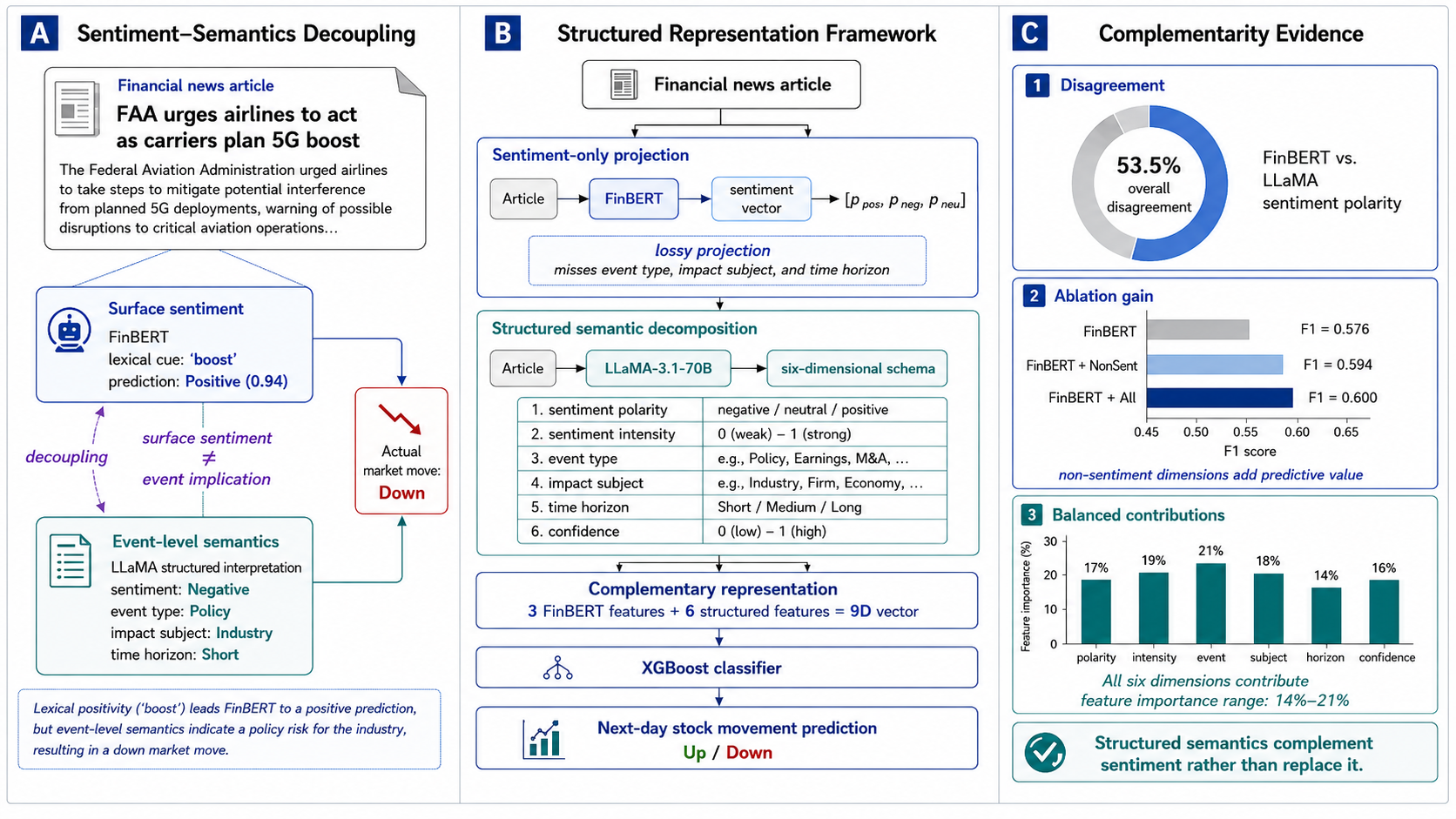
Fig 1: Overview of the proposed framework. (A) Sentiment–semantics decou-
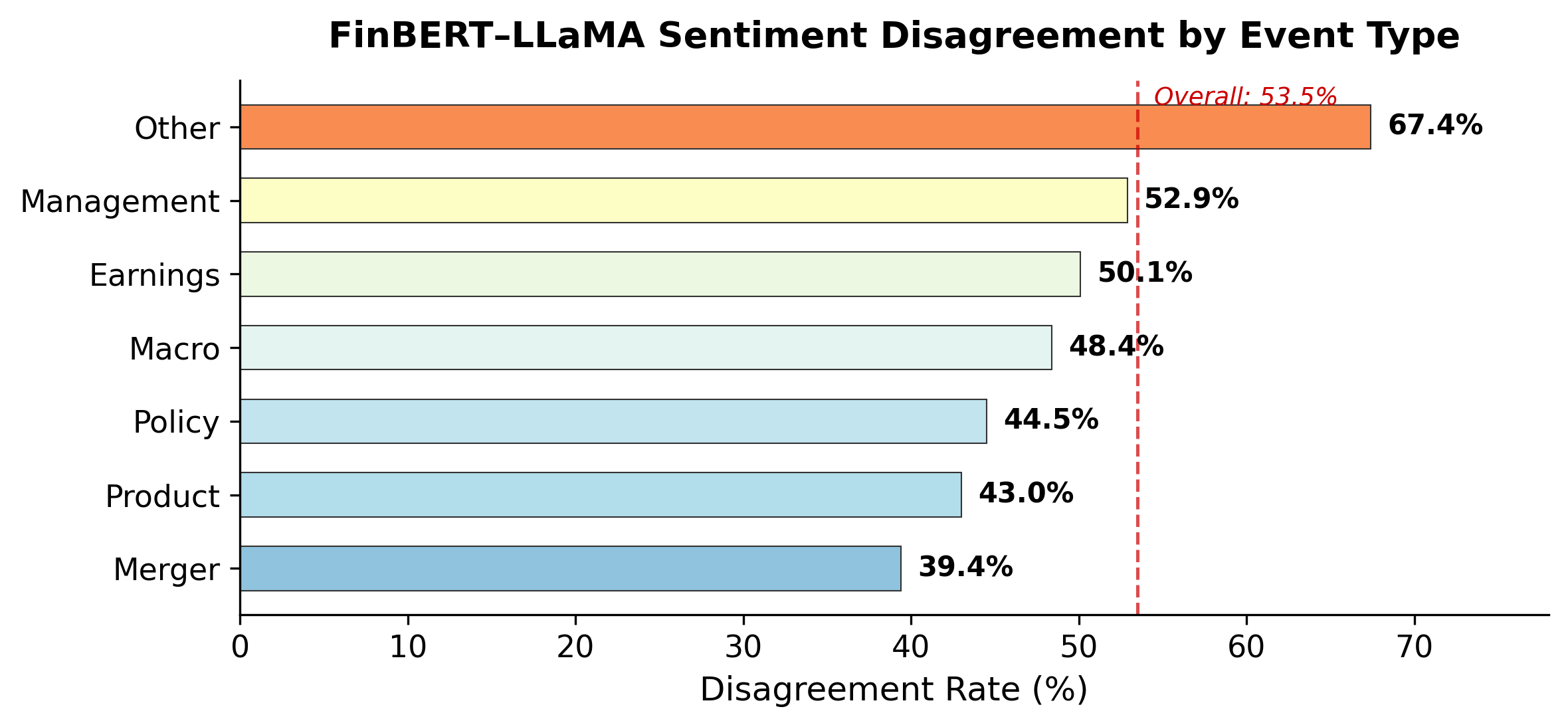
Fig 2: FinBERT–LLaMA sentiment disagreement rate by event type. Higher
Limitations
- Possible data leakage because LLaMA-3.1-70B was pretrained on datasets overlapping the evaluation period (2019–2023), possibly imparting implicit post-publication knowledge.
- Bootstrap sampling allows duplicates in train and test splits within iterations, potentially biasing absolute performance metrics optimistically.
- Evaluation protocol uses random splits rather than temporally ordered splits, limiting causal validity for deployment scenarios; walk-forward evaluation was not conducted.
- No ground truth annotations for the six semantic extraction dimensions, so extraction correctness relies on indirect measures such as parse success and downstream utility.
- LLM confidence scores are uncalibrated and may correlate with article length or lexical complexity rather than true semantic clarity.
- Integer encoding for nominal categorical features induces arbitrary ordinality; although one-hot encoding was tested with similar predictive performance, feature importance interpretations vary.
- Input length asymmetry between FinBERT (512 tokens) and LLaMA (2,000 characters) may confound direct comparison of feature quality.
- Study focused on 100 NASDAQ stocks; generalization to other markets, asset classes, or longer time horizons remains untested.
- Only a single LLM (LLaMA-3.1-70B-Instruct) was used; results may vary with alternative large language models.
Open questions / follow-ons
- Can richer multi-dimensional extraction schemas (e.g., including named entities, causal relations, market expectations) further improve predictive performance?
- Would adaptive weighting of different semantic dimensions by event type or market regime yield more effective models than simple concatenation?
- How generalizable is the sentiment–semantics decoupling effect to other asset classes, markets, or temporal horizons beyond next-day prediction?
- Can the structured extraction approach be adapted and validated in other domains exhibiting sentiment–semantics decoupling, such as medical news or political reporting?
Why it matters for bot defense
For bot-defense or CAPTCHA engineers, although this work is specialized in financial natural language processing, the key insight about extracting multi-dimensional semantic signals beyond simple sentiment carries broader implications. It highlights the value of decomposing complex textual inputs into orthogonal, interpretable features rather than relying on aggregate sentiment scores, which may lose critical information. Structured extraction using large language models can enhance robustness and interpretability of NLP systems facing adversarial or noisy inputs. The demonstrated nonlinear interactions also suggest that downstream models for security tasks should consider richer feature representations and nonlinear architectures to fully capture predictive signal. While this paper's focus is finance, the principles and evaluation rigor offer a useful template for evaluating multi-dimensional information extraction in bot detection or CAPTCHA challenge generation, where surface-level lexical cues may inadequately represent intent or user behavior.
Cite
@article{arxiv2607_28496,
  title={ Beyond Sentiment: Structured Information Extraction from Financial News },
  author={ Daohan Zhu and Sitong Ge and Ruofei Wang and Honggu Chen and Yubo Hou and Tao Wan and Zengchang Qin },
  journal={arXiv preprint arXiv:2607.28496},
  year={ 2026 },
  url={https://arxiv.org/abs/2607.28496}
}