
ABC methods for IoT Emitter Geolocalisation using LEO Satellite Doppler Measurements
Source: arXiv:2607.28585 · Published 2026-07-30 · By B. Ristic, Y. Choi, D. Y. Kim, A. Hourani
TL;DR
This paper tackles the challenging problem of passively localising a stationary, ground-level IoT radio emitter using Doppler frequency measurements collected from low-Earth orbit (LEO) satellites. The key difficulty arises due to various compounding sources of measurement error, including large unknown oscillator frequency offsets, time-varying drifts, atmospheric delays, and satellite ephemeris uncertainties, which make the likelihood function of observed data intractable in closed form. To overcome this, the authors apply likelihood-free inference via Approximate Bayesian Computation (ABC) methods, specifically rejection sampling ABC and sequential Monte Carlo ABC (SMC-ABC), to perform Bayesian emitter localisation without explicitly evaluating the likelihood.
They introduce a novel, offset-invariant distance function that aligns observed and simulated Doppler time series to remove unknown oscillators offsets that carry no localisation information, allowing the distance metric to reflect geometric position mismatches instead. Numerical experiments in a realistic scenario with three LEO satellites passing over an emitter in central Australia demonstrate that SMC-ABC significantly outperforms ABC rejection sampling in accuracy (RMS error 4.5 km vs 6.7 km), computational cost (calls per effective sample reduced by an order of magnitude), and posterior calibration (mean NEES closer to expected). Both methods report conservative uncertainty estimates. This work establishes ABC methods as a viable solution for emitter geolocation in settings with complex nuisance error sources that render classical likelihoods intractable.
Key findings
- SMC-ABC achieves a root-mean-square (RMS) positional error of 4.49 km compared to 6.68 km for ABC rejection sampling under the same scenario (Table III).
- Mean normalized estimation error squared (NEES) for SMC-ABC is 0.553, substantially closer to the 95% acceptance interval [1.35, 2.78] than 0.104 for rejection ABC, indicating more accurate uncertainty calibration.
- SMC-ABC requires approximately 77,500 simulator calls per run versus 363,000 for rejection ABC, an order of magnitude improvement in computational efficiency.
- Accounting for the effective sample size, SMC-ABC requires about 310 calls per effective sample compared to about 3,600 for rejection ABC.
- The proposed offset-invariant distance function aligns observed and simulated Doppler sequences by removing unknown oscillator frequency offsets, isolating geometric information critical for localisation accuracy.
- Neither ABC sampler is overconfident; reported posterior uncertainties are conservative with mean NEES below expected levels, reflecting benign under-confidence rather than tuning artifacts.
- The method successfully marginalizes over high-dimensional nuisance parameters including clock drift modeled as a Wiener process, atmospheric biases, ephemeris error, and thermal noise without explicit likelihood computation.
- Multiple satellites with different orbital geometries provide informative Doppler curves with S-shaped zero-crossings enabling geometric position constraints.
Threat model
The adversary is a passive, stationary low-cost IoT emitter transmitting continuously with unknown and drifting oscillator frequency offset and no cooperation. Observers are multiple LEO satellites with imperfect orbital ephemeris and measurement noise. The adversary cannot control or manipulate satellite measurements or access the observations, and the system assumes noisy, incomplete satellite visibility. The goal is to infer emitter position despite high-dimensional unknown nuisance parameters corrupting Doppler data.
Methodology — deep read
Threat Model & Assumptions: The adversary or emitter is a stationary, ground-level low-cost IoT device transmitting a continuous-wave signal with unknown and time-varying frequency offset due to an uncompensated crystal oscillator. Observers are multiple LEO satellites measuring Doppler frequency shifts. The nuisance parameters—initial frequency offset, clock drift modeled as Wiener process, atmospheric delay biases, satellite ephemeris errors, and thermal noise—are unknown and cannot be marginalized analytically due to complexity.
Data: Simulated data is generated for a scenario where three LEO satellites (altitude 550 km) pass over a fixed emitter located in central Australia within a 15-minute observation window. Doppler measurements are sampled every second (900 time steps). Satellite orbital parameters are circular Keplerian orbits with different inclinations, RAAN, and initial anomalies ensuring different approach vectors. The observed Doppler data includes additive noise from four sources described above.
Algorithm & Architecture: A stochastic forward simulator models Doppler shifts given emitter position and nuisance draws by propagating satellite orbits and simulating Doppler including measurement noises. To avoid intractable likelihood evaluation, Approximate Bayesian Computation (ABC) methods are used:
- ABC rejection sampling: candidate positions drawn from prior; simulate Doppler; accept if distance to observed data below tolerance.
- Sequential Monte Carlo ABC (SMC-ABC): iteratively samples and mutates a population of candidate emitter positions through decreasing tolerance thresholds with importance reweighting.
A key novel component is the offset-invariant distance function. Due to unknown additive frequency offset from oscillator instability, the raw Euclidean distance between observed and simulated Doppler time series is dominated by this offset rather than positional mismatch. The distance metric aligns simulated and observed Doppler by minimizing over all possible vertical translations using least squares, effectively factoring out the constant frequency offset.
Training Regime: Not applicable since this is simulation-based inference using ABC samplers. Parameters include tolerance settings (400 Hz for rejection ABC, progressively decreased to 150 Hz for SMC-ABC), sample counts (100 for rejection ABC, 256 for SMC-ABC), minimum joint visible samples per satellite (Nmin=100) and minimum number of satellites visible (Smin=2) for valid measurements.
Evaluation Protocol: Monte Carlo with M=30 independent runs fixing true emitter position and redrawing nuisance noise realizations each run. Evaluation metrics include RMS position error in kilometers (converted from geodetic degrees), Normalized Estimation Error Squared (NEES) to evaluate posterior covariance calibration, simulator calls to measure computational cost, and calls per effective sample size (accounting for sample weights in SMC-ABC). Comparative baseline is ABC rejection sampling. Results show SMC-ABC provides statistically more accurate and better calibrated posterior samples more efficiently.
Reproducibility: The paper does not mention public release of code or dataset. The scenario parameters, orbital data, and simulation models are fully described for reproducibility in principle, but exact random seeds or simulator implementations are not provided. Forward simulation model uses standard orbital mechanics and noise modeling referenced from literature.
Technical innovations
- Introduction of an offset-invariant distance function that removes unknown oscillator frequency offsets by vertical alignment of Doppler time series, isolating position-dependent residuals.
- Application of sequential Monte Carlo ABC with adaptive tolerance scheduling and importance weighting for efficient geolocalisation under highly intractable measurement likelihoods.
- Modeling of nuisance parameters including unknown initial frequency offset and time-varying clock drift as latent stochastic processes within the ABC simulation framework without likelihood evaluation.
- Demonstration of likelihood-free inference as a practical approach for IoT emitter geolocation from LEO satellite Doppler data with multiple complex noise sources.
Datasets
- Simulated IoT emitter Doppler dataset — 3 LEO satellites, 900 time steps per pass — synthetic data generated as described, no public release
Baselines vs proposed
- ABC rejection sampling: RMS error = 6.68 km vs proposed SMC-ABC: RMS error = 4.49 km
- ABC rejection sampling: mean NEES = 0.104 (outside 95% chi-square interval) vs SMC-ABC: mean NEES = 0.553 (closer to expected interval)
- Simulator calls per effective sample: ABC rejection sampling = ~3600 vs SMC-ABC = ~310 (order of magnitude improvement)
Figures from the paper
Figures are reproduced from the source paper for academic discussion. Original copyright: the paper authors. See arXiv:2607.28585.
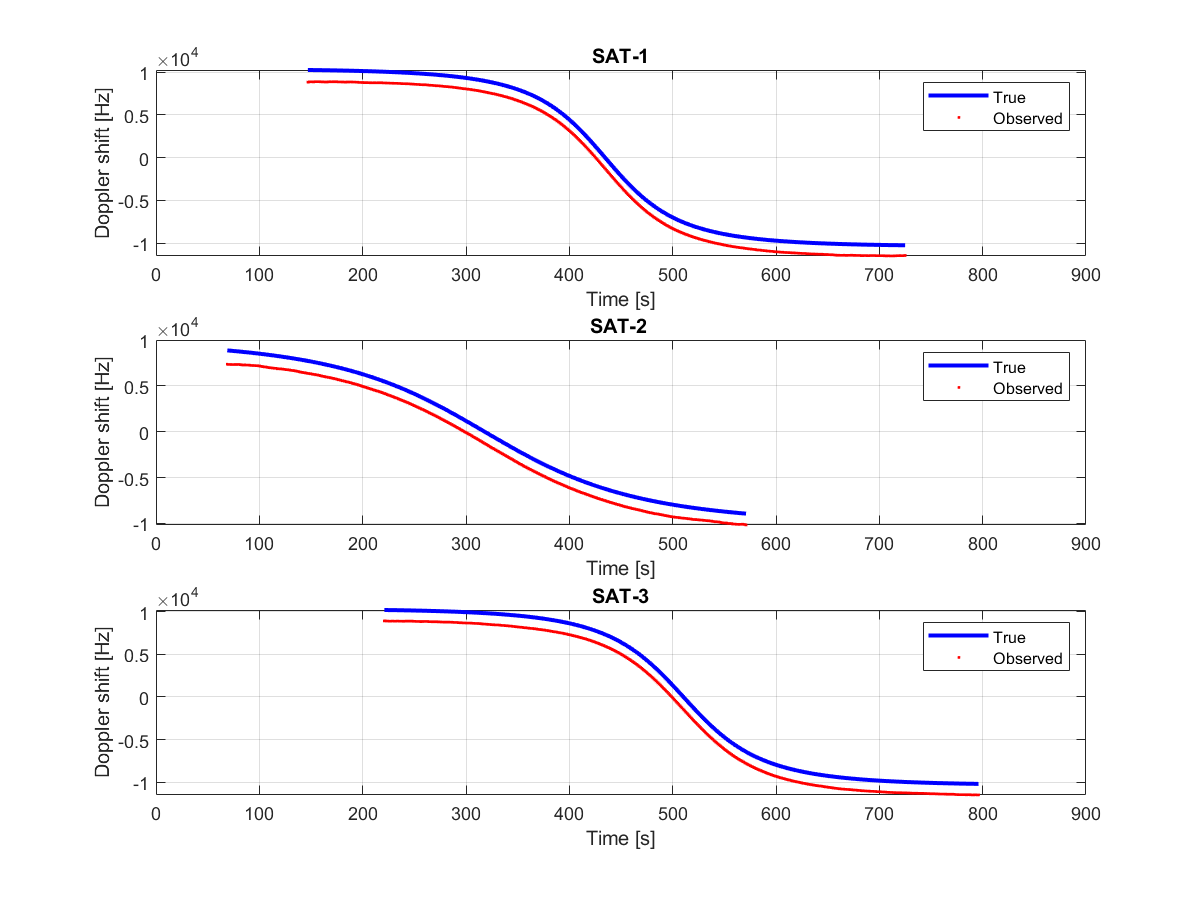
Fig 1: Satellite ground tracks and emitter location.
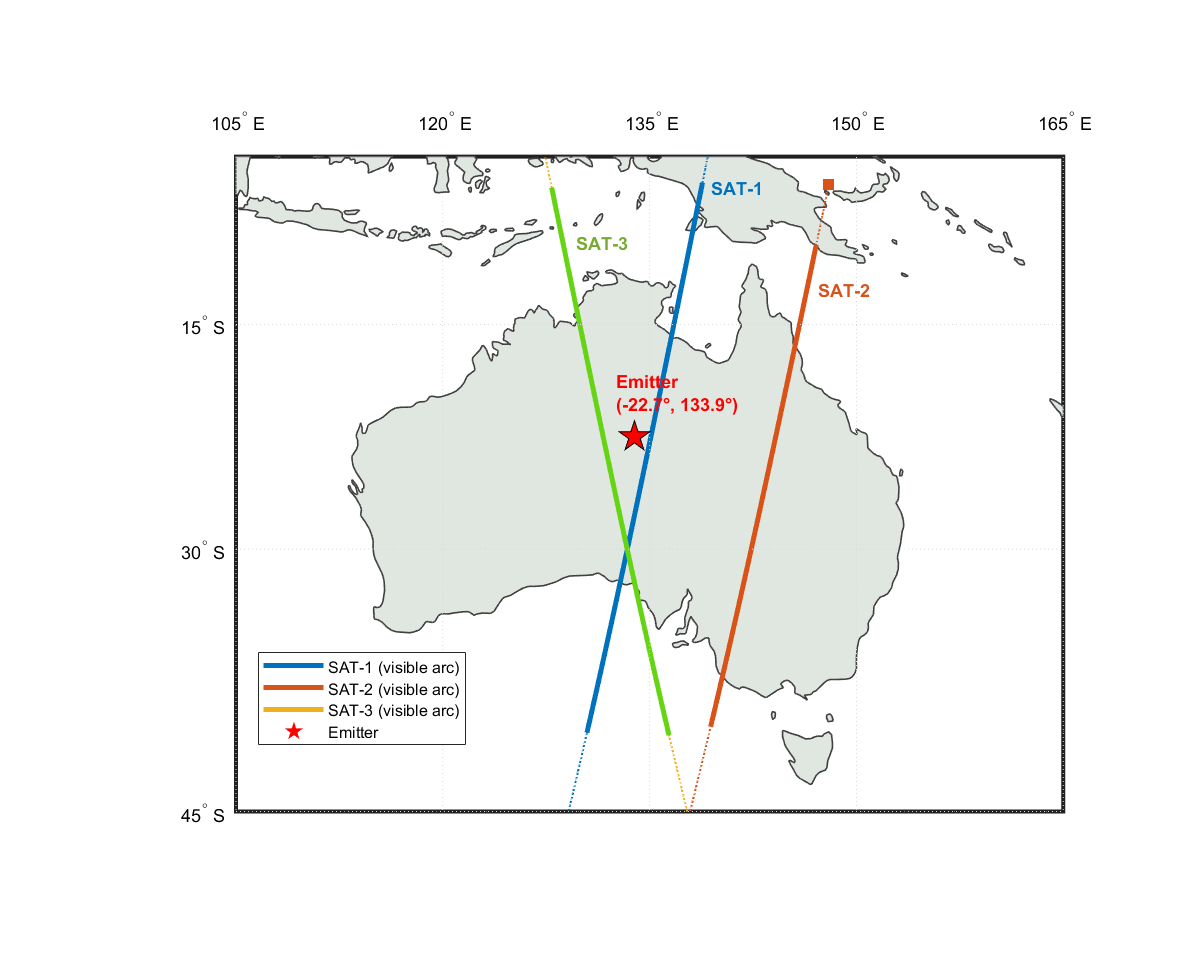
Fig 2: Ideal (blue) and observed (red) Doppler time series for all three
Limitations
- The study is simulation-based without experiments on real satellite IoT data, which may have additional complexities.
- Only stationary, single emitter geolocation is addressed; applicability to mobile emitters or multiple simultaneous emitters remains untested.
- The nuisance parameters are redrawn independently per simulation but no explicit adversarial manipulation or non-stationary environment variations are modeled.
- Posterior uncertainties are conservative but tend toward under-confidence; finer calibration may require more sophisticated summary statistics or learned distances.
- Computational cost remains high for rejection ABC; although SMC-ABC improves efficiency, the approach is still simulator-call intensive for real-time applications.
- No explicit sensitivity analysis on satellite constellation geometry, number of satellites, or observation window length yet, though proposed for future work.
Open questions / follow-ons
- How does localisation accuracy and uncertainty calibration depend quantitatively on satellite constellation geometry, number of visible satellites, and observation duration?
- Can machine learning methods for simulation-based inference (e.g., neural posterior estimation) reduce computational cost and improve posterior sharpness compared to ABC approaches?
- How well does the method extend to localising moving IoT emitters with dynamic frequency offsets?
- What is the robustness of the approach under real-world satellite ephemeris errors and environmental effects beyond the simulation model?
Why it matters for bot defense
This work is relevant to bot-defense and CAPTCHA practitioners interested in applying satellite-based signals for passive geolocation of radio emitters, including potentially unauthorized or spoofing IoT devices. The paper presents a likelihood-free Bayesian framework that enables accurate emitter localisation even when the measurement model is obscured by complex noise and unknown nuisance parameters characteristic of low-cost devices and dynamic satellite channels. Capturing and mitigating abusive or anomalous transmissions from such emitters requires robust inference despite intractable likelihoods, which ABC and SMC-ABC methods provide.
Practitioners implementing satellite-based verification or tracking systems may leverage the offset-invariant distance metric and the sequential Monte Carlo ABC algorithm to efficiently infer probable emitter locations without requiring closed-form likelihoods. The approach illustrates how the union of physical modeling (Doppler from satellite orbits) with simulation-based inference can address real-world nuisance complexities that break classical analytical estimators, a valuable lesson for geolocation system design in adversarial or noisy environments.
Cite
@article{arxiv2607_28585,
  title={ ABC methods for IoT Emitter Geolocalisation using LEO Satellite Doppler Measurements },
  author={ B. Ristic and Y. Choi and D. Y. Kim and A. Hourani },
  journal={arXiv preprint arXiv:2607.28585},
  year={ 2026 },
  url={https://arxiv.org/abs/2607.28585}
}