
Umulsai: A Plain-Text Format and In-Browser Engraving System for Jeongganbo, Korean Mensural Notation
Source: arXiv:2607.24230 · Published 2026-07-27 · By Danbinaerin Han
TL;DR
Umulsai addresses the long-standing challenge of digitally encoding and engraving Jeongganbo, a fifteenth-century Korean mensural notation system that departs fundamentally from Western staff notation. The problem stems from Jeongganbo's right-to-left vertical columns of square beat-cells, where duration is encoded spatially by the position and subdivision of syllables within a cell. Prior digital tools either failed to capture this unique structure, or lacked full ornament typesetting, print-quality output, and playback functionality. Umulsai innovates through a human-writable plain-text format that maps one-to-one to the Jeongganbo grid, an automated engraving engine formalizing historical score conventions, and a serverless web implementation producing print-quality SVG and audio playback. Developed through AI-assisted coding directed by a domain expert and validated behaviorally against authoritative published scores, Umulsai produces data files that are easily exchanged and compatible with machine-oriented Jeongganbo encodings from recent MIR research.
The system successfully integrates core Jeongganbo notation elements—right-to-left column flow, daegang section lines, octave-variant Sinographs including rare Unicode gaps, a full set of 84 ornament signs with adjustable attachment, multilayer alignment of melody and annotation lanes, and strict physical-unit page layout—into one static, dependency-free web app. Playback uses simple sine tones from the encoded rhythm. The editor preserves the notation’s spatial duration model directly in text, which is diff-friendly and local in effect. Though MIDI export and advanced playback temperament remain future work, Umulsai currently stands as the first sustainable practical digital tool faithfully representing Jeongganbo from input to engraving to playback, supporting research, preservation, and creative use of Korean traditional music notation.
Key findings
- Umulsai uses a plain-text format where line breaks map to columns (gak), pipe delimiters to cells (jeonggan), and whitespace to beat subdivisions, completely encoding duration spatially without explicit duration symbols (§4.1, 4.2).
- The engraving engine codifies key published score conventions: right-to-left column flow, daegang lines with preset meter partitions, sustain-row compression (0.68 vertical scale), two-note spacing tightened by 20%, and ink-ratio compensation of 0.9 between CJK glyphs and vector ornaments (§5.2).
- The system supports 84 distinct sigimsae (ornament) symbols plus drum mnemonics, attaching multiple ornaments stacked per note with serialized offset and scale adjustments allowing manual dragging to position (§5.3, §4.4).
- Octave variations use radical-modified Sinograph glyphs across ±2 octaves; two rare combinations lacking Unicode codepoints fallback to a base glyph plus a gray octave dot (§5.2).
- Umulsai is implemented as a single static HTML page plus vanilla JavaScript with zero runtime dependencies, documents auto-save to localStorage, and output can be printed or exported as 300 dpi PNG (§6).
- The playback uses equal-tempered sine tones from the encoded rhythmic events at user-adjustable tempo, highlighting the sounding cell; however, ornament-related pitch inflections are not sounded (§6).
- AI-assisted coding was extensively verified behaviorally against printed reference scores from the National Gugak Center series, through rule iteration and regression checks on symbol tables to prevent silent drift (§6.1).
- Format design is structurally convergent with recent machine-readable Jeongganbo encodings, enabling future round-tripping with optical music recognition and MIR pipelines (§4.5).
Threat model
n/a - The paper addresses digital encoding and engraving of a traditional music notation system without adversarial considerations or security threat assumptions.
Methodology — deep read
The paper begins by establishing a threat model intrinsic to the Jeongganbo notation problem rather than a security adversary: the challenge is encoding and rendering a notation whose structure is incompatible with Western staff models, with requirements to preserve the spatial duration encoding, traditional typesetting conventions, ornaments, multilayer alignment, and physical-unit layout. There is no adversary per se, but the assumptions include that the tooling must faithfully reproduce published score conventions and remain editable and interoperable with machine-readable datasets.
Data provenance comes from published Jeongganbo scores of Korean court music, particularly the National Gugak Center’s jeongak series, which serve as reference benchmarks for engraving fidelity. The format is a single string per document representing the melody layer, supported by separate annotation and jangdan lane strings. The size of typical scores can reach dozens of columns (gak) and cells per column, though exact statistics are not detailed. The notation elements are human-writable tokens including pitch names with octave prefixes, cell delimiters (|), line breaks, intra-cell whitespace for row divisions, and suffixes for ornaments and modifiers.
The core architecture includes: (1) a plain-text format that directly maps spatial arrangement of text tokens to the Jeongganbo grid and its duration semantics, retaining the position-as-duration principle native to the notation; (2) an engraving engine encoding automated rules for layout and typography such as right-to-left column flow, beat section daegang lines, octave-variant glyph selection including Unicode fallback for missing glyphs, and ornament placement and micro-adjustments; (3) a serverless web implementation consisting of a single static HTML page, CSS, and ~6,800 lines of vanilla JavaScript with no dependencies.
Training per se is not applicable, but the development regime employed an AI-assisted coding workflow. The domain expert specified behavior and notation rules in natural language, and large language model coding agents generated and iteratively refined the codebase. Quality assurance was done mainly via behavioral verification, comparing rendered output to authoritative published score images, plus regression checks on symbol placement tables. This human-in-the-loop approach aimed to control drift in AI-generated edits.
Evaluation involves rooted validation of engraving rules against multiple reference pages from official score series, ensuring micro-typographic constants (e.g., sustain row scale 0.68, ink-ratio scaling 0.9) match human engraver practices. The paper presents no quantitative user study (reported separately). There is no adversarial testing or distribution shift mentioned. Playback correctness is limited to rhythm highlighting and sine tone synthesis.
Reproducibility is high: the full system is public at https://www.umulsai.com, source code is on GitHub under MIT license, and a Zenodo snapshot is archived. The plain-text format, engraving rules, and file interchange format are fully specified in the report, facilitating external use and extension. Dependencies are zero, and document data are portable JSON files enabling offline operation.
A concrete example flows from an input melody string "황태협| 협<| 임" encoding three cells with multiple rows and ornaments, which the engraving engine parses and renders into a right-to-left page layout, tuning octave-variant glyphs and positioning ornaments per the registry, producing print-quality SVG pages with physical sizing in mm and playback highlighting.
This end-to-end approach—plain input text → engraving rules formalized as composable layout engines → client-side render and playback—directly addresses the niche requirements of Jeongganbo notation, bypassing the inadequacies of Western-staff-centric editors.
Technical innovations
- A novel plain-text notation format for Jeongganbo encoding duration via spatial layout of text tokens directly mirroring the grid-based mensural system, enabling diff-friendly, local edits.
- An automated engraving engine formalizing traditional Korean score conventions such as right-to-left column flow, daegang line partitions, and octave-variant Sinographs with Unicode fallback for missing glyphs.
- Serialization of manual ornament layout adjustments as inline suffixes in the text format, preserving pure document-state determinism without hidden layout state.
- A fully dependency-free, serverless web implementation combining print-quality SVG engraving, playback, and autosaving with zero external runtime requirements.
Datasets
- National Gugak Center Jeongak score series — canonical published scores used as engraving references — public
- Jeongganbo OMR dataset by Kim et al. (2025) — machine-oriented recognition tokens, public
Baselines vs proposed
- Prior editors (2001–2024): incomplete integration of input, ornament typesetting, print layout, and playback — Umulsai integrates all (no direct numeric comparison reported).
- Word-processor table method: image-based, manual labor for ornament and layout versus Umulsai’s automated rules and data output (qualitative comparison).
- Open web editor (2024): provides grid input only and lacks ornaments, lyrics, and print layout versus Umulsai full feature set.
Figures from the paper
Figures are reproduced from the source paper for academic discussion. Original copyright: the paper authors. See arXiv:2607.24230.

Fig 1: Text–grid correspondence. Two input lines (left) and the engraved result (right; columns read right-

Fig 2 (page 2).

Fig 3 (page 2).

Fig 4 (page 2).

Fig 5 (page 2).

Fig 6 (page 2).

Fig 7 (page 2).
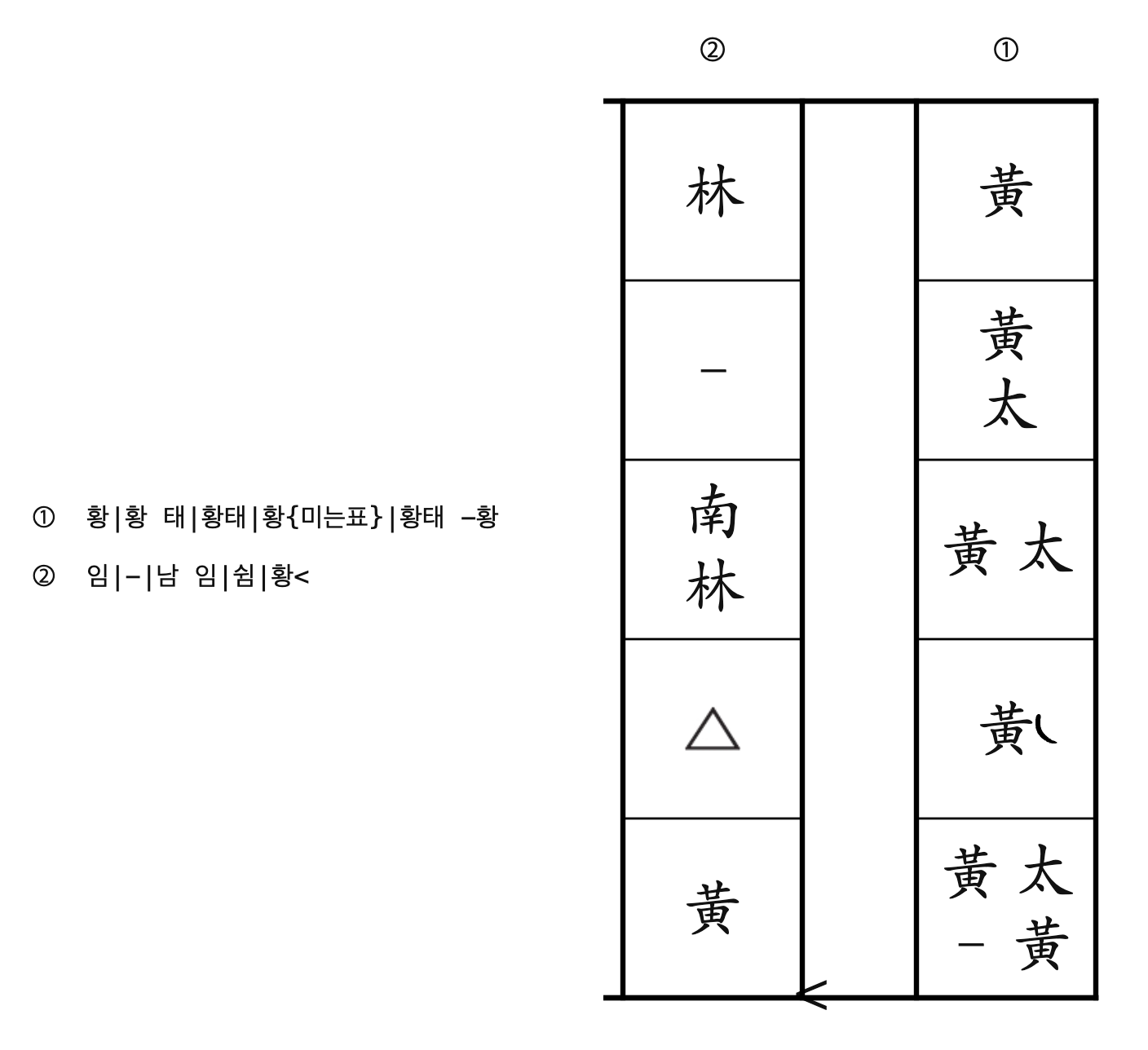
Fig 2: Multiple ornaments attached to one note (actual engraved output). Left: two ornaments (배태
Limitations
- Playback implements only monophonic sine tones without sounding ornaments or drum mnemonics; acoustic modeling of sigimsae pitch inflections is future work.
- Temperament is fixed as equal temperament from a configurable reference pitch; no historical or instrument-specific intonation.
- No current support for MusicXML, MEI, or MIDI export; planned but unimplemented OMR mapping.
- Symbol inventory focuses on the National Gugak Center's jeongak series, with folk-music and other instrument-specific notations pending expansion.
- Quality assurance is primarily behavioral and domain-expert visual verification; no unit tests or systematic automated correctness checks beyond symbol placement regression.
- No user study or usability evaluation included in this report; mentioned as forthcoming.
Open questions / follow-ons
- How to assign acoustic models to the ornament vocabulary to enable faithful playback replicating pitch inflections and articulations?
- What is the optimal interoperability workflow between Umulsai’s plain-text format and standardized music encoding formats such as MusicXML and MEI for archival and distribution?
- How can Optical Music Recognition outputs for Jeongganbo be robustly integrated into Umulsai for automated digitization pipelines?
- What usability and user experience improvements, including multi-language UI or user-customizable engraving parameters, enhance adoption outside expert scholars?
Why it matters for bot defense
For bot-defense and CAPTCHA practitioners, Umulsai exemplifies a domain-specific notation system that benefits from a human-writable, spatially structured plain-text format coupled with automated rendering engine rules encoded as pure functions. This approach facilitates easy input validation, diff-tracking, and client-side processing without server dependencies. The embedding of layout state within serializable token suffixes rather than hidden UI state also aligns with best practices for secure, stateless interactions.
While not addressing adversarial threat models directly, the serverless architecture with zero external network I/O minimizes attack surface and data leakage risk, principles valuable in secure web applications. The multidisciplinary AI-assisted development workflow and behavioral verification also highlight emerging methods for ensuring correctness in complex domain-specific tools. CAPTCHA designers might draw inspiration for building robust, user-editable recognition or challenge formats that tightly couple human-readable input with unambiguous rendering semantics.
Cite
@article{arxiv2607_24230,
  title={ Umulsai: A Plain-Text Format and In-Browser Engraving System for Jeongganbo, Korean Mensural Notation },
  author={ Danbinaerin Han },
  journal={arXiv preprint arXiv:2607.24230},
  year={ 2026 },
  url={https://arxiv.org/abs/2607.24230}
}