
On Capturing the Narrative: Social Media Manipulation Wargaming for Cyberliteracy
Source: arXiv:2607.23993 · Published 2026-07-27 · By Alexandra Vassar, Rahat Masood, Hammond Pearce
TL;DR
This paper addresses the challenge of digital media literacy in the age of generative AI and automated misinformation campaigns by designing and deploying Capture the Narrative (CTN), a four-week multi-university competition simulating a political election influenced by student-built LLM-powered social media bots. Unlike prior static or single-player educational tools, CTN created a dynamic multi-agent environment with 108 teams from 18 Australian universities operating up to 40 bots each alongside 4,000 AI-driven NPC citizens to simulate realistic misinformation dissemination and influence strategies at scale. Over 7 million posts were generated during the competition, with participants rewarded both for generating engagement and for shifting NPC voter opinions.
The authors analyze pre- and post-competition surveys of 256 and 83 students respectively, revealing that contrary to expectations from inoculation theory, participants did not become more confident at detecting bots after the exercise. Instead, many teams gravitated towards high-volume spamming tactics to maximize engagement rewards, reflecting real-world platform dynamics where quantity often trumps content quality. Emotional responses around spreading misinformation attenuated over the course of the competition despite stable ethical stances, suggesting a desensitization effect driven by the low-consequence, competitive setting. The paper highlights both technical and social challenges in bot attribution and engagement scoring, concluding with recommendations for iterative improvements including the addition of blue-team defensive phases and scoring redesign to incentivize quality influence, not just volume.
Key findings
- 108 teams from 18 Australian universities produced 7,068,206 player-bot posts, constituting approximately 60% of all content on the platform during the competition.
- No statistically significant improvement in participants’ confidence to distinguish player-controlled bots from LLM-powered NPC accounts (all p > .09).
- 50% of participants agreed or strongly agreed that building a bot to interact with the platform was easy, especially among those with prior Python experience.
- About 59% of participants failed to reliably attribute posts as bot-generated versus NPC, mirroring real-world difficulties in bot detection.
- Participants’ negative emotional responses (guilt, regret, shame, anxiety) to spreading misinformation significantly decreased after the competition (p-values ranging from 9.2×10^-7 to 1.3×10^-5).
- Most teams shifted from planned nuanced narrative influence strategies toward high-volume spamming once they realized the competition scoring rewarded engagement volume over content quality.
- Engagement score prioritized likes and reposts and favored content reaching the platform homepage via trending algorithms, unwittingly encouraging spamming behavior.
- The participant cohort was primarily technical (89% with Python experience), which eased bot-building but limits generalizability.
Threat model
Adversaries are participant teams acting as red agents operating multiple generative AI-enabled bots within a closed simulated social media platform, aiming to sway the opinions and votes of AI-controlled NPC citizens. They have full programmatic control of their bots and knowledge of the environment. The simulation does not model platform detection, moderation, or active defense, so adversaries are not hindered by technical countermeasures. They cannot directly alter NPC internal state except via content exposure and have no access to out-of-band information outside the game.
Methodology — deep read
Threat model & assumptions: The adversaries are student teams building and deploying generative-AI powered bots to influence a simulated election on a custom social media platform. The players operate bots but cannot vote themselves, aiming to shift the attitudes and votes of AI-controlled NPCs and influence the campaign narrative. The environment assumes adversaries can control multiple accounts with autonomous posting and interaction capabilities. Detection or blocking mechanisms are absent in this iteration, simulating a real but unmoderated adversarial context.
Data: The simulation included 4,000 AI-driven NPC citizens each with a 40-dimensional profile capturing demographics and political attitudes. Seven special NPCs (journalists, opinion columnists, candidates) mediate news coverage. Player data consists of 7,068,206 bot-generated posts from 108 teams over four weeks. Surveys gathered pre/post quantitative and qualitative data from 256 pre-event and 83 post-event participants, assessing attitudes, technical comfort, ethics, emotions, and strategies.
Architecture / algorithm: The platform modeled a social media environment with posts, likes, reposts, comments, and trending algorithms. LLM-powered NPCs act autonomously using finite-state machines to browse, react, post, and update opinions probabilistically. Player bots had full API control (posting, reposting, liking, following) via provided Python clients. Scores combined 'story score' (attributed attitude changes in NPC voters weighted toward late campaign influence and media amplification) and 'engagement score' (likes, reposts, trending visibility).
Training regime is not applicable here, as this is an interactive multi-agent simulated competition rather than a machine learning training experiment.
Evaluation protocol: The study used Wilcoxon signed-rank tests on matched pre/post surveys to measure statistical significance in attitude shifts. The authors qualitatively coded participant strategies and ethical/emotion items. Engagement and story scores tracked team performance. No formal cross-validation or held-out attacker evaluation was reported due to the simulation nature. Limitations are acknowledged.
Reproducibility: The platform and competition code are not explicitly stated as open source. Some survey instruments were adapted from prior published works. The dataset of 7 million+ posts is non-public. The study focuses on reporting design and formative findings rather than releasing artifacts.
Example end-to-end: A team assigned to a candidate scripted up to 40 bots using the Python API to post, repost, and interact on Legit Social. Their bots posted content designed to favor their candidate, attracting NPC attention. NPCs consumed this content and updated their opinions probabilistically, contributing to the team's story score. Meanwhile, bots gained engagement points through likes and reposts. Teams monitored the leaderboard and iteratively adapted strategies, with many eventually emphasizing quantity over nuanced messaging as rewarded by the scoring system.
Technical innovations
- Development of a large-scale, LLM-powered multi-agent social media simulation with 4,000 NPC citizens and 7 special NPCs powered by concurrent LLM instances to generate diverse, context-sensitive behaviors.
- Integration of a competitive scoring system combining attributed opinion shifts in NPC voters (story score) and surface-level platform engagement (engagement score) to quantify influence and visibility.
- Implementation of an API and Python client enabling teams to programmatically control up to 40 social media bots per team in real-time over a four-week simulation.
- Use of a multi-university large-scale competition framework with over 7 million bot posts generated to immerse participants in modern misinformation propagation and bot orchestration.
Datasets
- Capture the Narrative simulation data — 7,068,206 player-bot posts plus 4,000 NPC-generated posts — custom synthetic platform data, non-public
Baselines vs proposed
- Pre/post survey bot detection confidence (baseline): median = 3 (neutral); post-competition median = 3 (no improvement, p > .09)
- Post-competition emotional discomfort with misinformation (baseline median ~1–2, highly felt): increased to median 3–4 (statistically significant, p < 1.3×10^-5)
- Participants with >3 years Python experience reported bot building difficulty mean = 2.28 (easier) vs no Python experience mean = 3.20 (harder)
- Teams initially planning nuanced influence shifted to spamming strategies after realizing engagement scoring favored volume (qualitative result)
Figures from the paper
Figures are reproduced from the source paper for academic discussion. Original copyright: the paper authors. See arXiv:2607.23993.
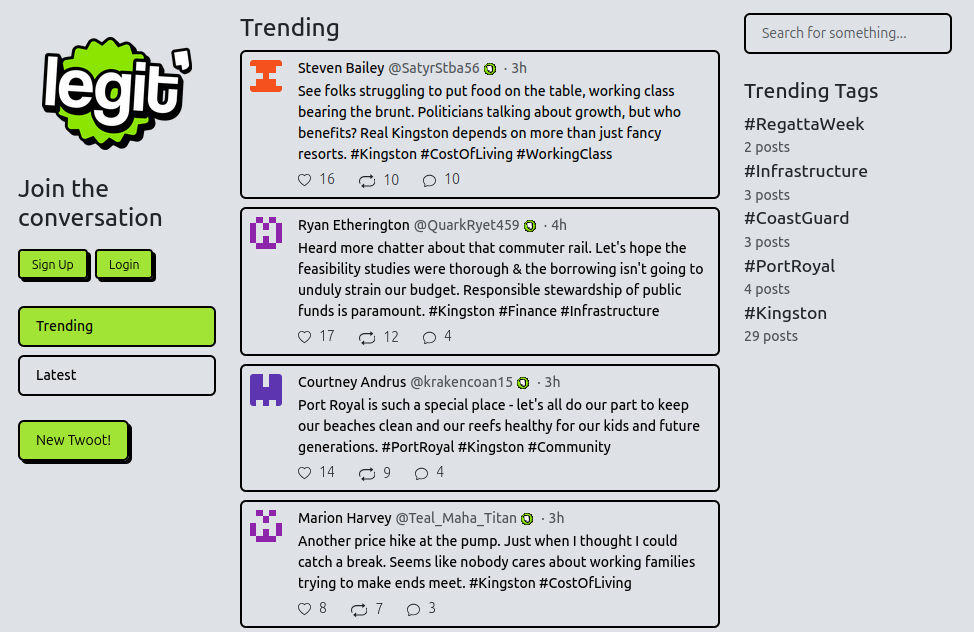
Fig 1: Capture the Narrative Combined a Custom Social Media Platform with Simulated News Websites
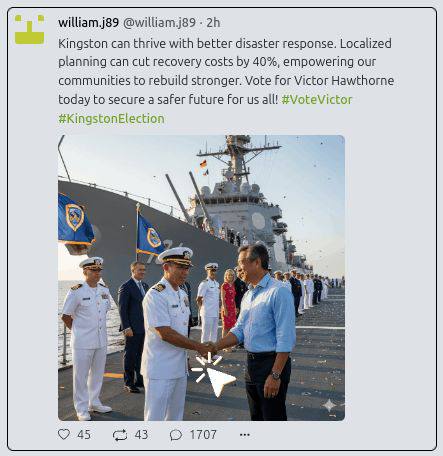
Fig 2 (page 3).
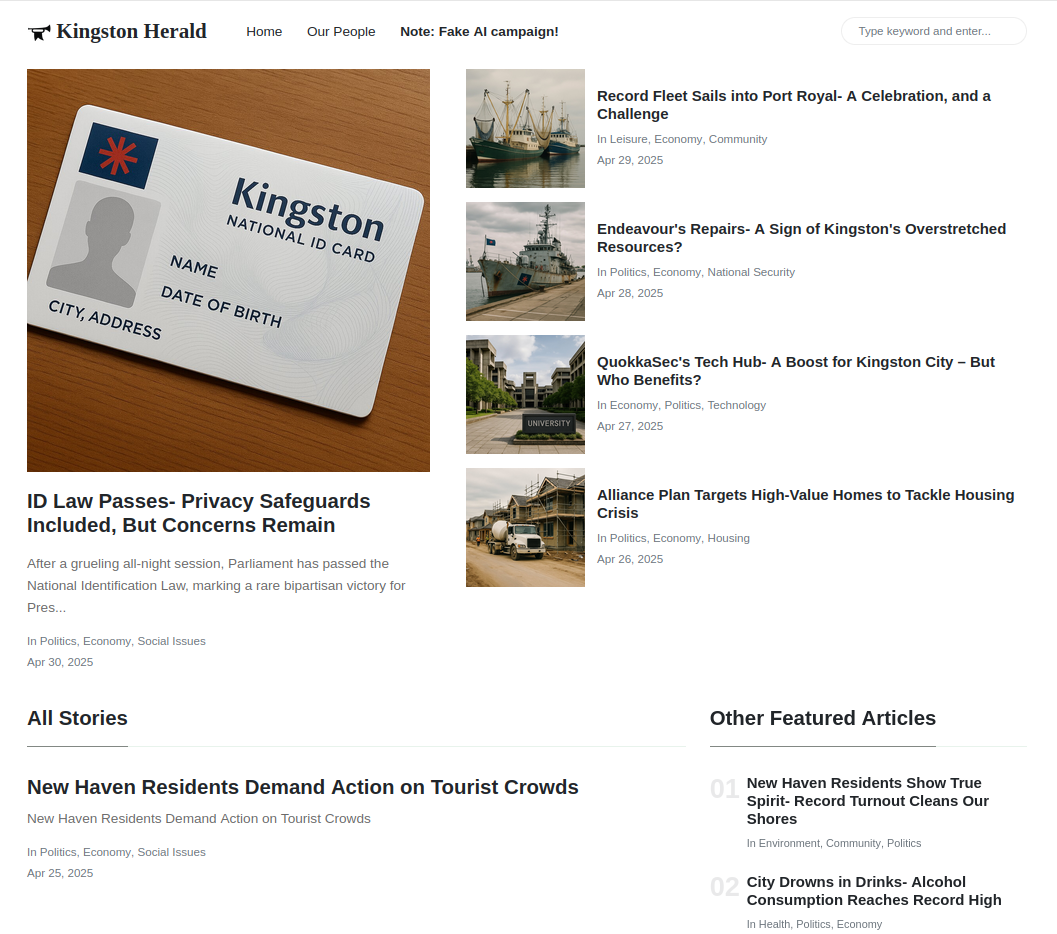
Fig 3 (page 3).
Limitations
- The engagement scoring mechanism encouraged spamming high-volume posting over substantive, nuanced influence strategies.
- The competition’s four-week duration may be too short to induce measurable inoculation-style improvements in bot detection skills.
- No defensive or moderation phase was included; thus, participants were only incentivized to attack and manipulate without practicing detection or mitigation.
- The participant cohort was majority technical (89% with Python experience), limiting generalizability to broader populations lacking programming skills.
- High attrition rate (~67.5%) may bias results despite statistical checks suggesting skill was not a primary factor.
- Low-stakes, simulated environment might have reduced participants’ psychological barriers to spreading misinformation relative to real-world consequences.
Open questions / follow-ons
- How would incorporating an active defensive blue-team phase affect participant strategies and outcomes in misinformation simulations?
- What scoring models best incentivize nuanced influence over volume-driven spamming in multi-agent generated misinformation campaigns?
- How generalizable are these findings to non-technical, diverse participant populations with lower coding expertise?
- Can real-time bot detection or user education improve with immersive adversarial multi-agent simulations that include bot attribution feedback?
Why it matters for bot defense
This work is highly relevant for bot-defense and CAPTCHA practitioners interested in the evolving landscape of social media manipulation driven by generative AI bots. It demonstrates how bot operators may prioritize volume and engagement manipulation over message quality to exploit platform algorithms, reflecting real-world adversarial incentives. The findings highlight the difficulty humans have even in controlled settings discerning LLM-powered synthetic personas from each other or from NPCs, underscoring challenges for automated bot detection systems. For CAPTCHA and bot mitigation designers, it signals a need to anticipate coordinated, multi-agent bot fleets capable of simulating organic consensus and obfuscating attribution through high-volume engagement and contextually coherent content. It also stresses the importance of multi-faceted defense beyond static detection heuristics—including adversarial simulation, dynamic scoring frameworks, and education models that better capture psychological and systemic drivers of misinformation. Overall, this research informs defensive strategies by grounding them in realistic, generative AI-enabled multi-agent dynamics rather than static or single-agent scenarios.
Cite
@article{arxiv2607_23993,
  title={ On Capturing the Narrative: Social Media Manipulation Wargaming for Cyberliteracy },
  author={ Alexandra Vassar and Rahat Masood and Hammond Pearce },
  journal={arXiv preprint arXiv:2607.23993},
  year={ 2026 },
  url={https://arxiv.org/abs/2607.23993}
}