
Mapping the Reddit Bot Ecosystem: Taxonomy and Evolution
Source: arXiv:2607.23941 · Published 2026-07-27 · By Qiusi Sun, Thomas Gaskin, Branko Blagojevic, Milena Tsvetkova
TL;DR
This study constructs the first empirical taxonomy and longitudinal analysis of Reddit's bot ecosystem using a large dataset of 3,389 publicly identified bots and their complete activity histories from 2005 to 2025. The authors leverage temporal, community, linguistic, and semantic features extracted from bot posts and comments to perform clustering analysis, revealing 18 distinct bot types, ranging from content-specialized bots to behaviorally and functionally differentiated bots such as moderation and utility bots. The study finds that Reddit's bot population grew rapidly up to the COVID-19 pandemic, then declined starting in 2022, before Reddit's 2023 paid API policy was implemented. Despite this contraction, the overall diversity and relative proportions of bot types remained remarkably stable. The official Reddit moderation bot AutoModerator grew to dominate bot activity, centralizing governance functions once performed by a broader diversity of community-developed bots. This suggests the bot ecosystem has evolved from a decentralized community-driven landscape toward a more institutionalized, platform-managed automation environment.
Key findings
- Identified 3,389 confirmed Reddit bots with at least 10 community votes labeling them as bots.
- Using 23 selected features capturing temporal, community, linguistic, and semantic behavior, hierarchical clustering found 18 distinct bot types (Fig 2).
- Bot population growth accelerated from 2017, peaking around 2020-2021 during COVID-19 (Fig 1A, 1B).
- Number of active bots and bot activity started declining in early 2022, prior to Reddit’s 2023 API pricing changes (Fig 1B, 1C).
- AutoModerator is responsible for more activity than all other bots combined, indicating centralization of moderation functions (Fig 1C).
- Most bot types emerged by 2016 and none have gone extinct through 2025; diversity of bot types remained stable throughout population shifts (Fig 3A).
- Temporal activity patterns vary by bot type, e.g., conversational GPT-2 bots spiked 2020-2021, adult content bots peaked in late 2023 (Fig 3B).
- Co-posting network analysis reveals tightly connected bot communities that fragmented after population decline in 2024 (Fig 4).
Threat model
The study considers adversaries who operate automated accounts on Reddit recognizable and labeled by community votes, focusing on overt, publicly identified bots rather than covert, deceptive, or malicious botnets. The adversary's capabilities are thus limited to public posting behavior and operate within platform rules allowing community identification. The analysis inherently excludes stealthy or low-vote bots and bots that perform non-public automation tasks.
Methodology — deep read
The study began by defining the threat model as analyzing publicly recognized Reddit bots, primarily overt and user-identified by community voting; covert or undisclosed bots were not captured. The authors compiled bots from two crowdsourced public databases, botranks.com and botrank.net, filtering accounts with at least 10 'good bot' or 'bad bot' votes for high precision, resulting in 3,389 bots. They retrieved the full posting histories (comments and submissions) of these bots from archived Reddit datasets on Academic Torrents, including parent posts to preserve conversational context.
From this data, they computed 33 features describing bot temporal behavior (e.g., hourly entropy, response time variance, mean inter-post time), community activity (number of subreddits posted to, specialization), linguistic attributes (lexical diversity, sentiment, lexicon size), and semantic content (topic distributions by BERTopic with Sentence-BERT embeddings grouped into 13 macro domains). Feature values were transformed (log, normalization) and correlated features pruned by PCA, retaining 23 features explaining over 90% variance.
They applied hierarchical clustering on these features to empirically derive bot types, selecting k=18 based on silhouette scores and confirming results with k-means. Dimensionality reduction used t-SNE to visualize bot clusters, where distances reflected similarity in the 23-feature space.
The temporal dimension was captured by analyzing bot account creation dates, last activity, and yearly counts of submissions and comments. Bot communities and niches were analyzed via co-posting networks, derived from bipartite graphs connecting bots to subreddits by posting activity per year (2009-2025). Using weighted one-mode projections based on shared subreddit interactions, they mapped bot network structures and clusters yearly to detect ecological niches.
Evaluations included analysis of population dynamics over time (number of active bots, species diversity), activity temporal trends by bot type, and structural changes in bot networks. The study excluded the highly active AutoModerator in many analyses to avoid skewing results.
The paper does not report experimental hyperparameters typical to ML training since the core method is unsupervised clustering on aggregate bot behavioral features. Code release status and dataset sharing are not explicitly mentioned; data originates from public archives and collaborative crowdsourced bot rankings. The study provides a detailed end-to-end empirical example tracing the evolving bot ecosystem structure and species taxonomy on Reddit across a 20-year span.
Technical innovations
- Empirical taxonomy of Reddit bots using a multi-dimensional feature set incorporating temporal, community, linguistic, and semantic behavior, unlike prior typologies based mainly on intent or purpose.
- Application of unsupervised hierarchical clustering validated with silhouette scores and t-SNE visualization to identify 18 distinct bot archetypes as "species" in the bot population.
- Longitudinal ecological analysis of bot population dynamics over two decades combining account creation and activity data with community co-posting networks to reveal evolutionary patterns and niche stability.
- Quantitative evidence on the centralization of bot functionality via Reddit's AutoModerator, highlighting shifts from decentralized community bots to institutionalized platform-supported automation.
Datasets
- Reddit bot list — 3,389 bots — compiled from crowdsourced bot ranking platforms botranks.com and botrank.net
- Public Reddit comment and submission archives — posts and comments from 2005 to 2025 — from Academic Torrents
Figures from the paper
Figures are reproduced from the source paper for academic discussion. Original copyright: the paper authors. See arXiv:2607.23941.
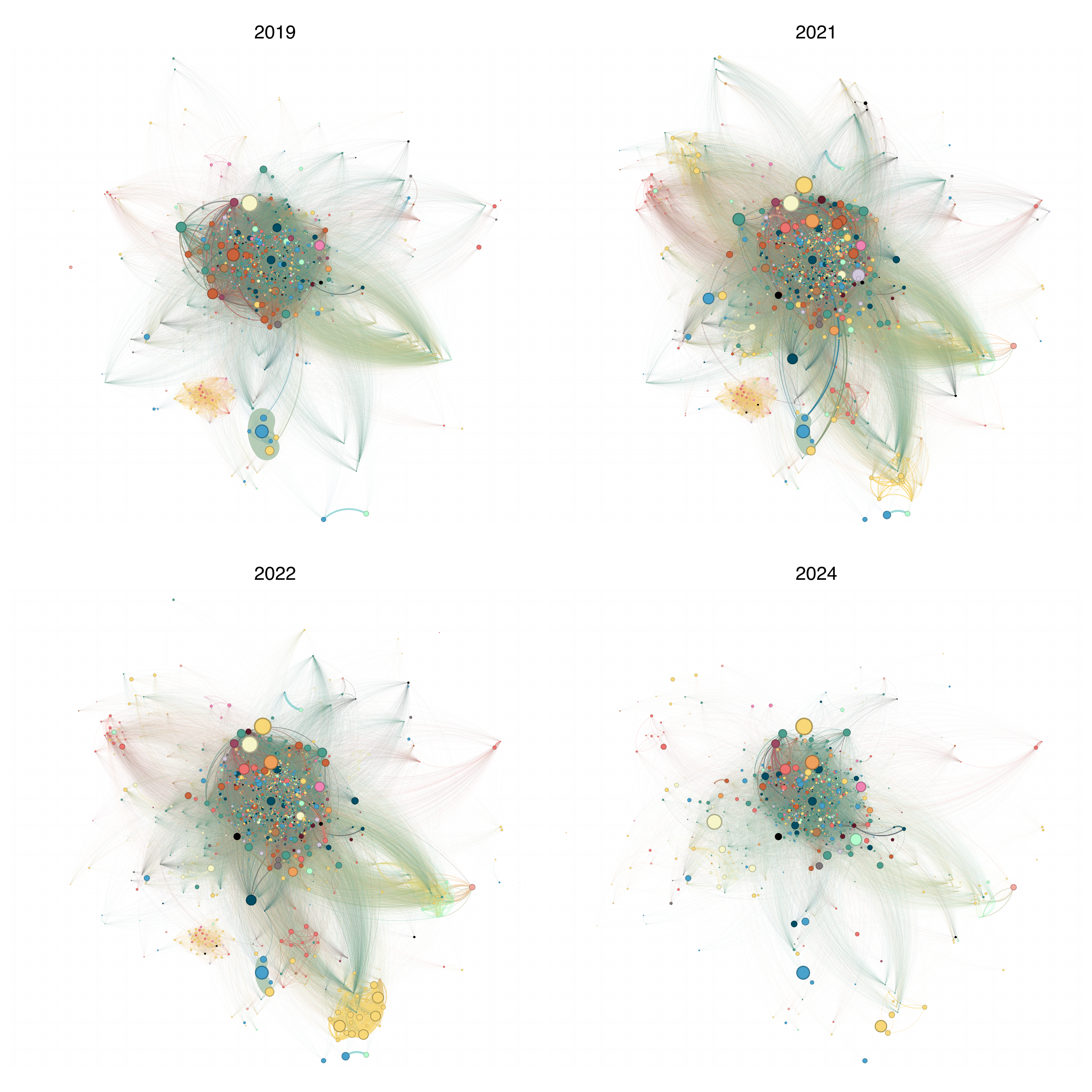
Fig 4: Co-posting networks of Reddit bot types in 2019, 2021, 2022, and 2024. Edge weights represent the shared number of posts
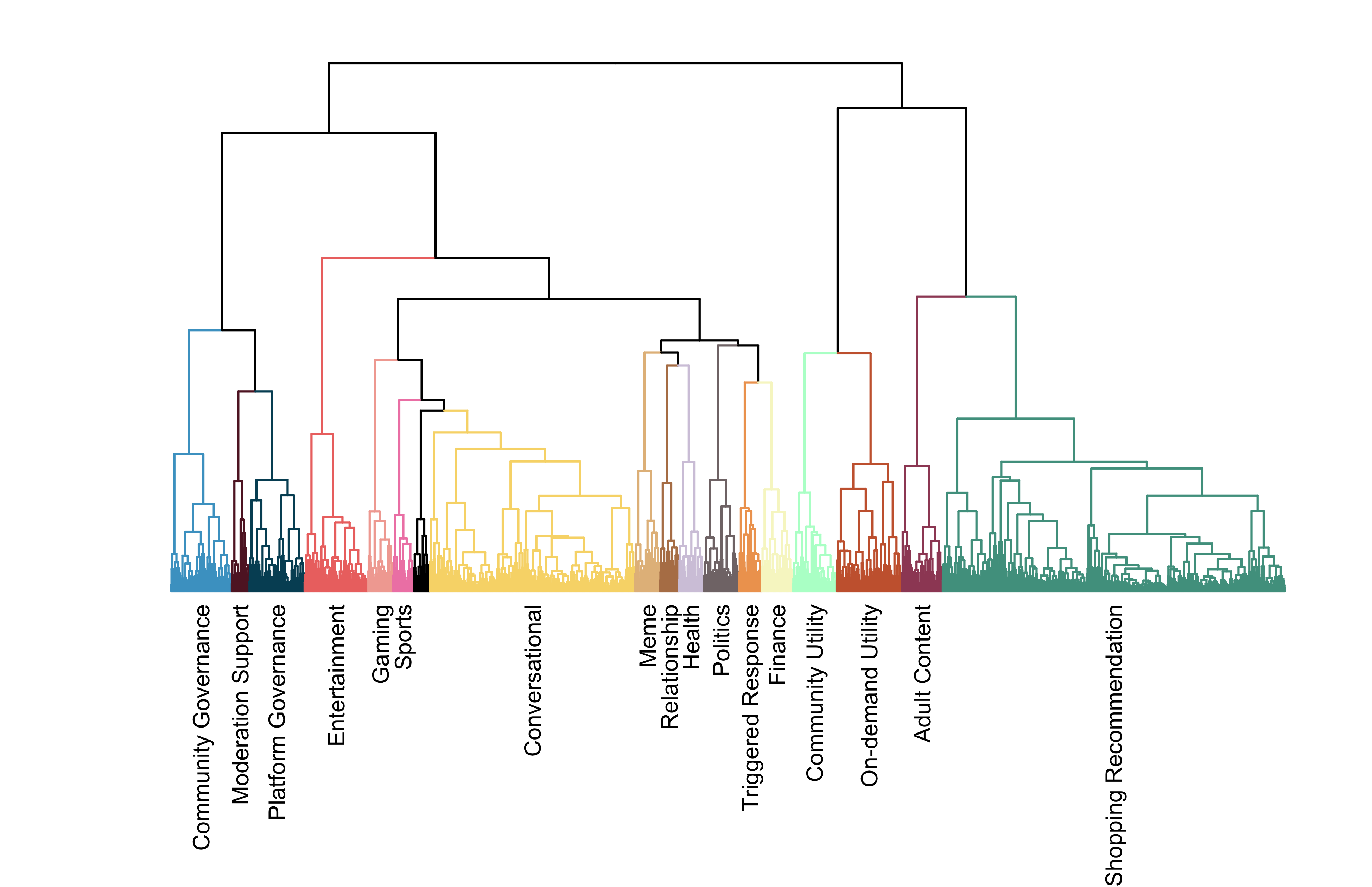
Fig 2 (page 15).
Limitations
- Dataset includes only overt, publicly recognized bots with at least 10 community votes, likely undercounting covert or stealth bots and botnets.
- Analysis excludes bots not posting publicly (e.g., crawlers, private message bots, award distributors), missing non-posting automation activities on Reddit.
- Decline in detected bots may be influenced by changes in user awareness, bot identification methods, or community voting patterns, not solely actual bot population reductions.
- Focus on one platform (Reddit) with unique community norms and governance limits generalizability to other social media ecosystems like Twitter or Facebook.
- Lack of adversarial evaluation or testing of bot detection robustness against evasion or LLM-generated bots that may be harder to detect.
- No explicit release of code or detailed reproducibility instructions documented to verify clustering and feature engineering steps.
Open questions / follow-ons
- How do direct interactions between bots and between bots and humans vary by bot type and evolve over time within Reddit communities?
- How might alternative taxonomies incorporating additional behavioral or network features reshape understanding of bot diversity and ecological roles?
- To what extent do bot populations coevolve with changes in human user behavior, platform policies, and technological innovations such as advances in generative AI?
- How transferable is the Reddit bot ecosystem taxonomy and evolutionary pattern to other social media platforms with distinct moderation and governance structures?
Why it matters for bot defense
This comprehensive bot taxonomy provides bot-defense engineers with a nuanced understanding of diverse bot roles and behaviors beyond the typical malicious/spam categories. Recognizing the persistence of distinct bot species despite population declines highlights the need for detection systems to differentiate functional bot archetypes rather than treat all bots as a homogenous threat. The observation that platform-level centralized bots like AutoModerator can dominate activity suggests that bot defense mechanisms must account for varied trust and governance roles bots may hold. Captcha and bot management strategies can benefit from integrating ecological and temporal context to detect shifts in bot populations responding to policy changes or new AI-powered automation. The work also underscores the limitations of relying solely on explicit community labeling, pushing practitioners to develop detection tools robust to covert and evolving bot behaviors as large language model-driven bots grow more sophisticated.
Cite
@article{arxiv2607_23941,
  title={ Mapping the Reddit Bot Ecosystem: Taxonomy and Evolution },
  author={ Qiusi Sun and Thomas Gaskin and Branko Blagojevic and Milena Tsvetkova },
  journal={arXiv preprint arXiv:2607.23941},
  year={ 2026 },
  url={https://arxiv.org/abs/2607.23941}
}