
Density-Robust Spherical Coordinates from Persistent Cohomology
Source: arXiv:2607.24650 · Published 2026-07-27 · By Nick Nordwald, Inés García-Redondo, Anthea Monod
TL;DR
This paper addresses a key limitation in topological coordinate constructions derived from persistent cohomology: their sensitivity to non-uniform sampling density. While density-robust circular (S1-valued) coordinates have been developed previously, extending these techniques to spherical (S2-valued) coordinates has remained an open challenge due to the fundamentally different nonlinear variational formulation involved for sphere-valued maps. The authors present the first density-robust construction of spherical coordinates by combining rejection-based subsampling to achieve approximate uniformity with a novel alignment method for independently computed sphere-valued maps. The alignment problem is formulated as a spherical Procrustes problem, and an efficiently computable Euclidean relaxation is proved to approximate it well. This approach avoids modifying the underlying nonlinear coordinate optimization, retains accuracy on uniform data, and scales better by computing persistent cohomology only on fixed-size subsamples. Experiments on synthetic datasets demonstrate accurate coordinate recovery even under strong sampling bias and scaling to 10,000 points, confirming robustness and computational practicality.
Key findings
- The proposed method recovers accurate spherical coordinates under severe non-uniform sampling bias, correcting distortions affecting classical constructions.
- Combining multiple approximately uniform subsamples via rejection sampling enables density robustness without modifying nonlinear optimization of sphere-valued maps.
- The spherical Procrustes problem formulation aligns independently computed sphere-valued coordinates up to a global rotation with provable approximation guarantees.
- The Euclidean relaxation of the spherical Procrustes problem provides a computationally tractable solution closely approximating the original optimization problem.
- Using fixed-size subsamples avoids the quartic memory complexity of full-data persistent cohomology, improving scalability to datasets of 10,000 points and beyond.
- Experimental runtime results show substantial speedups compared to the classical method with direct optimization on the full dataset (Fig. 4 and 5).
- Uniform sampling experiments confirm that the subsampling framework preserves accuracy comparable to classical spherical coordinate constructions.
- The proposed method provides the first general practical framework for density-robust degree-two topological coordinates, extending prior density-robust constructions limited to circular coordinates.
Threat model
n/a — The paper does not address adversarial threats but focuses on robustness of topological coordinates to bias in sampling density due to the data acquisition process or natural heterogeneity, assuming an honest but uneven sampling distribution.
Methodology — deep read
Threat Model & Assumptions: The adversary or threat is not explicitly modeled as this paper addresses the robustness of topological coordinates to sampling density bias rather than adversarial manipulation. The key assumption is that data points are sampled from an unknown manifold with potentially non-uniform density ρ, leading to distortions in classical topological coordinate extraction.
Data: Provenance & Preprocessing: Synthetic datasets sampled from manifolds (including the 2-sphere S2) were used with controlled density variations via rejection sampling or biased density functions such as von Mises-Fisher distributions. The method assumes input is a finite metric space (X, d) embedded in Euclidean space or abstract metric.
Architecture / Algorithm:
- Compute degree-two persistent cohomology on the Vietoris-Rips filtration of the data.
- Identify a prominent persistence interval and lift the Fp-cohomology class to an integral class.
- Apply rejection sampling to generate multiple approximately uniform subsamples Xi ⊂ X by estimating density bρ using local neighborhood counts and accepting points with probability inversely proportional to density.
- Compute classical spherical coordinates θi : Xi → S2 on each subsample using existing variational optimization minimizing harmonic energy of sphere-valued maps with Möbius centering.
- Extend each θi to the full dataset X via nearest-neighbor Gaussian kernel weighted interpolation.
- Solve the spherical Procrustes problem to jointly align all maps θi by finding rotations Ri ∈ SO(3) and a consensus coordinate θ¯ minimizing the sum of squared spherical geodesic distances.
- Approximate this problem by a Euclidean Procrustes problem in R3 with a global solution obtained via spectral decomposition.
- Average the aligned maps to produce the final density-robust spherical coordinate θ : X → S2.
4.Training Regime: This is an unsupervised computational pipeline without iterative training epochs. The nonlinear optimization for each subsample uses projected gradient descent to minimize the harmonic energy over the 2-skeleton simplices. Number and size of subsamples (M, l) were parameters controlling computational trade-offs.
Evaluation Protocol: Evaluation metrics included reconstruction accuracy of spherical coordinates comparing with ground truth, robustness to non-uniform sampling measured by distortions or coordinate variation, and runtime scaling analysis. Baselines included classical spherical coordinate methods on full datasets without density correction. Ablations isolated effects of subsampling size and number of subsamples. Statistical tests were not explicitly mentioned.
Reproducibility: The authors provide a publicly available implementation and experiment scripts at the provided GitHub repository. However, the datasets are synthetic, and no frozen pretrained models apply. The core algorithms depend on persistent cohomology computation and nonlinear optimization.
Example end-to-end: Given a biased sample X on S2, the pipeline estimates bρ(x) by counting neighbors in epsilon-balls, then applies rejection sampling to create uniform subsamples Xi. On each Xi, spherical coordinates θi are computed via nonlinear variational minimization with harmonic energy. Each θi is interpolated to X, then aligned using spherical Procrustes solved approximately by Euclidean relaxation. Averaging the aligned maps yields the final coordinate θ, which accurately parameterizes S2 despite initial sampling bias.
Technical innovations
- Extension of density-robust subsampling-and-alignment frameworks from circular (S1) to spherical (S2) coordinates addressing nonlinear variational challenges.
- Formulation of a spherical Procrustes problem for aligning multiple independently computed sphere-valued coordinate maps with rotation ambiguity.
- Proof of approximation guarantees bounding the solution of the spherical Procrustes problem by an efficiently computable Euclidean relaxation, enabling practical optimization.
- Demonstration that computing persistent cohomology only on fixed-size subsamples reduces memory from quartic to linear/quadratic scaling, improving scalability.
Datasets
- synthetic sphere samples — sizes up to 10,000 points — synthetic generation with controlled density bias
Baselines vs proposed
- Classical spherical coordinates (full data): coordinate recovery degrades substantially under non-uniform sampling vs Proposed method: accurate recovery maintained
- Classical spherical coordinates memory usage: O(n^4) complexity vs Proposed method on subsamples: scalable to 10,000 points (no memory bottleneck)
- Runtime baseline (full data direct optimization): highest runtime vs Proposed subsampling + alignment: substantial runtime reduction (Fig. 4 and 5)
Figures from the paper
Figures are reproduced from the source paper for academic discussion. Original copyright: the paper authors. See arXiv:2607.24650.
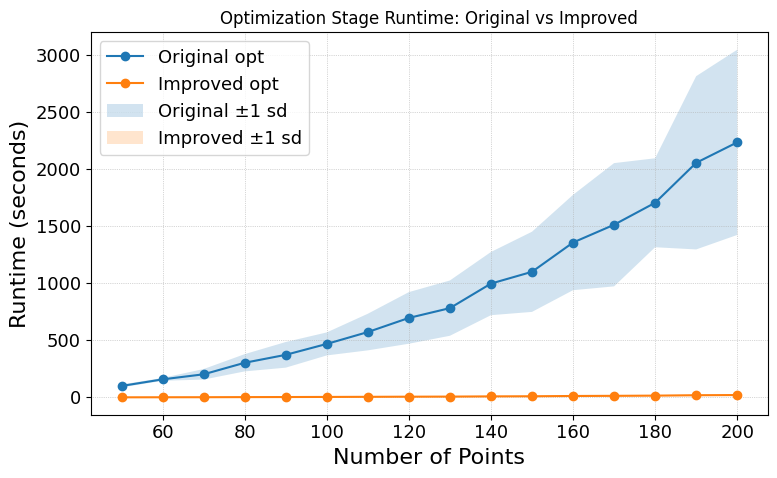
Fig 1: Effect of the two accelerations in isolation, comparing the baseline with the optimized baseline.
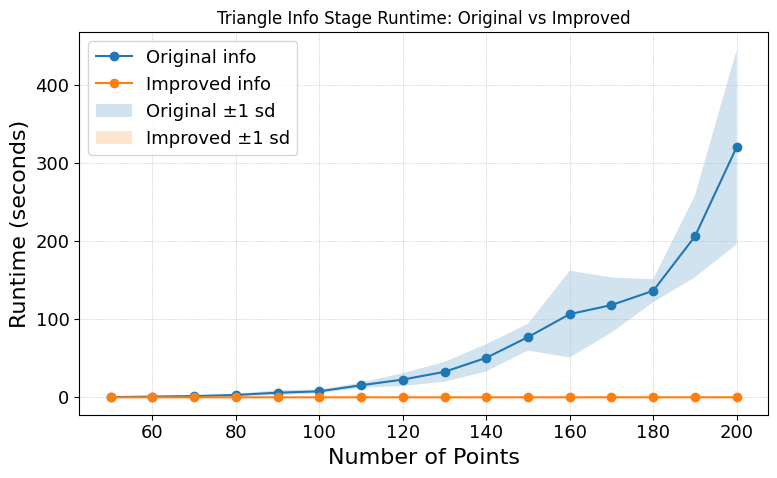
Fig 2: Overall runtime of the baseline and the optimized baseline on the full spherical coordinate
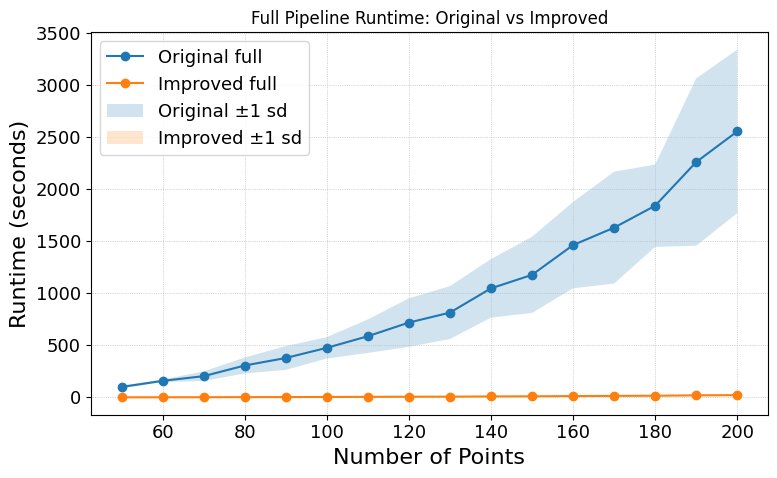
Fig 3: Runtime scaling of the subsampling method: a direct comparison against the optimised baseline
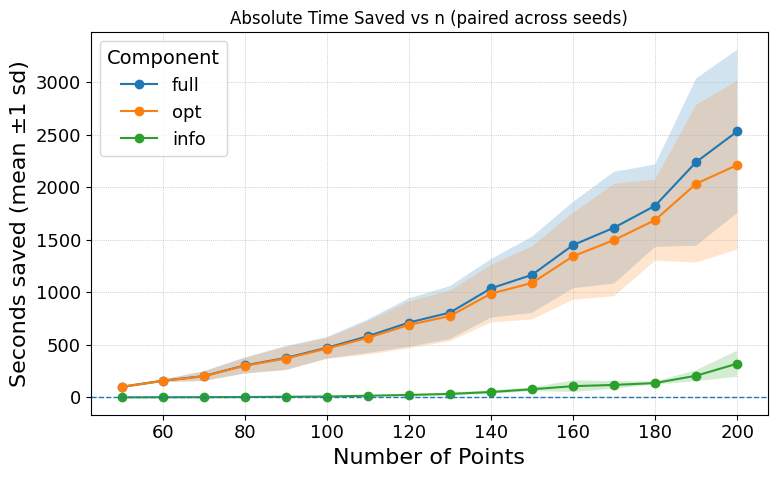
Fig 4: Runtime of the subsampling method as a function of subsample size and number of subsamples.
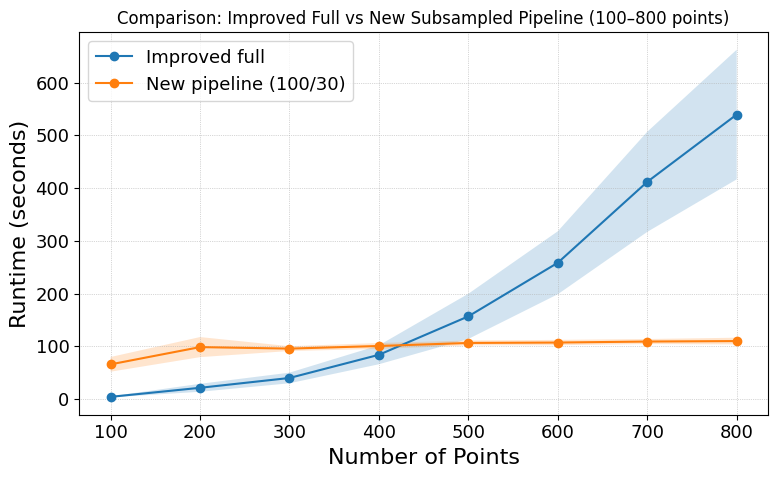
Fig 5: Uniform sampling control experiment. Top: uniform sample over S2. Middle and bottom rows:
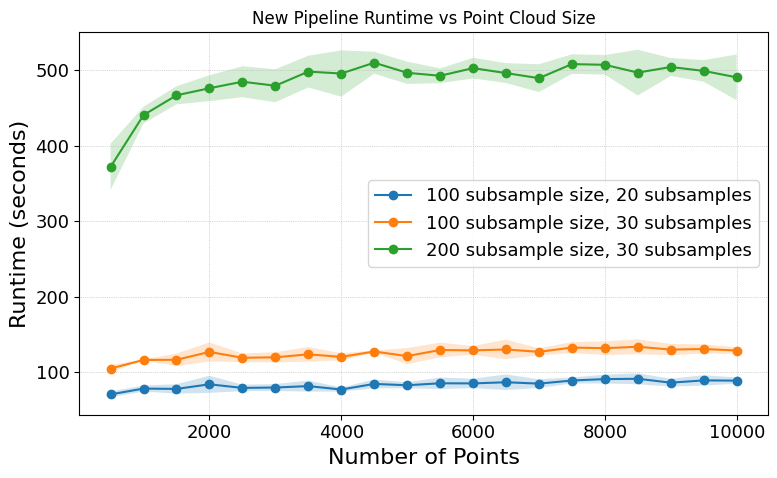
Fig 6 (page 19).
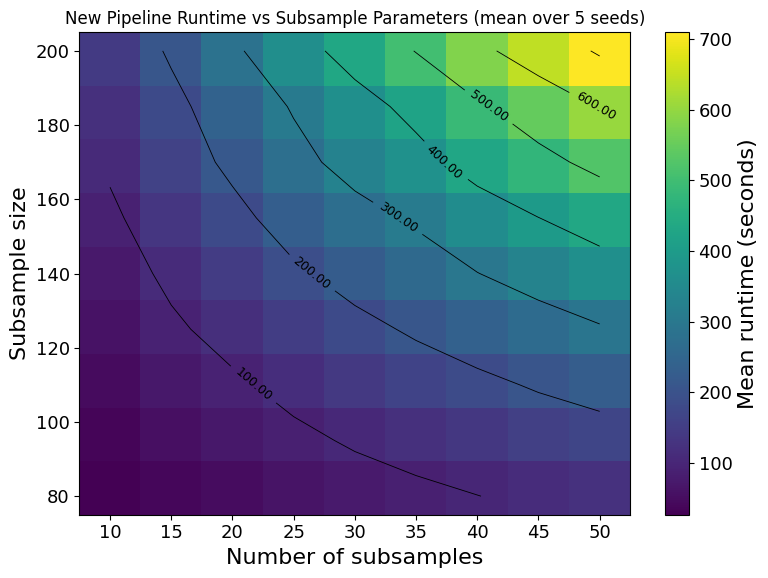
Fig 7 (page 19).
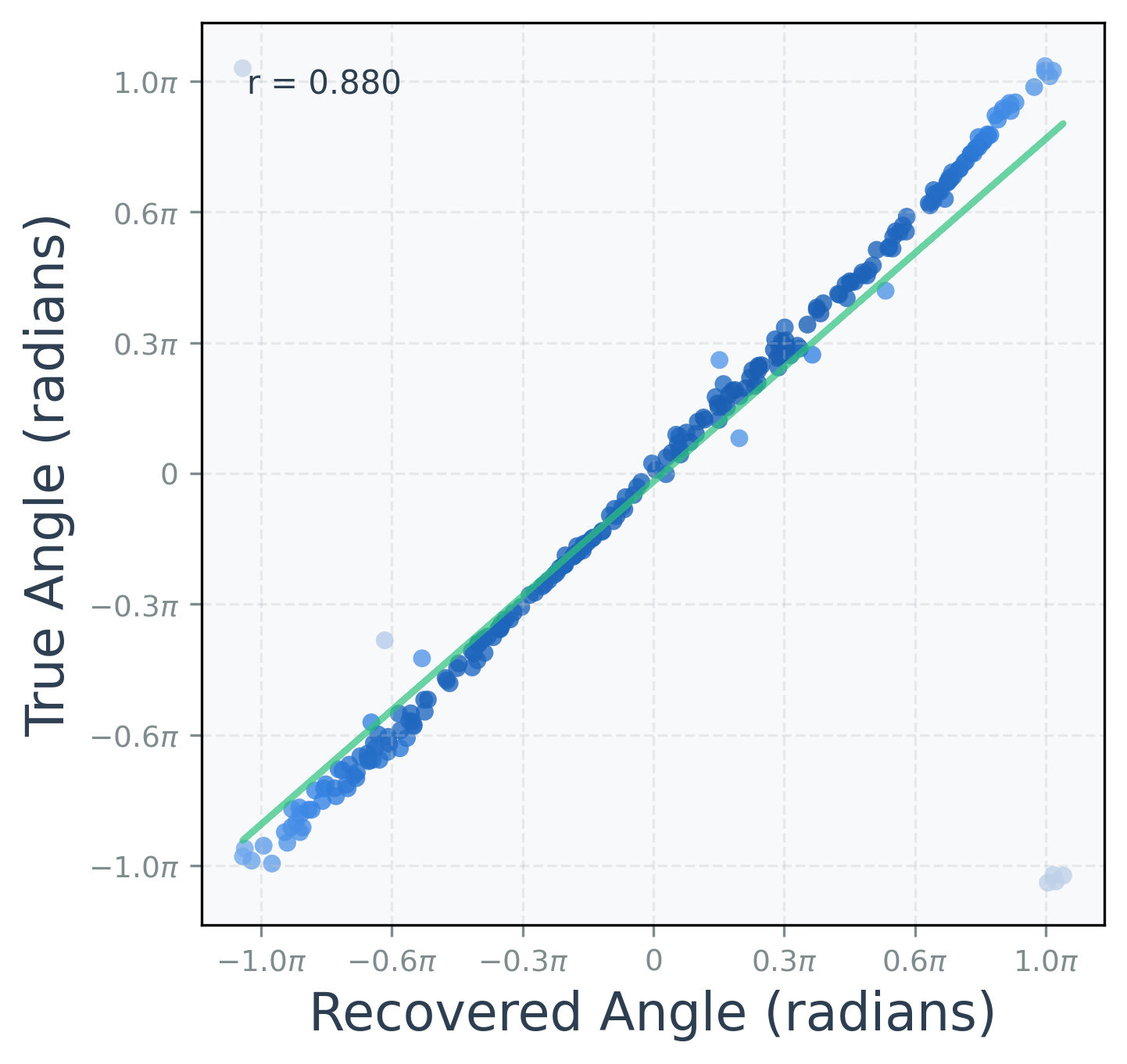
Fig 6: Embeddings and angle recovery on the non-uniform dataset. Top: input sampled from a von
Limitations
- Experiments are limited to synthetic datasets; real-world noisy/complex data evaluations are absent.
- The method assumes accurate density estimation and rejection sampling efficacy, which may be more challenging in high dimensions or complex manifolds.
- The spherical Procrustes problem is approximated via Euclidean relaxation; although guarantees exist, the impact on solutions on noisy real data remains to be fully tested.
- No adversarial or worst-case sampling distortions are considered beyond statistical bias models.
- The approach depends on choosing appropriate subsample sizes and numbers, which involve trade-offs not fully automated.
- The variational optimization for spherical coordinates may have multiple local minima, and convergence guarantees are not fully detailed.
Open questions / follow-ons
- How does the method perform on real-world, high-dimensional datasets with noisy or complex geometry and noise?
- Can the spherical Procrustes alignment be further improved to handle adversarial perturbations or be made more robust to noise?
- Is it possible to extend this subsampling-and-alignment approach to higher-degree cohomological coordinates beyond degree two (i.e., maps to higher-dimensional spheres or other spaces)?
- What automated criteria or adaptive schemes could optimally select subsample sizes and numbers to balance accuracy and computation?
Why it matters for bot defense
Topological coordinates from persistent cohomology provide nonlinear latent variables capturing intrinsic data geometry, which can aid bot-defense methods by modeling user interaction or behavior patterns on manifolds with nontrivial topology (e.g., orientation or periodicity). However, uneven sampling—common in real-world interaction data due to biases in bot vs human behavior—can distort these coordinates, reducing their discriminative power. This work introduces a practical, theoretically grounded way to construct density-robust spherical topological coordinates, improving robustness to sampling artifacts and scaling to larger datasets. Bot-defense engineers considering topological latent features in CAPTCHA or interaction modeling can apply this framework to maintain coordinate integrity despite biased or unevenly sampled behavioral data. The spherical extension is particularly relevant where directional or orientation latent variables arise naturally. The subsampling and alignment methodology also mitigates computational bottlenecks typical in persistent cohomology, facilitating deployment in real-time or large-scale systems.
Cite
@article{arxiv2607_24650,
  title={ Density-Robust Spherical Coordinates from Persistent Cohomology },
  author={ Nick Nordwald and Inés García-Redondo and Anthea Monod },
  journal={arXiv preprint arXiv:2607.24650},
  year={ 2026 },
  url={https://arxiv.org/abs/2607.24650}
}