
Ask the Curator: Demonstrating Expert-Driven RDF Data Curation with HERITRACE
Source: arXiv:2607.22348 · Published 2026-07-24 · By Arcangelo Massari, Silvio Peroni
TL;DR
This paper presents HERITRACE, an open-source web application designed to support expert-driven curation of RDF data stored in triplestores. The key novelty is its decoupling of domain expertise from technical configuration, enabling technicians to define the data model and display rules using SHACL and YAML, after which domain experts interactively curate data through generated web forms. Every user action is tracked with detailed RDF provenance snapshots, enabling inspection and restoration of any prior state. The authors demonstrate HERITRACE by walking through a real-world bibliographic ambiguity example involving two distinct articles erroneously sharing the same DOI in PubMed metadata. The demonstration shows how a technician configures HERITRACE with OpenCitations Meta data, and how curators merge records, revert erroneous merges via a detailed change history “Time Machine,” and verify corrections against authoritative Crossref metadata. This concrete workflow illustrates how HERITRACE supports transparent, reversible, and evidence-linked RDF curation in scholarly libraries.
Key findings
- HERITRACE uses SHACL shapes and YAML display rules to declaratively generate domain-specific editing forms for RDF data without migrating it.
- All data modifications are recorded as provenance snapshots in RDF, enabling change history inspection and restoration using the same technologies as the curated data.
- The demonstration dataset replicates a real case from OpenCitations Meta where PubMed assigns the same DOI to two unrelated journal articles, causing bibliographic ambiguity.
- The curator workflow shows merge suggestions based on exact value matches on properties like title and shared identifier nodes; false positives require expert review.
- The curator mistakenly merges a non-duplicate due to conflicting metadata but then successfully reverts the change using the Time Machine provenance interface.
- The final curation state correctly separates the two articles with their respective PMIDs and DOI assignments after verifying Crossref data.
- The configuration environment uses Docker containers with separate triplestores for data and provenance, connected via SPARQL endpoints.
- Duplicate detection currently relies on exact matches of configured properties; similarity-based detection is noted as future work.
Threat model
Not a security-focused system; the adversary model is not explicitly defined. The system assumes trusted domain experts curating data. No robustness against malicious data poisoning or unauthorized edits is discussed.
Methodology — deep read
The paper focuses on expert-guided RDF data curation where the challenge is to separate domain expertise from technical RDF manipulation.
Threat Model & Assumptions: The system assumes a curator as a trusted expert verifying and correcting ambiguous or conflicting metadata in RDF graphs; no adversarial threat model is explicitly considered.
Data: The curated dataset is a small subset of OpenCitations Meta, including real bibliographic records from PubMed and Crossref about two articles wrongly sharing the same DOI in PubMed but not in Crossref. The data is modeled with the OpenCitations Data Model (OCDM), using RDF nodes for articles, identifiers (DOI, PMID), titles, authors, etc.
Architecture / Algorithm: HERITRACE is a web app running alongside two triple stores (one for data, one for provenance) accessed over SPARQL endpoints. Technicians provide configuration describing the data model via SHACL shapes, which impose RDF constraints like required properties and data types, and YAML files defining display rules for form generation, similarity properties for duplicate suggestions, and UI aspects. From these declarative configurations, dynamic web forms are generated for domain experts to use. Edits create RDF provenance snapshots tracking agent, source, timestamp, and change details, stored in RDF format compatible with OpenCitations Data Model.
Training Regime: As it is not a machine learning system, there is no training.
Evaluation Protocol: The demonstration is a walkthrough of a real curation session, showing how the curator reviews duplicate candidates suggested by HERITRACE based on exact matches of configured properties, merges records, identifies a mistaken merge, reverts it with the Version History interface (Time Machine), and finally corrects DOI assignment by consulting authoritative Crossref metadata. The interface shows side-by-side entity comparisons including properties with highlighted conflicts.
Reproducibility: A Docker Compose environment is provided to launch the web app and triplestores with configuration files including SHACL shapes and YAML display rules. A reproducible data package reproduces the demonstration dataset. A video of the curation session and live SPARQL endpoints are provided.
End-to-end Example: The curator loads the entity NC (from Crossref Nilsson article), is suggested to merge NP (PubMed Nilsson article, matching title and shared DOI node) and MP (PubMed Maltezou article, only matching shared DOI node). The curator merges NP into NC, then accidentally also merges MP despite conflicting metadata. The system records each action as a provenance snapshot. Using the Time Machine feature, the curator reviews the timeline, rolls back the erroneous MP merge, and then edits MP to unlink the shared DOI after verification with Crossref API data. The final RDF graph correctly represents two distinct articles with accurate identifiers and metadata provenance.
Technical innovations
- Decoupling domain expertise and technical configuration by generating RDF editing forms from technician-authored SHACL shapes and YAML display rules.
- Recording all RDF data curation actions as provenance snapshots in RDF following the OpenCitations Data Model for full change tracking, inspection, and restoration.
- A web interface presenting duplicate candidates based on configurable exact-match similarity properties and detailed side-by-side comparisons to support curator decision-making.
- A version history “Time Machine” feature allowing incremental rollback to any prior state in the RDF triplestore provenance, inclusive of metadata about agent and data sources.
Datasets
- OpenCitations Meta subset — small demonstration graph of three RDF descriptions of two journal articles with ambiguous shared DOI — public via Zenodo and OpenCitations
Figures from the paper
Figures are reproduced from the source paper for academic discussion. Original copyright: the paper authors. See arXiv:2607.22348.
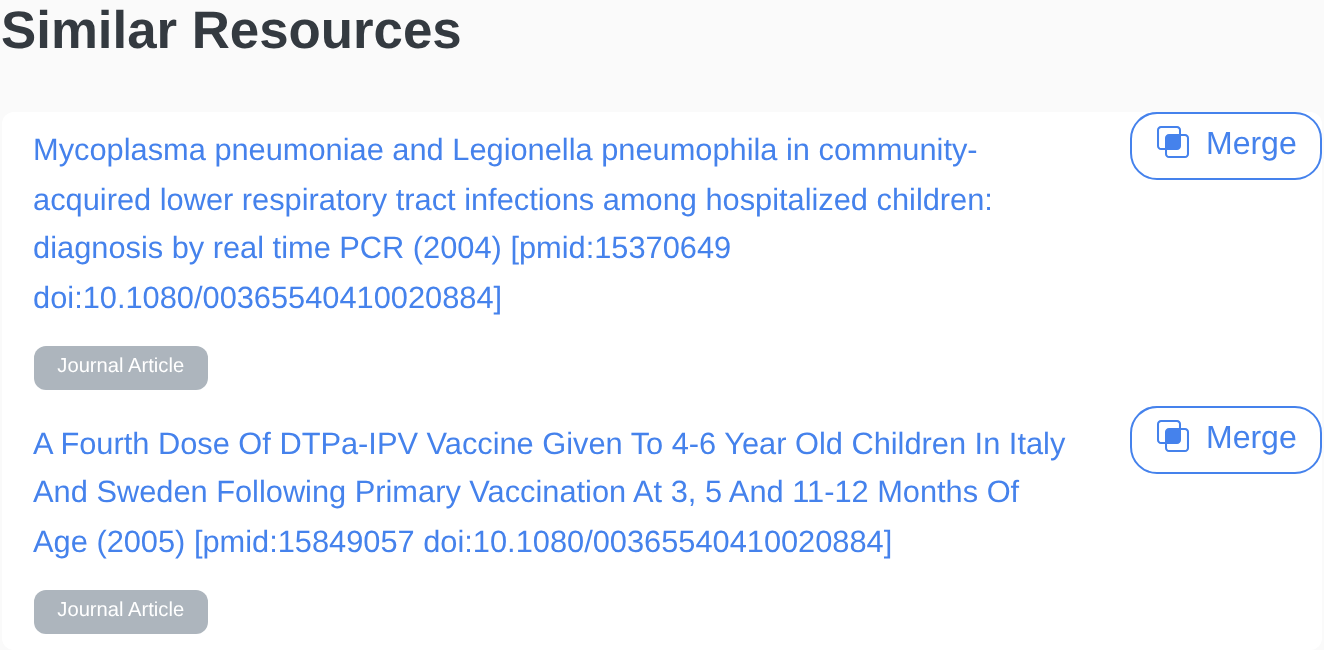
Fig 1: HERITRACE presents (a) two duplicate candidates for NC and (b) the comparison with NP.
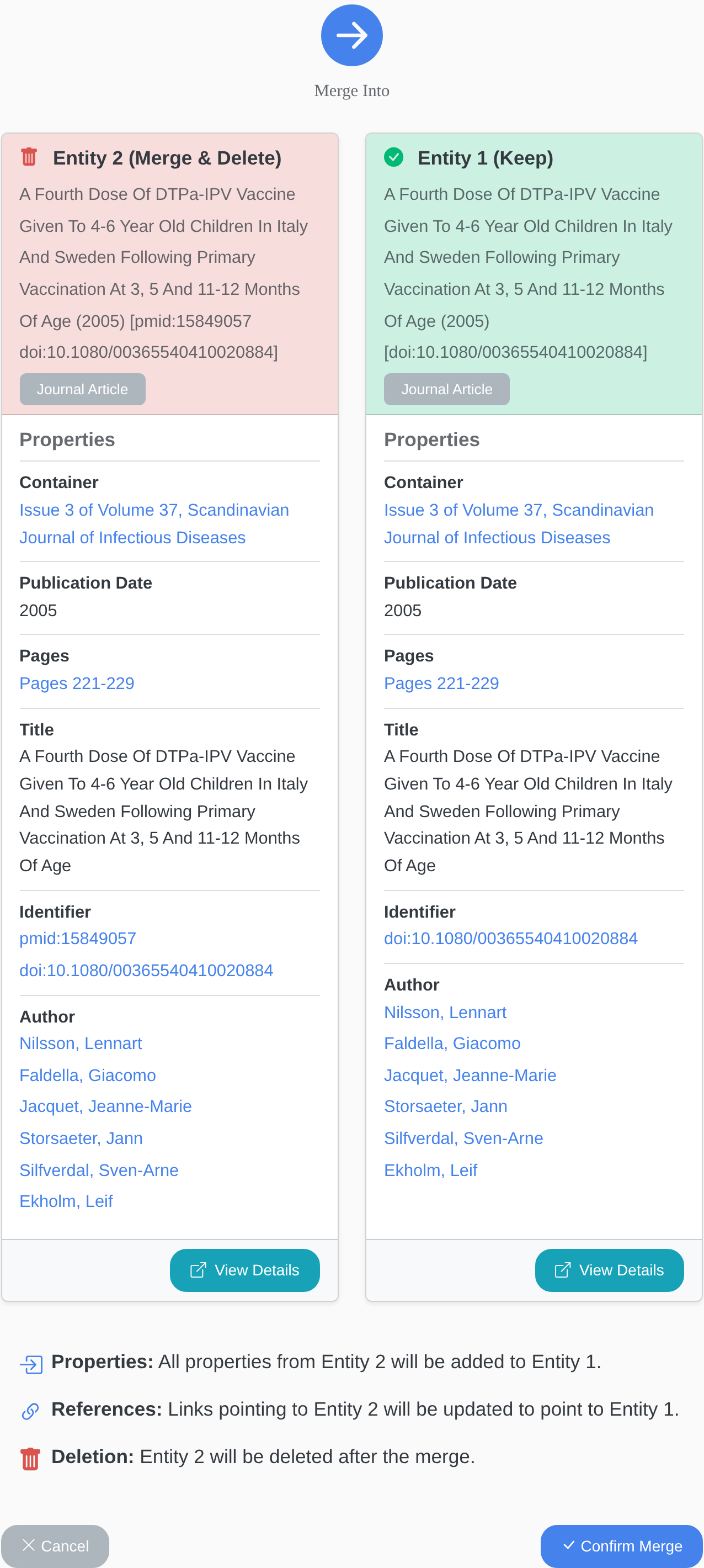
Fig 2: The curator (a) selects the version preceding the MP merge, (b) marks the shared DOI for removal
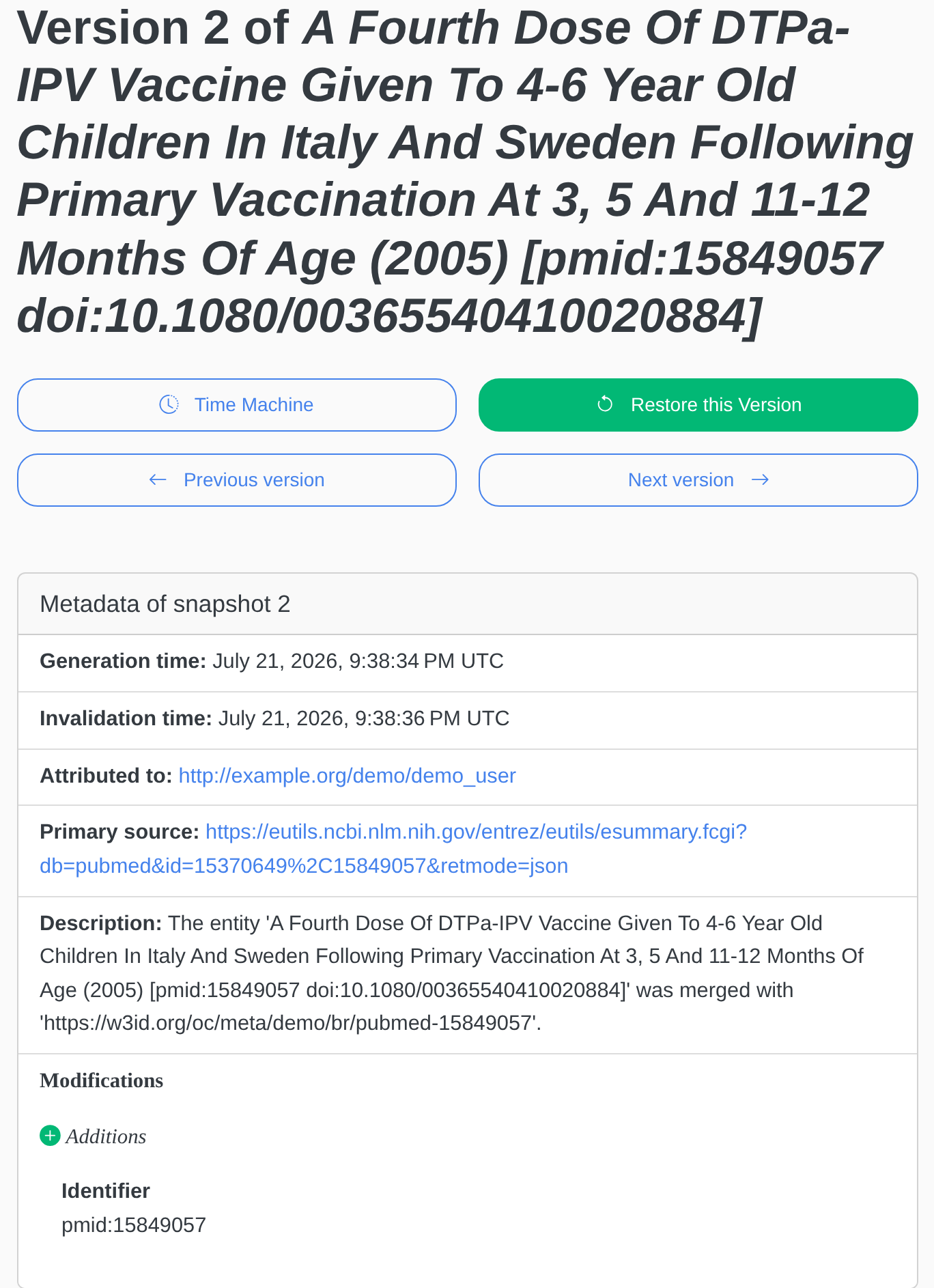
Fig 3 (page 5).
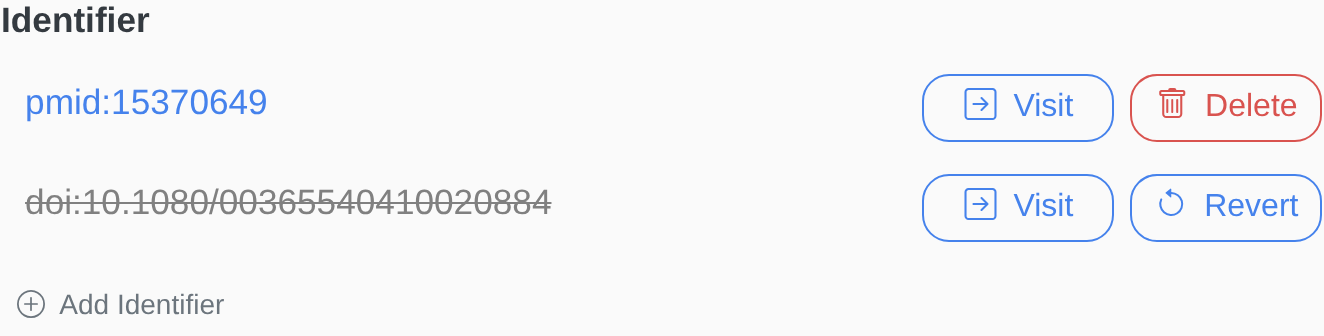
Fig 4 (page 5).
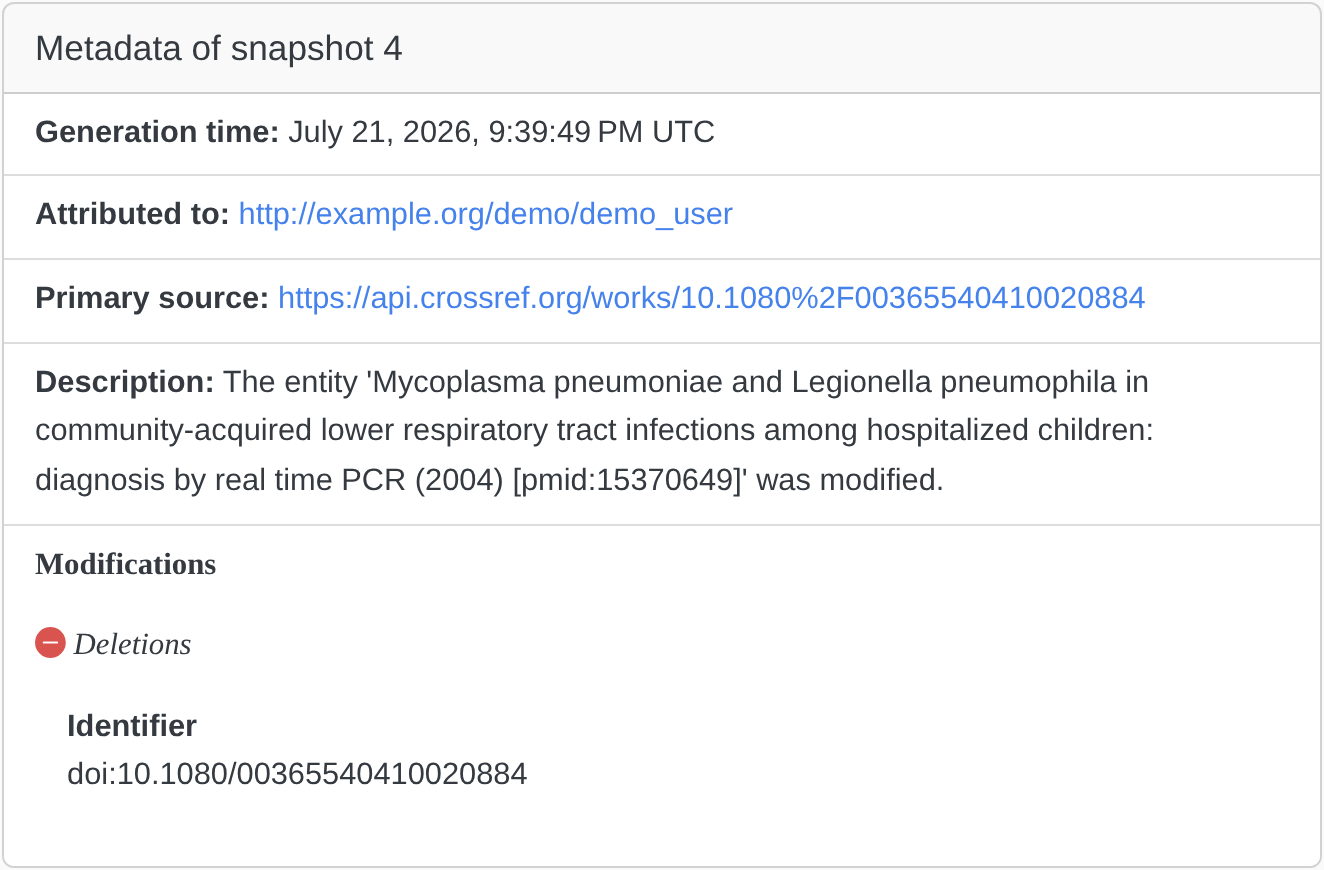
Fig 5 (page 5).
Limitations
- Duplicate detection relies solely on exact equality of configured properties; no similarity or fuzzy matching is included, potentially missing non-identical duplicates.
- The walkthrough involves a single curator; the system currently lacks explicit support for concurrent edits or collaborative conflict resolution.
- Configuration changes require technician intervention by editing files; no in-app editing of SHACL shapes or display rules yet.
- The demonstration is limited to bibliographic metadata; no cross-domain or larger scale validation was reported.
- Provenance tracking assumes trustworthy curators, not designed to resist malicious or adversarial edits.
- No quantitative measures of usability or scale performance provided in this paper (covered in a companion paper).
Open questions / follow-ons
- Can similarity-based duplicate detection methods be integrated to supplement exact property matching and improve recall?
- How can HERITRACE be extended to support collaborative multi-curator workflows with conflict detection and resolution?
- Is it feasible to enable self-configuration by curators via editing the SHACL shapes and YAML display rules within the user interface itself?
- How does the domain-independent model generalize to other types of RDF datasets outside bibliographic metadata?
Why it matters for bot defense
While this work is not directly related to CAPTCHA or bot-defense, it offers valuable insights for bot-defense engineers managing RDF-based knowledge graphs or datasets with provenance requirements. The approach of generating domain-specific editing forms declaratively and tracking all changes with rich, queryable provenance could inspire bot-defense solutions that require auditability and reversibility of data modifications in knowledge bases. Moreover, the explicit human-in-the-loop workflow with candidate suggestions but expert confirmation parallels CAPTCHA designs where human judgment complements automated detection. The Time Machine rollback feature demonstrates how fine-grained change histories can mitigate mistaken merges or bot-driven erroneous data edits in high-value datasets. Bot-defense engineers working with knowledge graph editing or curation could consider aspects of HERITRACE’s architecture—such as integrating provenance at the data model level and supporting configurable duplicate detection—when designing tools for secure human validations and forensic auditing that complement bot filtering and challenge mechanisms.
Cite
@article{arxiv2607_22348,
  title={ Ask the Curator: Demonstrating Expert-Driven RDF Data Curation with HERITRACE },
  author={ Arcangelo Massari and Silvio Peroni },
  journal={arXiv preprint arXiv:2607.22348},
  year={ 2026 },
  url={https://arxiv.org/abs/2607.22348}
}