
XMM-Newton and Swift Unveil Another X-Ray Transient in NGC 4945, XMM J130514.64-493311.27
Source: arXiv:2607.21587 · Published 2026-07-23 · By Ryan W. Pfeifle, Kimberly A. Weaver, Jenna M. Cann, Murray Brightman, Miranda McCarthy
TL;DR
This work reports the discovery and detailed characterization of a new off-nuclear X-ray transient, XMM J130514.64-493311.27, in the nearby starburst galaxy NGC 4945 using new, deep XMM-Newton observations from 2022. The source was not detected in prior XMM-Newton or Chandra observations spanning over 20 years, but archival Swift-XRT data reveal sporadic activity in 2008, 2019, and 2022, indicating recurrent outbursts. The transient is soft with a photon index near 3, and spectral modeling favors a multicolor disk plus power law component or alternatively a disk plus thermal plasma component, consistent with accretion onto a compact object. The derived X-ray luminosity of approximately 2.2-2.3 × 10^38 erg s^-1 and the inferred inner disk radius imply a compact object mass roughly 10-15 solar masses, suggesting a black hole X-ray binary origin, though a neutron star cannot be conclusively ruled out. No clear optical, ultraviolet, near-infrared, or radio counterpart was identified, but a candidate mid-infrared counterpart was found in NEOWISE data indicating some IR variability.
Key findings
- XMM J130514.64-493311.27 is a new off-nuclear transient in NGC 4945 detected only in 2022 XMM-Newton data, absent in 2001 and 2004 observations and all Chandra data from 2000-2021.
- Swift-XRT detected this source in 7 observations: 1 in 2008, 1 in 2019, and 5 in May-August 2022, confirming multiple outbursts separated by years.
- XMM-Newton spectral fits prefer a tbabs×(diskbb+pl) model with photon index Γ=3.48(+1.08/-0.86), disk temperature Tin=0.66(+0.04/-0.06) keV, and column density NH=0.32(+0.14/-0.13)×10^22 cm^-2.
- The 0.3-10 keV luminosity from XMM fits is ~2.27(+0.05/-0.07) × 10^38 erg s^-1, consistent with Swift stacked spectrum luminosity of ~1.9(+0.7/-0.4) × 10^38 erg s^-1.
- The inferred inner disk radius yields a compact object mass estimate of ~9.8-14.7 solar masses (assuming inclination 60°), suggesting a black hole rather than neutron star.
- No convincing optical, UV, near-IR or radio counterpart was found; a candidate mid-infrared counterpart in NEOWISE displayed variability between 2015-2023 with peak W1 ~15.46 mag.
- The source showed no significant X-ray flux variability on timescales of 100-1000 s within the 2022 observation based on light curve analysis.
- Alternative spectral models such as diskbb+apec and diskbb+bbody were tested but diskbb+pl provided the best physical fit and stable parameter constraints.
Methodology — deep read
The authors performed a comprehensive multi-epoch X-ray and multiwavelength analysis of the transient source in NGC 4945. Their threat model is astrophysical—a newly active compact X-ray source in a galaxy with prior transient ULXs and XRBs—but no explicit adversarial modeling is relevant here. Data provenance includes three XMM-Newton observations across 2001, 2004, and a much deeper 2022 exposure (~180 ks split into four ObsIDs, of which 125 ks was used). The data were reprocessed with SAS v20.0 and Heasoft v6.30.1, applying standard filtering for background flares and bad pixels. Source extraction used 30" apertures and background annuli from the 2022 EPIC pn and MOS cameras. They also analyzed all archival Chandra data (2000-2021) processed with CIAO, applying wavdetect for source identification. Swift-XRT archival data from 2008-2022 were analyzed using the University of Leicester online tools to produce light curves and spectra. Multiwavelength counterpart searches were done through catalogs: optical, near-IR, UV, radio, and mid-IR using NEOWISE data. Spectral fitting used XSPEC with Cash statistics on pn, MOS1, and MOS2 spectral files simultaneously, primarily in the 0.3-7 keV range due to instrumental background lines. They explored several absorbed spectral models (tbabs×diskbb, tbabs×pl, tbabs×apec), then two-component models adding blackbody (bbody), power law (pl), or thermal plasma (apec) to diskbb. Column densities were fixed or fitted cautiously with Galactic NH = 2.2×10^21 cm^-2 as a floor. Model selection was based on ∆C-stat improvement > 2.71 per added parameter and visual fit inspection. They also tested a physical Comptonization model (thcomp×diskbb). Time variability was quantified via light curves binned at 100, 500, and 1000 s intervals with fractional variability computed. Results were cross-validated across epochs and instruments, but no statistically robust detection occurred outside the 2022 XMM and Swift detections. Multiwavelength upper limits and NEOWISE mid-IR variability were assessed via statistical tests for source variability, but cadence and depth limitations prevented clear correlations with X-ray activity. Limitations include the off-axis position of the source near instrumental background features and a relative lack of high energy (>7 keV) spectral coverage to better constrain the Comptonization component. No publicly released code or frozen weights are relevant given the astronomical observational nature.
Technical innovations
- Identification and localization of a previously undetected off-nuclear transient X-ray source in NGC 4945 from deep 2022 XMM-Newton imaging, demonstrating the value of long-term archival comparison.
- Application of combined multicolor disk plus power law and multicolor disk plus thermal plasma models to characterize soft transient spectra at luminosities ~2 × 10^38 erg s^-1 lower than typical ULXs.
- Use of Swift archival data to trace recurrent outbursts of the source over a 14-year baseline complementing high-quality XMM-Newton spectroscopy.
- Integration of NEOWISE mid-infrared variability analysis as a novel approach to identify candidate counterparts for X-ray transients obscured at optical/UV wavelengths in a dusty starburst galaxy.
Datasets
- XMM-Newton observations of NGC 4945 (2001, 2004, 2022) — 24 ks, 65 ks, and 125 ks exposure respectively — public archival
- Chandra observations of NGC 4945 (2000-2021) — multiple short exposures with stacking — public archival
- Swift-XRT observations of NGC 4945 (2008-2022) — 146 pointings, variable exposure — public archival
- NEOWISE mid-infrared light curves (2015-2023) — public archive
Baselines vs proposed
- Simple absorbed diskbb model: C-stat/dof = 1831.07/1838 vs favored diskbb+pl: 1726.48/1835
- Absorbed power law model: C-stat/dof = 1815.72/1837 vs diskbb+pl: improved by ∆C-stat ~89
- Diskbb+apec model: C-stat/dof = 1771.84/1836 vs diskbb+pl: favored lower C-stat by ~45
- Diskbb+bbody model: C-stat/dof = 1736.18/1836 but physically disfavored due to large blackbody radius
- Physical Comptonization (thcomp×diskbb): C-stat/dof = 1728.57/1836 but unstable parameters, higher C-stat than diskbb+pl
Figures from the paper
Figures are reproduced from the source paper for academic discussion. Original copyright: the paper authors. See arXiv:2607.21587.

Fig 1: The XMM-Newton 0.3-10 keV pn X-ray image
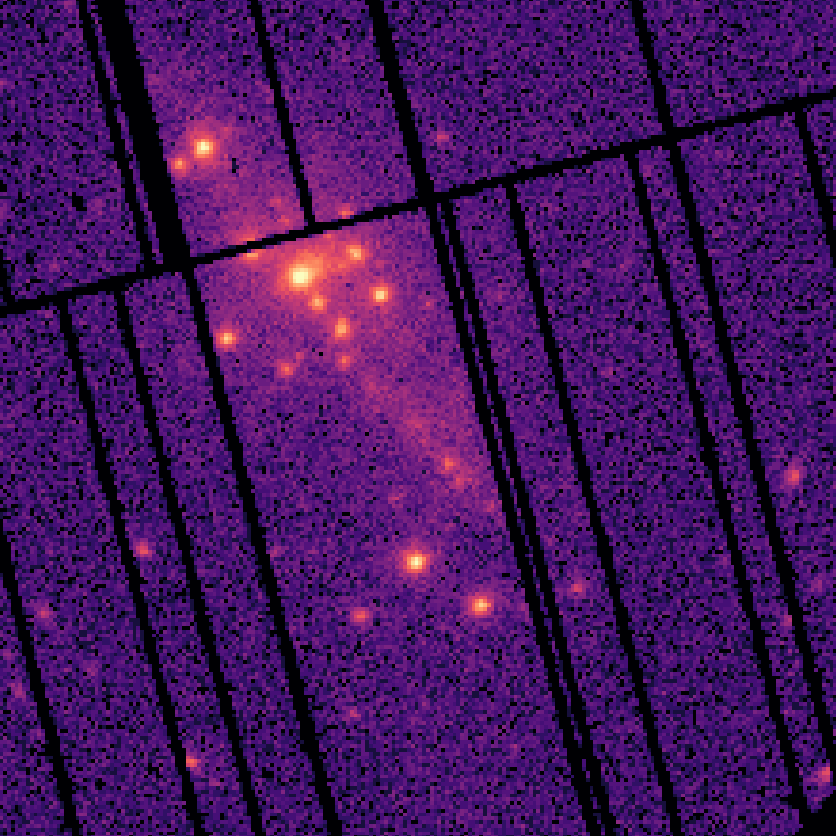
Fig 3: displays the source light curve binned at 500 s.
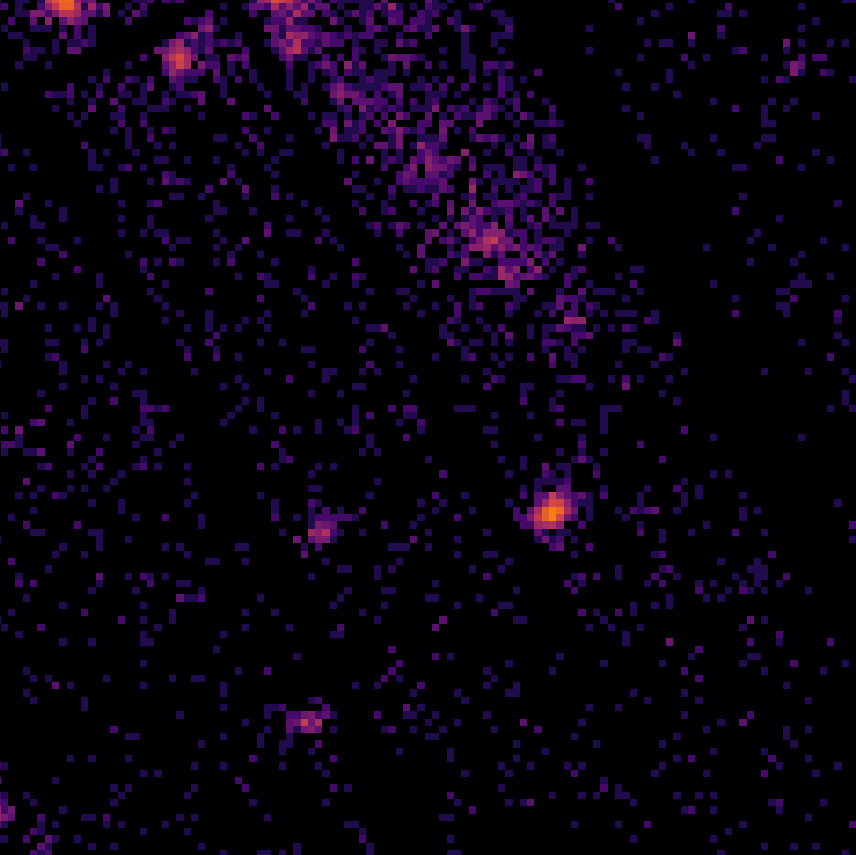
Fig 2: This four panel figure shows (from left to right) the XMM-Newton pn imaging from 2001, 2004, and 2022 along
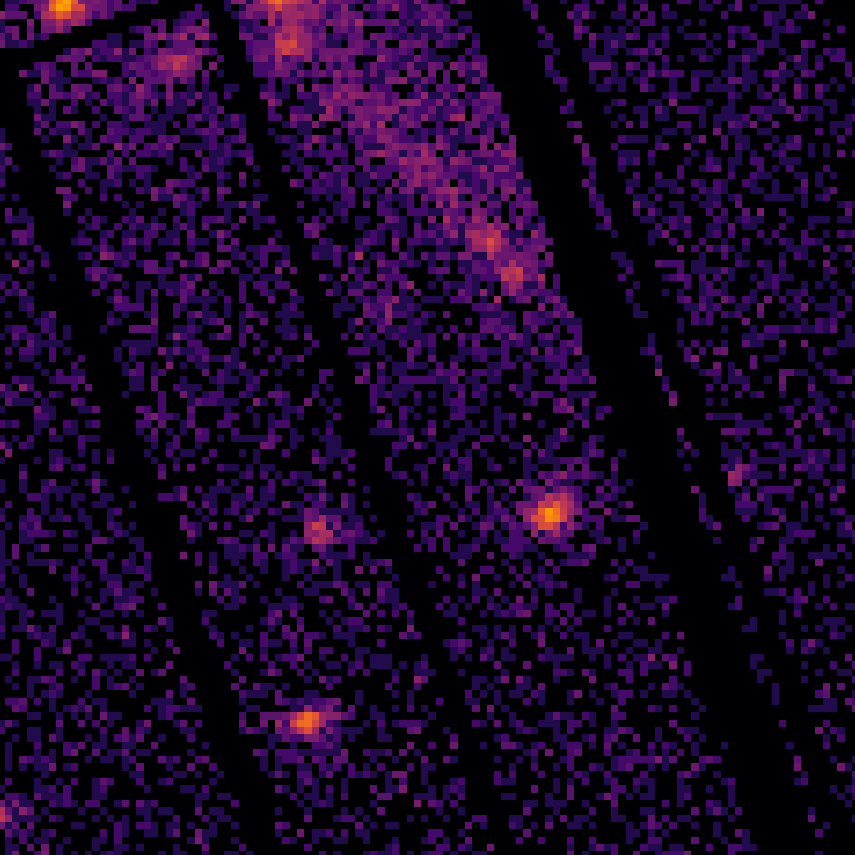
Fig 4: The favored spectroscopic models. (Top) Best-
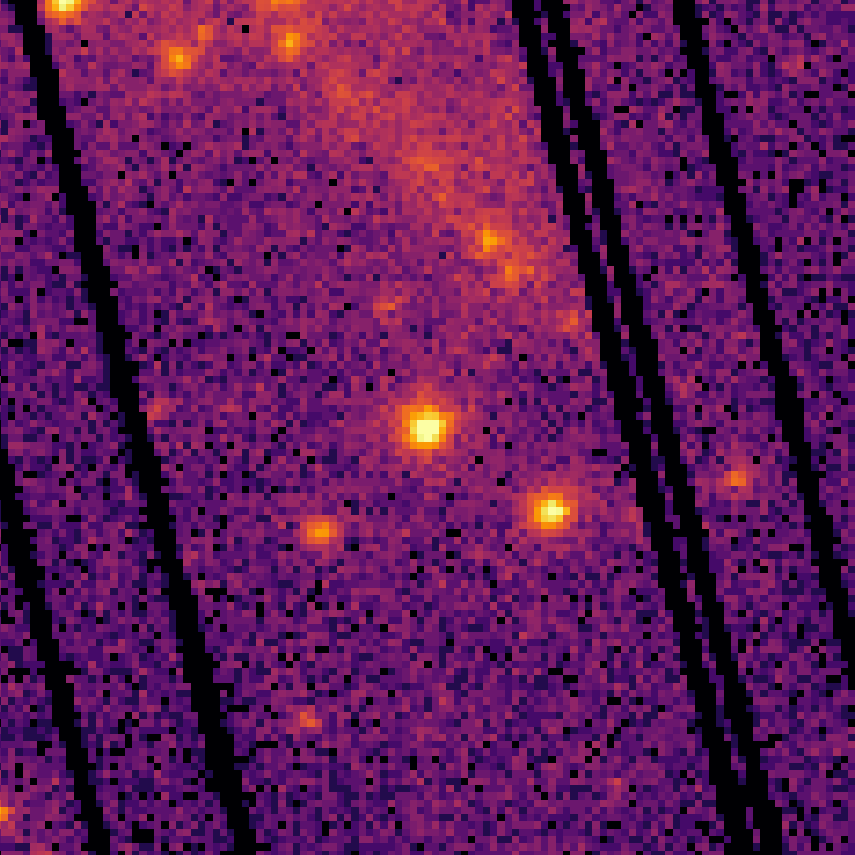
Fig 5 (page 4).
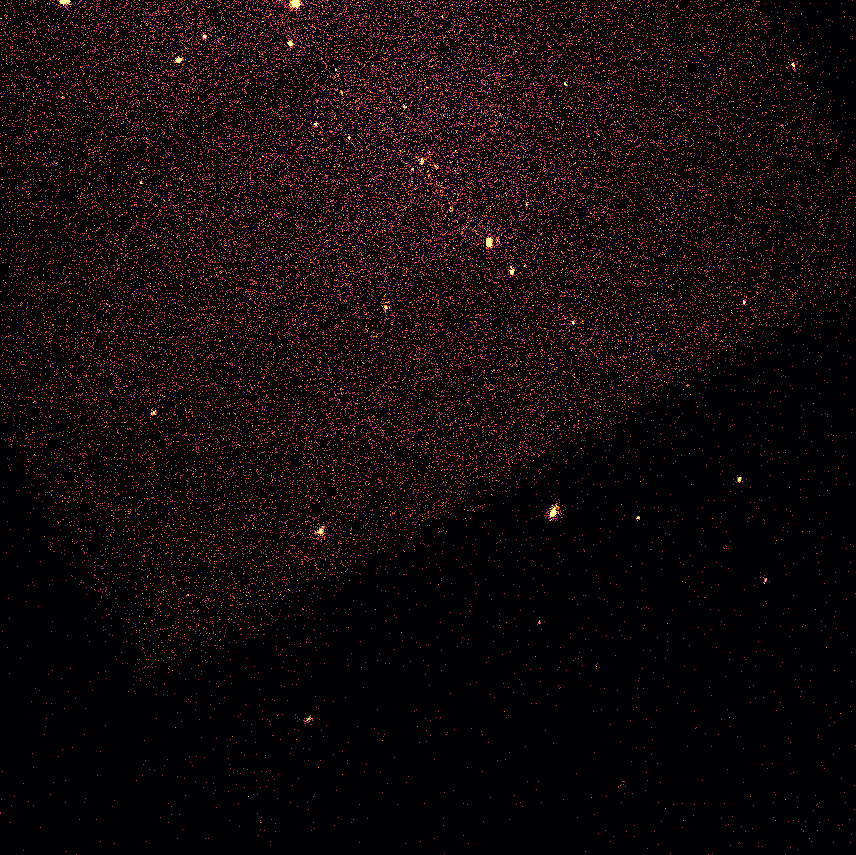
Fig 6 (page 4).
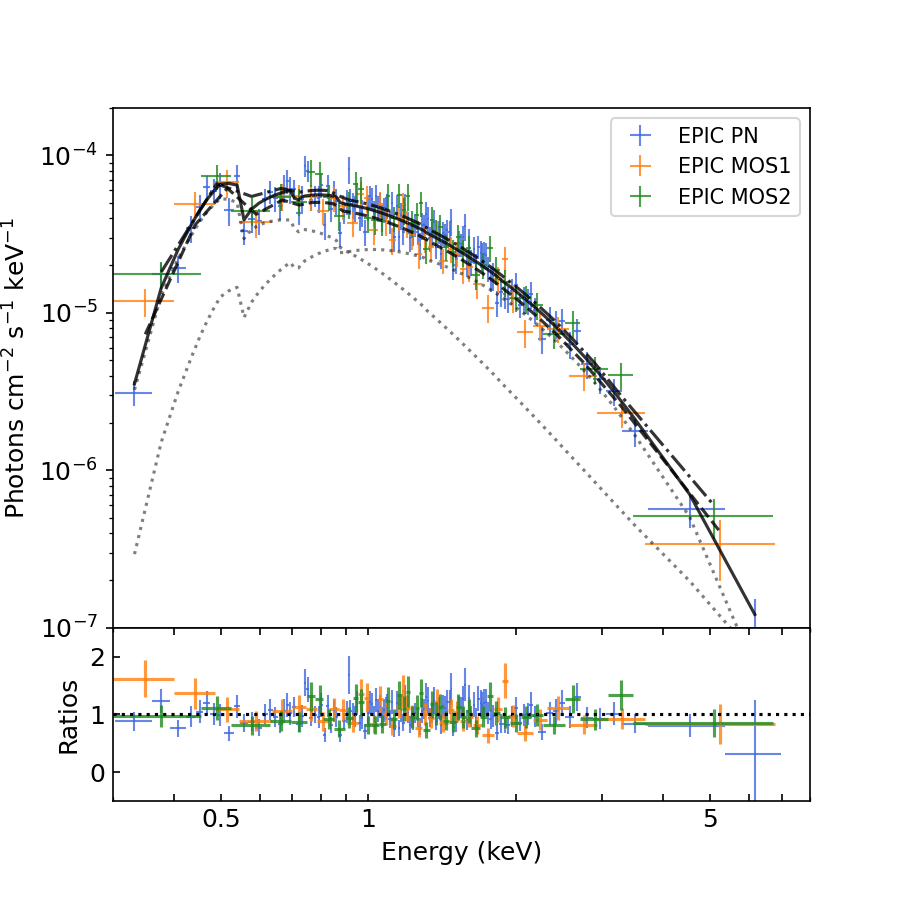
Fig 7 (page 5).
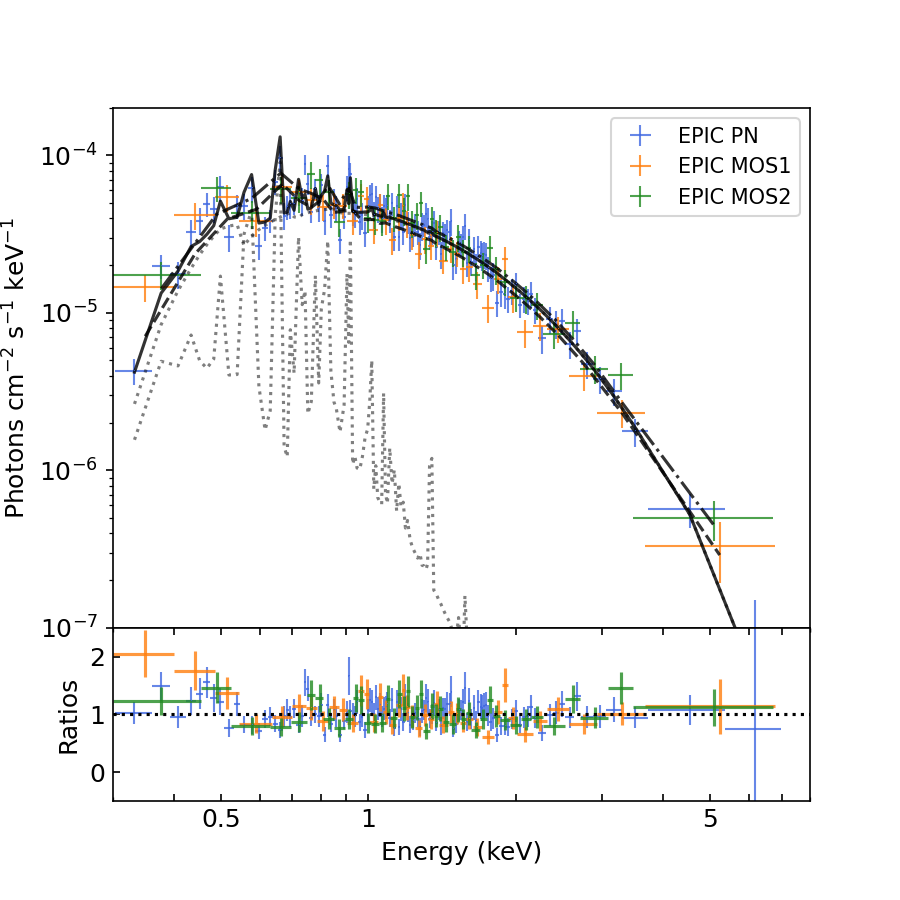
Fig 8 (page 5).
Limitations
- The source lies near the edge of the XMM-Newton Cu instrumental background hole, complicating background subtraction especially above 7 keV.
- Lack of detected variability within the 2022 XMM observation limits analysis of short-term timing properties.
- The 2018 Chandra observation excluded the source position; detection limits prior to 2022 remain limited.
- Swift-XRT detections are sparse and low-count, limiting spectral model complexity and parameter constraints from these epochs.
- No contemporaneous multiwavelength coverage simultaneous with X-ray activity, limiting counterpart identification certainty.
- Modeling assumptions on inner disk radius equating ISCO and non-spinning black hole could overestimate mass if neutron star or disk truncation applies.
Open questions / follow-ons
- What is the exact nature of the compact accretor—neutron star or black hole—and can future observations detect signatures (e.g., pulsations, bursts) to distinguish?
- What triggers the recurrent outbursts seen intermittently across >14 years, and what is the duty cycle and accretion mechanism driving the transient behavior?
- How does this off-nuclear transient relate to the ULX and XRB populations in NGC 4945—are transient ULXs a dominant population as suggested?
- Can coordinated multiwavelength observations in optical/IR/radio during future outbursts improve counterpart identification and clarify accretion environment?
Why it matters for bot defense
While this paper focuses on astrophysical transient detection and characterization rather than bot or human verification challenges, several parallels exist for CAPTCHA and bot-defense practitioners. The meticulous time-domain analysis using archival data spanning decades to detect rare transient events resembles long-term bot behavior monitoring for novel anomalies. The robust multi-component spectral modeling parallels the composite feature extraction and modeling in bot detection to separate real users from synthetic or transient bot activity. The use of multiwavelength (X-ray plus infrared) data to cross-validate and identify hidden counterparts echoes the principle of fusing multiple signals for bot decision accuracy. Additionally, the challenges of incomplete coverage, sparse cadence, and noisy backgrounds reflect typical data challenges in user-behavior modeling. While not directly providing CAPTCHA solutions, the methodological rigor, event-tracing approach, and multi-source data fusion offer useful analogies for designing bot defense systems sensitive to transient or rare attack patterns.
Cite
@article{arxiv2607_21587,
  title={ XMM-Newton and Swift Unveil Another X-Ray Transient in NGC 4945, XMM J130514.64-493311.27 },
  author={ Ryan W. Pfeifle and Kimberly A. Weaver and Jenna M. Cann and Murray Brightman and Miranda McCarthy },
  journal={arXiv preprint arXiv:2607.21587},
  year={ 2026 },
  url={https://arxiv.org/abs/2607.21587}
}