
Web-Halo Model Peak-Background Split (WHM-PBS): halo bias as a distribution, not a number
Source: arXiv:2607.21334 · Published 2026-07-23 · By Samuel Brieden, Alexander Tipp
TL;DR
This paper introduces the Web–Halo Model Peak–Background Split (WHM-PBS), a novel analytic framework that models the large-scale halo bias not as a deterministic function of halo mass, but as a distribution inherited from the cosmic-web environment in which the halo resides. By building on the cosmic web hierarchy—where haloes form inside filaments, which themselves reside inside sheets—WHM-PBS integrates moving barrier models for ellipsoidal collapse with the peak–background split formalism to predict a conditional host mass distribution for each halo. Consequently, halo bias b(M_h) becomes a strongly skewed distribution rather than a single number. The authors leverage this distribution for three applications: (i) to define physically motivated prior bands on bias relations that encompass the scatter seen in N-body simulations; (ii) to analytically predict halo stochasticity, reproducing super- to sub-Poisson shot-noise trends seen in prior simulation studies through the inclusion of halo exclusion effects; and (iii) to model assembly bias effects, notably reproducing the bias–concentration correlation inversion near a characteristic mass without tuning parameters.
WHM-PBS is derived from first principles in excursion-set theory with exact solutions to the Zhang–Hui integral equation for moving barriers corresponding to sheets, filaments, and haloes. The model predicts full distributions of linear, higher-order, and tidal bias coefficients, validated against multiple N-body simulations and previous analytic models. The analyses show the bias distributions have significant width and skewness, especially in tidal bias, matching simulation scatter. Including environment averaging helps solve projection effects in cosmological parameter inference using effective field theory (EFT) bias priors. Overall, this represents a conceptual and quantitative advance in understanding halo bias as an environmental distribution with practical implications for cosmological large-scale structure modeling.
Key findings
- Halo linear bias b1(Mh) is not a single deterministic number but a strongly skewed distribution inherited from the host cosmic-web environment P(Mf|Mh), with filament hosts giving narrower distributions than sheet hosts (Fig. 3).
- The mean bias predicted by WHM-PBS overestimates Tinker et al. (2010) benchmark by ~20% near ν ≃ 1 and ~7% near ν ≃ 3 due to calibration on morphology rather than bias (Section 4.1).
- Density bias relations b2(b1) and b3(b1) predicted by WHM-PBS remain tight and match simulations well, whereas tidal bias bs2(b1) shows significant scatter consistent with N-body results (Section 4.3 and Fig. 12).
- Including halo exclusion effects in WHM-PBS reproduces the transition from super-Poisson to sub-Poisson stochasticity in halo shot noise identified by Baldauf et al. (2013), translated into priors on EFT stochasticity amplitude parameters (Section 5).
- The model explains the sign inversion of the bias–concentration correlation (BCC) near the characteristic halo mass M_h ≃ 1.7 × 10^13 h^{-1} M_⊙ without free parameter tuning, arising naturally from the host-environment distribution (Section 6.1).
- Tidal bias priors calibrated using Lazeyras et al. (2016) simulations link the assembly bias signal in the tidal sector to the selection prior band derived in WHM-PBS, integrating the three model applications coherently (Section 6.2).
- Applying WHM-PBS-derived physically motivated bias and stochasticity priors in a synthetic DESI-like EFT inference reduces cosmological parameter projection effects typically induced by broad nuisance priors (Section 7).
Methodology — deep read
The authors develop WHM-PBS within the excursion-set theoretical framework for halo formation, modelling the smoothed linear matter density field as a Markovian random walk in the variance parameter S = σ²(M). They use moving ellipsoidal collapse barriers B(S) calibrated by Shen et al. (2006) for sheets, filaments, and haloes, instead of the fixed spherical collapse barrier. These moving barriers encode the increasing collapse threshold due to tidal shear at smaller mass scales.
The main analytic object is the exact solution to the Zhang–Hui Volterra integral equation for first-crossing distributions f(S) given these moving barriers, solved numerically. This yields unconditional and conditional mass functions n(M) and N(M_h|M_f), describing haloes within filaments and filaments within sheets (Section 2).
Key to the model is recognizing that each halo resides within a distribution of host environments (filaments or sheets) parameterized by conditional host mass distributions P(M_f|M_h) or P(M_s|M_h), inferred by Bayes' theorem from the conditional mass functions. The large-scale halo bias is computed using the peak–background split (PBS) formalism as a first-crossing response to background density or tidal perturbations. For density bias, the response is a shift in the barrier height, yielding a bias b_1 that averages over the host environment bias weighted by P(M_f|M_h) (Eq. 3.4). For tidal bias b_{s^2}, the barrier slope variation leads to a distinct convolution calculation where conditional responses to tidal background affect the conditional mass functions, resulting in a distribution of tidal bias values at fixed halo mass (Eq. 3.9).
Additional higher-order density biases (b_2, b_3) and cubic nonlocal biases (b_{Γ3}) are obtained via expansions of the first-crossing responses and co-evolution equations converting Lagrangian to Eulerian biases (Section 3).
Empirically, the WHM-PBS bias distributions and their moments are compared against several high-resolution N-body simulation measurements at z=0, confirming qualitative and quantitative agreement in bias trends and scatter (Section 4). The stochasticity of halo counts is modeled with inclusion of halo exclusion effects, reproducing the known super- to sub-Poisson shot noise transitions reported in Baldauf et al. (2013), translated into priors on EFT stochastic parameter amplitudes (Section 5).
The authors also demonstrate how assembly bias effects, specifically the bias–concentration correlation inversion around characteristic mass, emerge naturally from the environment-averaged bias distributions with no additional parameter fitting (Section 6). Using simulation calibration for the tidal bias prior, they integrate assembly bias into the prior framework.
Finally, they test the prior sets derived from WHM-PBS on synthetic idealized data mimicking EFT analyses for surveys like DESI, showing the priors reduce detrimental prior-volume projection effects when marginalizing over nuisance bias and stochasticity parameters (Section 7).
Although the theoretical development is largely analytic, exact numerical solutions to the integral equations underpin the framework. The authors provide full derivations of the moving-barrier excursion-set formalism with exact first-crossing kernels, including appendices with solver and response calculations. The data provenance is primarily from publicly known or literature N-body simulation bias measurements used for validation. Exact software release status is not explicitly stated, though the text notes new numerical solvers and compares to approximations used previously.
Technical innovations
- Replacing the deterministic halo bias–mass relation b(M_h) by an environment-averaged conditional bias distribution derived from a nested cosmic web hierarchy (halos inside filaments inside sheets).
- Exact solution of the Zhang–Hui integral equation for moving ellipsoidal barriers jointly describing sheets, filaments, and haloes, enabling analytic conditional mass and bias distributions with guaranteed normalization and positivity.
- Extension of the peak–background split to non-uniform moving barriers, enabling analytical prediction of tidal bias distributions that incorporate the effect of variable barrier slopes and their impact on conditional mass functions.
- Integration of stochasticity modeling including halo exclusion effects into the analytic bias distribution framework, reproducing known super- to sub-Poisson halo shot noise trends without free parameters.
- Analytic explanation of assembly bias phenomena such as bias–concentration correlation inversion from first principles via environment-averaged bias distributions, unifying halo bias, stochasticity, and assembly bias modeling.
Baselines vs proposed
- Tinker et al. (2010) linear bias fit: benchmark bias values used for comparison; WHM-PBS mean bias overpredicts by ~20% at ν≈1 and ~7% at ν≈3.
- Sheth and Tormen (1999) PBS bias: within 8% of Tinker et al. bias; WHM-PBS mean bias less accurate but predicts bias distribution instead of just mean.
- Excursion-set-peaks prediction: ∼2% agreement with Tinker et al. mean bias, better than WHM-PBS mean but lacks scatter modeling.
- Baldauf et al. (2013) halo stochasticity shot-noise trend: WHM-PBS reproduces transition from super-Poisson to sub-Poisson shot noise when including halo exclusion effects.
- Paranjape et al. bias–concentration correlation inversion: WHM-PBS explains sign inversion near characteristic mass (~1.7×10^13 h^{-1} M_⊙) without tuning parameters.
Figures from the paper
Figures are reproduced from the source paper for academic discussion. Original copyright: the paper authors. See arXiv:2607.21334.
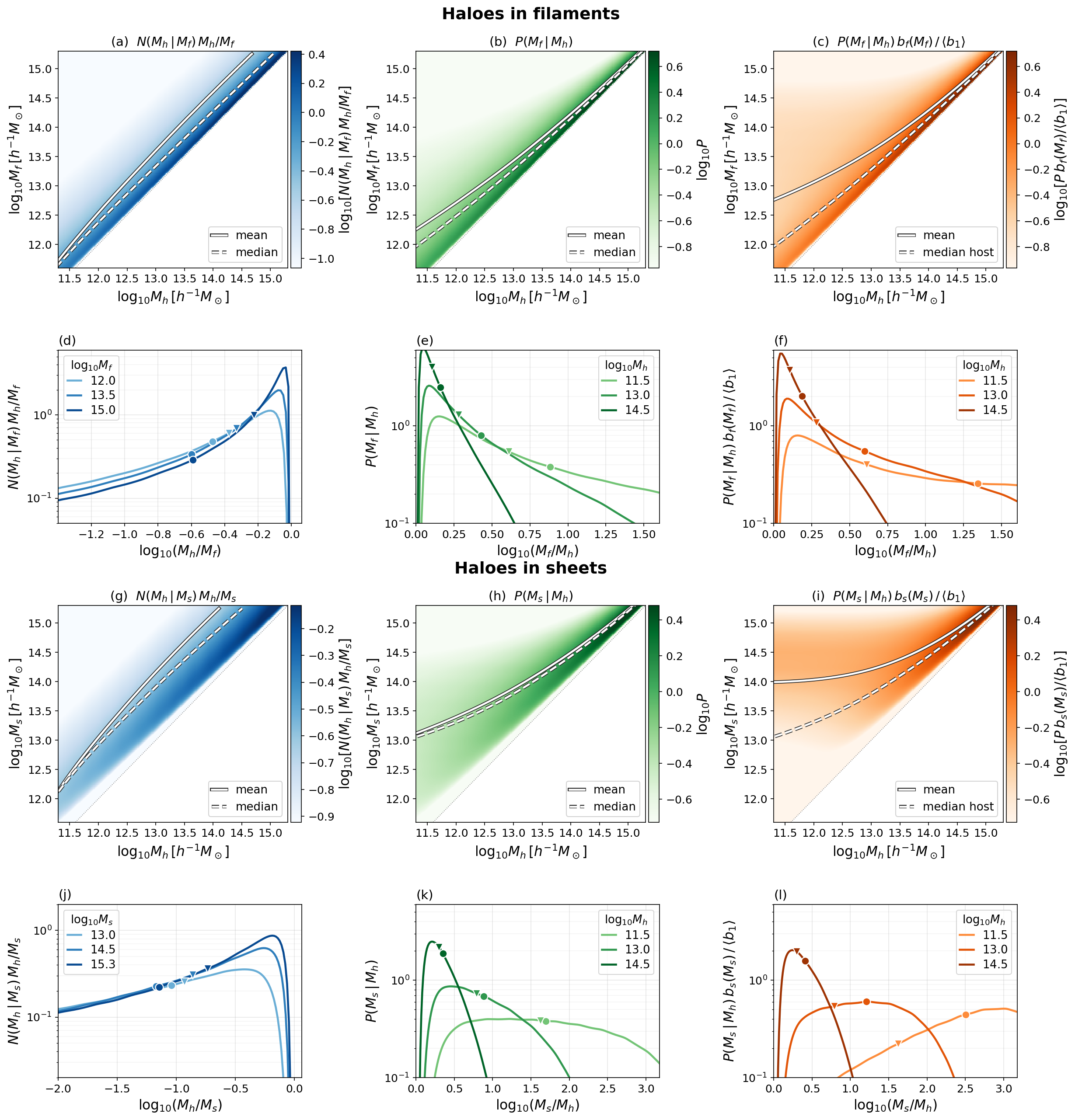
Fig 2: The cosmic-web conditional mass functions and the build-up of the environment-averaged
Limitations
- The WHM-PBS mean bias systematically overpredicts existing simulation-calibrated bias fits by up to 20% at moderate peak height ν~1.
- The current analytic framework assumes a Markovian (sharp k-space filtered) random walk, whereas realistic filter effects induce step correlations not accounted for.
- Higher-derivative bias terms beyond cubic nonlocal bias b_Γ3 are not included and could impact precision bias modeling.
- The tidal bias distribution calculation involves approximations such as treating filament barrier slope as nearly constant; full exact treatment may differ slightly.
- Absence of direct adversarial or robustness evaluations under extreme cosmological parameters or non-standard structure formation.
- Reproducibility details such as code or frozen weights release are not provided, potentially limiting direct application.
Open questions / follow-ons
- How well does the WHM-PBS hold under more realistic non-Markovian filtering and correlated step processes in excursion-set theory?
- Can the framework be extended to include higher-derivative and velocity bias terms systematically within the cosmic-web environment-based model?
- What is the quantitative impact of WHM-PBS bias distributions on cosmological parameter estimation from real survey data beyond synthetic tests?
- Can the analytic approach predict galaxy bias scatter and assembly bias directly, incorporating halo occupation and baryonic physics?
Why it matters for bot defense
Although WHM-PBS addresses a cosmological structure formation problem unrelated to bot defense or CAPTCHA systems, its conceptual advance—modeling an observed deterministic parameter as a distribution conditioned on hierarchical environment—can inspire analogous approaches in bot detection. For example, rather than assigning a single risk score or bias to a user session, one could model the distribution of behavior conditioned on layered contextual features, capturing intrinsic variability and uncertainty.
The methodology of integrating exact conditional distributions and environmental priors could bolster bot-defense systems seeking to quantify uncertainties and model complex correlated factors influencing authenticity. Similarly, the approach to modeling stochasticity arising naturally from distributions rather than fixed parameters might aid CAPTCHA difficulty adaptation by providing a probabilistic framework for challenge scoring. However, direct technical application is limited, and the insights mainly serve as a conceptual analog rather than an immediately actionable bot-defense algorithm.
Cite
@article{arxiv2607_21334,
  title={ Web-Halo Model Peak-Background Split (WHM-PBS): halo bias as a distribution, not a number },
  author={ Samuel Brieden and Alexander Tipp },
  journal={arXiv preprint arXiv:2607.21334},
  year={ 2026 },
  url={https://arxiv.org/abs/2607.21334}
}