
Transparent by Design, Usable in Practice? A Formative Usability Study of a Conversational Product Advisor
Source: arXiv:2607.21513 · Published 2026-07-23 · By Kevin Schott, Dagmar Kern, Daniel Hienert
TL;DR
This paper presents a formative usability study of a transparent conversational product advisor chatbot designed for laptop search. The system uses a hybrid architecture that separates a deterministic ranker from a constrained language model, enabling transparent ranking explanations and comparison features embedded in a natural language dialogue interface. The study involved seven participants completing three laptop search tasks with think-aloud protocols, post-task questionnaires, and interviews. While participants reported high overall ease and satisfaction, the key finding was that transparency-by-design alone did not guarantee user understanding; the ranking explanation feature—intended to improve transparency—emerged as the most severe usability problem. Participants also valued the chatbot's labor-saving properties but desired more direct-manipulation controls for finer-grained user input and sorting.
Key findings
- Participants rated task ease high (mean SEQ scores 6.14, 5.43, 6.14/7) and satisfaction slightly increased across tasks.
- "Why this ranking?" ranking explanation feature caused the most severe usability problem (severity 3/4) due to opaque, negatively framed penalty values and difficult radar chart visualization.
- Discoverability and navigation problems affected 5 of 7 participants, including confusion over card selection and mixing up explanation vs comparison modals.
- Participants wanted explicit filter controls, sorting options, and tailored explanations (raised by 4 of 7).
- Ranking order was unclear to some participants, with 2 uncertain whether leftmost item was best ranked.
- AI-generated web review summaries were perceived as bland and sometimes untrustworthy; provenance labels helped build trust.
- Voice input inadvertently cut off mid-utterance for 2 participants, prompting usability issues.
- Context retention was limited—system lost track of recently discussed laptops in 2 participants’ interactions.
Threat model
The adversary is not adversarial in a security sense but represents the typical user facing opaque recommendations from an LLM-powered conversational product advisor. Users attempt to understand, trust, and exert control over recommendations but may be misled by hidden or negatively framed ranking logic. The system assumes no malicious manipulation but does not evaluate robustness to adversarial inputs or deceptive AI outputs.
Methodology — deep read
The study targeted the usability of a transparent conversational product advisor for laptops designed with built-in transparency features: constrained natural language generation grounded in catalog data, an on-demand ranking explanation modal (with radar charts and penalty tables), and a comparison feature. The threat model implicitly includes shoppers relying on AI recommendations and seeking to understand and trust results, though adversarial aspects were not evaluated.
Data collection involved seven UK-resident English-speaking participants recruited from Prolific, each completing three fixed laptop search tasks in a remote moderated think-aloud session averaging 40 minutes. Task 1 was an open free search using participant’s own requirements to exercise natural language elicitation and initial UI exploration; Task 2 focused on exploring the ranking explanation feature; Task 3 included refining requirements with context retention and using the comparison feature.
Participants’ screens and audio were recorded and automatically transcribed. Post-task subjective measures included the Single Ease Question (SEQ) and satisfaction on 7-point Likert scales, plus a shortened BUS-11 chatbot usability scale on 5-point Likert scales to assess functional interactive conversation quality and responsiveness. A closing semi-structured interview solicited feedback on helpful/confusing features and trust.
Analysis combined thematic qualitative coding of transcripts and logs to identify usability problems, rated by severity (1 minor to 4 critical) following Nielsen’s framework. Quantitative responses were descriptively summarized. Only one coder conducted the analysis.
The system architecture separated a rigid deterministic ranker applying categorical and numeric filters over a structured laptop spec catalog from a constrained language model that generated grounded natural language responses to user queries, limiting hallucination and enhancing transparency. The ranking explanation modal presented a radar chart comparing match scores for up to three laptops and a penalty table showing per-attribute ranker penalties labeled with a legend.
Participants interacted via text or speech. The chatbot reflected back inferred requirements and provenance labels on AI-generated content. The study did not include adversarial or distribution shift evaluations, nor automated behavioral or success metrics.
Reproducibility details include availability of full task prompts, interview guides, and interface screenshots on OSF. The ranker’s laptop catalog was derived from Amazon data; the language model and full codebase are not publicly disclosed.
Technical innovations
- A hybrid architecture combining a deterministic ranker with constrained natural-language generation to ensure grounded, explainable conversational recommendations.
- On-demand, per-attribute ranking explanation combining positive-framed radar charts with a penalty table breakdown for transparent auditability.
- Integration of conversational preference elicitation with supplemental direct-manipulation features like comparison modals and provenance-labeled AI-generated content.
- Severity-rated thematic usability coding applied to think-aloud data to systematically prioritize critical transparency and control issues.
Datasets
- Laptop catalog — unspecified size — derived from Amazon Windows laptops product data
Figures from the paper
Figures are reproduced from the source paper for academic discussion. Original copyright: the paper authors. See arXiv:2607.21513.
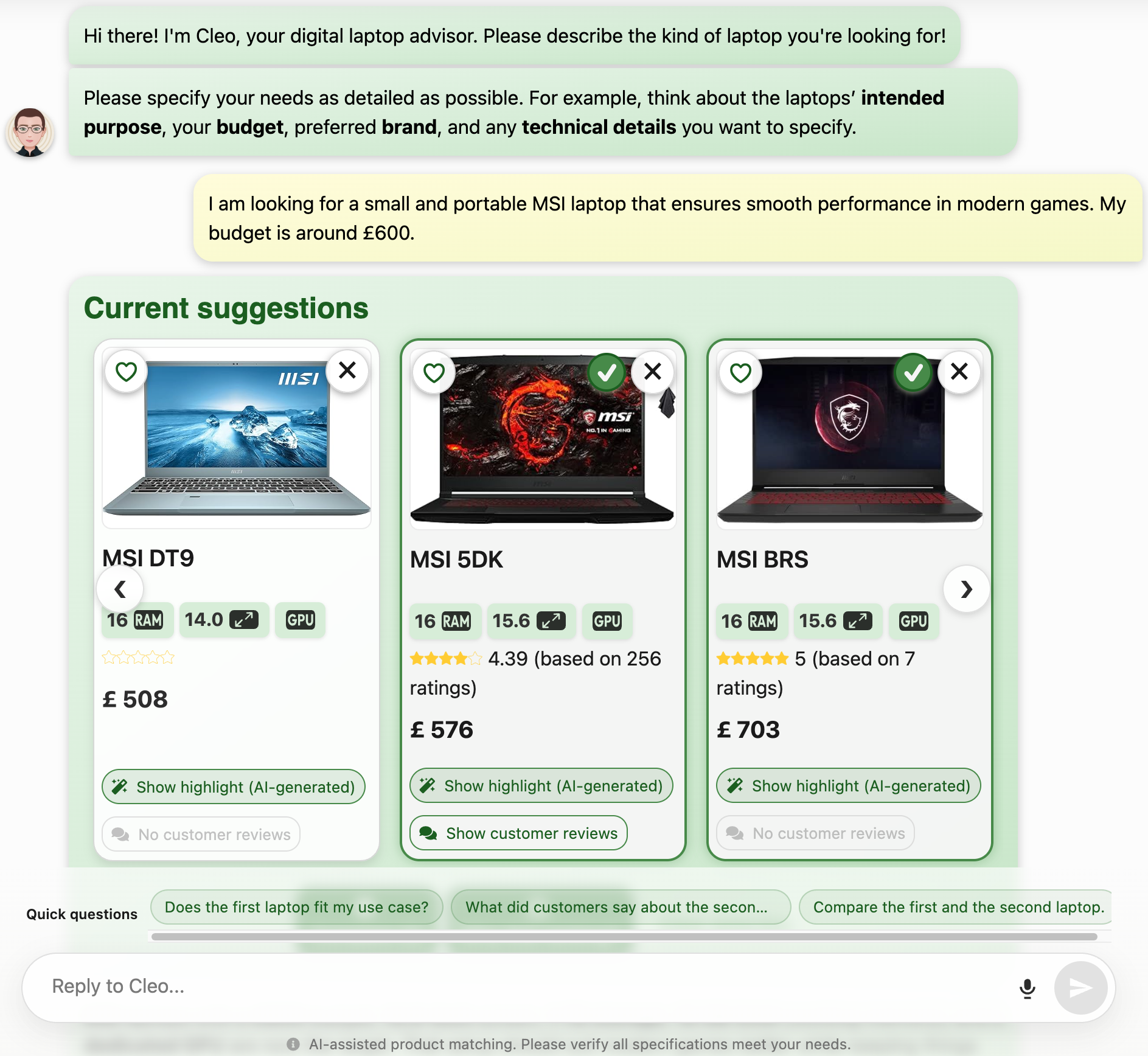
Fig 1: The interface of the evaluated product advisor and the views central to our findings: (a, b) the conversational elicitation
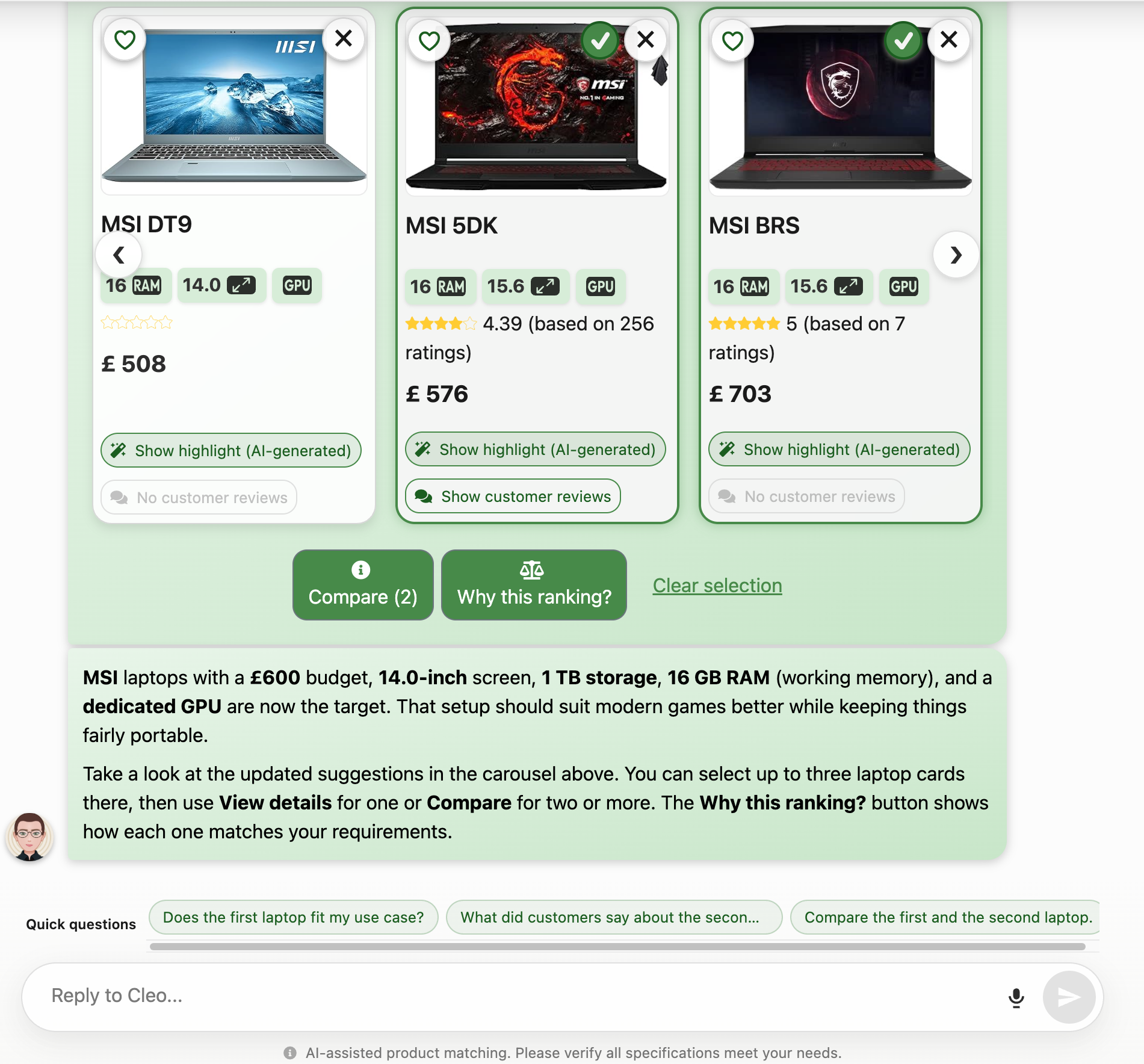
Fig 2 (page 2).
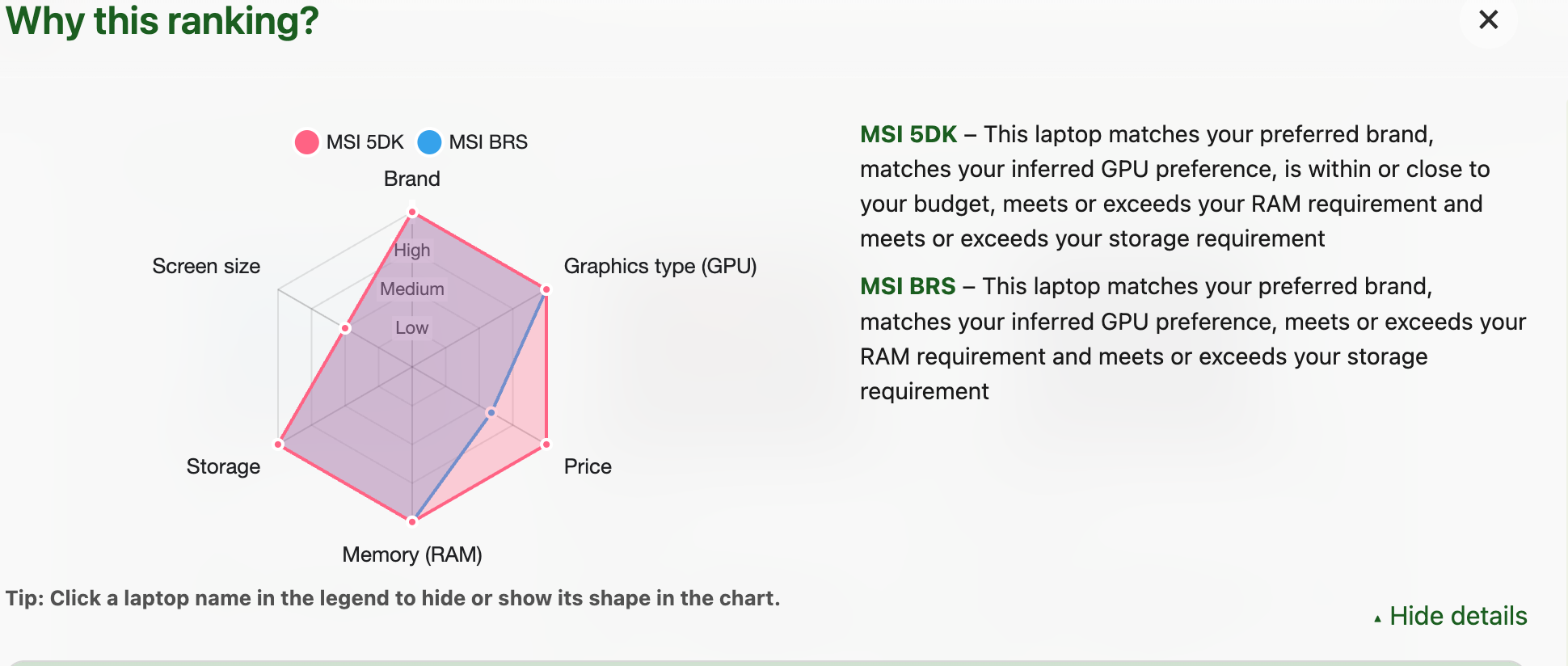
Fig 3 (page 2).
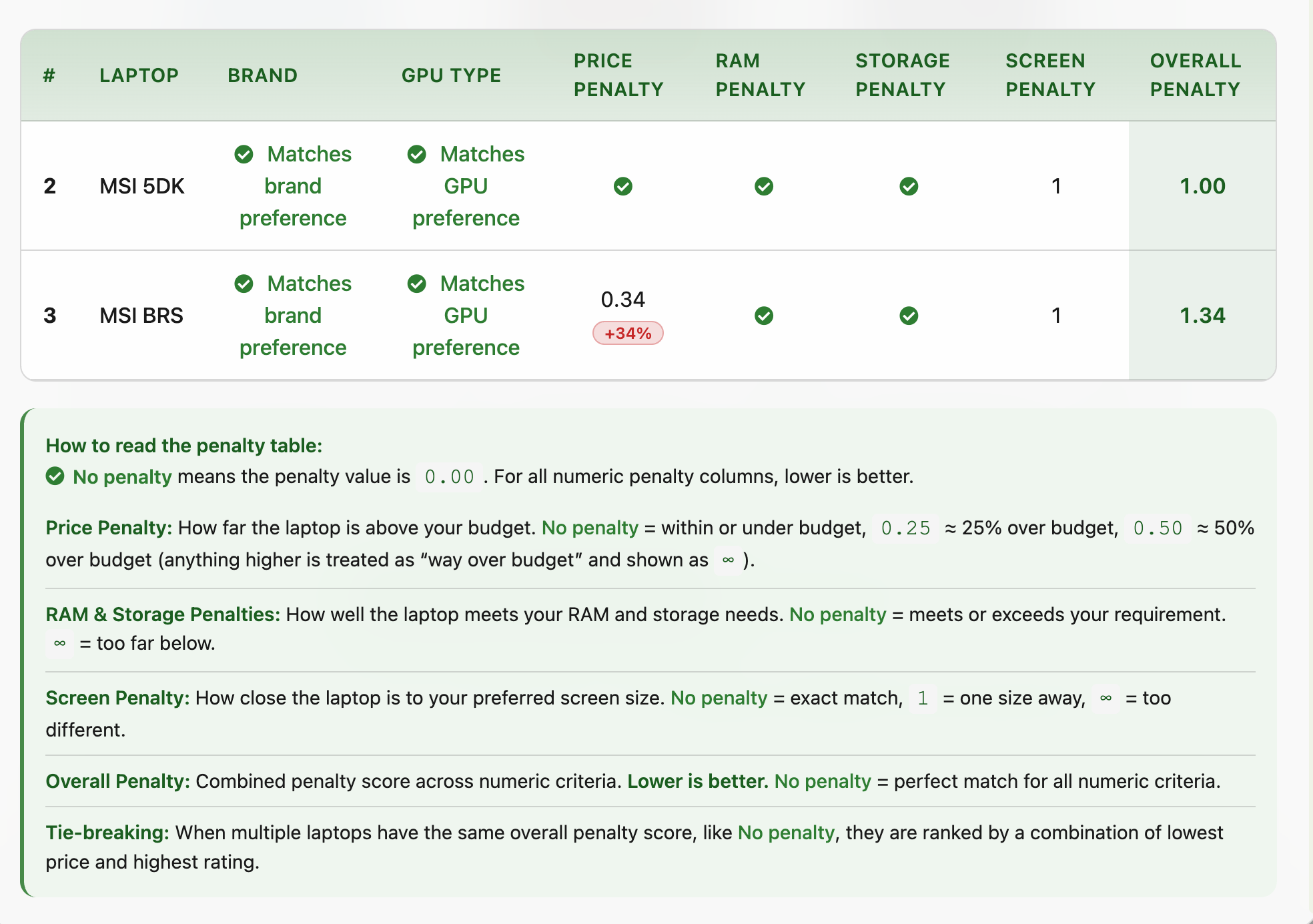
Fig 4 (page 2).
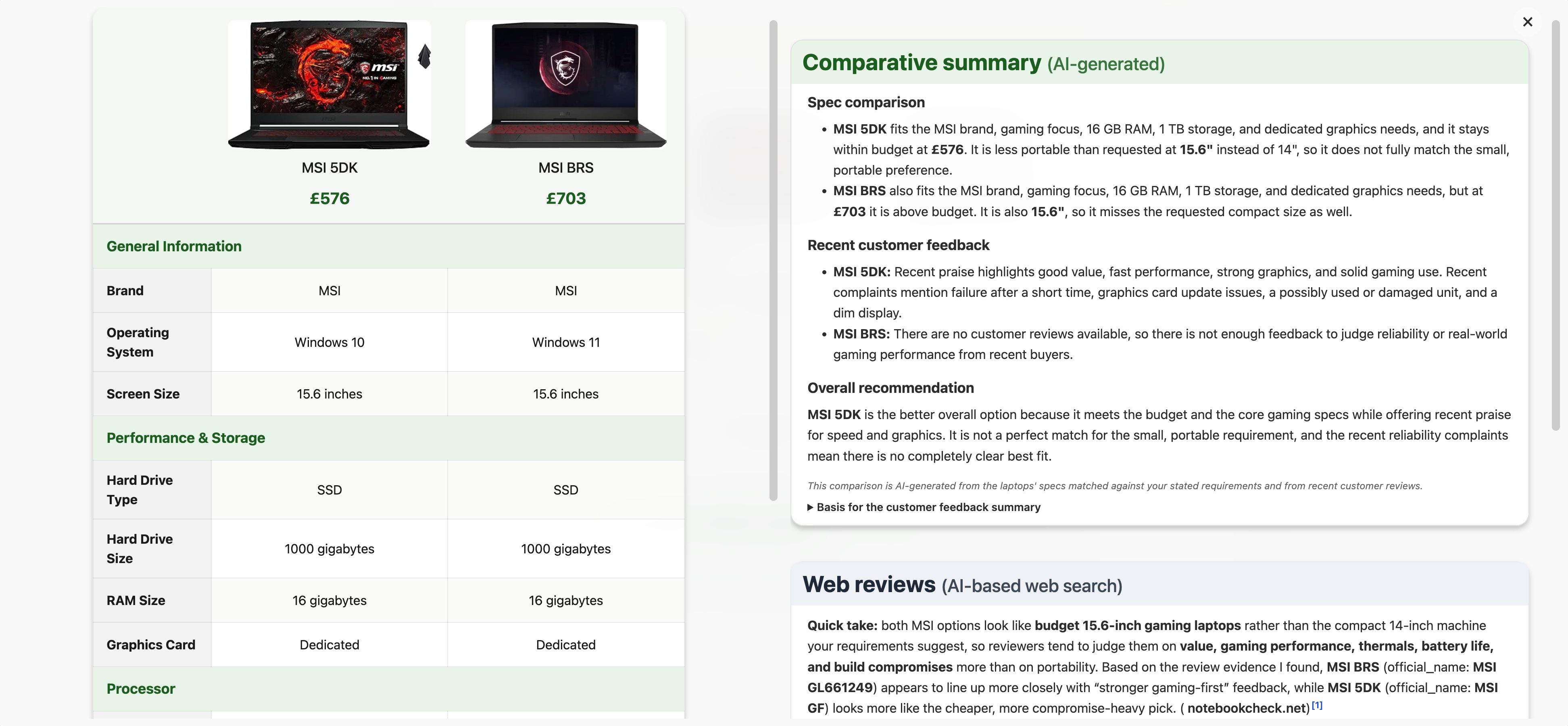
Fig 2: Quantitative results (𝑁= 7; bars = mean, whiskers = 𝑆𝐷, dots = individual participants). Left: post-task ease (SEQ) and
Limitations
- Small sample size (n=7) limits frequency estimates and generalizability; study intended as formative design research.
- Single-system evaluation with no control or comparison conditions; potential novelty effects.
- Moderated sessions led to some feature exploration only after prompting, which may not reflect spontaneous use.
- Measures were subjective self-reports and qualitative coding; lacked objective task success or behavioral trust metrics.
- Single analyst conducted coding and severity rating, risking evaluator bias.
- Ranking explanation features focused on structured laptop specs, may not translate to experiential or less structured products.
Open questions / follow-ons
- How can semantic retrieval of experiential or unstructured product attributes be integrated into ranking explanations without losing transparency?
- Would adding direct manipulation controls (filters, sliders, user-driven sorting) measurably improve comprehension, trust, and adoption in a summative evaluation?
- How do users with different domain knowledge levels (low, medium, expert) vary in their trust and reliance on conversational advisors with built-in transparency?
- Can alternative visualization techniques for ranking explanations better balance detail and legibility for multiple items?
Why it matters for bot defense
For bot-defense and CAPTCHA engineers, the core takeaway is the nuanced challenge of transparency in LLM-driven conversational systems: making internal logic understandable and trusted by users is not solved by merely surfacing raw ranking data or expose decision criteria. Negative framing of internal model scores (penalties) can confuse users, reducing effectiveness. Delivering transparent explanations requires careful visualization design, positive framing, and supporting direct-manipulation controls to maintain user trust and agency.
This study warns that conversational AI interfaces designed to delegate decision-making may inadvertently reduce user understanding and control if transparency explanations are opaque or cumbersome. Bot-defense systems relying on explainability or user steering mechanisms should consider these usability pitfalls, emphasizing legible, user-confirmable explanations rather than assuming transparency by design works in practice.
Cite
@article{arxiv2607_21513,
  title={ Transparent by Design, Usable in Practice? A Formative Usability Study of a Conversational Product Advisor },
  author={ Kevin Schott and Dagmar Kern and Daniel Hienert },
  journal={arXiv preprint arXiv:2607.21513},
  year={ 2026 },
  url={https://arxiv.org/abs/2607.21513}
}