
Synthetic data generation framework for quality control automation in gravure printing
Source: arXiv:2607.21577 · Published 2026-07-23 · By Korota Arsène Coulibaly, Mohamed Hamlich, Khalid Hmali, Andrea Trombin
TL;DR
This paper addresses the challenge of automating quality control in rotogravure printing, where manual inspection remains slow, expensive, and subjective. The core barrier to deploying deep learning-based defect detectors (like YOLO or Vision Transformers) is the scarcity of labeled real-world defect images given defect rarity and annotation difficulty. To overcome this, the authors propose a synthetic data generation framework specifically designed to model and simulate key gravure printing defects—creases, streaks, misregistration, and fisheyes—with pixel-accurate segmentation masks generated automatically alongside defected images. This synthetic dataset (7,533 images) trained an RF-DETR model, which achieved strong transfer performance with an 80.9% mAP on real industrial test images without using any real defect training data. The detailed simulation models incorporate physical and photometric characteristics of each defect type, enabling creation of rich, diverse, and accurate training data that bridges the reality gap common in industrial machine vision scenarios.
Key findings
- Using 7,533 synthetic images of gravure printing defects, an RF-DETR Large model achieved 80.9% mAP@50 on a held-out real inspection dataset.
- The model trained solely on synthetic data obtained Precision = 85.6%, Recall = 78.3%, and F1-score = 81.7% when evaluated on live production defect images.
- The fisheye defect simulation models crater-like ink absence with a bright center and darker rim (Equation 1), realistically reproducing contamination effects.
- Streak defects are generated using a parabolic cross-profile combined with 1D Perlin noise longitudinal texture for photometric realism (Equation 3).
- Misregistration defects simulate multi-cylinder misalignment by transparent ink fringe overlays aligned precisely on pattern edges extracted by a deep contour detector.
- Creases involve geometric pixel displacement with Gaussian decay from a fold line combined with shadow and highlight photometric layers for volume effect (Equation 5 and 6).
- The synthetic segmentation masks capture subtle defect footprints at pixel-level accuracy, surpassing manual annotation fidelity (Fig. 3, 5, 7, 9).
- The framework controls defect variety and severity via random parameters, allowing subtle to extreme defect scenario modeling critical for robust model training.
Threat model
Not applicable. The paper is not a security-focused work but addresses challenges of limited training data for industrial defect detection. The primary 'adversary' is the data scarcity problem that limits machine learning performance.
Methodology — deep read
Threat Model & Assumptions: The adversary is not directly applicable here as this is an industrial computer vision and synthetic data research. The primary challenge is scarcity of real defect images for training, so the threat is lack of sufficient labeled samples to train robust deep learning models.
Data: The authors collected clean reference images (healthy printed patterns) and applied their synthetic defect pipeline to generate 7,533 defective images paired with pixel-accurate segmentation masks for each defect class. The synthetic dataset was split using Roboflow for rigorous evaluation. Testing was performed on a completely independent, real-world dataset from a live production line with authentic defect images.
Architecture/Algorithm: The core architecture for evaluation was RF-DETR Large, a state-of-the-art object detection and instance segmentation model. The novelty lies in the defect simulation pipeline, which includes mathematically and physically motivated algorithms for each defect type:
- Fisheyes: crater effect modeling with concentric regions for ink absence (bright crater center) and darkened rim (β factor).
- Streaks: vertical bands with parabolic cross-profile and longitudinal 1D Perlin noise texture to capture organic streak texture.
- Misregistration: uses a pretrained contour detection CNN to extract shape skeletons, isolates color channel-specific edges, and applies translated, dilated ink fringes per cylinder with transparency α, synthesizing physical misalignments.
- Crease: pixel displacement modeled as Gaussian decay influenced by distance to fold line combined with additive photometric effects (shadows, highlights, centerline) modulated by color saturation and Perlin noise. Each defect generation function simultaneously outputs the defective image and its segmentation mask. Random parameters are sampled for location, size, intensity, and number of defects per image.
Training Regime: Details of training (epochs, batch size, optimizer, seed) are not explicitly provided. The model was trained purely on synthetic data and evaluated on real defect data.
Evaluation Protocol: Metrics reported include Precision, Recall, F1-score, and mAP@50, assessed on real defect images not used during training or validation. Evaluation demonstrates the ability of the synthetic-trained model to generalize to real-world defects.
Reproducibility: The authors provide code at https://github.com/Korotaa/STAGE-PLASTIMA to generate synthetic data. The real defect dataset is proprietary and not released. Detailed algorithms for all defect types support reproducibility. Some hyperparameter and training regime details are sparse.
Example end-to-end: Starting from a clean pattern image, the framework randomly selects 1-N defects to apply. For each defect, it samples location, size, and visual parameters. For a misregistration defect, it extracts edges with a pretrained model, isolates per-cylinder color regions, and overlays shifted ink fringes with alpha blending, updating the segmentation mask. After all defects are applied sequentially, the final image and combined mask are saved. The full synthetic dataset built this way is used to train RF-DETR instance segmentation to detect defects on real testing images.
Technical innovations
- Physically grounded mathematical models for multiple gravure printing defects enabling realistic photometric and geometric simulation.
- Integration of a structured contour detector and CMYK channel isolation to simulate color-fringe misregistration defects precisely on pattern edges.
- Generation of pixel-accurate segmentation masks simultaneously with defect image synthesis, eliminating manual annotation.
- Use of procedural noise (Perlin noise) combined with parametric intensity profiles to model subtle texture variations in defects like streaks and creases.
Datasets
- Synthetic gravure printing defect dataset — 7,533 images — generated by the proposed framework
- Industrial real defect dataset — size unspecified — proprietary production line defect images used for testing only
Baselines vs proposed
- RF-DETR Large trained on synthetic data: mAP@50 = 80.9% on real defect test set, Precision = 85.6%, Recall = 78.3%, F1 = 81.7%
- No comparison to real-data trained model baselines reported
Figures from the paper
Figures are reproduced from the source paper for academic discussion. Original copyright: the paper authors. See arXiv:2607.21577.
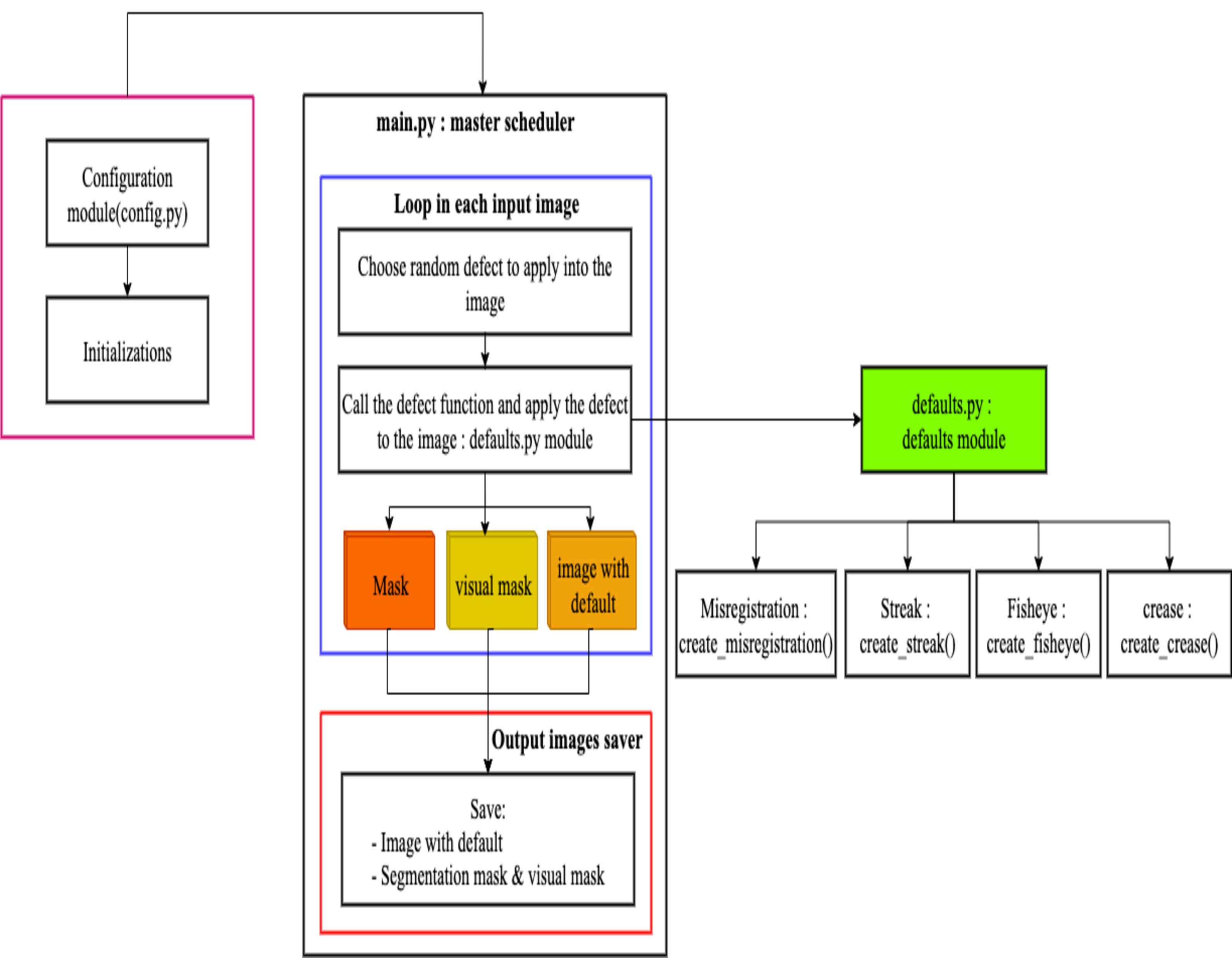
Fig 1: Framework architecture
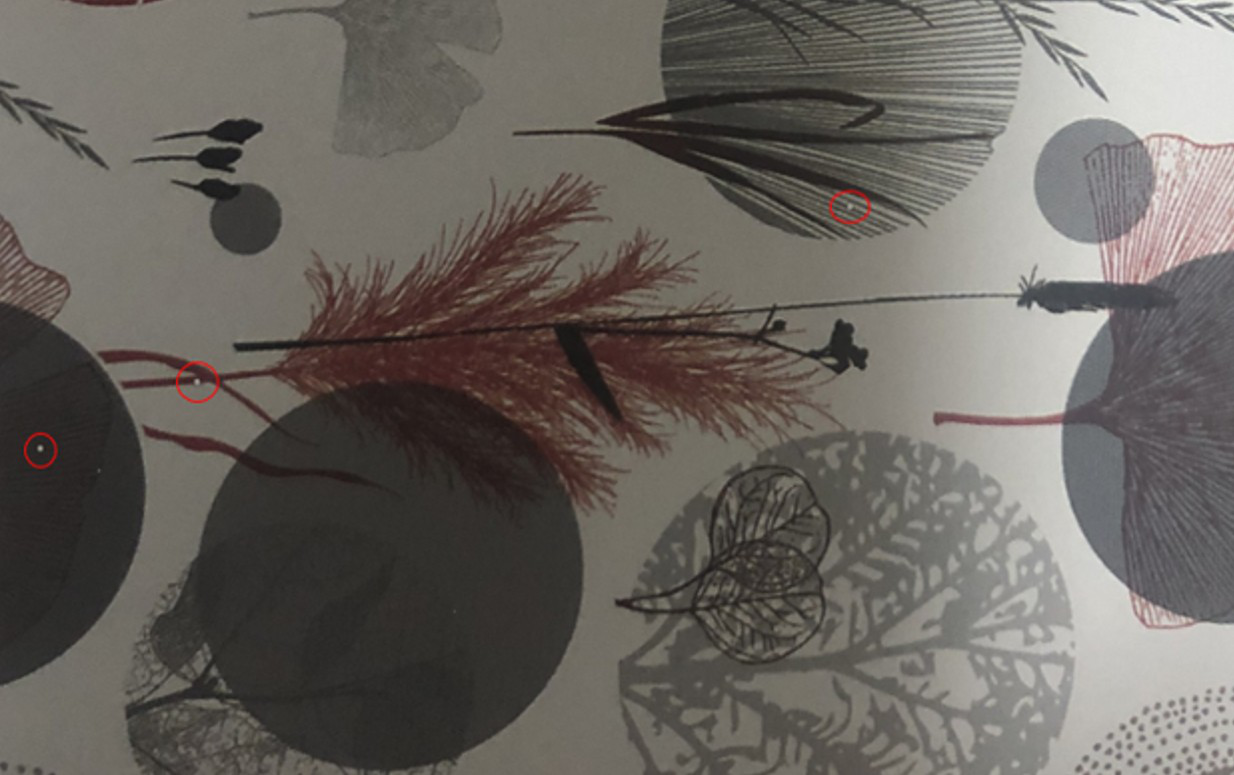
Fig 2: shows a complex pattern to which white dot defects have been

Fig 3: Fisheye mask
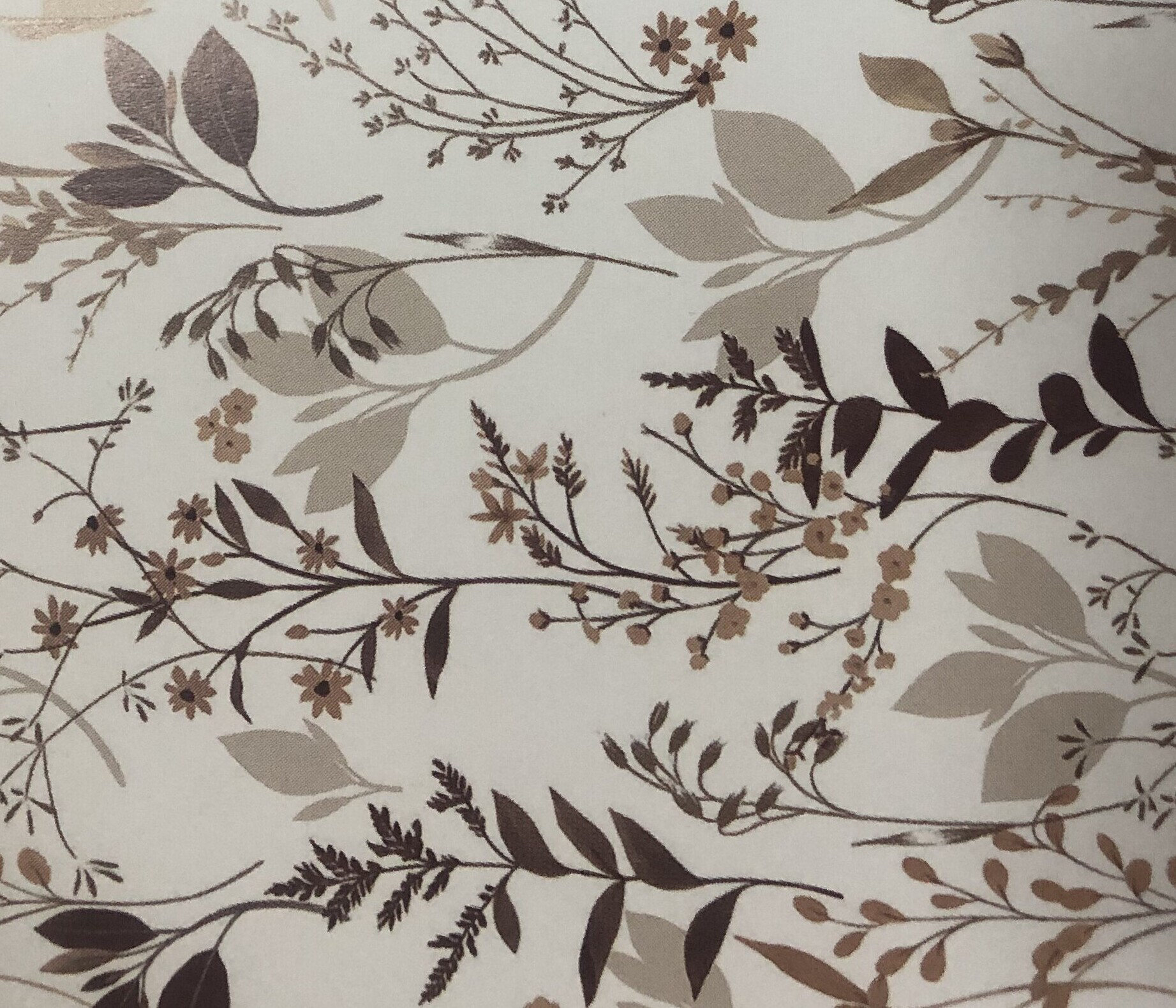
Fig 4: Streak defect
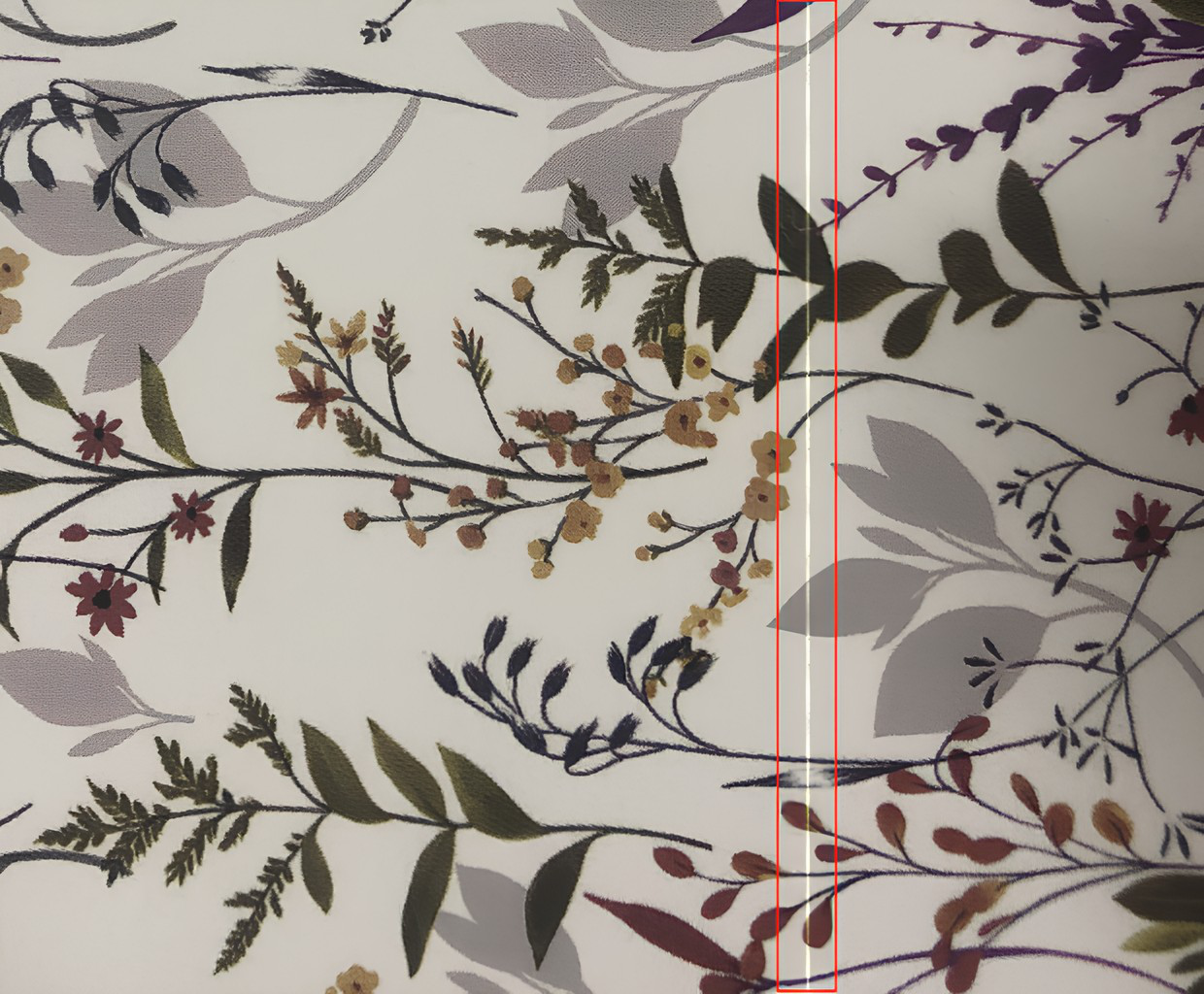
Fig 5: Streak mask, a binary image that isolates the exact area of the streak, confirming

Fig 6: Misregistration defects. Cylinders offset alignment causes incorrect superposition

Fig 9: Crease mask defect.
Fig 7: Misregistration defect mask. The mask corresponds to the walls (drawings or
Limitations
- No adversarial robustness or distribution shift tests provided; generalization beyond tested production line unknown.
- Training hyperparameters and detailed training regime omitted, limiting reproducibility of detection results.
- Real-world defect dataset used for testing is proprietary and not publicly available.
- Effectiveness on other defect types or printing techniques beyond rotogravure not evaluated.
- Potential differences between synthetic and rare or evolving defect variants not fully characterized.
- No ablation studies reported isolating impact of individual defect models on final detection metrics.
Open questions / follow-ons
- How well can this synthetic data framework generalize to new defect types or patterns not modeled explicitly?
- Can the framework support real-time synthetic data augmentation for continual learning in production?
- What is the relative importance of each defect simulation in contributing to final model accuracy on real defects?
- How would joint training on hybrid synthetic and scarce real defect data affect generalization and robustness?
Why it matters for bot defense
This work is relevant to bot-defense and CAPTCHA practitioners interested in automated visual anomaly detection under extreme data scarcity. The approach demonstrates the feasibility of using physically inspired synthetic data generation to train robust object detection and segmentation models when real-world annotated images are prohibitively rare or expensive to collect. Key lessons include the value of modeling realistic defect physics and textures combined with exact ground truth mask generation, which can transfer well to real inspection scenarios. For CAPTCHA and bot-defense, synthetic data frameworks like this could inspire approaches to generate rare or adversarial input samples for robust classifier training, especially when labeled attack data is scarce or costly. The principled use of structured semantic defect simulation and validation on live data shows synthetic training as a strategic line of defense for visual AI systems operating in constrained-data industrial or security environments.
Cite
@article{arxiv2607_21577,
  title={ Synthetic data generation framework for quality control automation in gravure printing },
  author={ Korota Arsène Coulibaly and Mohamed Hamlich and Khalid Hmali and Andrea Trombin },
  journal={arXiv preprint arXiv:2607.21577},
  year={ 2026 },
  url={https://arxiv.org/abs/2607.21577}
}