
Fault-tolerant quantum algorithms for simulating atomic nuclei
Source: arXiv:2607.21563 · Published 2026-07-23 · By James Benstead, Michael Garn, Neil Gaspar, Sean Greenaway, Angus Kan, Lloyd La Ronde et al.
TL;DR
This work addresses the relatively unexplored problem of simulating atomic nuclei on fault-tolerant quantum computers, extending beyond the well-studied electronic structure problems common in chemistry and condensed-matter physics. The authors develop quantum algorithms based on qubitization and compile circuits for effective shell-model and no-core shell-model Hamiltonians including three-body interactions derived from chiral effective field theory (EFT). This is significant because nuclear Hamiltonians differ due to the presence of distinguishable fermions (protons, neutrons), three-body forces, and challenges like weaker binding and less understood nuclear interactions. The paper provides the first quantum resource estimates—namely Toffoli gate counts and logical qubit counts—for fault-tolerant simulation of these nuclear systems, benchmarking nuclei such as 24Mg, 32Mg, and 219At. Notably, resource costs for 32Mg and 219At shell-model Hamiltonians are comparable to recent chemical simulations (Femoco), but the no-core shell-model Hamiltonians for light nuclei require substantially higher resources, indicating a need for more specialized algorithmic improvements. The authors report substantial Toffoli gate reductions via their optimized circuit constructions compared to prior work, and suggest that applying nuclear-structure-specific factorization methods could dramatically improve costs in future research. This work thus lays a groundwork for leveraging fault-tolerant quantum computation in nuclear physics, bridging communities and highlighting unique domain challenges.
Key findings
- First quantum resource estimates for fault-tolerant quantum simulation of atomic nuclei, quantified in Toffoli gate counts and logical qubit counts.
- For 32Mg and 219At shell-model Hamiltonians, largest coherent quantum phase estimation circuits require ~1.95e10 and ~1.44e10 Toffoli gates respectively, with logical qubits ~1400 and ~1500, comparable qubit counts but about an order of magnitude more Toffoli gates than Femoco chemical simulations.
- Resource estimates applying symmetry partitioning by angular momentum projection (M-scheme blocks) reduce qubit counts significantly compared to simulating entire Hamiltonians.
- No-core shell-model Hamiltonians with three-body interactions for light nuclei (~40Ca) require orders of magnitude more resources: e.g., up to ~6.99e15 Toffoli gates and several thousand qubits.
- Dominant resource costs stem from two-body terms in no-core shell models, driven by a very large number (up to 5 × 10^7) of nonzero matrix elements and high 1-norms (~5.9 × 10^6).
- Optimized Sel circuits reduce Toffoli gate counts by ~40-70% compared to prior art (e.g., [71]), primarily by encoding non-unitary fermionic operators directly and merging cases.
- Using M-block partitioning reduces largest-quantum-circuit size and thus code distance requirements, making resource costs more practical for fault-tolerant error correction.
- Resource estimates were produced targeting a simulation error ε=0.01 MeV, a reasonable though heuristic precision for nuclear energy calculations.
Methodology — deep read
Threat Model & Assumptions: The adversary context is not directly applicable, but the work assumes access to a fault-tolerant quantum computer capable of implementing Toffoli gates and large logical qubit registers under surface code or similar QEC protocols. The algorithm targets ground-state energy estimation of nuclear Hamiltonians, assuming the ability to prepare input quantum states with reasonable overlap.
Data: No empirical data sets are used—rather, the authors select Hamiltonians for nuclei 24Mg, 32Mg, 219At constructed from phenomenological shell models (with an inert nuclear core) and no-core shell models derived from chiral EFT including two- and three-body interactions. These Hamiltonians vary in size: e.g., 32Mg involves 16 particles over 64 orbitals, while the chiral EFT model for ~40Ca involves 660 orbitals. Matrix elements and one-norms from these Hamiltonians serve as inputs for resource estimation.
Architecture / Algorithm: The core algorithm uses qubitization-based quantum phase estimation (QPE) for Hamiltonian energy estimation. The nuclear Hamiltonian H is expressed as a linear combination of unitaries (LCU) with oracles Prep and Sel implementing the block-encoding of H. Sel circuits implement controlled unitaries corresponding to one-, two-, and three-body fermionic operators, transformed via Jordan-Wigner encoding to qubit Pauli operators. Prep prepares superposition states encoding Hamiltonian coefficients using Alias Sampling with QROM data structures to efficiently load sparse Hamiltonian data.
Training Regime: Not applicable as this is an algorithm and circuit compilation work rather than ML training.
Evaluation Protocol: The evaluation consists of compiling explicit quantum circuits for Sel and Prep oracles for various nuclear Hamiltonians, then calculating the total number of Toffoli gates (dominant non-Clifford gates) and logical qubits required to implement the largest coherent QPE circuit with target error ε=0.01 MeV. Two resource strategies are evaluated: direct QPE over entire Hamiltonians and partitioned QPE over M-blocks (angular momentum subspaces). Resource tradeoffs with different QROM ancilla and parallelization parameters k are considered. Results are compared to prior quantum resource estimates for the Femoco electronic structure benchmark.
Reproducibility: The authors release detailed algorithms and circuit decompositions, but the Hamiltonian data (especially for EFT no-core shell models) rely on specialized nuclear physics software (NuHamil) and large classical computations. The paper references open-source tools for some components but exact circuit code and compiled artifacts are not explicitly stated as released.
Concrete example: For 32Mg, the authors compile a 16-particle, 64-orbital phenomenological shell-model Hamiltonian with an inert 16O core. They construct Prep and Sel oracles encoding the one- and two-body Hamiltonian terms using the optimized circuits. Resource estimates for QPE applied to the largest M-block produce a coherent circuit requiring ~9.38e10 Toffoli gates and 746 logical qubits, showing significant resource savings compared to simulating the full Hamiltonian as one block.
Overall, the methodology is a thorough application of state-of-the-art fault-tolerant quantum algorithmic frameworks to nuclear physics Hamiltonians, combined with optimized low-level circuit synthesis that respects physical symmetries and sparsity structures in these complex many-body systems.
Technical innovations
- Development of optimized qubitization-based Sel circuits directly encoding non-unitary fermionic ladder operators without expansion into unitary Pauli strings, reducing Toffoli gate counts by ~40-70% over prior methods.
- Application of Alias Sampling combined with clean-ancilla-assisted QROM for efficient state preparation of large sparse nuclear Hamiltonians with one-, two-, and three-body interactions.
- Leveraging angular momentum projection (M-scheme) symmetries to block-diagonalize nuclear Hamiltonians and reduce qubit counts and code distances required for phase estimation.
- First quantum resource estimation of fault-tolerant simulation of nuclear shell-model and no-core shell-model Hamiltonians incorporating chiral EFT three-body forces.
- Demonstration that the dominant resource bottleneck in no-core shell-model simulations arises from dense two-body interaction terms with very large matrix dimensions.
Datasets
- Phenomenological shell model Hamiltonians for 24Mg (8 particles, 24 orbitals), 32Mg (16 particles, 64 orbitals), 219At (13 particles, 102 orbitals) — sources: nuclear data fitted interaction models [75-77]
- No-core shell-model Hamiltonians for light nuclei up to ~40Ca (660 orbitals) — derived from chiral effective field theory using NuHamil software [53,78-80]
Baselines vs proposed
- Simulating full 32Mg Hamiltonian: 1.16e11 Toffoli gates, 2640 qubits vs M-block approach: 9.38e10 Toffoli gates, 746 qubits
- Simulating full 219At Hamiltonian: 3.07e11 Toffoli gates, 84200 qubits vs M-block approach: 2.90e10 Toffoli gates, 1486 qubits
- Femoco chemical benchmark: fewer Toffoli gates (~1e9) and fewer qubits (~1500) compared to 32Mg and 219At nuclear models requiring ~1e10 Toffoli gates and similar qubit counts
- No-core shell-model Hamiltonians: Toffoli gate counts from ~4.11e14 to 6.99e15, qubit counts from ~67000 to ~2400, orders of magnitude higher than phenomenological shell models
Figures from the paper
Figures are reproduced from the source paper for academic discussion. Original copyright: the paper authors. See arXiv:2607.21563.
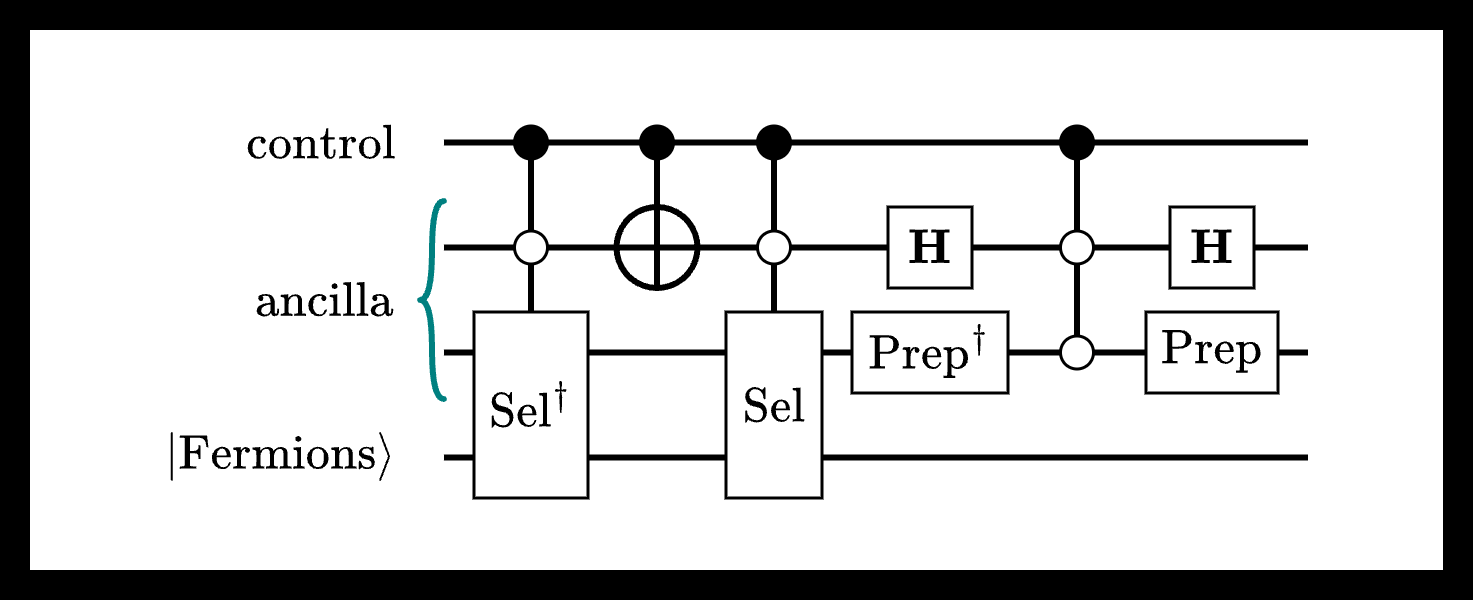
Fig 1 (page 4).
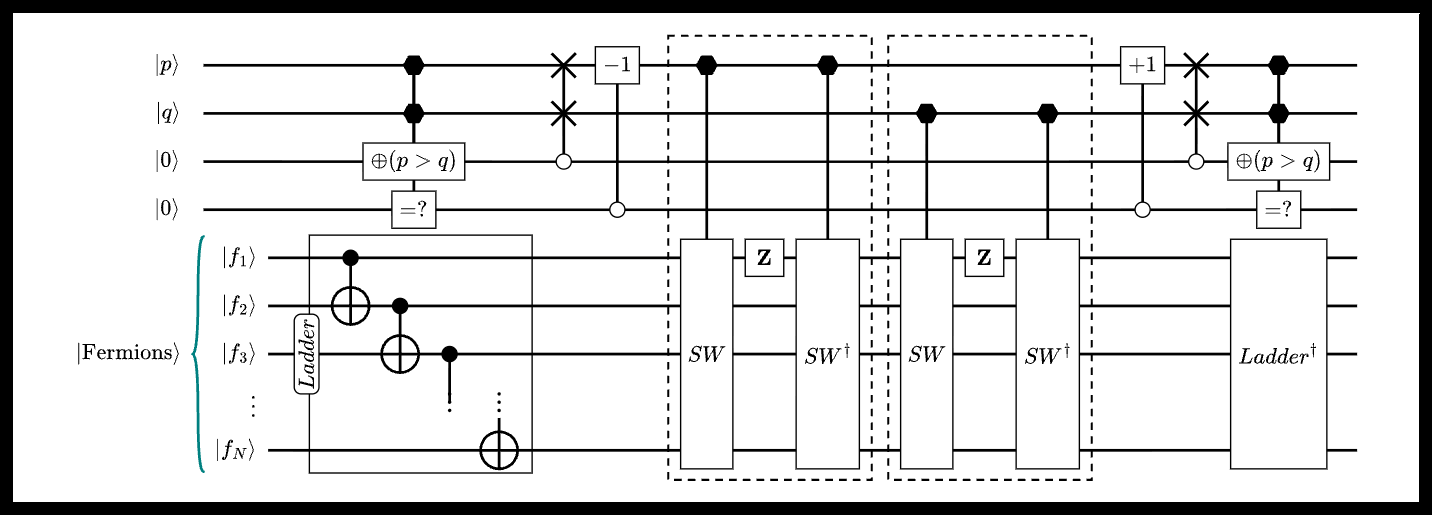
Fig 2 (page 5).
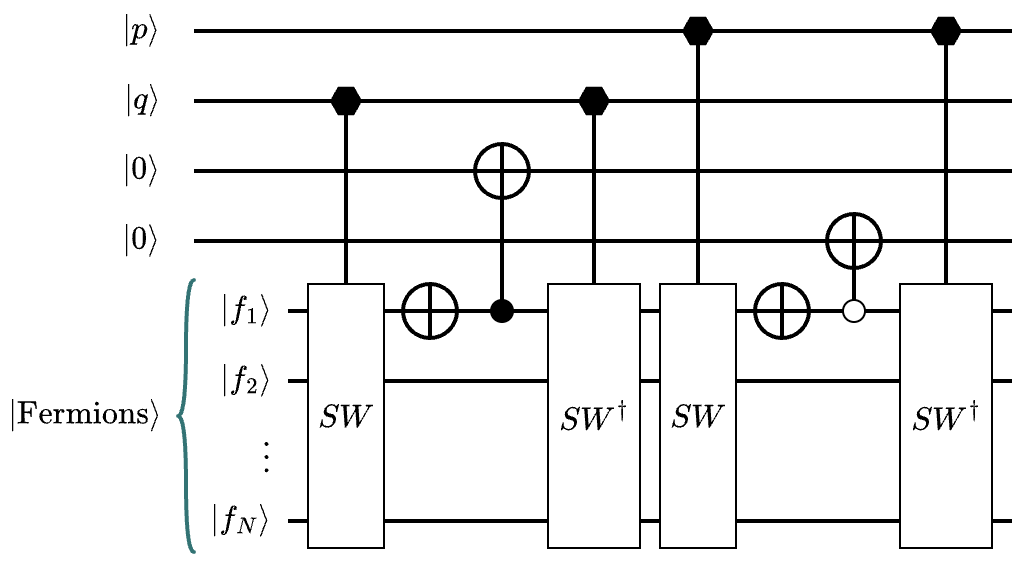
Fig 3 (page 5).
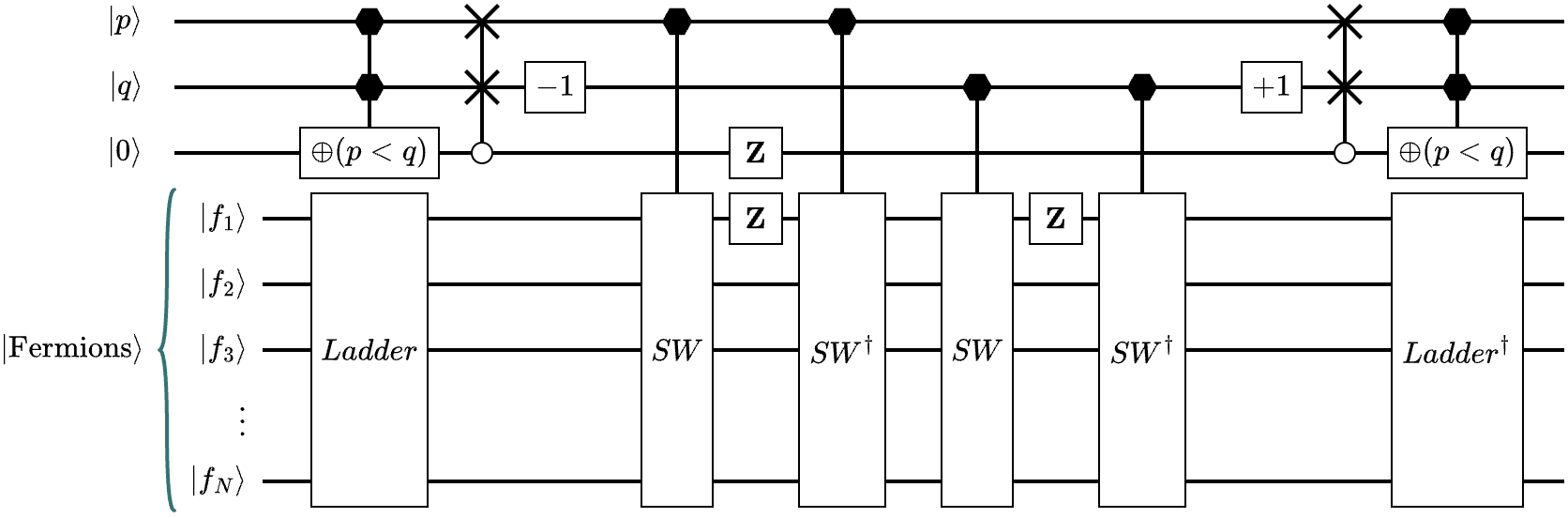
Fig 4 (page 6).
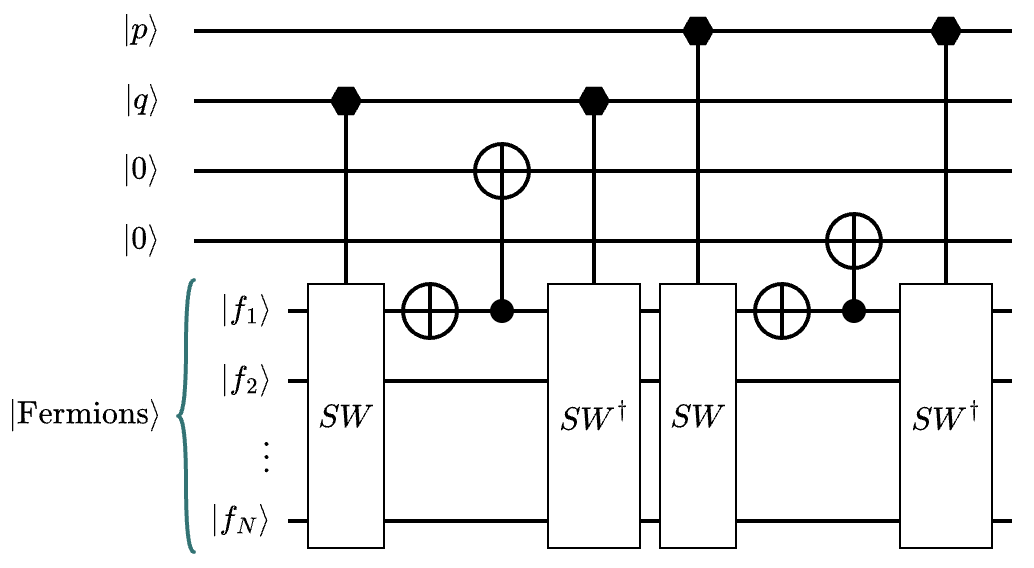
Fig 5 (page 7).
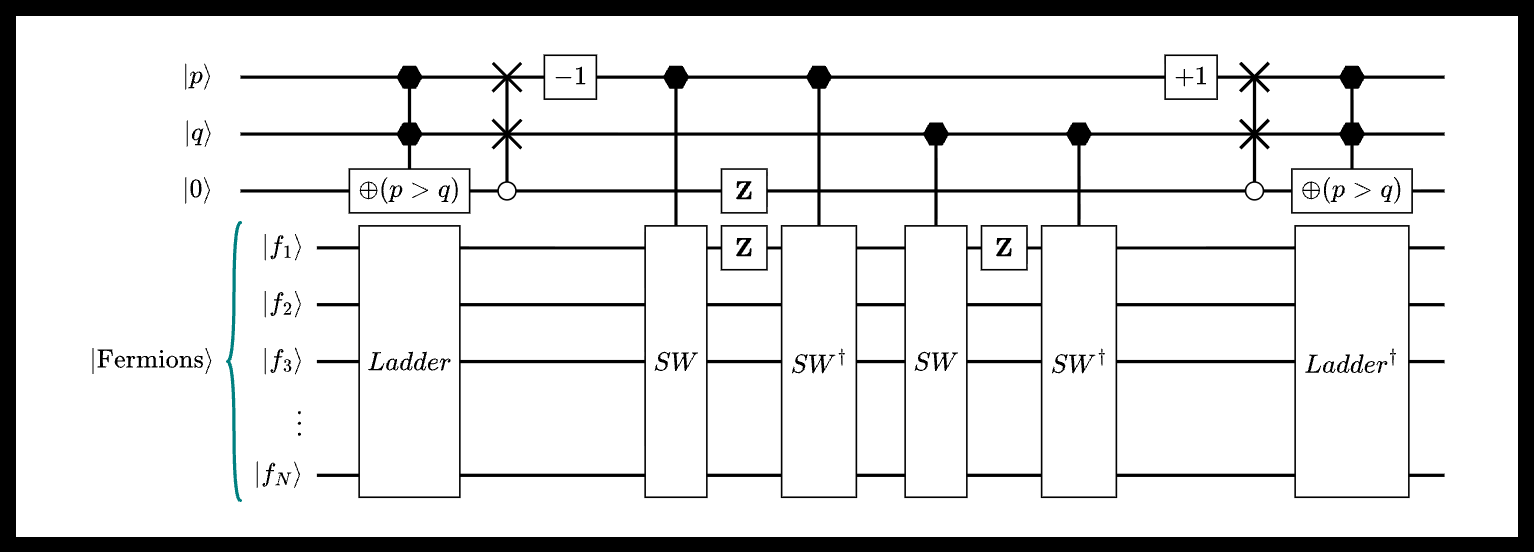
Fig 6 (page 7).
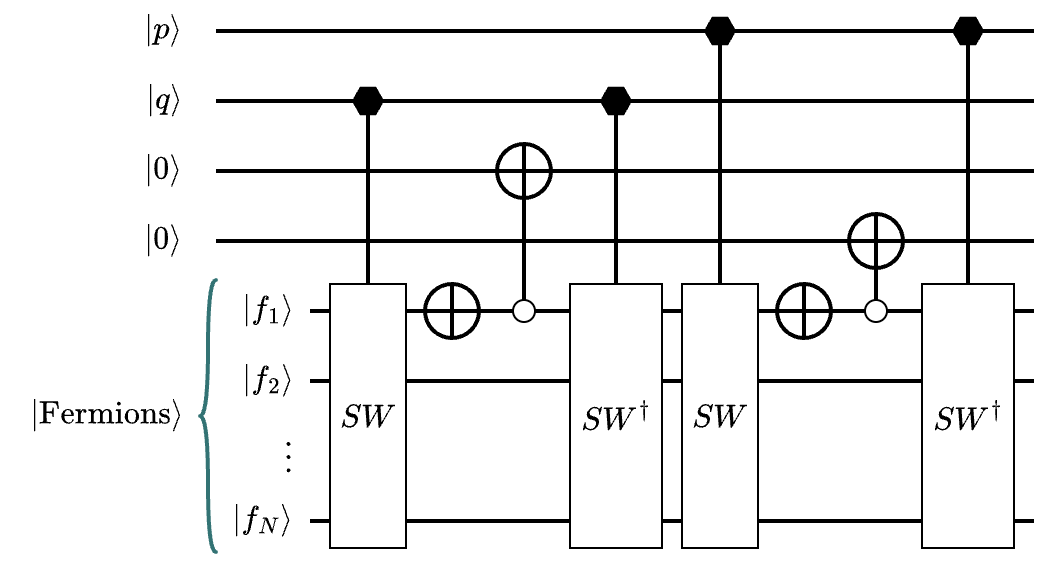
Fig 7 (page 7).
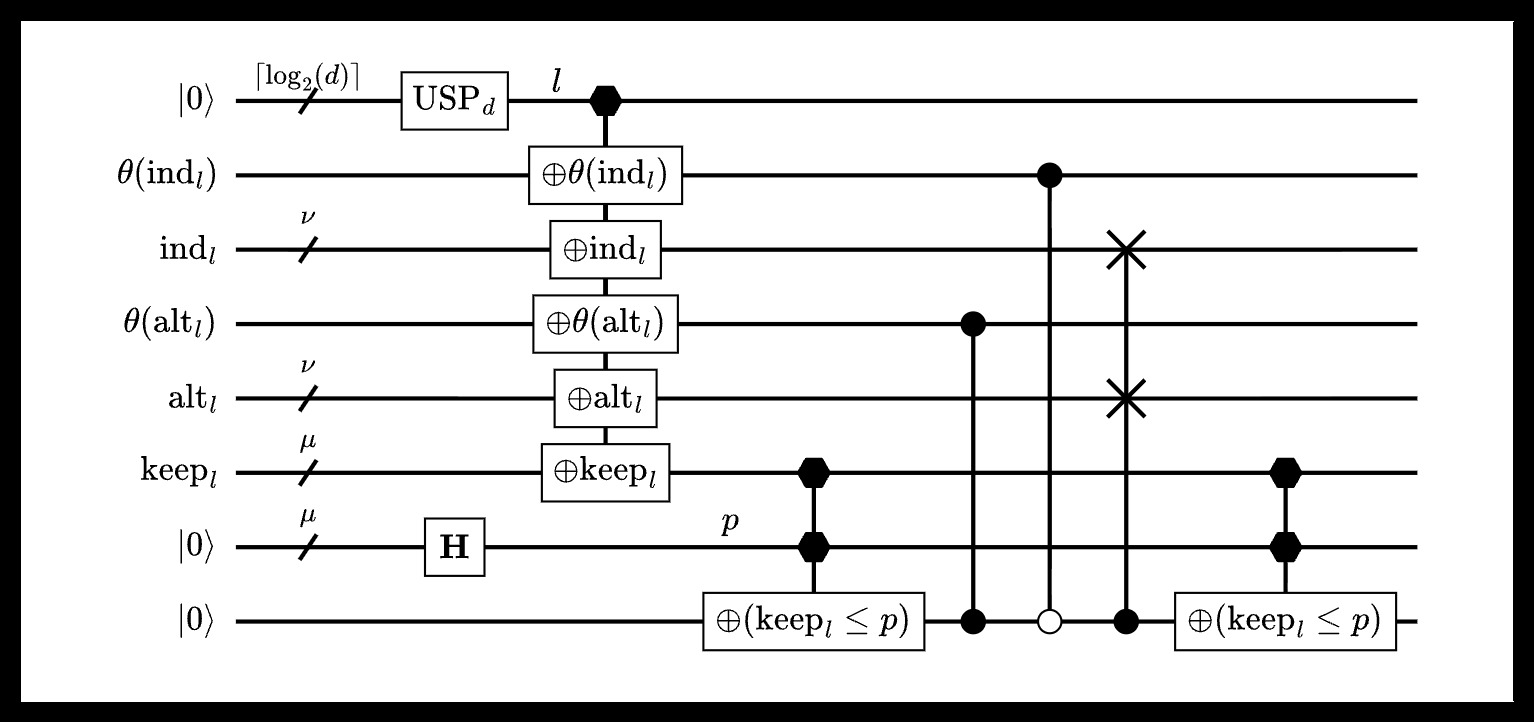
Fig 8 (page 8).
Limitations
- Resource estimates target a fixed error tolerance (ε=0.01 MeV) chosen heuristically; acceptable precision for nuclear physics remains an open question.
- No concrete implementation or experimental validation on hardware; estimates rely on logical-level compiled circuits and asymptotic QEC assumptions.
- No demonstration of tensor factorization or symmetry exploitation techniques to reduce resource costs for dense no-core shell-model Hamiltonians.
- Simulations of no-core shell-model Hamiltonians appear prohibitively expensive without further algorithmic advances.
- Hamiltonian models neglect relativistic effects and focus on non-relativistic nuclear structure, which may limit breadth of application.
- EClassical data requirements (e.g., similarity renormalization group evolved interactions) and classical preprocessing are assumed available but can be large and complex.
Open questions / follow-ons
- How much can tensor factorization and other low-rank approximations, successful in electronic structure, reduce quantum resource costs for nuclear Hamiltonians?
- What is the minimal simulation accuracy (ε) required to produce useful and predictive nuclear physics results on quantum hardware?
- Can nuclear-physics-specific symmetries and multi-body interaction structures be further exploited to reduce qubit and gate counts beyond M-block partitioning?
- What state preparation strategies yield good overlap on ground states for nuclear shell-model Hamiltonians to enable efficient phase estimation?
Why it matters for bot defense
While this paper focuses on fault-tolerant quantum simulation of atomic nuclei rather than traditional bot defense or CAPTCHA challenges, it provides a rigorous case study in the complexity and resource requirements of simulating structured fermionic many-body systems on future quantum hardware. Bot-defense engineers can view the authors' approach to decomposing large, sparse Hamiltonians and exploiting symmetries as a parallel to devising layered defenses that leverage problem structure for computational efficiency. The emphasis on tradeoffs between qubit count and gate complexity, as well as block-encoding strategies, may inspire analogous considerations in designing CAPTCHAs or bot-detection tasks where resource or query limits are critical. Additionally, the paper highlights the challenges of optimizing algorithms for specialized domains, illustrating that domain-specific characteristics must drive customized defenses rather than generic schemes. Overall, the detailed quantum resource accounting and circuit-level optimization mindset exemplified here encourages security practitioners to rigorously quantify costs and tradeoffs when deploying defenses against adaptively resourceful adversaries.
Cite
@article{arxiv2607_21563,
  title={ Fault-tolerant quantum algorithms for simulating atomic nuclei },
  author={ James Benstead and Michael Garn and Neil Gaspar and Sean Greenaway and Angus Kan and Lloyd La Ronde and Chandan Sarma and Paul Stevenson },
  journal={arXiv preprint arXiv:2607.21563},
  year={ 2026 },
  url={https://arxiv.org/abs/2607.21563}
}