
Bayesian evidence adaptive pursuit to identify neutron sources with scatter-based spectrometers
Source: arXiv:2607.21543 · Published 2026-07-23 · By David Breitenmoser, William Heriot, Peter Marleau, Shaun D. Clarke, Sara A. Pozzi
TL;DR
This work addresses the challenging problem of neutron source identification from recoil spectroscopy measurements, which is crucial for nuclear nonproliferation, safeguards, and homeland security. Traditional approaches struggle due to the ill-conditioned nature of neutron spectral inversion, particularly in mixed-source scenarios with overlapping spectral signatures. The authors propose a Bayesian Evidence Adaptive Pursuit (BEAP) algorithm, a scalable, efficient Bayesian model selection framework that iteratively explores and prunes candidate source combinations based on their Bayesian evidence. By replacing data-driven forward models with physics-based Monte Carlo-generated templates, BEAP reduces experimental overhead and generalizes better to diverse detector configurations and source types.
The method is experimentally validated using controlled Cf-252 spontaneous fission and DD neutron generator measurements, alongside extensive high-fidelity Monte Carlo simulations that model spontaneous fission, (α,n), and fusion sources with varying emission rates and complexities. BEAP reliably identifies both single- and multi-source neutron fields with high-confidence statistical support exceeding 4 standard deviations. The number of detected recoil events required for confident identification scales from about 10 for simple single-source scenarios to 1 million for complex three-source mixtures with similar spectral features. This work establishes BEAP as a practical, robust, and computationally feasible tool that substantially extends the capability of scatter-based neutron spectrometry for mixed neutron source identification in security and emergency response.
Key findings
- BEAP reduces computational complexity of exhaustive Bayesian model comparison by 83% when configured to detect up to three sources from a 10-source library, evaluating 175 mixtures instead of 1023.
- Experimentally, BEAP correctly identifies dominant neutron sources (Cf-252, DD) and secondary contamination (DT) in mixed-source measurements with decisive statistical support (log Bayes factors >9, corresponding to >4σ significance).
- The number of detected recoil events required for confident true-source recovery ranges from O(10^1) for single-source cases to O(10^6) for complex three-source mixtures with spectrally similar sources and unbalanced emission rates.
- Physics-based Monte Carlo simulations of detector response templates accurately capture neutron interactions, including room-return and secondary scattering effects, enabling robust forward modeling without retraining.
- Data augmentation with synthetic recoil spectra spanning source mixtures, emission strengths (10^4 to 10^6 s^-1), and detected counts (1 to 10^9) supports comprehensive benchmarking and uncertainty quantification.
- BEAP’s adaptive Occam-window pruning strategy preserves multiple statistically plausible source combinations to avoid premature elimination, balancing robustness and computational cost.
- Nested sampling inference with the dynesty package effectively computes Bayesian evidences and posterior distributions for candidate source subsets under a negative-binomial likelihood accounting for count overdispersion.
- Posterior predictive spectrum fits show close agreement with measured recoil spectra and reveal characteristic spectral features such as the high-energy DT fusion neutron plateau in DD generator measurements.
Threat model
n/a — This work addresses a scientific inference problem for neutron source identification rather than adversarial threat mitigation. The adversary is not explicitly modeled; rather, the methodology assumes measured recoil spectra arise from mixtures of candidate neutron sources with known templates, and aims to statistically identify these sources under realistic measurement conditions.
Methodology — deep read
Threat model and assumptions: The adversary is not explicitly defined as this is a statistical inference method relying on physical neutron recoil spectra for source identification. The algorithm assumes measured recoil spectra are obtained from scatter-based neutron spectrometers with known detector response templates. Sources emit neutron fields with potentially overlapping spectra, and environmental and detector systematics like neutron moderation and background are accounted for in modeling.
Data: Experimental validation used controlled neutron sources: Cf-252 spontaneous fission (~1.5 × 10^6 n/s) and DD neutron generator (~10^6 n/s) at fixed geometry with shielding to reduce gamma and X-ray backgrounds. Measurements acquired with an array of twelve pulse-shape-discrimination organic scintillator bars, with ~2000 s acquisition per experiment. Three experiments covered single-source Cf-252, single-source DD, and mixed-source Cf-252 + DD. Monte Carlo simulations generated physics-based recoil templates for spontaneous fission (Cf-252, Pu-240), (α,n) sources (PuBe, AmBe), and fusion sources (DD, DT) using MCNPX-PoliMi v2.0 with detailed detector and room geometry. For each source template, 4 × 10^10 primary histories were simulated to ensure <5% spectral uncertainty.
Algorithm: BEAP iteratively explores candidate neutron source subsets up to a maximum size D (here D=3), starting with all single sources. At each iteration k, evidence (marginal likelihood) is computed for all k-element subsets constructed from sources retained in the previous iteration. Source mixtures are ranked by their Bayesian evidence scores. An adaptive Occam-window criterion, based on average evidence decay, retains a set number B (here B=15) of statistically plausible mixtures, preventing premature source elimination. The retained source indices form the candidate pool for the next iteration. This procedure efficiently searches the combinatorial space (~2^N subsets) without exhaustive enumeration.
Bayesian inference uses a full-spectrum forward model: expected recoil spectrum is a linear superposition of source-specific, emission-rate-normalized detector templates scaled by inference parameters θ. The likelihood is negative-binomial to model count overdispersion. Parameter priors include truncated normal distributions for emission rates and dispersion parameters. Nested sampling (dynesty) estimates evidence and obtains posterior distributions.
Training/Inference: Since forward models are physics-based templates, no training is needed. Nested sampling inference runs independently per candidate subset to compute evidence and parameter estimates. Independent likelihood evaluations enable parallelization. Conservative pruning parameters ensure all single-, two-, and three-source combinations evaluated. Computational cost scales linearly with number D of iterations and duration of nested sampling evidence calculations.
Evaluation: Experimentally, evidence values and Bayes factors compare competing source ensembles, with >4σ confidence achieved for identifying dominant and weaker secondary sources. Posterior predictive spectra compared with measured recoil histograms confirm model fit quality. Synthetic data with ground truth source compositions and strengths enable performance benchmarking across event counts (1 to 10^9), source emission strengths (10^4 to 10^6 s^-1), and mixture complexities (1 to 3 sources).
Reproducibility: Experimental data, Monte Carlo models, and nested sampling code are publicly referenced in prior work ([2]). The methodology uses publicly available MCNPX-PoliMi and dynesty codes. Synthetic datasets generated via described augmentation procedures. Exact code release status is not explicitly stated, but the framework is modular.
Example end-to-end: For a synthetic two-source mix (e.g., Cf-252 and DD at equal emission rates 10^6 s^-1), the BEAP algorithm first evaluates single sources, ranks and retains candidates per Occam-window. Then, all retained source pairs (subset order k=2) are evaluated, evidence computed via nested sampling from negative-binomial likelihood comparing measured or synthetic recoil histogram to combined source templates scaled by intensity parameters. The mixture with highest Bayesian evidence yielding significant Bayes factor selects the inferred sources. Posterior predictive spectra generated using parameter posteriors validate the fit to measured data.
Technical innovations
- Introduction of the Bayesian Evidence Adaptive Pursuit (BEAP) algorithm that prunes large combinatorial source spaces efficiently using an adaptive Occam-window criterion balancing evidence support and search breadth.
- Replacement of prior data-driven machine learning forward models with physics-based Monte Carlo-generated neutron recoil response templates, enhancing generalizability and reducing experimental overhead.
- Use of a negative-binomial likelihood model to account for count overdispersion in recoil spectroscopy, improving inference robustness compared to simpler Poisson models.
- Application of nested sampling (dynesty) for Bayesian evidence evaluation in neutron spectral inversion problem, enabling rigorous statistical model comparison over complex source subsets.
Datasets
- Cf-252 spontaneous fission source measurements — ~2000 s acquisition per experiment — controlled laboratory data
- Deuterium-deuterium neutron generator measurements — ~2000 s acquisition per experiment — controlled laboratory data
- Synthetic neutron recoil spectra dataset generated by Monte Carlo template augmentation — covering 1 to 10^9 detected events, single- to three-source mixtures with known ground truth
Baselines vs proposed
- Exhaustive Bayesian model comparison: evaluated 1023 mixtures for N=10; BEAP prunes down to 175 mixtures with D=3 and B=15 — 83% complexity reduction
- Single-source identification: confident recovery from O(10) detected events versus multi-source three-component mixtures requiring up to O(10^6) events
- BEAP model vs single-source alternatives: log Bayes factors >9 in experiments, corresponding to >4σ statistical significance
- BEAP identified minor DT contamination in DD source with inferred emission fraction 0.25 (+0.04 / -0.03)
Figures from the paper
Figures are reproduced from the source paper for academic discussion. Original copyright: the paper authors. See arXiv:2607.21543.

Fig 1 (page 1).
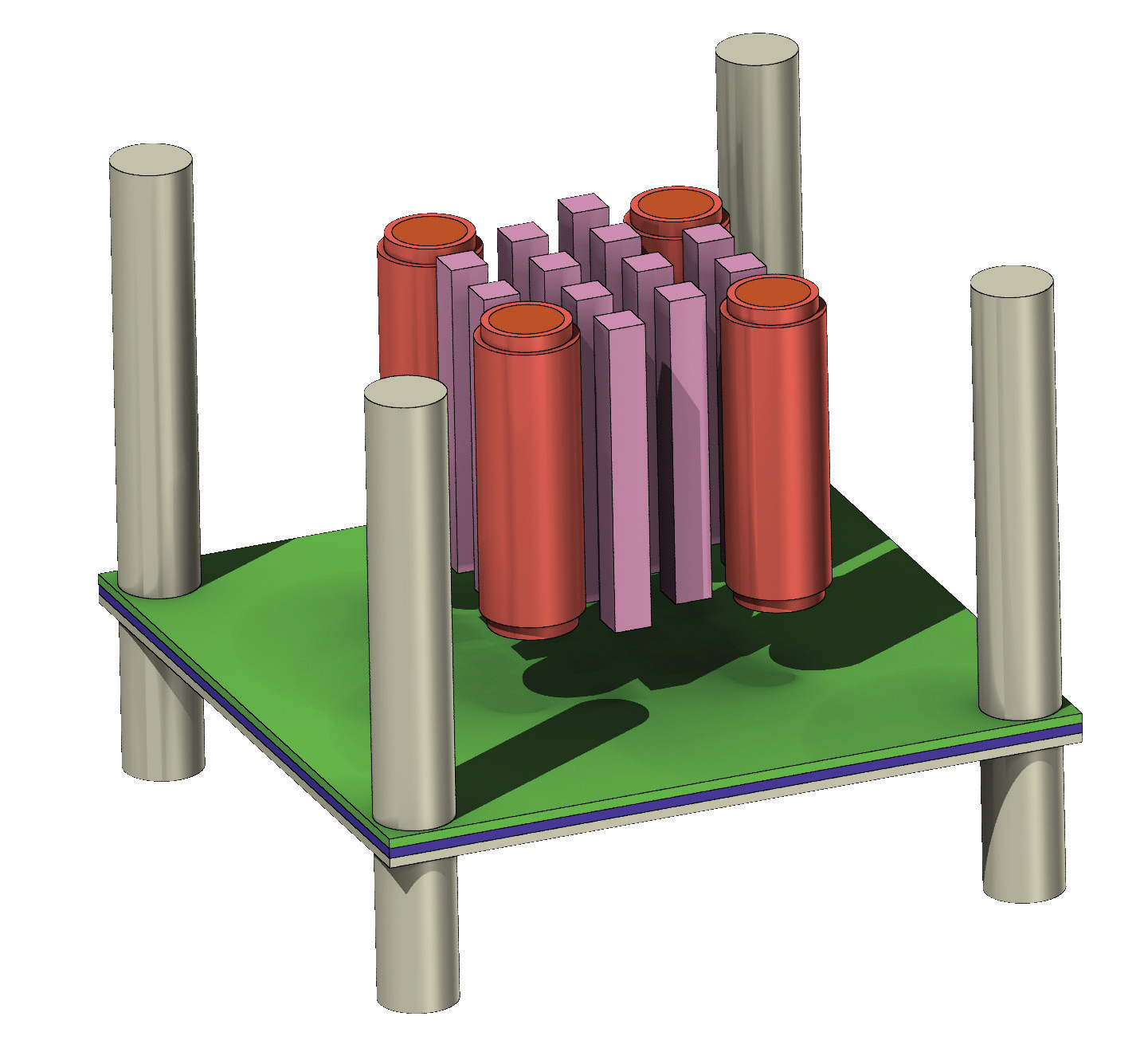
Fig 1: Experimental setup used for the validation measurements showing the Cf-252 spontaneous fission source and

Fig 2: Monte Carlo mass model of the experimental setup used for spectral template generation. The model includes

Fig 3: Bayesian inference results for the neutron recoil spectroscopy experiments performed using single- and mixed-

Fig 5 (page 6).

Fig 6 (page 6).

Fig 7 (page 6).

Fig 8 (page 6).
Limitations
- Experimental validation limited to controlled laboratory sources at fixed geometry and moderate acquisition times (~2000 s); field variability not assessed.
- The method assumes accurate physics-based Monte Carlo templates; template inaccuracies or environmental changes may degrade identification.
- Computational cost still depends on nested sampling evaluation times, which can be on the order of minutes per model, potentially limiting real-time applications.
- Current pruning configuration limits source mixtures to three components; scaling beyond this is unexplored and may require further heuristics.
- No explicit adversarial or distribution shift robustness evaluation was provided (e.g., unmodeled sources or background variability).
Open questions / follow-ons
- How does BEAP perform under realistic operational conditions with variable background radiation and environmental effects outside controlled laboratory setups?
- Can the BEAP framework efficiently scale to source libraries larger than 10 candidates and mixture orders beyond three without excessive computational cost?
- What is the robustness of BEAP to unmodeled or novel neutron sources, i.e., those not included in the physics-based template library?
- Could hybrid approaches integrating limited data-driven calibration with Monte Carlo templates further improve identification accuracy or computational efficiency?
Why it matters for bot defense
For bot-defense and CAPTCHA engineers, this paper demonstrates a rigorous Bayesian evidence-based adaptive pursuit strategy to efficiently identify mixture components from complex, noisy observation data without exhaustive combinatorial search. The methodological insights—iterative model pruning with adaptive statistical thresholds and physics-based forward modeling—can inform analogous signal-disentangling problems in bot-detection scenarios involving mixed behavioral patterns or multi-factor adversarial signals.
While the application domain differs, the BEAP approach emphasizes scalable, statistically principled model comparison balancing robustness and computational feasibility. Such an approach could inspire novel CAPTCHA system designs or bot-defense detection pipelines that combine domain-informed generative models with adaptive evidence-based search methods to identify malicious or automated actors amidst large candidate hypothesis spaces.
Cite
@article{arxiv2607_21543,
  title={ Bayesian evidence adaptive pursuit to identify neutron sources with scatter-based spectrometers },
  author={ David Breitenmoser and William Heriot and Peter Marleau and Shaun D. Clarke and Sara A. Pozzi },
  journal={arXiv preprint arXiv:2607.21543},
  year={ 2026 },
  url={https://arxiv.org/abs/2607.21543}
}