
AI-Integrated Scientific Inquiry: A Practice-Centered Vision for Science Education
Source: arXiv:2607.21777 · Published 2026-07-23 · By Arne Bewersdorff, Matias Rojas, Xiaoming Zhai
TL;DR
This article presents a practice-centered vision for integrating artificial intelligence (AI) into science education by embedding AI as scientific instruments within authentic scientific inquiry. Recognizing that AI is increasingly central to scientific research—used for observing, analyzing, and modeling phenomena—the authors argue that science education should evolve accordingly. Instead of teaching AI concepts in isolation, they propose pedagogically bounded AI instruments that students actively operate within science practices aligned to the Next Generation Science Standards (NGSS). Each instrument preserves core scientific functions while simplifying controls, and is paired with reflection points that prompt critical evaluation of the AI outputs and limitations. The three exemplar instruments discussed are computer vision for observing, clustering for data analysis, and generative modeling for developing scientific models.
This approach aims simultaneously to engage students in authentic scientific inquiry and to build discipline-based AI literacy (DAIL), emphasizing when and why AI outputs can mislead. It also highlights the emerging role of agentic AI systems that autonomously run multiple inquiry stages and cautions that foundational instruction in AI instruments and scientific inquiry must precede student reliance on such autonomous agents. The article is primarily a conceptual and design vision rather than an empirical study of learning outcomes, but it lays out a detailed framework and platform prototype that enacts it. Overall, it offers a grounded roadmap for science educators and AI literacy advocates to embed AI meaningfully, critically, and sustainably in science classrooms.
Key findings
- AI instruments are treated as genuine scientific tools with pedagogically bounded interfaces, preserving core functionality but simplifying complexity.
- Each AI instrument is paired with a reflection point that prompts students to critically evaluate outputs and consider potential failures or misleading results.
- Computer vision AI instrument allows students to count objects in images, tuning sensitivity and comparing AI counts to manual counts, reflecting on detection errors due to image properties.
- A clustering instrument lets students select the number of groups (k) and reflect on whether discovered clusters are data-supported or imposed by analytical choices.
- A generative modeling instrument enables students to specify features for molecular design, generate candidates, and evaluate scientific plausibility and fit to evidence.
- The approach situates AI instruments within NGSS-aligned scientific practices (observing, analyzing, modeling) rather than teaching AI separately.
- Agentic AI systems operate across multiple inquiry stages autonomously but require prior scientific and AI literacy to evaluate outputs and avoid overreliance.
- The approach emphasizes functional rather than mechanistic understanding of AI instruments, focusing on what they do, when to trust them, and how they can fail.
Threat model
n/a - This is an education research/design paper rather than a security or adversarial study. The 'threats' discussed revolve around potential student overreliance and uncritical acceptance of AI outputs rather than adversarial manipulation or attacks.
Methodology — deep read
The article presents a conceptual design vision rather than an empirical study, but details an implemented platform prototype illustrating AI instruments integrated into scientific inquiry. The methodology breaks down as follows:
Threat Model & Assumptions: Not a security paper, but it presumes students as learners who must critically evaluate AI instrument output. Adversarial misuse or intentional deception are not primary concerns; rather, overreliance and uncritical acceptance are cautioned against.
Data: The AI instruments are demonstrated with authentic scientific data from existing studies: camera-trap wildlife images for computer vision; astronomical and genomic datasets for clustering; molecular structure datasets for generative modeling. These domain datasets are repurposed to allow student interaction within bounded versions of the AI instruments.
Architecture / Algorithm: Each AI instrument is a reduced, pedagogically bounded version of a standard AI technique:
- Computer vision: simplified object detection methods (edge, color, blob thresholding) allowing students to adjust parameters.
- Clustering: unsupervised similarity-based grouping with user-set number of clusters k, showing within-group variance and point-feature contributions.
- Generative modeling: black-box generation of candidate molecular structures from user-specified property features, with student evaluation of output plausibility. The underlying full models are not deeply detailed because focus is on user operation and reflection rather than internal AI internals.
Training Regime: Not applicable as the paper does not train new models; it uses pre-existing AI models or simplified algorithms repurposed for education. The focus is pedagogical interface design rather than model optimization.
Evaluation Protocol: The platform includes built-in reflection points prompting students to question whether AI output is trustworthy, plausible, or biased by input data/preprocessing. For example, in clustering, students try different k values and assess fit. Empirical classroom evaluation of learning outcomes is noted as future work and not reported.
Reproducibility: The platform and AI instruments are implemented as a browser-based learning environment; code release status is not specified. The datasets originate from public scientific sources cited, but the exact splits or processed versions for instruction are not detailed. The design is described conceptually and with example screenshots.
Concrete Example: In the computer vision AI instrument, students load wildlife images, select detection methods, tune thresholds, and manually count animals. The AI count and manual count are compared. Students see matched, false positive, and missed detections, and reflect on effects of image contrast or framing. This workflow grounds AI use in genuine observation practice, embedding functional understanding and critical evaluation.
Overall, the methodology focuses on instructional design and alignment of AI instrument use with authentic scientific practices, using simplified interfaces to preserve scientific function and embed explicit reflection rather than focusing on technical model innovations or empirical validation of learning effects.
Technical innovations
- Conceptualization of AI as pedagogically bounded scientific instruments embedded within authentic NGSS scientific practices rather than standalone AI topics.
- Design of AI instruments with simplified user interfaces preserving core scientific function alongside built-in reflection points to prompt critical evaluation of AI outputs.
- Use of a continuum of AI techniques—from classical computer vision, clustering, to generative modeling—as exemplar instruments aligned to observing, analyzing, and modeling inquiry practices.
- Integration of discipline-based AI literacy (DAIL) emphasizing functional rather than mechanistic understanding tailored to science education contexts.
- Articulation of the role of agentic AI systems traversing entire scientific inquiries and the pedagogical need to build foundational literacy before relying on autonomous AI collaborators.
Datasets
- Camera-trap wildlife images — size not specified — from Norouzzadeh et al. (2018)
- Astronomical and genomic datasets — size unspecified — from Jordan & Mitchell (2015) and Wang et al. (2023)
- Molecular structures and property data — size unspecified — from Watson et al. (2023) and Yun et al. (2026)
Figures from the paper
Figures are reproduced from the source paper for academic discussion. Original copyright: the paper authors. See arXiv:2607.21777.
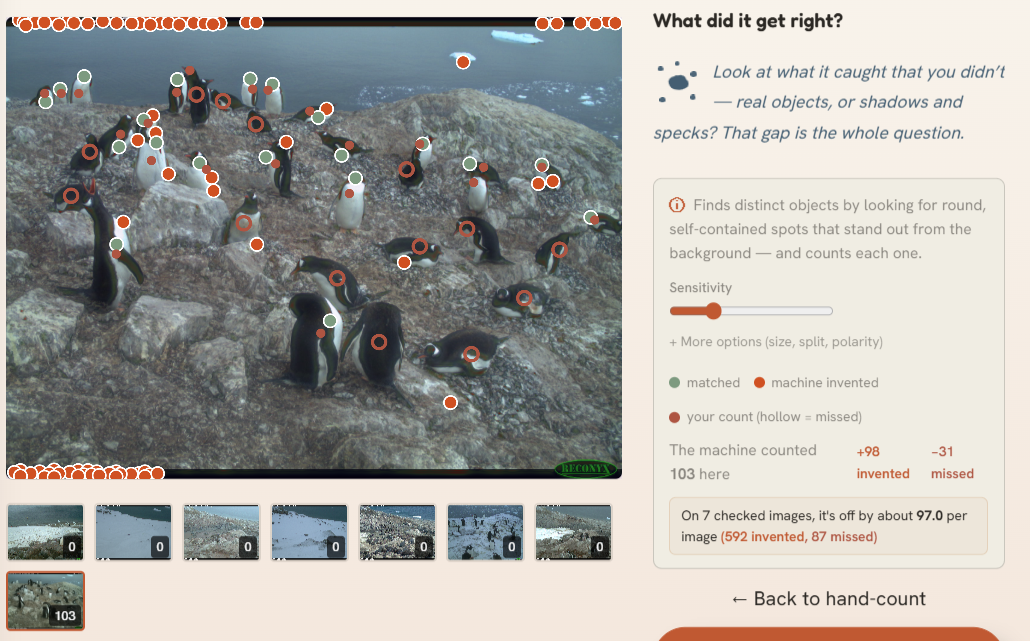
Fig 1: Observing: Computer-vision counter
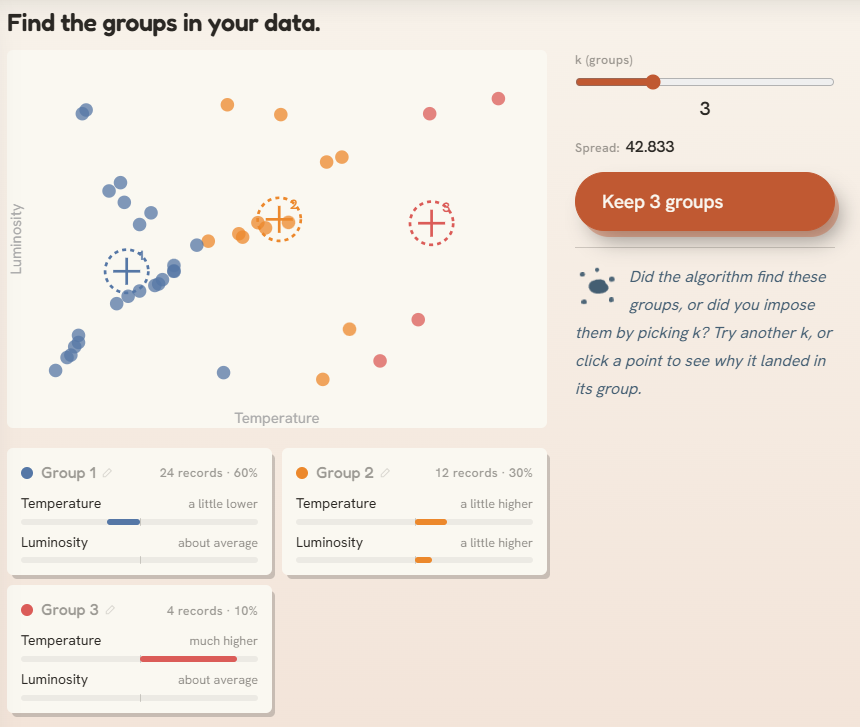
Fig 2: Analyzing: Clustering
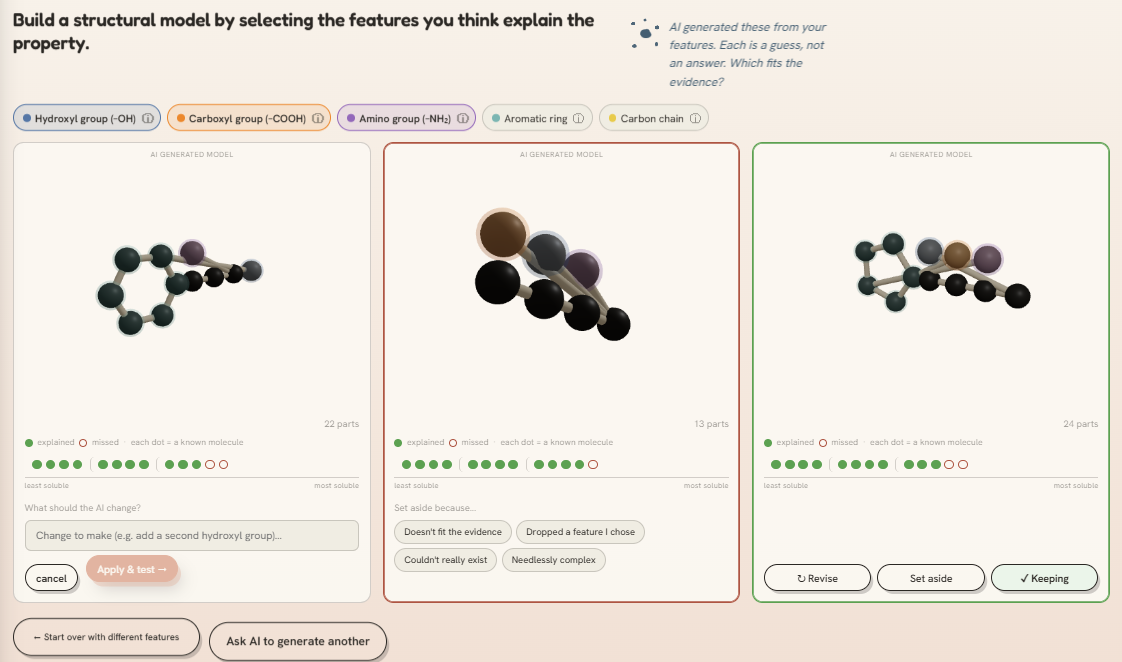
Fig 3: Modeling: Generative modeler
Limitations
- The paper is primarily a design and conceptual vision without empirical validation of the instructional approach’s effectiveness in classrooms.
- Potential overreliance on AI instrument outputs by students is a risk acknowledged but not experimentally addressed.
- Teacher preparation and expertise to effectively guide reflection on AI instrument limitations may be lacking, hindering implementation.
- The pedagogically bounded AI instruments simplify the underlying models, possibly omitting mechanistic transparency and deeper understanding opportunities.
- The platform and approach rely on selection of suitable data inputs; poor data choice can limit educational value or induce misinterpretations.
- No evidence is provided on whether critical evaluation skills learned with isolated AI instruments transfer to evaluating complex agentic AI systems.
Open questions / follow-ons
- How effective is the AI instrument approach at producing authentic scientific inquiry skills and discipline-based AI literacy in diverse classroom settings?
- To what extent does critical evaluation learned using simplified AI instruments transfer to trusting or supervising more autonomous agentic AI systems?
- What are best practices for teacher training and instructional design to scaffold effective reflection on AI instrument limitations?
- How can pedagogical AI instruments balance simplification with fostering mechanistic understanding to deepen student comprehension?
Why it matters for bot defense
While this article focuses on integrating AI into science education rather than direct bot-defense or CAPTCHA design, its conceptual framing of AI as pedagogical instruments with critical reflection parallels challenges in bot detection and CAPTCHA systems where automated tools must be interpretable and their limitations understood. Bot-defense engineers might draw inspiration from embedding transparency and reflection points in AI tools to avoid blind trust and overreliance. For CAPTCHA practitioners, the emphasis on designing user-facing simplified AI interfaces with preserved core function aligns with usability and interpretability goals. However, the paper does not address adversarial robustness, security threats, or bot-detection performance metrics directly, so practical takeaways are conceptual rather than technical.
Cite
@article{arxiv2607_21777,
  title={ AI-Integrated Scientific Inquiry: A Practice-Centered Vision for Science Education },
  author={ Arne Bewersdorff and Matias Rojas and Xiaoming Zhai },
  journal={arXiv preprint arXiv:2607.21777},
  year={ 2026 },
  url={https://arxiv.org/abs/2607.21777}
}