
Towards Generalized Dimers for GTPs: $\mathcal{N}=2$ Fractional Branes at Infinite Coupling
Source: arXiv:2607.20607 · Published 2026-07-22 · By Sebastián Franco, Diego Rodríguez-Gómez
TL;DR
This paper addresses the challenge of generalizing brane tilings (also known as dimer models) beyond the well-studied case of toric Calabi-Yau 3-folds to the broader class of Generalized Toric Polygons (GTPs). GTPs arise naturally as combinatorial objects encoding 5-brane webs in Type IIB string theory that end on shared 7-branes, thus extending the geometric engineering of 5d superconformal field theories (SCFTs). The authors focus on GTPs connected to ordinary toric diagrams by polytope mutations and propose a concrete physical mechanism called "N=2 strip condensation". This corresponds to bringing parallel zig-zag paths in the brane tiling together and shrinking the associated N=2 fractional branes to zero size, resulting in gauge groups at infinite coupling. They demonstrate that this process is reflected in mirror symmetry via tuning coefficients in the Newton polynomial to the GTP point, and confirm via detailed examples and consistency checks that the final quivers after confinement reproduce the expected gauge group count given by tessellations into T-cones. Moreover, these GTP quivers differ from mutation-related toric quivers only by vector pairs and adjoint fields, thus connected by relevant deformations. The authors validate their proposal on all previously studied examples and introduce new infinite families of GTPs, providing strong evidence they have uncovered the correct generalization of brane tilings to GTPs and extended the known correspondence between polytope mutations and IR-relevant deformations to this broader setting.
Key findings
- Terminating multiple 5-branes on a common 7-brane (white dots in GTP) corresponds to identifying parallel zig-zag paths in the brane tiling, shrinking the associated N=2 fractional branes to zero size via 'strip condensation'.
- Strip condensation drives gauge groups on the condensing strips to infinite coupling, after which confinement reduces n² gauge groups in the Tn-cone region to a single gauge group, decreasing total gauge groups by n² - 1.
- The number of gauge groups in the GTP quiver equals the number of T-cones in a tessellation of the GTP polygon, and matches the number for the mutation-related ordinary toric diagram.
- Mirror symmetry analysis shows the continuous interpolation from toric diagrams to GTPs corresponds to tuning coefficients in the Newton polynomial, realizing strip condensation dynamically.
- Quivers for GTPs differ from mutation-related toric quivers by vector-like pairs and adjoint fields, which can be integrated out by relevant deformations, extending the known correspondence between polytope mutations and IR-relevant deformations.
- Consistency checks hold for all previously studied examples in the literature as well as for newly constructed infinite families of GTPs with arbitrarily large T-cones.
- Proposed strip condensation process explains reduction in gauge groups quantitatively, with each condensing strip containing n+1 faces and accounting for total n² - 1 gauge groups reduced in Tn-cone sectors.
- Hanany-Witten transitions on the (p,q)-web correspond to polytope mutations in GTPs and induce the relevant deformations on corresponding quiver theories.
Methodology — deep read
Threat Model & Assumptions: The paper considers 5d SCFTs engineered via (p,q) 5-brane webs in Type IIB string theory, focusing on configurations where multiple 5-branes end on common 7-branes, described by Generalized Toric Polygons (GTPs). The physical picture assumes supersymmetric configurations obeying the s-rule constraints and that polytope mutations correspond to Hanany-Witten (HW) transitions in the webs, altering gauge theory descriptions. They assume the underlying brane tiling/dimer model technology applies or can be generalized, and that geometric engineering through toric Calabi-Yau 3-folds and mirrors remain valid tools.
Data: The study uses known examples of toric diagrams and GTPs from prior literature, including explicit GTPs connected to toric diagrams via polytope mutations. They construct infinite parametric families of GTPs with large T-cones to test scaling behavior. The "data" hence is theoretical models and combinatorial polygons representing brane webs. The labeling involves colors and markings in GTPs (black and white dots) indicating 5-brane terminations.
Architecture / Algorithm: The core conceptual construct is the brane tiling (bipartite graph on T^2), whose faces encode gauge groups and edges encode chiral fields. Zig-zag paths correspond to external (p,q) legs of the brane web. Parallel zig-zags bound N=2 fractional branes, corresponding to strips of faces representing gauge groups with N=2 supersymmetry. The novel element is the identification (merging) of multiple parallel zig-zags due to multiple 5-branes ending on a common 7-brane, shrinking associated fractional branes in a process called "N=2 strip condensation." This is interpreted as the faces on these strips contracting to zero size, corresponding physically to gauge groups hitting infinite coupling.
Training regime: Not applicable in traditional sense; the paper uses mathematical/physical analysis, construction of brane tilings, mirror symmetry arguments via tuning coefficients in the Newton polynomial, and explicit examples. Many polytope mutations and corresponding HW moves are worked through step-by-step.
Evaluation protocol: The key criteria are consistency checks, including matching the number of gauge groups from two independent counts (T-cones from tessellation vs. mutation-linked toric diagrams), recovering known quivers from literature, and verifying that resulting quivers differ from toric ones by only vector-like pairs/adjoint fields allowing relevant deformations. Mirror symmetry calculations show continuous interpolation realizing strip condensation. Abelian and non-Abelian gauge theory confinement arguments are used to relate infinite coupling points to IR quivers. No statistical tests apply; the setting is pure mathematical physics.
Reproducibility: The paper provides detailed constructions and multiple illustrative examples, including new infinite classes. Code or explicit datasets are not provided but the combinatorial and geometric procedures are described sufficiently for specialists with expertise in brane tilings and (p,q) webs to replicate. The core constructions hinge on well-established tools from string theory and algebraic geometry.
Example end-to-end illustration: Starting from a toric diagram (e.g. for dP0), a polytope mutation acting on an edge produces a GTP containing a Tn-cone. The associated brane tiling before mutation has n² gauge groups forming strips bounded by n parallel zig-zags. Moving to the GTP perspective, the multiple 5-branes ending on a single 7-brane merge those zig-zags, shrinking the strips to zero size (strip condensation). This corresponds to gauge groups hitting infinite coupling and confining. After confinement, the quiver reduces the n² gauge groups on the strip to a single gauge group, decreasing total gauge groups by n² - 1 and reproducing the expected GTP quiver, differing from the initial toric quiver by vector pairs and adjoint fields removable by relevant deformations.
Technical innovations
- Proposal that multiple 5-branes terminating on a single 7-brane correspond to identification (merging) of parallel zig-zag paths in brane tilings, realizing N=2 strip condensation.
- Introduction of the strip condensation mechanism shrinking N=2 fractional branes to zero size, driving gauge groups on strips to infinite coupling and triggering confinement.
- Demonstration via mirror symmetry that tuning Newton polynomial coefficients continuously realizes the strip condensation process.
- Establishment that GTP quivers are connected to mutation-related toric quivers by relevant deformations, extending known dualities to GTPs.
- Quantitative identification of the brane tiling counterparts of Tn-cones as (n-1) strips each containing (n+1) faces, exactly accounting for the reduction of n² -1 gauge groups.
Baselines vs proposed
- Mutation-related toric diagram quiver: number of gauge groups = G (triangles in triangulation) vs GTP quiver: number of gauge groups = number of T-cones in tessellation = G - (n² -1), matching predictions exactly
- Known toric quivers vs GTP quivers after strip condensation differ only by vector-like pairs and adjoint fields that can be removed by relevant deformations
Figures from the paper
Figures are reproduced from the source paper for academic discussion. Original copyright: the paper authors. See arXiv:2607.20607.
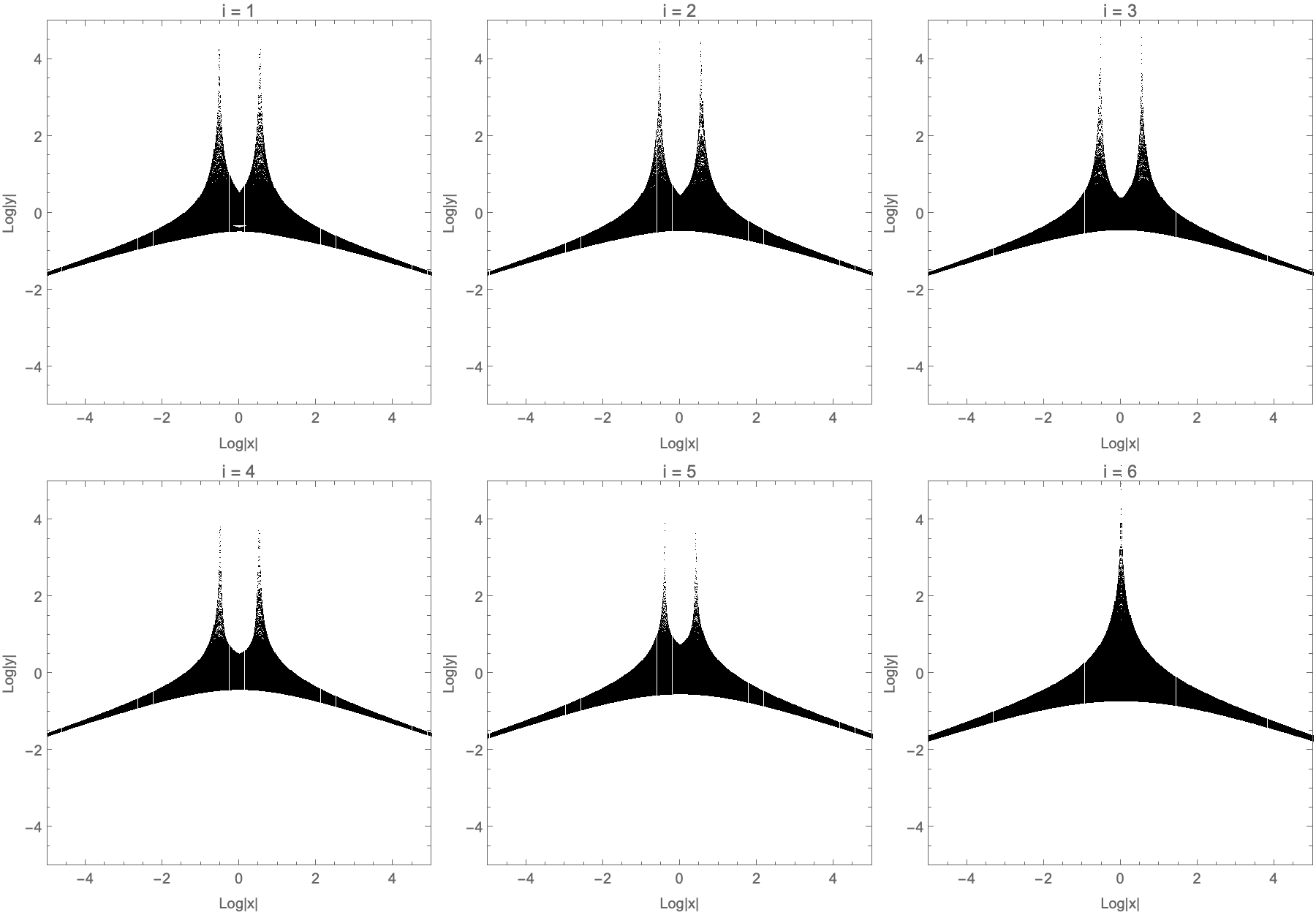
Fig 20: shows the resulting sequence of amoebae. As expected, the two parallel
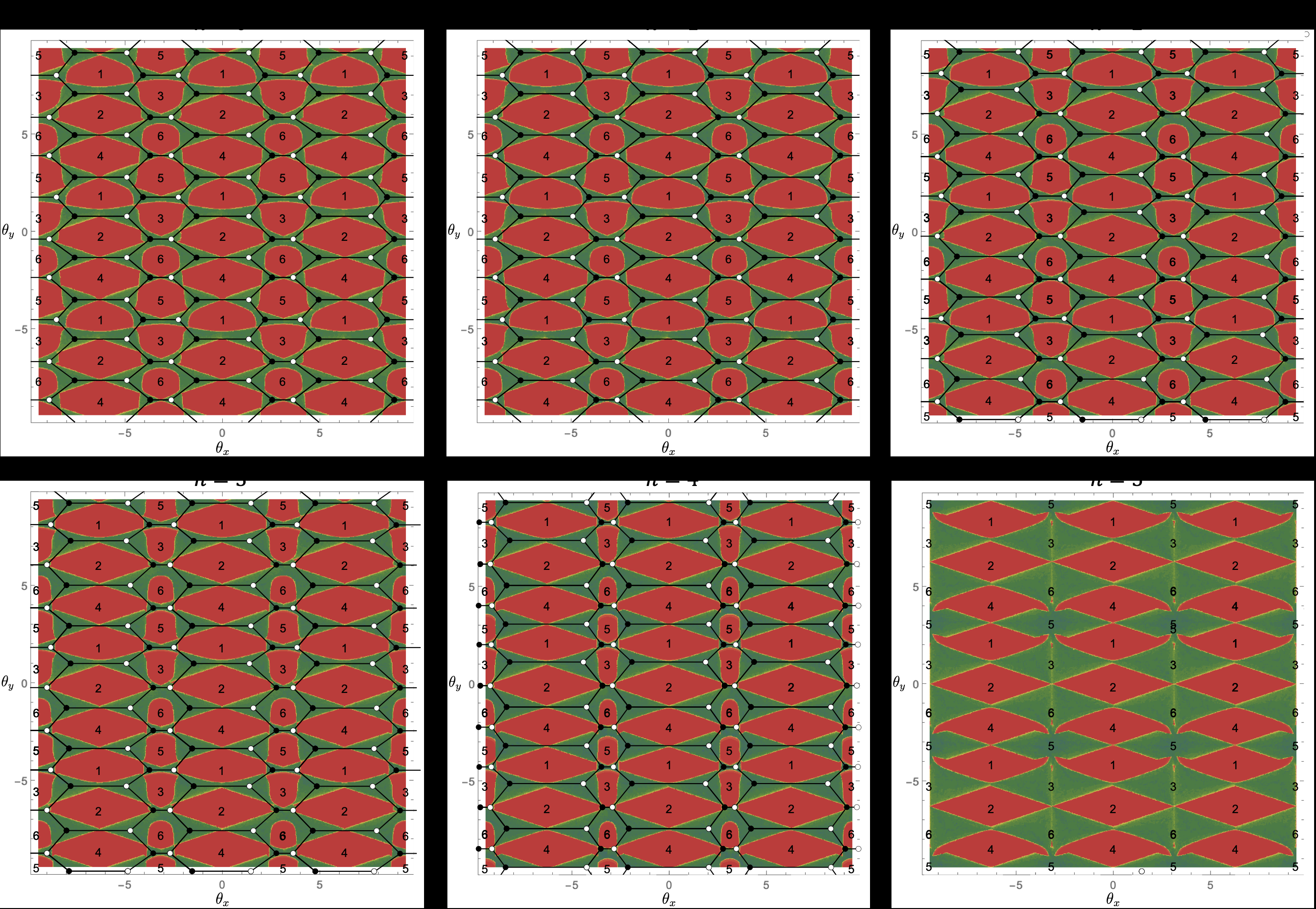
Fig 21: Evolution of the coamoeba and the corresponding brane tiling as the
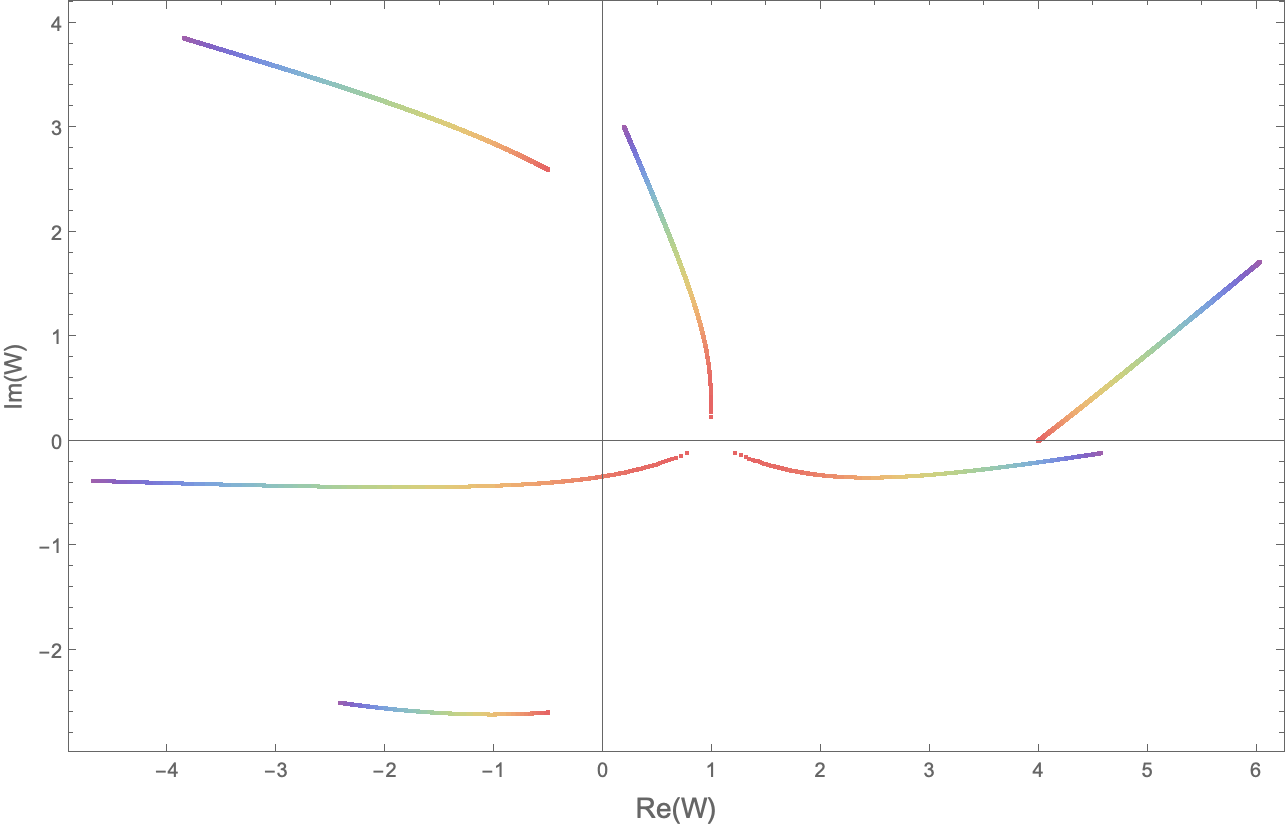
Fig 22: Evolution of the critical values associated to each of the gauge groups as
Limitations
- Analysis restricted to GTPs connected to ordinary toric diagrams by sequences of polytope mutations and tessellations composed exclusively of T-cones without locked superpositions.
- Conjecture on the generality of strip condensation and gauge group counting is supported by explicit examples but lacks formal proof.
- Mirror symmetry arguments rely on tuning coefficients in the Newton polynomial but a fully geometric understanding of the condensation process is not yet complete.
- Quiver dynamics at infinite coupling are inferred from confinement analogies, but a detailed non-perturbative gauge theory analysis is not provided.
- Lack of explicit brane tiling constructions or superpotentials for GTP quivers in closed form; some steps require extensions and assumptions beyond standard brane tiling technology.
Open questions / follow-ons
- Can a formal proof be established that strip condensation reduces n² gauge groups in Tn-cones to a single gauge group systematically for all GTPs?
- Is there a direct combinatorial or geometric characterization of generalized brane tilings for GTPs beyond the quiver and superpotential level, possibly involving new classes of bipartite graphs?
- How does strip condensation and the associated infinite coupling point manifest in a direct gauge theory or geometric moduli space analysis beyond confinement arguments?
- Can the cluster integrable systems associated with GTPs be fully constructed from the proposed generalized brane tilings, extending Goncharov-Kenyon's framework?
Why it matters for bot defense
This paper advances the understanding of generalized quiver gauge theories encoding 5d SCFTs arising from extended brane configurations. While not directly addressing CAPTCHAs or bot defense, the methodological approach—connecting combinatorial geometry (GTPs), graph constructions (brane tilings), and physical mechanisms (strip condensation and confinement)—illustrates a powerful paradigm for dealing with complex combinatorial and geometric structures through operational rules and consistency checks. Bot-defense engineers might see inspiration in the concept of merging parallel structures (zig-zag paths) to simplify or reduce the effective 'state space,' analogous to reducing complexity by identification or condensation. Furthermore, the study highlights how modifying boundary conditions (5-branes ending on common 7-branes) can drastically alter system dynamics, a principle potentially translatable to bot detection challenges where subtle boundary behaviors signpost complex phenomena. The explicit structural reductions and transformations correspond to simplifying intricate models while preserving key features, a concept valuable in designing scalable yet robust detection frameworks or challenge generation in CAPTCHA systems.
Cite
@article{arxiv2607_20607,
  title={ Towards Generalized Dimers for GTPs: $\mathcal{N}=2$ Fractional Branes at Infinite Coupling },
  author={ Sebastián Franco and Diego Rodríguez-Gómez },
  journal={arXiv preprint arXiv:2607.20607},
  year={ 2026 },
  url={https://arxiv.org/abs/2607.20607}
}