
Scalable Low-Cost Laboratory Automation: A Digital Twin-Integrated Robotic Platform for Autonomous Liquid Handling (RAINBOTTM)
Source: arXiv:2607.20662 · Published 2026-07-22 · By Mohamed Rami Ayeche, Souhil Sid, Ahyen Mostofa, Rehaan Hussain, Ali Shayesteh, Fadwa El Mellouhi
TL;DR
This paper addresses the high cost, proprietary design, and limited remote monitoring of commercial laboratory liquid-handling automation by developing RAINBOTTM, a low-cost, openly reproducible robotic liquid handler. RAINBOTTM is created by converting a consumer-grade Elegoo Neptune 4 Max 3D printer, replacing its extruder with a precision single-channel pipette actuated via the printer's original G-code-driven Cartesian gantry and two added linear actuators under Python control. The platform integrates a browser-based digital twin that synchronizes in real-time with the physical robot, enabling remote monitoring, intervention, and emergency stop capability from any web browser. As a proof of concept, RAINBOTTM performs sequential mixing of colored aqueous solutions with an on-board RGB color sensor, demonstrating expected color responses with a mean absolute error of 2 percentage points, validating accurate execution and tracking. Furthermore, coupling RAINBOTTM with the CEIDTM inverse design optimization framework enables goal-directed liquid handling with human-in-the-loop oversight. The entire hardware cost is under US$1300, roughly an order of magnitude less than entry-level commercial handlers, demonstrating an accessible physical–virtual platform for scalable, self-driving laboratory automation.
Key findings
- Complete RAINBOTTM hardware costs approximately US$1260 at catalog prices, dominated by the printer and research-grade pipette; lower-cost configurations (~US$700–800) achievable with refurbished parts.
- Gravimetric validation shows dispensed volumes of 200 µL, 500 µL, and 1000 µL with mean variations under 0.3% coefficient of variation (CV = 0.182–0.303%), and dispensed volumes closely match nominal values (e.g., 999.8 µL mean for 1000 µL nominal).
- Colorimetric mixing experiments with red, yellow, and blue dyes show measured RGB channel responses agree with expected values within a mean absolute error of two percentage points, confirming correct liquid transfer execution and real-time sensing.
- The browser-based digital twin synchronizes robot gantry kinematics and pipetting states bidirectionally with sub-second latency, enabling live remote monitoring and emergency stop via any modern web browser.
- The CEIDTM inverse design algorithm conducted 24 closed-loop optimization experiments, identifying the best color mixture with a corrected discrete Frechet distance of 0.0145 to a target spectrum after 16 trials.
- Compared to other automated liquid handlers, RAINBOTTM costs roughly an order of magnitude less than entry-level open platforms like Opentrons OT-2 (~US$5000) and far less than commercial systems (≥US$50,000).
- The architecture is modular and instrument-agnostic, allowing future integration of additional sensors and tools beyond colorimetric assays.
- Live data logging with time-stamped motion commands and sensor readings supports archival, replay, and remote supervision.
Methodology — deep read
The authors started with a consumer-grade Elegoo Neptune 4 Max Cartesian 3D printer with Klipper firmware, removing its default extruder assembly and replacing it with a precision single-channel Eppendorf Research plus pipette mounted on the printer's X–Y–Z gantry carriage. Two compact linear actuators actuate the pipette's plunger (for aspiration/dispensing) and tip-eject mechanisms independently. The pipette volumes are controlled by timing plunger actuator activation at a fixed speed of 15 mm/s, providing direct proportional volume control without custom fluidics.
The physical platform integrates a GY-33 (TCS34725 RGB) color sensor mounted over a stirred mixing vessel to provide real-time colorimetric feedback on liquid mixtures. The vessel is agitated by a magnetic stirrer to homogenize the dyes. A Python software layer streams motion commands as G-code to the Klipper firmware and controls the relay-based linear actuators. The same layer streams state data bidirectionally over a WebSocket connection to a browser-based Unity WebGL digital twin rendering the gantry motion and pipetting states synchronized in real time. A Logitech C270 webcam records actual positions independently for verification.
For closed-loop optimization, the CEIDTM (Cooperative Explorer for Inverse Design) framework represents formulations as discrete units of red, yellow, blue, and water volumes with a total volume constraint. Target color spectra are provided via a calibrated eight-channel AS7341 sensor, and the objective is to minimize the discrete Frechet distance between measured and target spectra through iterative experimental trials. CEIDTM uses a probabilistic surrogate model updated after each batch of experiments to suggest new candidate mixtures. The loop runs with human oversight allowing remote intervention or emergency stop.
The authors validate volume dispensing gravimetrically in five replicates at standard volumes (200, 500, 1000 µL), demonstrating high precision and accuracy. The color mixing proof-of-concept cycles sequential liquid transfers, comparing observed color sensor responses against expected volumes, yielding mean absolute errors of about two percentage points per color channel. The digital twin’s synchronization latency was sub-second, demonstrating live remote observability.
The entire system costs about US$1260 using new parts, dominated by printer and pipette. Lower-cost variants substituting refurbished pipettes and discounted printers can cost ~$700–800. All hardware designs and control software for the robotic platform and digital twin are open source under MIT license, but CEIDTM optimization engine and robot hardware remain proprietary with access by request.
The authors provide detailed bill of materials, bill of labor, assembly guides, and Supplementary Information including pseudocode for CEIDTM closed-loop optimization. Experimental runs include 24 trials with initial space-filling designs followed by model-informed iterations, confirming convergence to low error formulations within 16 trials. The digital twin allows remote browser-based visualization and control without local software installation, facilitating accessibility and supervision.
Taken end-to-end, a liquid handling task proceeds as follows: the CEIDTM algorithm proposes a formulation, Python software translates it to G-code motion and timed actuator pulses to aspirate and dispense specified dye volumes, the color sensor reads the resulting mixture, data streams to the digital twin for live remote visualization, and CEIDTM updates its model for the next trial, all under human-in-the-loop control.
Technical innovations
- Repurposing a consumer-grade Cartesian 3D printer gantry as a precision liquid-handling robot by mounting a standard pipette actuated via external linear actuators.
- Implementation of a lightweight, browser-based digital twin synchronized bidirectionally in real time with the physical robot to enable remote observation, control, and emergency stop.
- Integration of a closed-loop inverse design optimization framework (CEIDTM) that uses real-time colorimetric sensor feedback to autonomously guide liquid mixing experiments while allowing human-in-the-loop oversight.
- Modular software architecture combining G-code motion commands with relay-controlled actuator timing to directly control existing pipette mechanics, avoiding bespoke fluidic systems and enabling scalable, low-cost automation.
Datasets
- Colorimetric mixing data — sequential liquid exchange sequences using red, yellow, blue aqueous dyes — collected on RAINBOTTM platform during closed-loop optimization (24 experiments).
Baselines vs proposed
- Deterministic grid search baseline: final discrete Frechet spectral distance = 0.017236 vs CEIDTM best 0.014524.
- Random search baseline: final spectral distance = 0.059319 vs CEIDTM best 0.014524.
- Strict-blind language-model-guided search: 0.045000 vs CEIDTM best 0.014524.
- Resumed language-model-guided search: 0.017375 vs CEIDTM best 0.014524.
Figures from the paper
Figures are reproduced from the source paper for academic discussion. Original copyright: the paper authors. See arXiv:2607.20662.
Fig 1: Overview of the low-cost, digital-twin-integrated liquid-handling platform (RAINBOTTM).
Fig 2: Browser-based digital twin of the RAINBOTTM platform. The
Fig 3 (page 3).
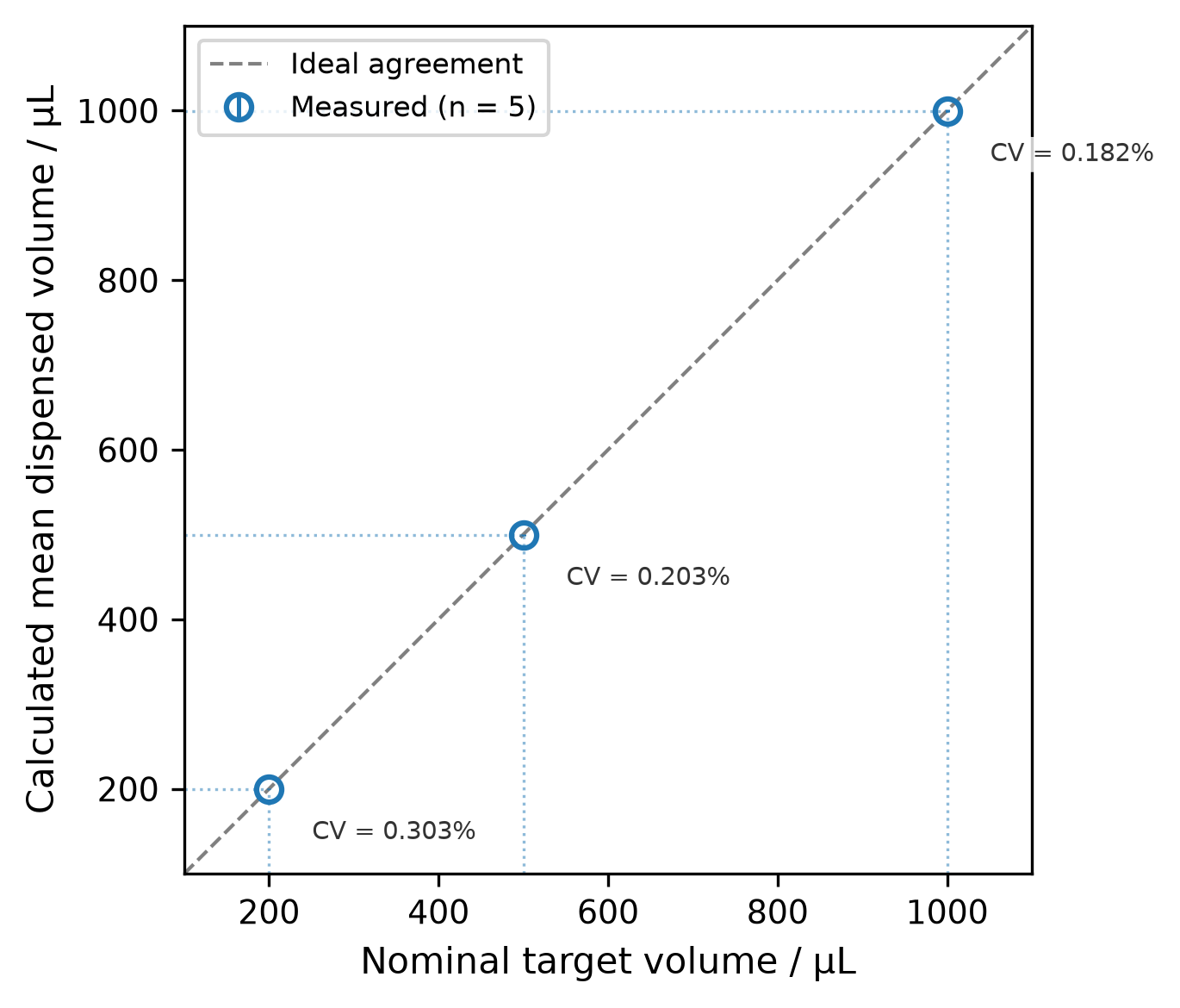
Fig 3: Gravimetric validation of liquid dispensing at nominal volumes
Limitations
- The CEIDTM optimization engine and physical hardware are proprietary and not open source, limiting reproducibility of the autonomous closed-loop control beyond hardware and digital twin.
- Evaluation limited to a colorimetric dye mixing proof-of-concept rather than quantitative chemical or biological assays, restricting demonstrated application scope.
- No adversarial testing or robustness evaluation under hardware mechanical drift or sensor noise over extended runs presented.
- The platform is single-channel pipetting only; no multi-channel or high-throughput scaling demonstrated.
- Latency and bandwidth constraints of the digital twin synchronization over network connections are only qualitatively described, detailed benchmarks would be informative.
- Experimental stopping criteria fixed by budget (24 trials), no adaptive or early stopping strategies evaluated.
Open questions / follow-ons
- Can the platform's architecture be extended to multi-channel pipetting or more diverse liquid handling tasks to broaden throughput and functionality?
- How well does the digital twin and remote supervision perform under network latency, packet loss, or other real-world connectivity constraints in distributed laboratory settings?
- What modifications are needed to adapt the platform for quantitative chemical or biological assays rather than colorimetric proxies?
- Can the CEIDTM closed-loop optimization tolerate sensor noise and experimental variability in less controlled environments, and what fault detection mechanisms are needed?
Why it matters for bot defense
Though not directly focused on CAPTCHA or bot detection, the paper offers valuable insight into low-cost, open-source robotic automation platforms equipped with real-time remote supervision and human-in-the-loop control. For bot-defense and CAPTCHA practitioners interested in laboratory automation or experimental infrastructure, RAINBOTTM demonstrates how a low-cost physical system can be tightly integrated with a live digital twin to enable remote operation and intervention, which could inspire designs for secure, remotely monitored platforms resisting automated misuse. The real-time synchronization of physical state with a browser interface showcases robust state consistency protocols valuable beyond labs. Furthermore, the closed-loop autonomous optimization framework with human oversight provides a model for balancing autonomy and manual intervention, a concept transferable to CAPTCHA or bot-challenge system designs involving adaptive defense strategies. Practitioners should note the importance of modular, low-cost hardware combined with transparent, digitally mirrored controls as a template for trustworthy remote-agent systems.
Cite
@article{arxiv2607_20662,
  title={ Scalable Low-Cost Laboratory Automation: A Digital Twin-Integrated Robotic Platform for Autonomous Liquid Handling (RAINBOTTM) },
  author={ Mohamed Rami Ayeche and Souhil Sid and Ahyen Mostofa and Rehaan Hussain and Ali Shayesteh and Fadwa El Mellouhi },
  journal={arXiv preprint arXiv:2607.20662},
  year={ 2026 },
  url={https://arxiv.org/abs/2607.20662}
}