
Learning to Detect UI Principle Violations via Reinforcement Learning
Source: arXiv:2607.20690 · Published 2026-07-22 · By Nishi Mehta, Swathi Alse, Himani Kumavat, Yue Yu, Pratik Jayarao
TL;DR
This paper tackles the challenge of automatically detecting violations of established UI quality principles in generated web front-end code. While current language models and coding agents generate functionally correct webpages, their outputs may still breach various accessibility, usability, and design guidelines, including WCAG 2.2 accessibility criteria, deceptive dark patterns, and cognitive usability principles. Existing auditing solutions either rely on expensive expert human review, costly frontier vision-language models, or inexpensive but limited rule-based tools. The authors present a lightweight 4-billion parameter vision-language model trained via reinforcement learning (RL) to act as an effective automated critic of generated interfaces across 19 unified UI principle violations drawn from accessibility, deceptive patterns, cognitive, and visual composition domains.
Their core innovation is a procedurally generated dataset of roughly 10,000 clean LLM-generated Tailwind webpages with synthetically injected, teacher-verified principle violations. This synthetic data enables exact labeling without costly human annotation. Continued RL training dramatically improves detection performance, raising micro-F1 from 36% to 84% on a 500-page test set, with 13 of 19 principles exceeding 80% F1. The model learns to leverage both rendered screenshots and HTML source together to catch both visual-only violations and markup issues. This results in a practical, scalable system for auditing interface quality, filtering training data, and rewarding design-aware code generation. The authors release their data generation and injection recipes for reproducibility and future research.
Key findings
- Reinforcement learning on the 4B vision-language model boosts micro-F1 from 36% (zero-shot) to 84% on the 500-page evaluation set.
- 13 out of 19 UI principles achieve over 80% F1 after RL training, spanning accessibility, dark patterns, and cognitive/perceptual principles.
- The zero-shot model completely misses several visual-only violations that improve substantially after RL: non-text contrast (A1) from 0% to 64%, spacing consistency (D1) from 4% to 94%, and content-container fit (D3) from 0% to 92%.
- Manipulative dark patterns with textual cues such as confirmshaming (B1), hidden costs (B3), and trick questions (B4) saturate near 97-100% F1 post-training.
- Format compliance (valid model output parsing) improves from 80% to 96% over RL training, reflecting more concise and effective reasoning output.
- The hardest principles remain those requiring relative judgments across multiple elements: misdirection (B2) improves from 3% to 55% F1; Miller's Law (C3) from 49% to 54%; and Fitts's Law (C6) from 3% to 36%.
- Synthetic injection with teacher verification produces a high-quality labeled dataset of approx. 10K pages, with 1-3 violations per page verified by a 235B-parameter vision-language teacher model.
Threat model
The adversary is an automated code-generating system that produces web pages potentially violating UI quality principles. The auditor model is designed to detect these known violations from static rendered screenshots and HTML source. The adversary is not explicitly modeled as an adaptive attacker aiming to evade detection, nor can it manipulate the auditor's input modality. The system does not handle runtime behavioral adversaries or multi-page consistency attacks.
Methodology — deep read
The authors propose training a small vision-language model to automatically detect violations of 19 UI principles across accessibility, dark patterns, cognitive/perceptual, and visual composition domains in generated webpages. The threat model assumes an auditor needing scalable automated review; adversaries are not directly modeled beyond potentially exposing violations embedded in generated code.
Data generation is carefully designed: starting with structurally complex seed pages from the WebCode2M dataset (real web pages), they regenerate these pages as clean, self-contained Tailwind CSS documents using a three-round LLM prompting process to increase diversity and richness. Pages are stratified by domain and page type to cover a broad range of real-world scenarios.
Next, each regenerated page undergoes a staged injection of known violations corresponding to the 19 principles. Each candidate violation is only applied if the page is structurally eligible to host it (e.g., a trick question requires a form element). To ensure label correctness, a powerful teacher model (Qwen3-VL-235B) performs a verification step: after injection and re-rendering, it checks visually and in HTML that the violation is genuinely present and perceptible. They retry injections up to three times before discarding failures.
The resulting dataset contains roughly 10,000 pages, each with 1-3 verified violations, establishing exact ground truth by construction. Pages also undergo pre-screening to exclude organic (naturally occurring) violations unrelated to injection from scoring.
The student model is Qwen3-VL-4B-Thinking, a 4.6B-parameter vision-language transformer accepting as input both low-resolution screenshots (448×544 pixels, producing 238 vision tokens per image) and the full HTML source as text. This multimodal input enables detection of both markup-based and visual-only violations.
Training proceeds with Generalized Reward Policy Optimization (GRPO) reinforcement learning, optimizing a dense multi-label F1 reward that balances precision and recall for violations present. They use batches of 32 prompts with 16 samples each, learning rate 1e-6, and train until the evaluation reward converges. The reward relies on exact injection ground truth and excludes organic issues.
At inference, the model outputs a structured binary label (1/0) for each principle within a <labels> tag, preceded by chain-of-thought reasoning in XML-like <think> blocks. This approach encourages interpretable reasoning and reduces unparseable responses.
Evaluation uses a held-out 500-page set stratified by violation counts and disjoint by seed pages to avoid data leakage. Metrics reported are micro-averaged precision, recall, and F1 over the positive class (presence of violation) as well as per-principle F1. Format compliance tracks how often model output is parseable.
In summary, the method integrates a rigorously-constructed synthetic violation dataset verified by a strong teacher model, multimodal vision+HTML inputs, chain-of-thought RL training optimizing multi-label F1 reward, and fine-grained evaluation on a representative webpage corpus. One concrete example: a login page is regenerated as a clean Tailwind HTML+CSS page; the teacher model injects a low-contrast violation on an input border, verifies its visual presence in rendered screenshots, and labels it positive for the non-text contrast principle. The student model trains to detect this and other violations using visual and textual cues.
Technical innovations
- Unified taxonomy of 19 UI principle violations combining WCAG 2.2 accessibility, deceptive dark patterns, cognitive and perceptual design laws into a single detection task.
- Data generation pipeline with controlled synthetic injection of violations into realistic LLM-regenerated Tailwind web pages plus teacher-model verification to ensure label correctness.
- Multimodal 4B-scale vision-language model architecture accepting both screenshots and HTML source to detect violations visible only in rendered visuals and those detectable in markup.
- Reinforcement learning with a dense multi-label F1 reward, encouraging precise and recall-optimized detection along with concise chain-of-thought reasoning outputs.
- Use of a frontier 235B-parameter teacher vision-language model during injection and verification to create a high-quality labeled dataset without human annotation.
Datasets
- Synthetic Injection Dataset — ~10,000 Tailwind-generated web pages with 1-3 verified violations each — generated and verified using Qwen3-VL-235B teacher model
- WebCode2M — Large corpus of real-world web pages used as seeds for regeneration — public
Baselines vs proposed
- Zero-shot Qwen3-VL-4B-Thinking: micro-F1 = 36% vs RL-trained model: micro-F1 = 84%
- Zero-shot non-text contrast (A1): F1 = 0% vs +RL: 64%
- Zero-shot spacing consistency (D1): F1 = 4% vs +RL: 94%
- Zero-shot content-container fit (D3): F1 = 0% vs +RL: 92%
- Zero-shot confirmshaming (B1): F1 = 53% vs +RL: 97%
- Zero-shot misdirection (B2): F1 = 3% vs +RL: 55%
- Zero-shot Fitts's Law (C6): F1 = 3% vs +RL: 36%
Figures from the paper
Figures are reproduced from the source paper for academic discussion. Original copyright: the paper authors. See arXiv:2607.20690.

Fig 1: Our task. Left: a clean signup page. Right: the same page after our pipeline injects
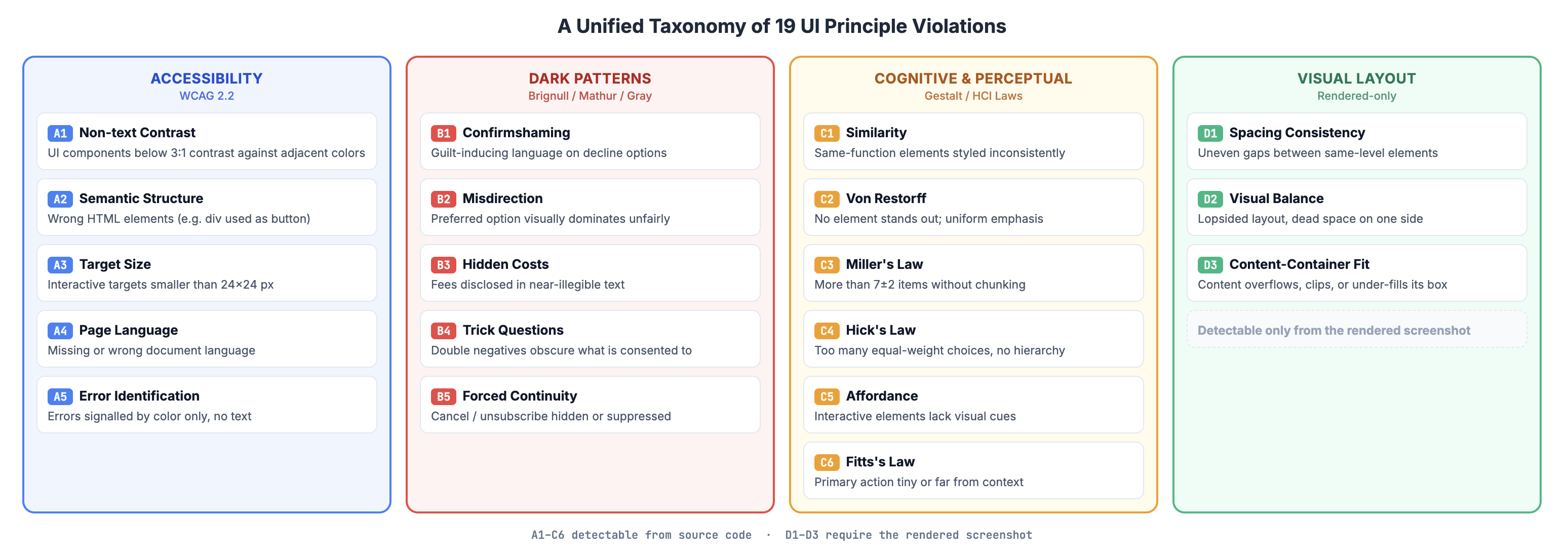
Fig 2: The 19-principle violation taxonomy, grouped into four families. Principles A1–C6 are
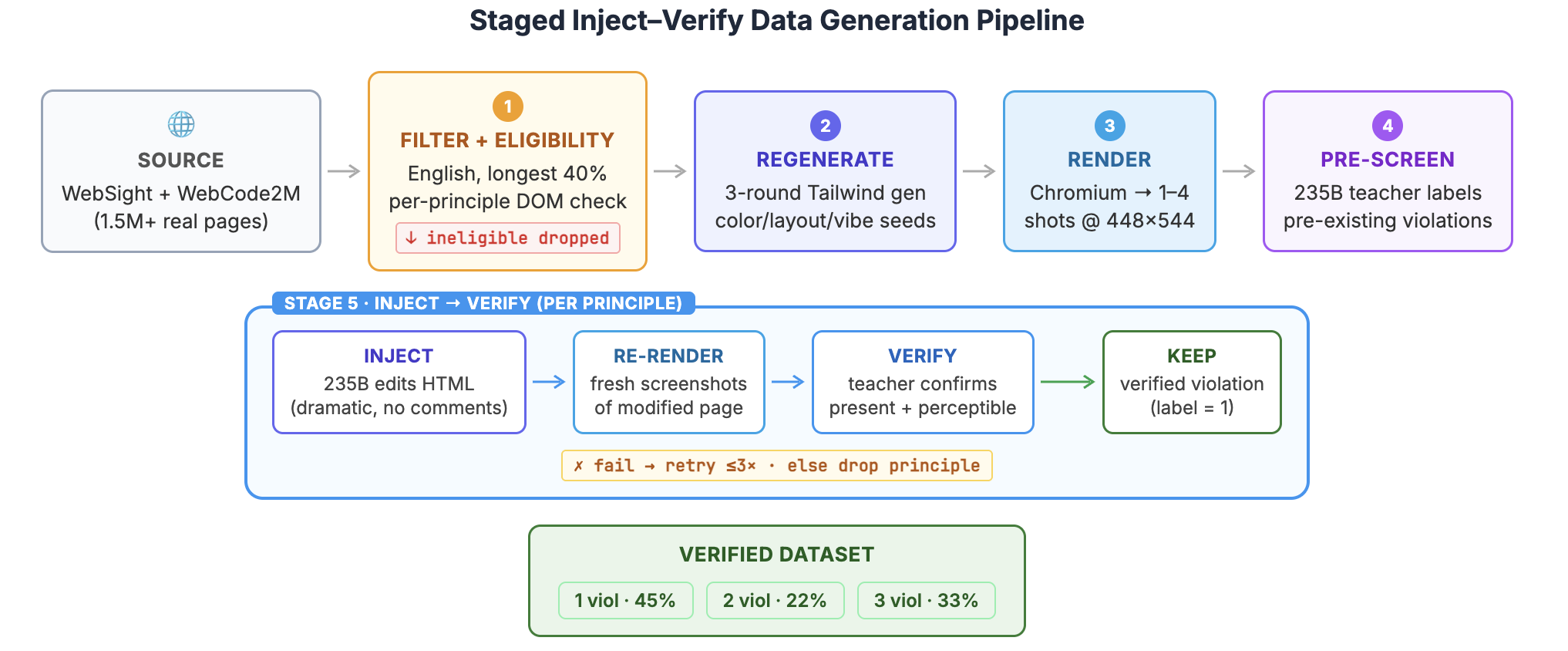
Fig 3: The data generation pipeline. Real pages are filtered and screened for per-principle eligi-
Limitations
- Only a single training run reported, with one random seed; no variance or robustness characterization.
- Training and evaluation labels come solely from the teacher model, not human annotators, so label noise or systematic biases could affect results.
- Input screenshot resolution (448×544) likely limits fine-grained spatial relational judgments required by hardest principles like misdirection, Miller's Law, and Fitts's Law.
- Evaluation restricted to synthetic injections on regenerated Tailwind pages; transfer to organic violations or diverse production interfaces not validated.
- Does not cover runtime or dynamic UI behaviors (e.g., keyboard navigation) or multi-page consistency violations.
- Relative judgments across multiple elements remain challenging, suggesting system improvements or higher-resolution inputs may be needed.
Open questions / follow-ons
- How well does the model generalize from synthetically injected violations to organically occurring UI principle violations in real-world production sites?
- Can higher-resolution inputs or explicit spatial/region segmentation cues improve detection of challenging relational principles like misdirection and Fitts's Law?
- What is the impact of human-verified labels on training and evaluation accuracy compared to teacher-model-only supervision?
- How can this multimodal critic be integrated effectively into generative code pipelines to provide design-aware reward signals while maintaining generation diversity?
Why it matters for bot defense
For bot-defense and CAPTCHA practitioners, this work highlights the feasibility and value of building multimodal, vision-language auditing tools that go beyond superficial functional correctness to detect deeper usability, accessibility, and ethical violations in generated user interfaces. CAPTCHA and bot-detection interfaces often require adherence to strict accessibility and usability principles to ensure fairness and efficacy; automated UI violation detection could improve the quality and security of such front-end elements. The synthetic data generation and teacher verification pipeline demonstrate a scalable approach for creating labeled datasets where manual annotation is infeasible, a useful technique for building specialized UI quality or bot-detection monitoring tools. However, practitioners should note the limitations on relational and dynamic principles, and consider how domain-specific adaptations or higher-resolution visual inputs might be necessary for robust real-world deployment.
Cite
@article{arxiv2607_20690,
  title={ Learning to Detect UI Principle Violations via Reinforcement Learning },
  author={ Nishi Mehta and Swathi Alse and Himani Kumavat and Yue Yu and Pratik Jayarao },
  journal={arXiv preprint arXiv:2607.20690},
  year={ 2026 },
  url={https://arxiv.org/abs/2607.20690}
}