
A ProbLog program to infer individual genotypes from familial phenotypes in autosomal, X-linked, and Y-linked Mendelian disorders
Source: arXiv:2607.20250 · Published 2026-07-22 · By Maxime Mahout
TL;DR
This paper addresses the problem of reconstructing individual genotypes from familial phenotypes across multiple generations for Mendelian monogenic disorders classified as autosomal, X-linked, or Y-linked. The novel contribution is a probabilistic logic programming tool called mendelprob.pl, implemented in ProbLog, which models inheritance using Mendel's laws combined with Hardy-Weinberg equilibrium. The tool can incorporate both genotype and phenotype evidence, inferring individual and familial genotype probabilities and disorder type (autosomal/X/Y-linked) without prior knowledge of the disorder. Extensive examples from genetic counseling literature illustrate the approach, demonstrating concordance with the state-of-the-art pedprobr tool but with added benefits such as phenotype inference and logical negation. The approach emphasizes explainability and open-source availability for clinical use.
Key findings
- The mendelprob.pl tool matches pedprobr's genotype probability predictions on example pedigrees like Cystic Fibrosis (CF), e.g., the predicted probability that Rhonda's children carry the disease allele is 0.001 (1/1000).
- Unlike pedprobr, mendelprob.pl can leverage phenotypic evidence with negation to exclude genotypes, refining probabilities (e.g., decreasing CF genotype probabilities in unaffected family members).
- Mendelprob.pl automatically infers the mode of inheritance (autosomal, X-linked, or Y-linked) when unknown, demonstrated on Huntington's disease pedigree where tool inferred autosomal dominant inheritance from phenotype constraints.
- The tool supports modeling recessive and dominant allele transmission with bi-allelic gene models across up to three generations, aligned with clinical pedigree standards.
- Probabilistic logic programming implementation enables simultaneous reasoning about genotype and phenotype probabilities in males and females accounting for sex-linked differences.
- Using Hardy-Weinberg equilibrium to model founder genotype frequencies for unknown ancestors provides a computationally efficient approximation for extending family trees.
- Commands and probabilistic queries in ProbLog allow flexible input of evidence and yield interpretable genotype and phenotype probability distributions per individual and generation.
- The tool is open-source and available on GitHub, promoting transparency and extensibility for genetic counseling applications.
Threat model
n/a (the paper focuses on probabilistic modeling of genetic inheritance rather than security or adversarial threat scenarios).
Methodology — deep read
The authors developed mendelprob.pl, a probabilistic logic program implemented in ProbLog version 2. The threat model assumes no malicious adversary, rather the challenge is uncertainty in genotype transmission in familial pedigrees for Mendelian disorders. Mendel's laws and Hardy-Weinberg equilibrium form the genetic transmission model. The program inputs include pedigree structure, known genotypes and/or phenotypes of individuals, and disorder prevalence (allele frequency p).
Data and examples come from pedigrees described in published genetic counseling literature (e.g., Bennett 2011) and historical cases (e.g., Huntington's disease pedigree from Gusella et al. 1983). The examples illustrate tool usage rather than statistical evaluation across large datasets.
The core architecture encodes Mendelian inheritance for autosomal, X-linked, and Y-linked bi-allelic genes as probabilistic logical rules. For each generation, genotypes of family members are modeled with carry predicates and phenotypes with show predicates, distinguished by biological sex where relevant. The program calculates genotype transmission probabilities from parents to children according to Mendelian laws.
Unknown spouses and remote ancestors who are not in the direct pedigree are assumed to have genotypes drawn from Hardy-Weinberg equilibrium based on allele prevalence p. The tool supports dominant and recessive dominance modeling by relating alleles a (mutant) and A (wild type) to phenotype via deterministic rules (penetrance = 100%). Logical negation can encode phenotypic absence.
ProbLog's inference engine compiles the probabilistic logic program into weighted Boolean formulas solved using Binary Decision Diagrams. The program supports setting evidence (phenotype or genotype observations) and queries probability distributions over genotypes/phenotypes for each individual and generation. Random uniform variables model unknown disorder type (auto/X/Y) and offspring sex when absent.
Training or optimization is not applicable since this is a logic-programming deterministic model with probabilistic inference, not a machine learning model. Model hyperparameters include prevalence p and number of generations modeled (typically 3). No stochastic optimization or batches are used.
Evaluation is by comparisons to pedprobr tool outputs on representative pedigrees, showing identical genotype probability distributions where prior information overlaps. Further, the tool's ability to incorporate phenotypic negation and infer disorder type distinguishes it from pedprobr. No large-scale cross-validation or adversarial robustness tests are reported. Statistical tests are not applicable.
The authors provide all code and example data open-source on GitHub. The ProbLog model specification, evidence commands, and queries are fully disclosed and can be reproduced with ProbLog version 2. The approach has limited scalability beyond three generations and direct pedigrees due to combinatorial explosion.
A concrete example is the Cystic Fibrosis pedigree: genotype and phenotype evidence on three generations is input, Mendelprob.pl infers genotype probabilities for the proband and family, matches pedprobr results, and refines them by incorporating negative phenotypic evidence to exclude disease alleles in unaffected relatives.
Technical innovations
- Encoding Mendelian autosomal, X-linked, and Y-linked inheritance as probabilistic logic programs supporting both genotype and phenotype inference, including logical negation.
- Use of Hardy-Weinberg equilibrium as probabilistic priors for unknown family members in direct pedigrees within a logic programming framework.
- Automatic inference of the disorder type (autosomal vs sex-linked) from phenotype patterns without prior specification.
- Integration of phenotype evidence and negation to refine genotype probability predictions, which previous tools like pedprobr cannot handle.
- Providing an open-source, explainable, and logically interpretable alternative to proprietary and closed-source pedigree analysis tools.
Datasets
- "Bennett (2011) practical genetic counseling pedigrees" — small number of manually constructed pedigrees from literature — public
- "Gusella et al. (1983) Huntington’s disease pedigree branch" — a partial pedigree from a historic genetic study — public
Baselines vs proposed
- pedprobr: genotype probability for Rhonda’s children carrying CF allele = 0.001 vs mendelprob.pl: 0.001
- pedprobr: unable to incorporate phenotype negation vs mendelprob.pl: phenotype negation reduces grandparent genotype aa probability from 0.0005 to ~0
- pedprobr: requires predefined disorder type vs mendelprob.pl: automatically inferred autosomal dominant for Huntington’s disease example
Figures from the paper
Figures are reproduced from the source paper for academic discussion. Original copyright: the paper authors. See arXiv:2607.20250.
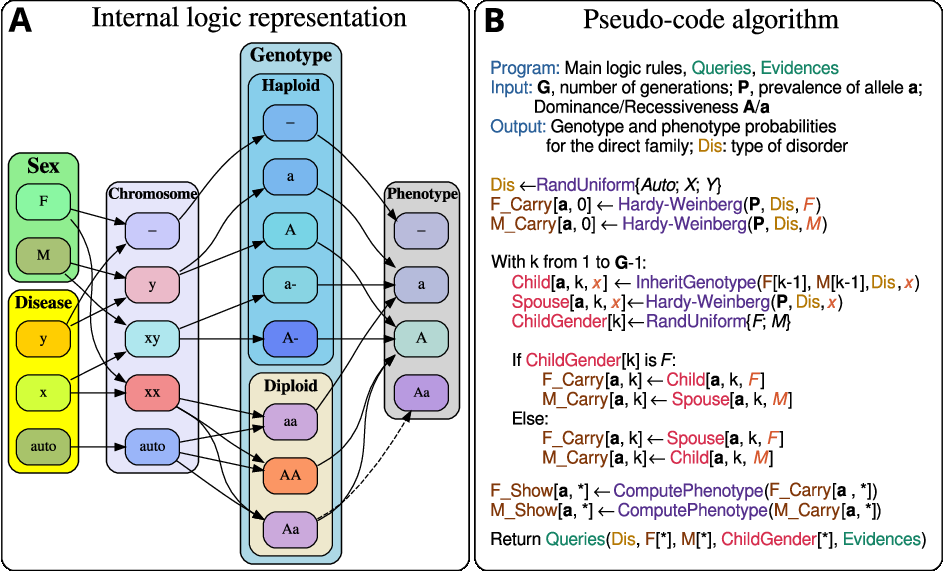
Fig 1: Description of the mendelprob.pl functioning: A Internal logic representation of genotypes
Limitations
- The tool only supports single-locus monogenic disorders with bi-allelic variants; does not handle multi-allelic or polygenic conditions.
- Modeling restricted to direct pedigrees limited to about three generations due to exponential complexity; not scalable to full large family trees.
- Assumes Hardy-Weinberg equilibrium for unknown family members, which may not hold in some populations or pedigrees.
- Penetrance is assumed to be 100% or can be set manually; no modeling of variable expressivity or incomplete penetrance with population-level uncertainty.
- No adversarial evaluation or robustness checks against pedigree errors or phenotype misclassification.
- No probabilistic linkage analysis or recombination modeling; purely inheritance probabilities presumed for known pedigree structure.
- Evaluation limited to literature examples; no large-scale validation on clinical datasets or prospective testing.
Open questions / follow-ons
- How can the model be extended to multi-allelic loci and polygenic inheritance patterns?
- What is the scalability of the probabilistic logic program to larger pedigrees beyond three generations with more complex family structures?
- How to incorporate variable penetrance, expressivity, and environmental modifiers probabilistically within the logic framework?
- Could the approach integrate genotype uncertainly from noisy or partial genetic test results and sequence data?
Why it matters for bot defense
This work is relevant to bot-defense engineers in that it exemplifies how probabilistic logic programming can be applied to infer hidden states (genotypes) from observed data (phenotypes) under complex inheritance constraints. The methodology highlights the importance of integrating prior domain knowledge (Mendelian genetics, Hardy-Weinberg equilibrium) as logical and probabilistic rules to reason under uncertainty, which is analogous to reasoning about user behavior in bot-detection scenarios.
For CAPTCHA and bot defense applications that rely on multi-step inference from observed signals and uncertain user states, the detailed logic-based probabilistic programming approach can serve as a conceptual template. Notably, the ability to incorporate negative evidence (logical negation) and multiple inheritance modes corresponds to handling nuanced user behavior patterns and diverse bots. Additionally, their approach of encoding biological prior knowledge could be compared to encoding rules or behavioral heuristics in bot defense.
However, the domain difference (genetics vs bot detection) suggests direct algorithmic reuse is limited. Still, the paper demonstrates the utility of explainable, interpretable probabilistic logic programming for complex inference tasks, an approach potentially valuable for CAPTCHAs requiring layered reasoning or sequential evidence accumulation to distinguish human from bot.
Cite
@article{arxiv2607_20250,
  title={ A ProbLog program to infer individual genotypes from familial phenotypes in autosomal, X-linked, and Y-linked Mendelian disorders },
  author={ Maxime Mahout },
  journal={arXiv preprint arXiv:2607.20250},
  year={ 2026 },
  url={https://arxiv.org/abs/2607.20250}
}