
Real-time optimal control with shallow recurrent decoder networks
Source: arXiv:2607.19302 · Published 2026-07-21 · By Matteo Tomasetto, Francesco Braghin, J. Nathan Kutz, Andrea Manzoni
TL;DR
This paper addresses the challenge of real-time optimal control for high-dimensional, parametric dynamical systems governed by PDEs, where traditional optimal control approaches suffer from high computational cost due to repeated PDE solves and system complexity. The authors introduce SHRED-ROM, a data-driven reduced order modeling approach using shallow recurrent decoder networks, which leverages sparse sensor measurements and limited training data from expert demonstrations to predict optimal distributed control actions directly. A sensor forecaster module further enhances robustness by enabling feedback loop closure at the latent level, mitigating the impact of sensor failures or delays. The approach is experimentally demonstrated on three high-dimensional control problems involving parametric density control and fluid flow control, where SHRED-ROM achieves performance close to full-order optimization solutions but with orders of magnitude lower runtime, enabling adaptive feedback control in real-time across multiple unseen scenarios.
Key findings
- SHRED-ROM can predict optimal distributed control actions in real-time from only sparse state sensor readings without explicit parameter knowledge.
- Model trained with just 100 full-order optimal control trajectories generalizes to new parametric scenarios with mean relative control errors as low as 2.68% (unsteady flow control test).
- In the fluidic pinball case, the controller reduces density dispersion and boundary collisions effectively, closely matching full-order control performance (Fig. 3 and 4).
- Sensor forecaster enables latent-level feedback closure, allowing continued control under sensor failures or delays with minimal performance degradation.
- Training uses compressed control space via POD reducing from 59344 to 300 control DOFs, enabling efficient training and inference on consumer hardware.
- Using LSTM for temporal encoding of time-lagged sensor sequences (L=10 or 20) effectively captures system dynamics for control prediction.
- Control inference latency is suitable for real-time closed-loop control in scenarios with strict timing constraints, outperforming traditional PDE-based optimal control solvers.
- Joint prediction of both control and high-dimensional state variables is possible with mean relative state error around 2.38%, offering comprehensive system monitoring.
Threat model
The assumed adversary is limited to causing sensor failures or delays in feedback data acquisition but cannot manipulate the system state directly or access full system parameters. The model relies on sparse sensor readings, with mitigation strategies to forecast missing sensors to maintain control continuity.
Methodology — deep read
The threat model assumes an adversary seeks to disrupt control by exploiting sensor failures or delays, with the system relying solely on limited sensor readings without direct access to full state or parameters.
Data: The authors generate datasets via PDE-constrained optimal control simulations using full-order adjoint methods for various parametric configurations (e.g., 100 trajectories in fluidic pinball and unsteady flow control cases). Data are split 80/10/10 for training, validation, and testing. Control and state data are reduced via POD to low-dimensional latent spaces (e.g., r=300 for control).
Architecture: SHRED-ROM consists of a sequence encoder fT implemented as a multi-layer LSTM operating on time-lagged sensor readings (window length L=10 or 20) which produces a latent representation encoding system dynamics. A shallow decoder network fX, a feedforward network with two hidden layers (350 and 400 neurons), maps the latent code to POD-reduced control coefficients. The latent sensor forecaster module is another LSTM trained to predict future sensor measurements from past sensor and latent variables to close the feedback loop in absence of sensor data.
Training: Supervised learning trains both fT and fX jointly by minimizing the squared error between predicted and expert optimal controls over sensor histories, using the Adam optimizer for 200 epochs with learning rate schedules (0.001 halving to 0.0001), batch size 64, and dropout of 0.1 to reduce overfitting.
Evaluation applies the learned controller on new scenarios unseen in training, predicting controls from sparse sensors, and measuring mean relative errors versus ground-truth optimal controls. Ablations confirm robustness to sensor loss via the latent forecaster. Performance is compared to full-order adjoint PDE solvers.
Reproducibility: The paper reports hyperparameters, data splits, and network details, though no explicit public code release or frozen weights are mentioned. The datasets are generated from simulation software (dolfin-adjoint, custom PDE solvers) not publicly provided.
Technical innovations
- Use of shallow recurrent decoder networks to directly learn mapping from sparse sensor time histories to optimal distributed control actions without parametric inputs.
- Latent feedback loop enabled by a sensor forecaster LSTM that predicts future sensor states to maintain control integrity despite sensor failures or delays.
- Compression of high-dimensional control spaces via POD enabling scalable and efficient surrogate training on control snapshots of order 10^4 dimensions.
- Application of Takens embedding theorem concepts to relate time-lagged sparse sensor sequences to underlying high-dimensional dynamical states for control synthesis.
Datasets
- Fluidic pinball: 100 optimal control trajectories generated via full-order adjoint methods over 3D parameter space of cylinder velocities.
- Unsteady flow control in channel with obstacle: 100 trajectories doubled via symmetry, parameterized by angle of attack in [−1,1].
- Additional high-dimensional flow control cases with similar sizes, generated by numerical PDE solves, details unspecified.
Baselines vs proposed
- Full-order adjoint solver: control error baseline = 0% (ground truth) vs SHRED-ROM: mean relative control error ≈ 2.68% in unsteady flow control.
- Uncontrolled scenario loss significantly worse than SHRED-ROM feedback controller loss, as shown in Figure 4 loss curves for fluidic pinball.
- Joint state-control prediction by SHRED-ROM achieves mean relative state reconstruction error ≈ 2.38% without explicit physics-informed constraints.
Figures from the paper
Figures are reproduced from the source paper for academic discussion. Original copyright: the paper authors. See arXiv:2607.19302.
Fig 1: Graphical summary of sensor-based feedback control with SHRED-ROM. Sparse sensor readings sµi

Fig 2 (page 2).
Fig 3 (page 2).
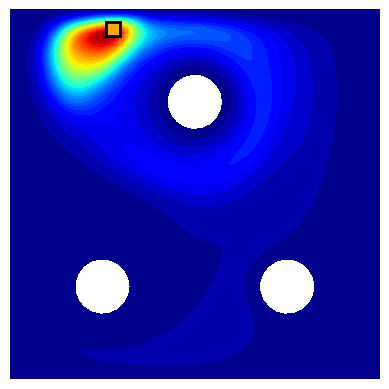
Fig 4 (page 2).
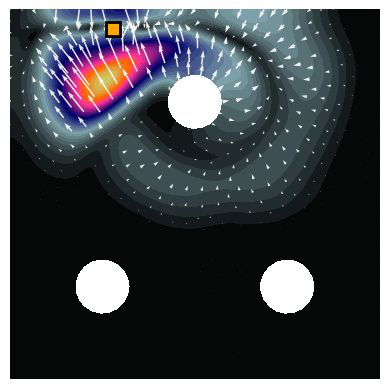
Fig 5 (page 2).
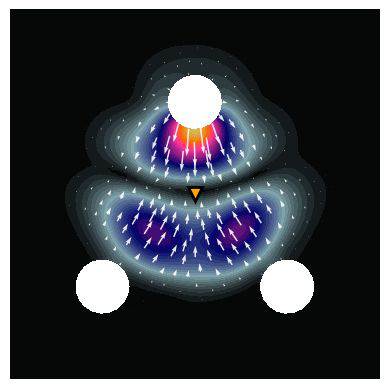
Fig 6 (page 2).
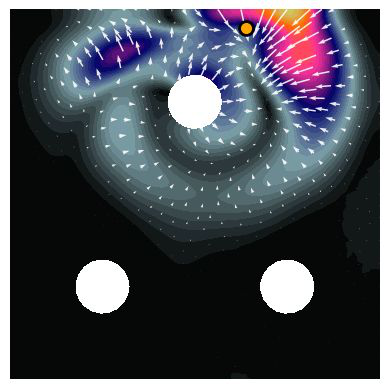
Fig 7 (page 2).
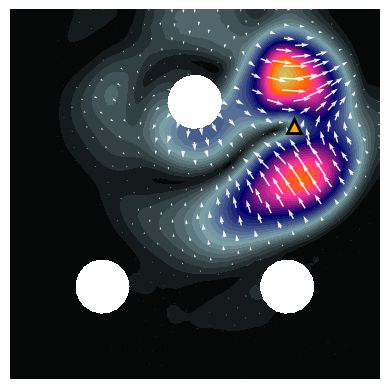
Fig 8 (page 2).
Limitations
- Requires availability of expert optimal control trajectories for supervised training, limiting applicability when such data are scarce or costly.
- No adversarial evaluation against active attackers or deliberate perturbations beyond sensor failures is presented.
- Generalization tested only on parameter shifts sampled similarly to training data; robustness under large distribution shifts unknown.
- The approach assumes fixed sensor placement or at least stationary sensor types; performance with dynamically changing sensors is not studied.
- No reported evaluation of latency or computational overhead on embedded or resource-constrained hardware for real industrial deployment.
- The method may face challenges extending to highly nonlinear, non-smooth or discontinuous dynamics beyond presented smooth PDE examples.
Open questions / follow-ons
- How does SHRED-ROM perform under adversarial sensor attacks that inject false data rather than sensor outages?
- Can the approach be extended to handle time-varying sensor networks or variable numbers of sensors during deployment?
- What are the latency and computational requirements for SHRED-ROM inference on embedded controllers typical in robotics or aerospace?
- How well does the model adapt when expert demonstrations are unavailable or partially suboptimal, requiring reinforcement or online learning?
Why it matters for bot defense
For CAPTCHA and bot-defense systems that often require real-time decisions under partial or noisy observations, the SHRED-ROM methodology demonstrates how to leverage limited sensor data combined with lightweight recurrent neural decoders to approximate optimal control policies efficiently. The sensor forecaster concept is particularly relevant in scenarios with intermittent measurement availability or delayed feedback, offering a way to maintain robust, adaptive control or decision-making even under partial observability. Although the paper focuses on physical PDE systems, the architecture and closed-loop feedback strategy can inspire CAPTCHA systems that must tolerate missing or corrupted signals (e.g., behavioral features) without performance degradation. This insight may guide the design of bot detection or user verification schemes that rely on sensor-like sparse streaming data while remaining robust to signal dropout or noise.
Cite
@article{arxiv2607_19302,
  title={ Real-time optimal control with shallow recurrent decoder networks },
  author={ Matteo Tomasetto and Francesco Braghin and J. Nathan Kutz and Andrea Manzoni },
  journal={arXiv preprint arXiv:2607.19302},
  year={ 2026 },
  url={https://arxiv.org/abs/2607.19302}
}