
Computing on the Fly: Navigating a Vision for the Future of Drone Computing
Source: arXiv:2607.19213 · Published 2026-07-21 · By Kevin Butler, Christopher Stewart, Nils Aschenbruck, Alina Gerall, Weisong Shi, Deborah Silver et al.
TL;DR
This 2026 Computing Community Consortium (CCC) report provides a forward-looking, decade-scale vision of AI-powered drone technology transforming civil infrastructure and services. It addresses a "capability gap" where recent hardware advances outpace current software, AI, networking, and security systems needed for safe, scalable drone fleets. By 2035, millions of drones could deliver goods, inspect infrastructure, and respond rapidly to disasters—comparable in impact to highways or electric grids. However, realizing this requires overcoming 12 deeply interconnected technical challenges, ranging from scaling coordination to trust and secure distributed authentication, real-time edge-cloud integration, and workforce development. The report lays out prioritized, multi-year recommendations to address these, emphasizing interdisciplinary research, testbed development, regulatory frameworks, and collaboration among academia, industry, and policymakers. It discusses alternative partial progress scenarios, underscoring that only coordinated breakthroughs across AI, security, and policy will unlock the full transformative potential of safe, autonomous drone operations at national scale.
Key findings
- Millions of drones are forecast by 2035, creating unprecedented wireless spectrum contention and airspace management bottlenecks that current centralized systems cannot handle.
- Traditional certfication methods are infeasible for continuously learning AI swarms; compositional and continuous monitoring frameworks are needed.
- Non-deterministic AI agents introduce emergent multi-agent behaviors and integration crises, requiring new formal verification and runtime monitoring infrastructures.
- Drone AI must be physics-aware and integrated with control theory to close the 'depth-semantic gap' that threatens safety-critical perception failures.
- Distributed trust in drone networks requires new scalable authentication and privacy-preserving protocols resistant to spoofing, jamming, and infrastructure adversaries.
- Current autonomy stacks cannot guarantee worst-case execution time (WCET) for safety-critical control loops; real-time-aware autonomy frameworks are essential.
- Policy and regulatory frameworks—FAA, ASTM, FCC coordination—are critical for enabling large-scale Beyond Visual Line of Sight (BVLOS) and multi-operator operations.
- Scalable simulation-to-reality pipelines and digital twin technologies are vital to validating million-drone fleet behaviors before live deployment.
Threat model
Adversaries include malicious actors capable of spoofing GPS and communication signals, jamming wireless links, introducing compromised drones into fleets, and attacking the distributed trust and authentication frameworks. The adversary cannot easily perform physical sabotage or penetrate well-monitored secure facilities. The model assumes attackers seek to degrade, mislead, or seize drone fleet operations by exploiting networking and AI vulnerabilities, especially during degraded or intermittent connectivity conditions.
Methodology — deep read
This report is a comprehensive synthesis from a December 2025 CCC workshop involving 47 experts spanning academia, government, and industry. The authors conducted a collaborative horizon-scanning and challenge-mapping exercise rather than empirical experimentation. The methodology involved: 1) Establishing a threat model focused on adversaries capable of spoofing or jamming communications, potentially exploiting unverified autonomous AI drone behaviors in contested airspace. 2) Synthesizing projections of drone fleet growth (from thousands to millions by 2035) from governmental reports and market research. 3) Analyzing current limitations in drone hardware, AI autonomy stacks, communication protocols, certification processes, and regulatory frameworks through literature review and expert consensus. 4) Identifying 12 critical technical challenge areas by consensus, encompassing scaling coordination, AI assurance, security, edge-cloud integration, policy, and workforce concerns. 5) Proposing prioritized multi-year recommendations for each challenge area with estimated timelines (2-8 years) to guide federal funding agencies, researchers, industry, and policymakers. 6) Defining alternative progress scenarios (edge AI only, security only, or policy only) to illustrate the necessity of combined breakthroughs for systemic transformation. 7) Recommending creation of hybrid simulation-to-reality digital twin testbeds to bridge the sim-to-real gap for validating large fleet emergent behaviors pre-deployment. 8) Advocating interdisciplinary research and standards development to support compositional runtime verification, distributed trust without centralized authorities, and real-time low-latency autonomy scheduling to ensure physically safe AI operations. While no datasets or code releases apply, the methodology is a careful synthesis of diverse expert perspectives, government reports, technical literature, and market analyses to chart an integrative research roadmap. One concrete example discussed is the need for coordinated large-scale fleet simulations combining synthetic and field data to certify millions of heterogeneous, autonomous drones operating safely in shared airspace.
Technical innovations
- Integrated vision identifying 12 interconnected technical challenges spanning AI, networking, security, and policy to achieve safe million-drone fleet operation.
- Emphasis on simulation-to-reality hybrid digital twin pipelines enabling pre-deployment validation of emergent multi-agent behaviors at fleet scale.
- Proposal of real-time-aware autonomy frameworks exposing timing, energy, and QoS interfaces for runtime adaptation with predictable guarantees.
- Development of scalable, distributed trust and decentralized authentication protocols aligned to aerial fleets' adversarial threat model and intermittent connectivity.
Figures from the paper
Figures are reproduced from the source paper for academic discussion. Original copyright: the paper authors. See arXiv:2607.19213.

Fig 1 (page 1).

Fig 2 (page 1).

Fig 3 (page 2).
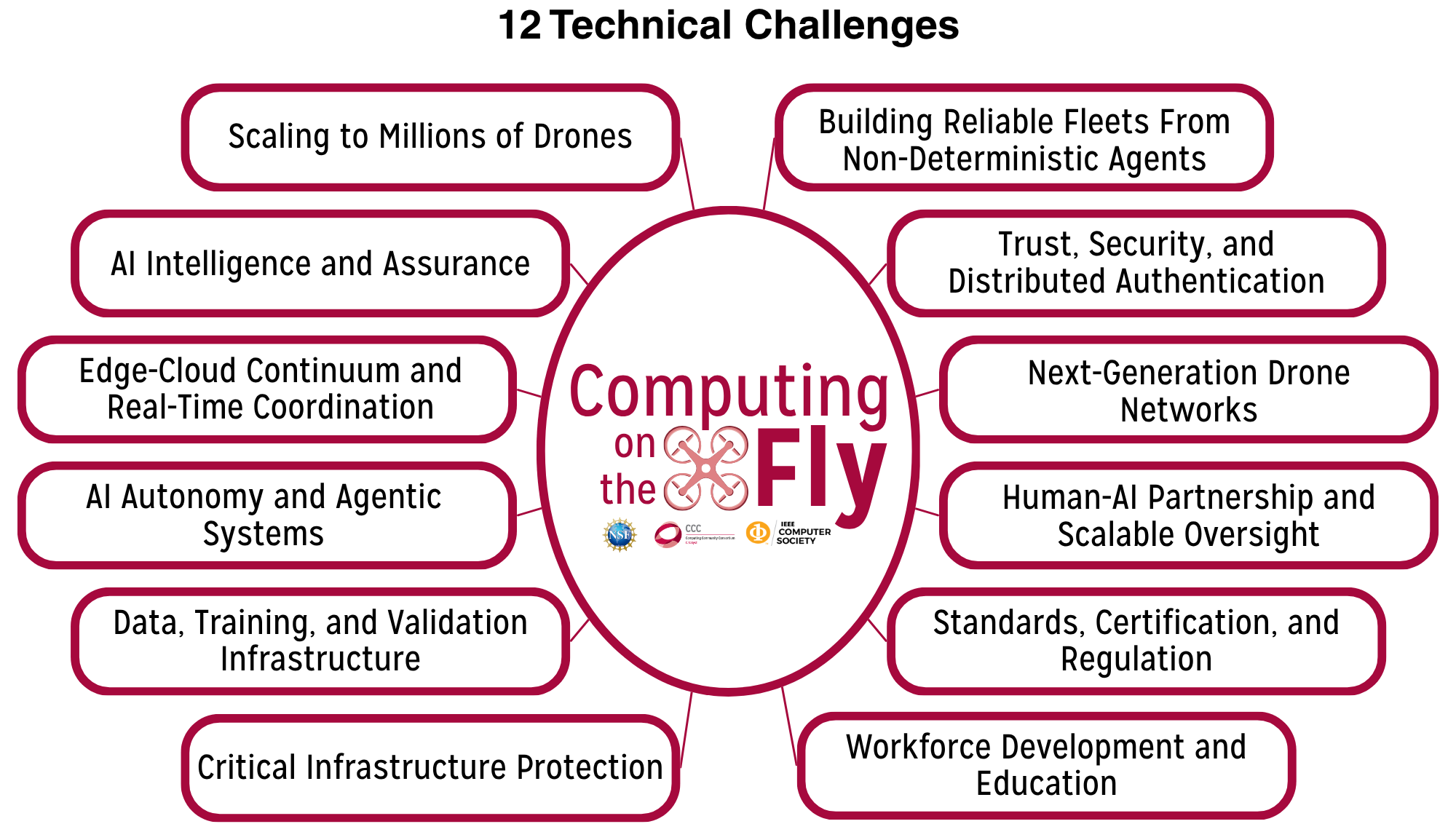
Fig 4 (page 4).
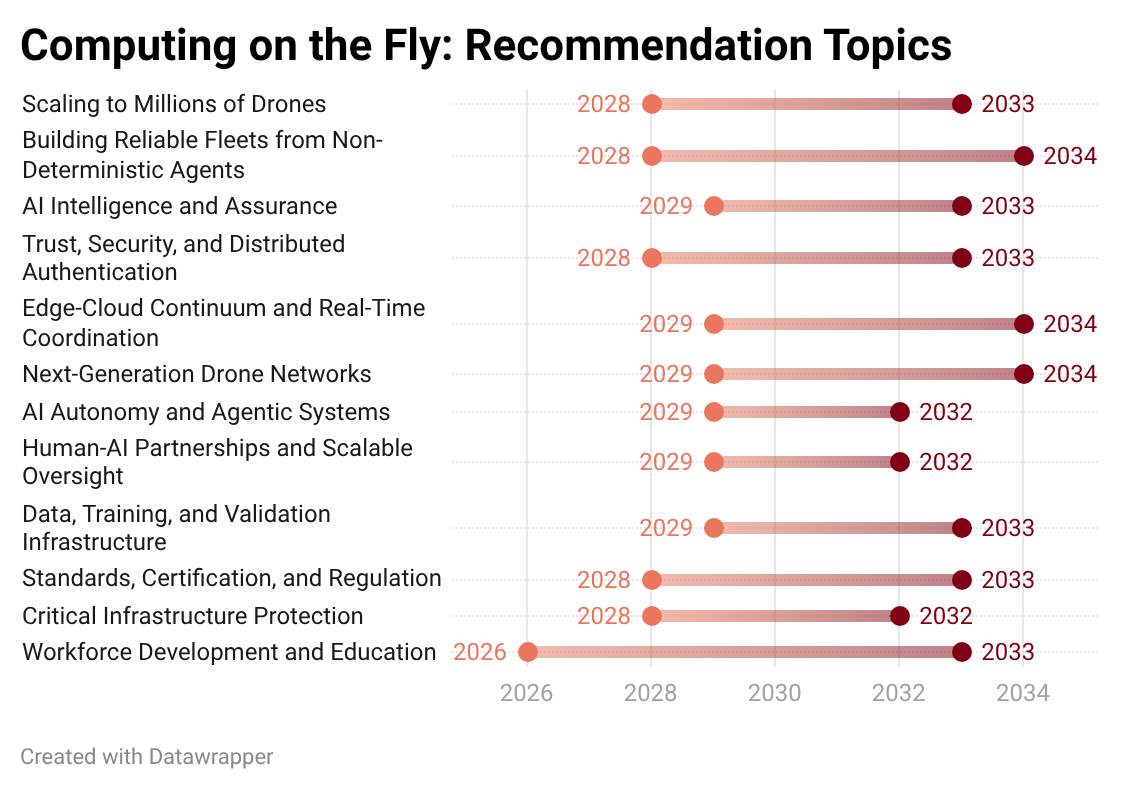
Fig 5 (page 6).
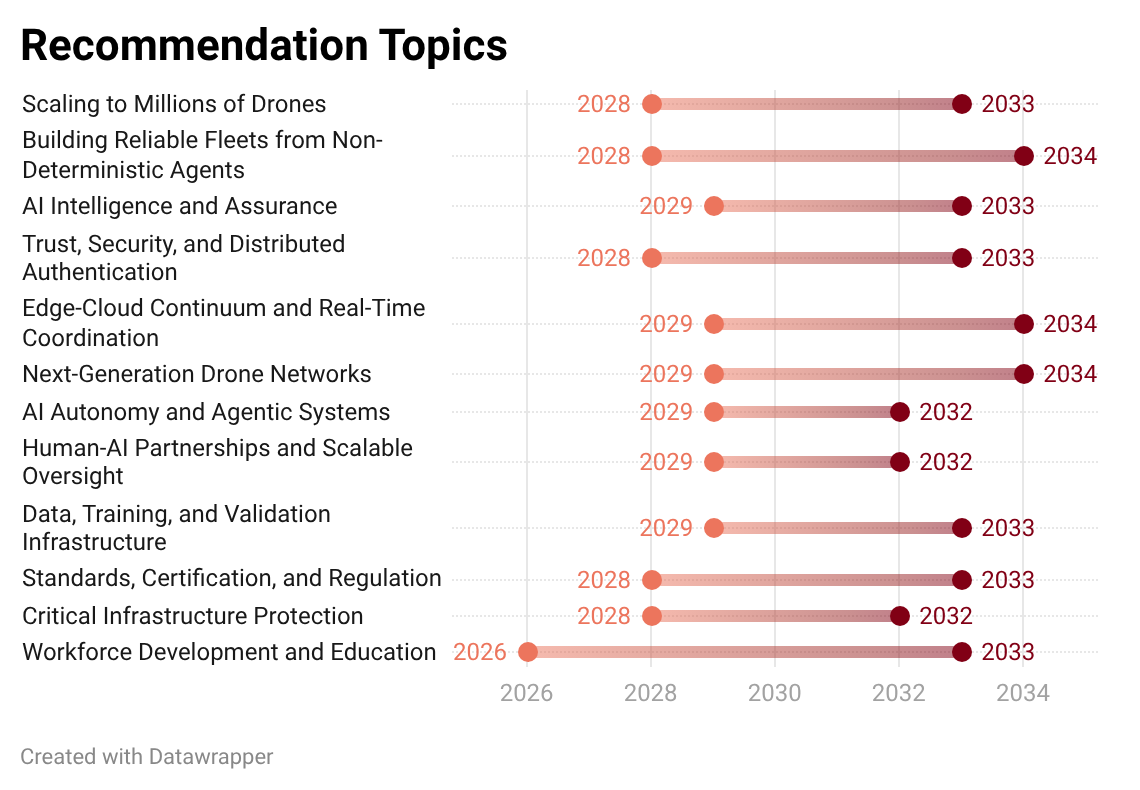
Fig 6 (page 33).
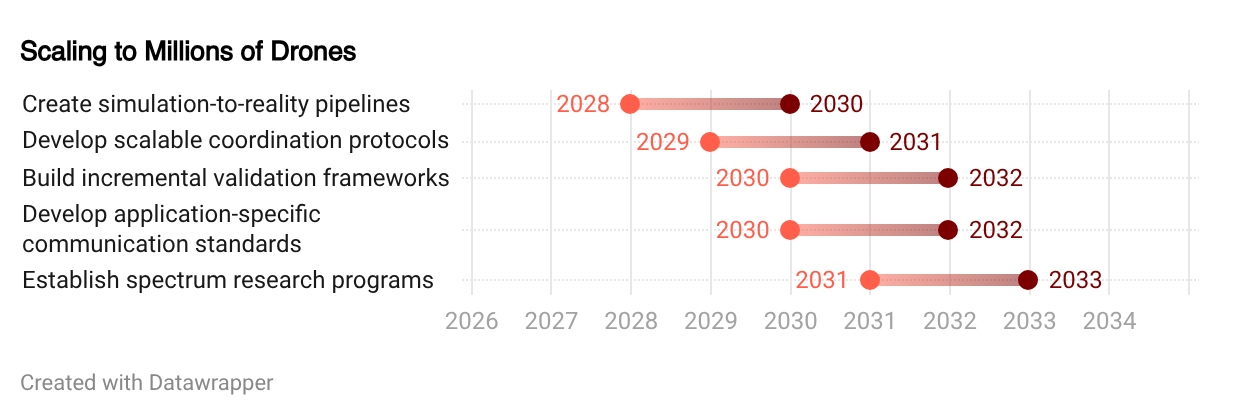
Fig 7 (page 34).
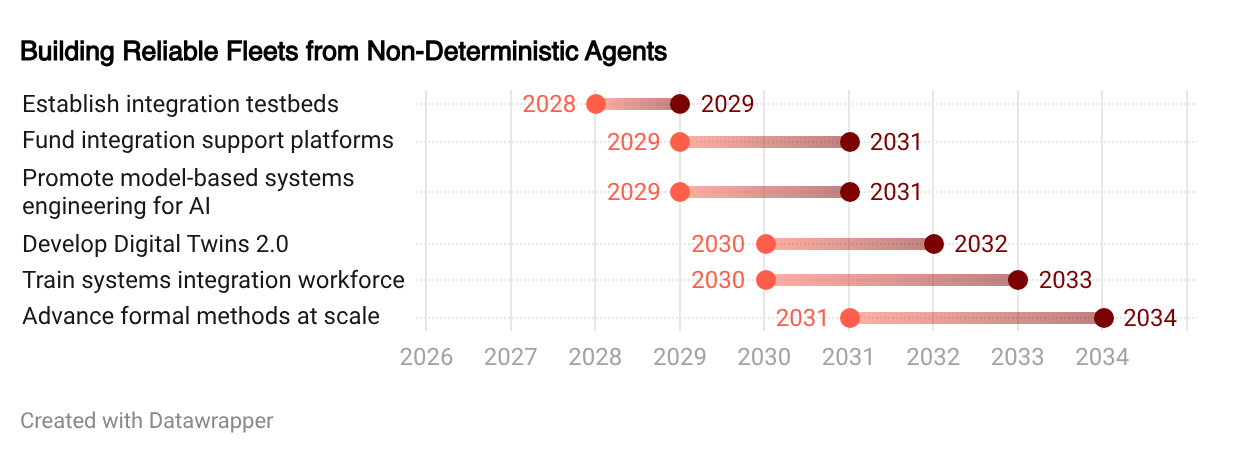
Fig 8 (page 34).
Limitations
- The report is a synthesis of expert opinion and projections rather than empirical validation or novel experimental research.
- Lack of quantitative performance benchmarks or prototype implementations for recommended architectures and protocols.
- No adversarial evaluation or attack simulations to empirically test trust and security frameworks proposed.
- Assumes successful interdisciplinary collaboration and regulatory alignment that may be politically or practically challenging.
- Many technical recommendations rely on breakthroughs in nascent or hard-to-achieve technologies like formal neural network verification and real-time AI scheduling.
- Limited concrete details on implementation complexity, costs, or failure modes of proposed simulation-to-reality pipelines.
Open questions / follow-ons
- How to scale formal verification and certification methods effectively to multi-agent learning-based autonomy at fleet scale?
- What are optimal protocol designs balancing communication latency, energy constraints, and security/privacy in dense aerial networks?
- What architectures can ensure robust, real-time operation of AI perception and control under worst-case latency jitter and energy scarcity?
- How to design distributed trust systems supporting cross-organizational drone collaborations with privacy and auditability?
Why it matters for bot defense
For bot-defense and CAPTCHA practitioners, this report highlights the growing importance of secure, trustworthy, and verifiable AI-driven agent networks operating in adversarial environments with real-time constraints. The challenges of distributed authentication and continuous attestation under intermittent connectivity resonate with challenges in validating human versus bot behaviors in decentralized systems. The recommended privacy-preserving coordination protocols offer parallels to developing CAPTCHA that protects user data yet reliably distinguishes authorized agents. The emphasis on multi-layer security, formal verification, and monitoring to prevent spoofing and adversarial interventions can inform robust challenge design and detection systems. Finally, the report's systemic perspective—integrating AI, networking, security, and policy considerations—demonstrates the value of holistic approaches over isolated defenses when scaling to millions of interacting, autonomous agents.
Cite
@article{arxiv2607_19213,
  title={ Computing on the Fly: Navigating a Vision for the Future of Drone Computing },
  author={ Kevin Butler and Christopher Stewart and Nils Aschenbruck and Alina Gerall and Weisong Shi and Deborah Silver and Ufuk Topcu },
  journal={arXiv preprint arXiv:2607.19213},
  year={ 2026 },
  url={https://arxiv.org/abs/2607.19213}
}