
Physics-Guided Spectral Parametric Reduced-Order Modeling for Transient Prediction of Controlled Dynamical Systems
Source: arXiv:2607.18133 · Published 2026-07-20 · By Ao Zhang, Tian Zhang, Antonio Cammi, Xiang Wang
TL;DR
This paper addresses the challenge of efficient parametric transient prediction for controlled dynamical systems, especially under unseen parameter values and new operating conditions, where high-fidelity simulations are computationally expensive. The authors propose a physics-guided spectral parametric reduced-order modeling (pROM) framework that separates intrinsic system dynamics and control effects via Dynamic Mode Decomposition with control (DMDc). They then perform physics-informed coordinate transformations and apply a Secondary DMD regression along the parameter dimension to capture coherent evolution of spectral quantities and operator components. This enables stable extrapolative prediction beyond sampled parameter ranges.
The framework is validated on three representative systems covering linear transient (mechanical transmission), nonlinear transient (Helium-Xenon closed Brayton cycle), and nonlinear periodic (Kármán vortex street) dynamics. Results show relative norm errors below 1% for mechanical and Brayton systems and preserved vortex shedding structures for fluid flow cases. Comparisons with linear and radial basis function (RBF) regression, as well as LSTM surrogates, demonstrate better predictive accuracy and robustness, particularly in extrapolation. Auxiliary error-prediction models assess confidence bounds. Overall, the work extends parametric reduced-order modeling capabilities from interpolation within sampled domains to accurate transient prediction under unseen parameters and new controls in complex controlled dynamical systems.
Key findings
- For the mechanical transmission system, relative norm errors remain below 1% for both interpolative (J=0.1375) and extrapolative (J=0.5 and 1) predictions when using physics-guided parameter transformation μ̃=1/J and Secondary DMD, outperforming linear and RBF regression (Fig. 7).
- In the Helium-Xenon closed Brayton cycle, baseline regularization by subtracting steady offsets reduces prediction errors by over 50%, maintaining relative norm errors below 1% at extrapolated parameter values (T_min=390K, 400K) (Fig. 10).
- Incorporating measured auxiliary inputs βᵃ in the Brayton cycle improves transient response accuracy, reducing pointwise errors of key variables to within ±3% at largest extrapolation (T_min=400K) (Fig. 11-13).
- For the nonlinear periodic Kármán vortex street, nondimensional time mapping based on Strouhal and Reynolds numbers enables consistent spectral operator identification across flow conditions, preserving dominant vortex shedding patterns with relative norm errors lower than both linear and RBF regression methods (Fig. 16-18).
- Secondary DMD regression along the parameter domain captures coherent low-rank operator evolution better than static pointwise fitting methods, giving increased robustness to noise and higher extrapolation fidelity across all cases.
- Higher temporal reduced ranks (r_t >3) tend to degrade extrapolation accuracy due to sensitivity to local noise, supporting strict low-rank truncation for stability (Sections 3.1 and 3.2).
- Comparison with LSTM surrogate models shows that the proposed physics-guided spectral pROM offers more consistent and physically interpretable predictions under parameter extrapolation, highlighting the limitations of black-box approaches outside training data.
- Nondimensional time mapping reduces spectral blurring caused by frequency variation in nonlinear periodic systems, effectively enabling a single reduced operator to represent their dynamics.
Threat model
n/a — The paper focuses on improving computational modeling and prediction of controlled dynamical systems’ transient responses, with no security adversary or attack model analyzed.
Methodology — deep read
The study begins by framing the problem of transient prediction for controlled dynamical systems where system dynamics depend on parameters μ and control inputs β, requiring predictions for unseen parameter values and new control scenarios. The threat model is a computational challenge rather than a security adversary: the goal is to produce reliable predictive surrogate models beyond sampled training data.
Data for the method is generated from three case studies representing key dynamical archetypes: a linear transient mechanical transmission system modeled and simulated in OpenModelica, a nonlinear transient Helium-Xenon closed Brayton cycle also built in Modelica with multi-physics coupling, and a nonlinear periodic Kármán vortex street flow simulated using Lattice Boltzmann Method (LBM). Each dataset consists of transient state snapshots X(t), with parameters μ varying (e.g., inertia ratios or temperature minimums), control inputs β(t) such as torques or load demands, and measured auxiliary inputs βᵃ for strongly coupled nonlinearities. Training/test parameter splits reserve certain parameter points to test extrapolation.
Methodologically, the framework builds on Dynamic Mode Decomposition with control (DMDc), which identifies a linear reduced-order model x_{r,k+1} = A x_{r,k} + B β_k in discrete time on a low-dimensional subspace found via truncated Singular Value Decomposition (SVD) of the snapshot matrix X ≈ U_r Σ_r V_r*. Importantly, DMDc separates intrinsic system dynamics (A) from control effects (B). Spectral decomposition of A yields eigenvalues Ω and modes Φ encoding temporal frequencies, growth rates, and spatial structures.
Baseline regularization first subtracts steady-state offsets from snapshots and inputs to focus on intrinsic transient dynamics. For nonlinear periodic systems, a physics-guided time coordinate transformation τ(t) is introduced (e.g., nondimensional time scaled by Strouhal and Reynolds numbers) to recast transient dynamics on a consistent temporal scale for tracking spectral evolution.
A key novel step is physics-guided parameter transformation μ̃ = f(μ) designed to linearize the nonlinear dependence of spectral quantities on parameters, e.g. μ̃ = 1/J for inertia in the mechanical system or μ̃ = Re for vortex shedding flow. Then, aligned spectral quantities (Φ, Ω, b) and factorized components of B are extracted and matched across parameter samples through eigenvalue pairing, phase correction, and normalization to enforce modal consistency.
The framework employs Secondary DMD, a dynamic mode decomposition along the parameter axis μ̃, to model how reduced operators evolve smoothly as functions of the transformed parameter, treating parameter space samples as pseudo-temporal sequences capturing coherent operator evolution. This contrasts with baseline methods using pointwise linear or Radial Basis Function (RBF) regression. Auxiliary nonlinear effects are captured as measured auxiliary inputs βᵃ in the control channel.
The final predicted reduced operators are reconstructed from the Secondary DMD outputs and used to simulate transient responses at unseen parameter values and new control inputs via the discrete or continuous-time DMDc propagator. Prediction accuracy is quantified by relative norm errors computed on full state responses over all variables and time steps.
In essence, the method extracts interpretable spectral operators for controlled dynamical systems, aligns them across samples in a physics-informed way, then models their smooth evolution across parameters with Secondary DMD to enable physically consistent extrapolative transient predictions without repeated high-fidelity solves.
The evaluation protocol includes validating predictions at interpolated and extrapolated parameters in original and novel operating scenarios, comparing Secondary DMD regression versus linear and RBF baselines, examining ablations such as inclusion of auxiliary inputs and baseline regularization, and analyzing sensitivity to model ranks. Quantitative error metrics, time-domain trajectories, and modal/vortex shedding reconstructions assess performance. Code release or dataset availability is not stated clearly, suggesting limited reproducibility.
A concrete example: For the mechanical transmission, snapshots of angular positions and velocities under different torque inputs are collected with varying motor inertia J. DMDc identifies reduced operators at sampled J values after subtracting steady-state offsets. Parameter transformation μ̃=1/J linearizes operator evolution. Secondary DMD models how the operators vary with μ̃, enabling prediction of operator A, B and spectral modes at unseen J=0.5 (extrapolation). Simulating with these predicted operators and new torque inputs yields transient state predictions with <1% relative norm error against full high-fidelity simulation, demonstrating the pipeline from data collection through physics-guided spectral alignment and parametric operator propagation to accurate transient prediction.
Technical innovations
- Extension of Dynamic Mode Decomposition with control (DMDc) to parametric reduced-order modeling by incorporating a physics-guided parameter transformation and spectral operator alignment.
- Introduction of Secondary DMD regression along the parameter coordinate to model coherent evolution of reduced operators across parameter space, enabling extrapolative prediction beyond the sampled domains.
- Use of baseline regularization via subtraction of steady-state offsets and nondimensional time mapping to stabilize spectral identification and improve robustness for nonlinear periodic systems.
- Incorporation of measured auxiliary inputs as nonlinear observables in the control channel to better capture residual nonlinear parameter effects without contaminating the state-transition operator.
- Physics-guided eigenvalue matching, phase correction, and normalization procedures for aligning spectral quantities and reduced operator components across parameter samples, preserving modal correspondence.
Datasets
- Mechanical transmission system — moderate size transient state and control snapshots simulated via OpenModelica — non-public
- Helium-Xenon closed Brayton cycle — multi-physics nonlinear transient state/control snapshots simulated in Modelica — non-public
- Kármán vortex street — 2D fluid velocity fields from Lattice Boltzmann Method simulations at various Re — derived from open-source reference, but processed data is custom
Baselines vs proposed
- Linear regression: relative norm error ~2-3% vs Secondary DMD: <1% in extrapolation on mechanical transmission
- Radial Basis Function (RBF) regression: similar errors as linear regression, both worse than Secondary DMD for extrapolation
- Unregularized (no steady offset subtraction) vs regularized baseline: error reductions from ~5% down to <1% for Brayton cycle prediction
- Without measured auxiliary inputs βᵃ, Brayton cycle prediction error increases by ~50% compared to full framework
- Standard DMDc without time coordinate mapping yields degraded spectral identification and larger errors for vortex street; mapping reduced error below 1%
- LSTM surrogate models trained on same datasets show accurate interpolation but significantly higher prediction errors under parameter extrapolation
Figures from the paper
Figures are reproduced from the source paper for academic discussion. Original copyright: the paper authors. See arXiv:2607.18133.
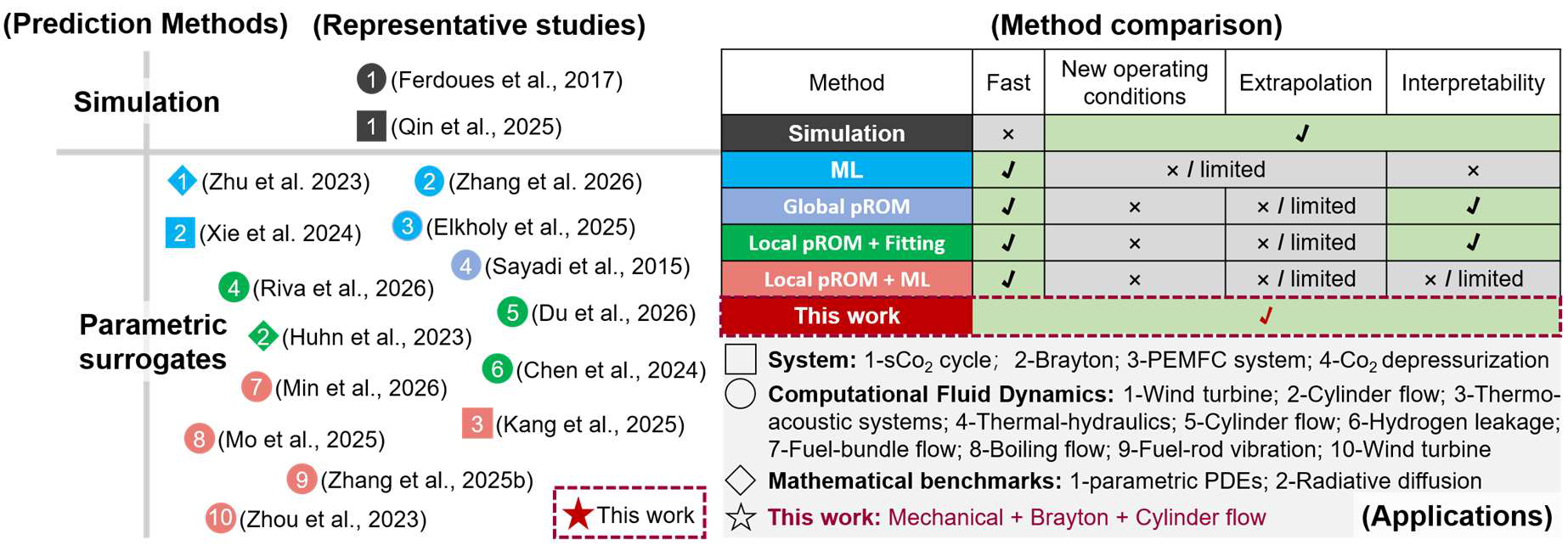
Fig 1: Review of existing approaches and novelty positioning of this work.
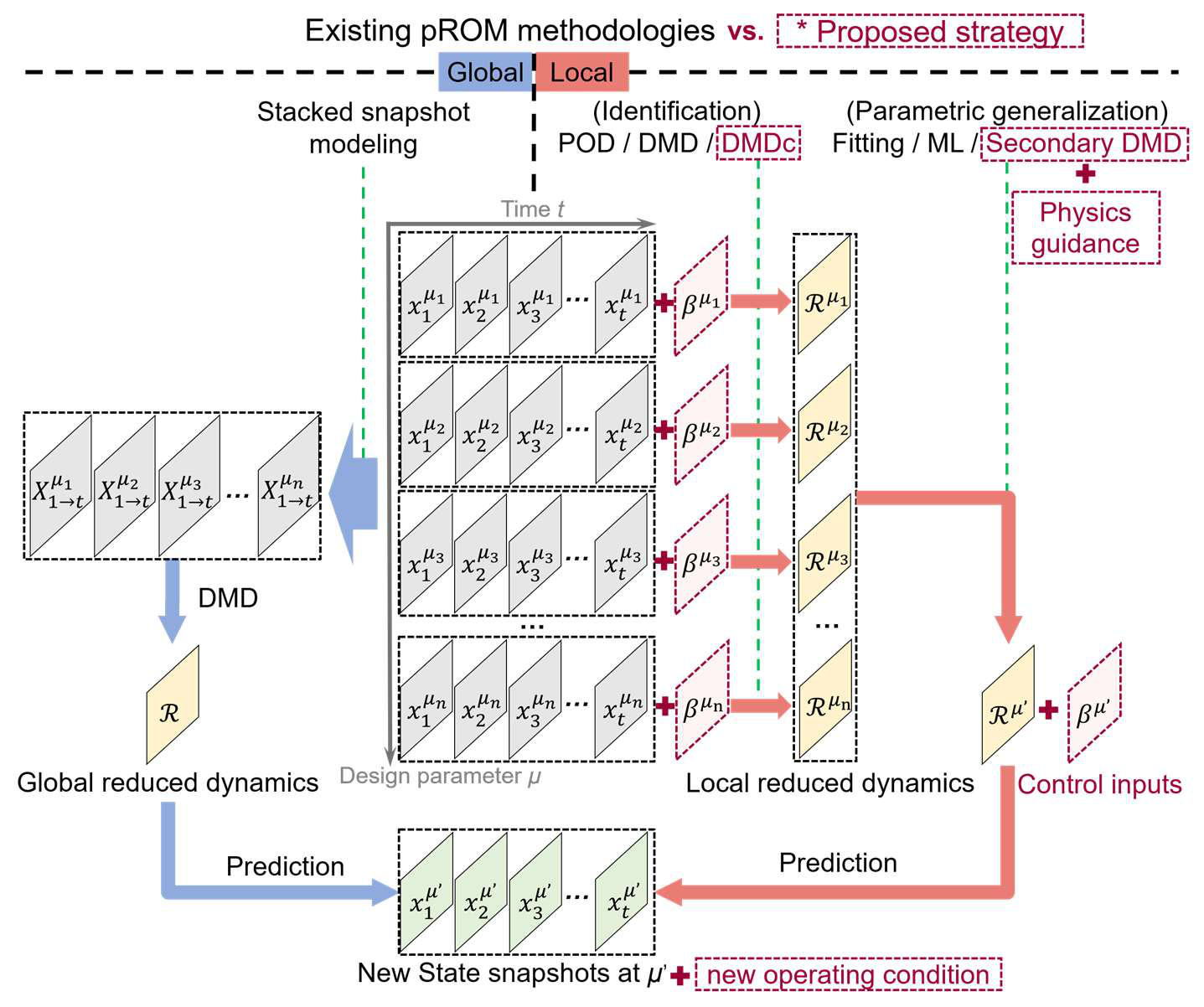
Fig 2: Physics-guided spectral pROM framework.
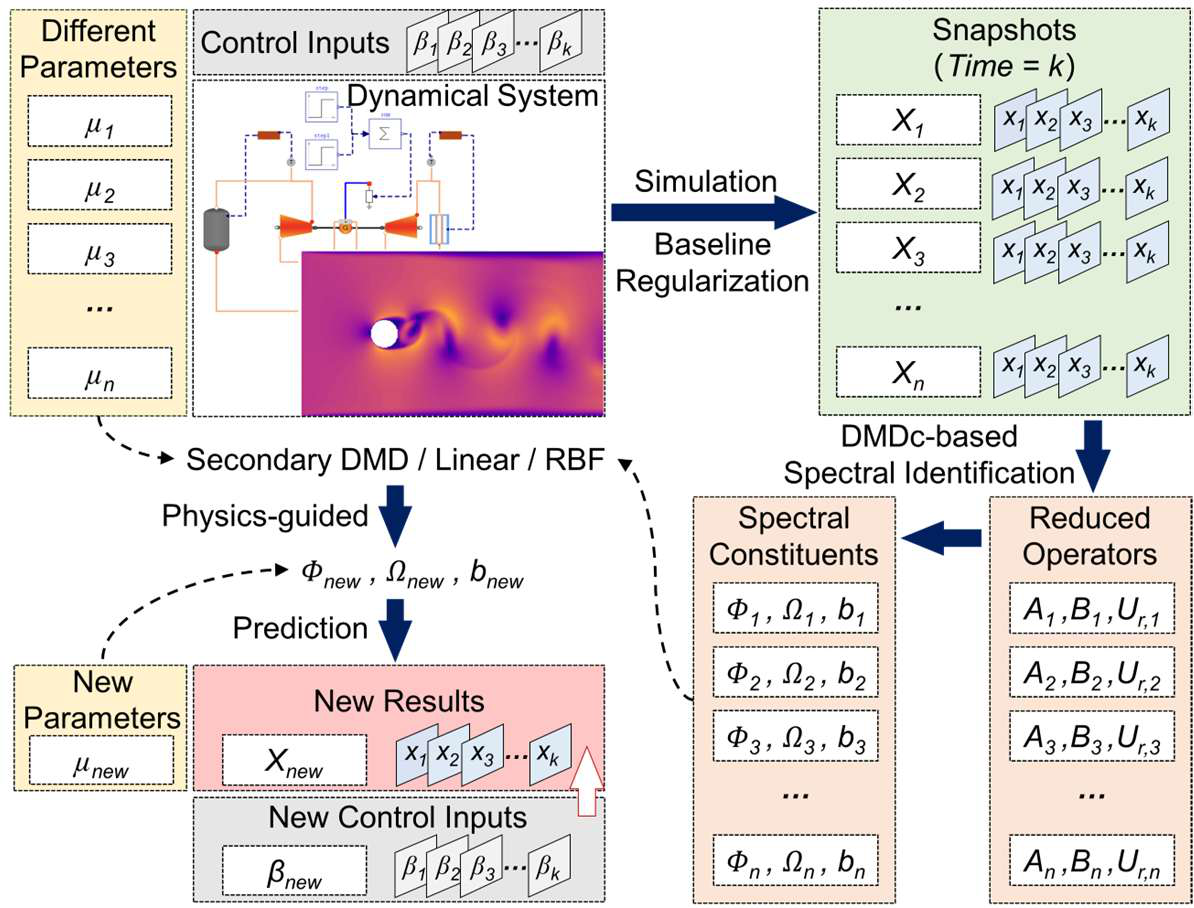
Fig 3 (page 8).
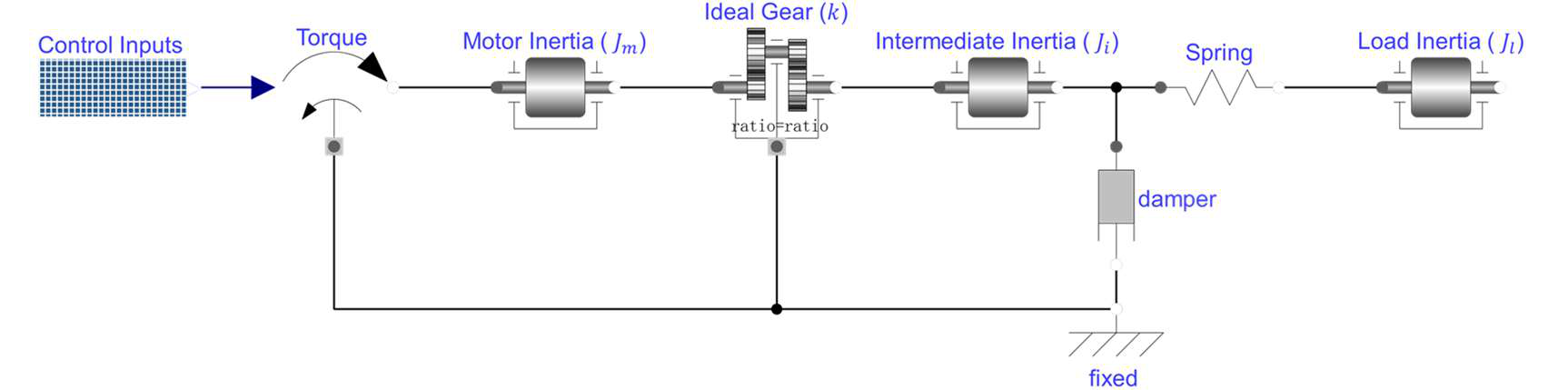
Fig 3: Modelica-based model of the mechanical transmission.
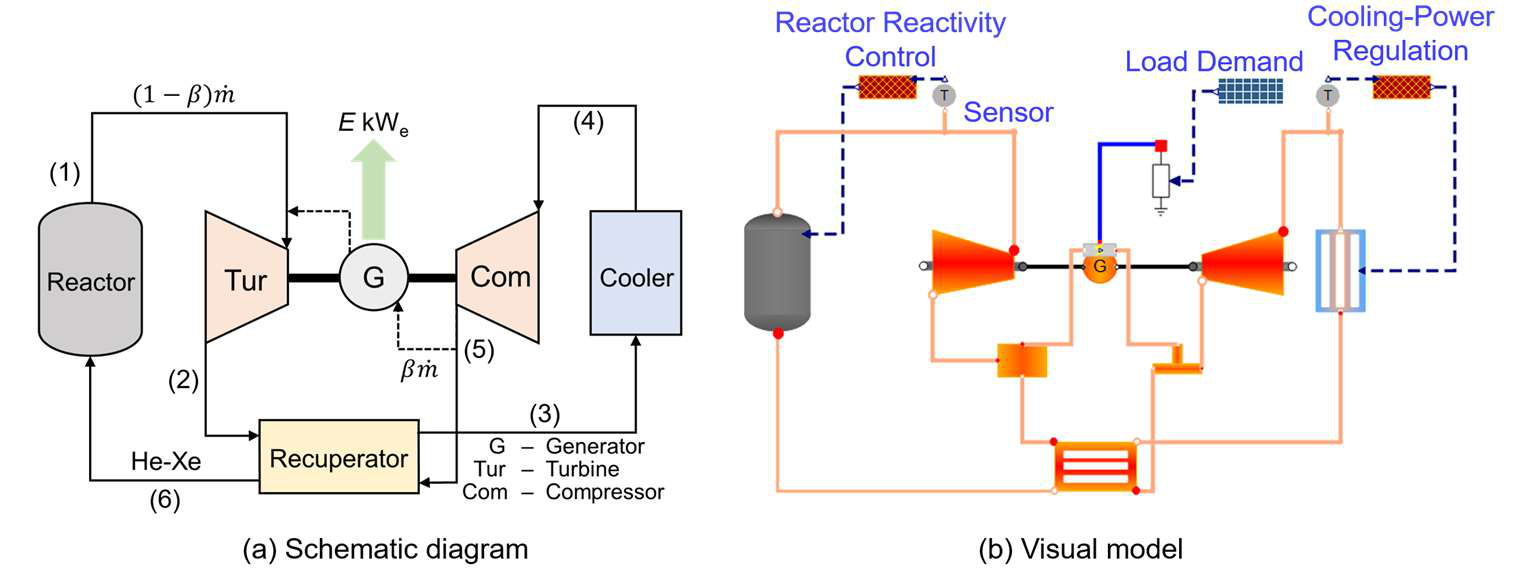
Fig 4: Modelica-based visual model of the Helium-Xenon closed Brayton cycle.
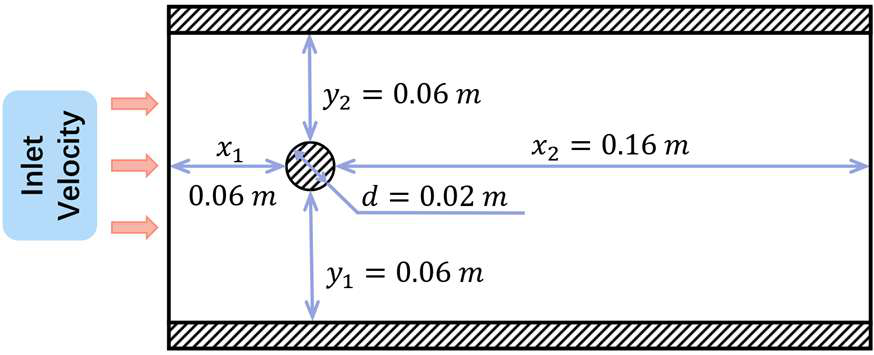
Fig 5: Geometric structure of the Kármán vortex street (Luo et al., 2024).

Fig 6: Setup of the scenarios and parameter points.

Fig 7: Prediction error comparison of pROMs using different regression methods.
Limitations
- The method relies on physics-guided parameter transformations which require expert knowledge and may not generalize to arbitrary systems or parameters.
- Lack of publicly available code or datasets limits reproducibility and independent validation.
- Unclear robustness under noisy or sparse observational data, as all results are based on simulation data.
- Extrapolation limits remain unknown for very large parameter shifts beyond the tested ranges.
- Applicability to high-dimensional or strongly nonlinear chaotic systems is not demonstrated.
- The approach assumes availability of measured auxiliary inputs βᵃ to absorb nonlinear effects, which may not be practical in all settings.
Open questions / follow-ons
- How to automatically learn or adapt physics-guided parameter transformations for arbitrary systems without explicit expert insight?
- Can the framework be extended to chaotic or highly nonlinear controlled dynamical systems outside the tested archetypes?
- What is the impact of measurement noise, partial observations, or limited snapshot availability on prediction robustness?
- How to incorporate uncertainty quantification or probabilistic error bounds within the spectral pROM framework?
Why it matters for bot defense
While not directly related to bot defense or CAPTCHA, the paper’s methodology for physics-guided parametric reduced-order modeling offers valuable insights into creating interpretable, operator-based predictive models that can robustly extrapolate to unseen conditions. For CAPTCHA engineers interested in bot detection, the approach highlights the benefit of embedding domain knowledge (physics-guidance) and structured operator decompositions to improve model stability and generalization beyond training data. Similar principles could inspire designing challenge-response systems or behavioral models that can anticipate or extrapolate bot strategies under changing parameters. Additionally, leveraging spectral decomposition and control separation might inform modeling of temporal user/input patterns for detecting anomalous behavior. However, direct technical transfer would require adaptation to the discrete, behavioral nature of CAPTCHA tasks rather than continuous physical systems.
Cite
@article{arxiv2607_18133,
  title={ Physics-Guided Spectral Parametric Reduced-Order Modeling for Transient Prediction of Controlled Dynamical Systems },
  author={ Ao Zhang and Tian Zhang and Antonio Cammi and Xiang Wang },
  journal={arXiv preprint arXiv:2607.18133},
  year={ 2026 },
  url={https://arxiv.org/abs/2607.18133}
}