
The Internet of Things for Smart Manufacturing: A Review
Source: arXiv:2607.16172 · Published 2026-07-17 · By Hui Yang, Soundar Kumara, Satish Bukkapatnam, Fugee Tsung
TL;DR
This review paper addresses the role of the Internet of Things (IoT) as a foundational technology for smart manufacturing, a critical evolution enabling cyber-physical manufacturing systems. It outlines how IoT enables interconnected networks of manufacturing "Things"—including machines, sensors, materials, and humans—that generate large-scale data aimed at improving production, visibility, and competitive advantage. The authors survey the historical evolution of the Internet toward IoT, key IoT sensing technologies like RFID, wireless sensor networks, and mobile computing, and their applications in manufacturing systems such as Manufacturing Execution Systems (MES).
A novel contribution of the paper is a new conceptual framework that leverages the Internet of Manufacturing Things (IoMT) and cloud computing to create virtual machine networks enabling distributed data analytics and real-time process control. The review also highlights major cybersecurity concerns in IoMT, government policy initiatives around IoT-enabled smart factories, and discusses challenges including data heterogeneity, interoperability, bandwidth, latency, and the need for domain-specific IoT platform customizations. Overall, this multidisciplinary synthesis aims to catalyze further research and practical innovation toward fully realized smart factories leveraging IoT ecosystems.
Key findings
- The Internet’s evolution leads to an estimated 212 billion connected "Things" by 2020, emphasizing the scale of IoMT growth.
- RFID technologies in manufacturing support work-in-process tracking and inventory control, with active tags enabling communication ranges up to 1500 feet.
- Wireless Sensor Networks (WSNs) are fundamental for distributed sensing but face latency, bandwidth, and interference challenges that restrict full industrial deployment.
- MTConnect, an open standard for manufacturing data, provides read-only communication enabling data sharing but not control commands to machines, ensuring safety.
- Cloud computing integration with IoT offers scalable infrastructure for data storage, management, and analytics, overcoming local device resource constraints.
- Kindred IoT platforms (GE Predix, IBM Watson, Azure, AWS IoT) offer diverse capabilities but lack manufacturing-specific customization critical for operational value.
- The proposed virtual machine network framework (Section IV) leverages MapReduce and cloud computing to process large-scale IoMT sensor data enabling distributed control optimization.
- Cybersecurity in IoMT is paramount due to increased attack surface from massive interconnectivity; secure architectures and government policies are necessary for trust.
Threat model
The paper considers adversaries who can remotely attack connected manufacturing "Things" through network vulnerabilities aiming to disrupt operations, alter sensor data, or steal proprietary information. It assumes adversaries do not have physical access or capability to break strong cryptographic protections but may exploit weaknesses in communication protocols, cloud platforms, or IoT device software. Defenses must therefore emphasize cybersecurity standards, secure communication protocols, and policy-driven governance.
Methodology — deep read
Threat Model & Assumptions: The paper is a comprehensive literature review and conceptual synthesis rather than an empirical security or attack study. The implicit threat model for IoMT cybersecurity is adversaries capable of remote cyber attacks on networked manufacturing devices aiming to disrupt operations or steal data. Defenses must assume adversaries cannot break cryptographic protections easily but may attempt interception, data manipulation, and denial-of-service.
Data: This review aggregates findings from multiple prior works, industrial deployments, and government standards, rather than collecting original datasets. It references manufacturing data types from heterogeneous IoT sensors including RFID, vibration, acoustic emission, and machining parameters.
Architecture/Algorithm: The key architectural contribution described is a virtual machine network framework which integrates IoMT devices with cloud computing platforms. It leverages protocols like MTConnect for standardized manufacturing data exchange, combined with big-data processing frameworks like MapReduce/Hadoop to enable scalable analytics and distributed control. Other architectural models surveyed include RAMI 4.0 and OPC Unified Architecture aligned with Industry 4.0 standards.
Training Regime: Not applicable as this is a survey paper without specific ML model training. However, it notes that machine learning capabilities are increasingly integrated into IoT platforms to analyze real-time data streams.
Evaluation Protocol: The paper appraises existing IoT technologies, platforms, communication protocols, and cybersecurity approaches based on literature evidence, including case study descriptions (e.g. Section IV on virtual machine networks). Comparative figures such as communication range, data rate, and platform features are tabulated.
Reproducibility: Being a review and framework proposal, there is no released source code or datasets. The frameworks and standards discussed (MTConnect, RAMI 4.0, OPC UA) are publicly documented by their respective consortia.
Concrete Example End-to-End: As illustrated in the paper (Fig 6-7), the virtual machine network uses distributed IoT sensor inputs (e.g., machine current profiles) sent via MTConnect adapters to cloud agents. MapReduce runs data analytics jobs over these data partitions to extract dissimilarity matrices and build network models that optimize virtualized machine operations, feeding back control decisions to physical machines. This example demonstrates integrating heterogeneous sensor data, cloud computing analytics, and cyber-physical integration to improve manufacturing performance.
Technical innovations
- A conceptual virtual machine network framework that combines IoMT and cloud computing with MapReduce to support scalable distributed manufacturing analytics and control.
- Detailed review and integration of heterogeneous IoT sensing technologies (RFID, WSN, mobile) applied specifically to manufacturing tasks.
- Application of MTConnect as a read-only standard enabling standardized data sharing across diverse IoT-enabled manufacturing equipment, enhancing interoperability.
- Comprehensive survey of IoT data link protocols and their suitability for various manufacturing scenarios with range, bandwidth and power trade-offs.
Figures from the paper
Figures are reproduced from the source paper for academic discussion. Original copyright: the paper authors. See arXiv:2607.16172.
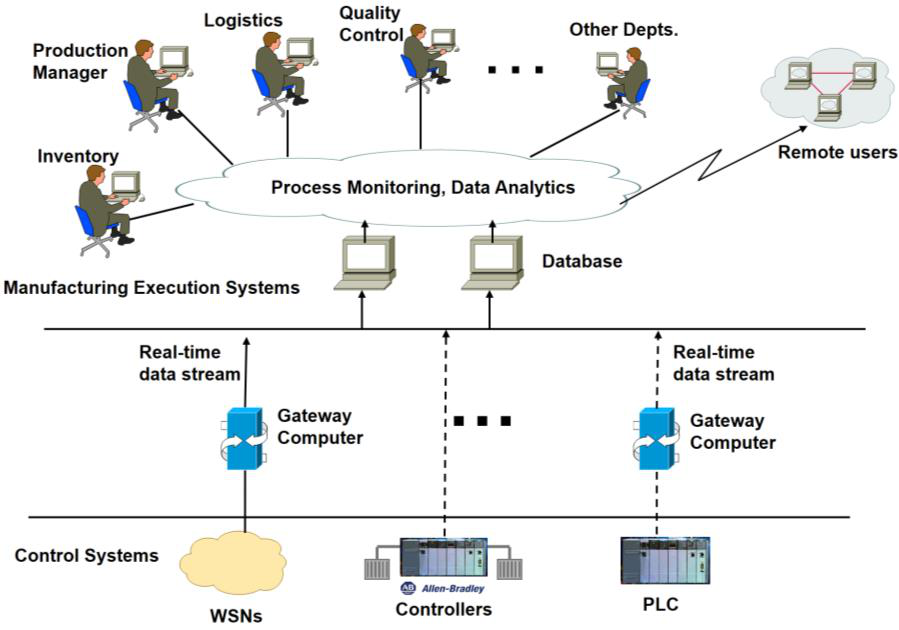
Fig 4: shows the bidirectional data flow between Enterprise Resource Planning (ERP) systems, MES, and
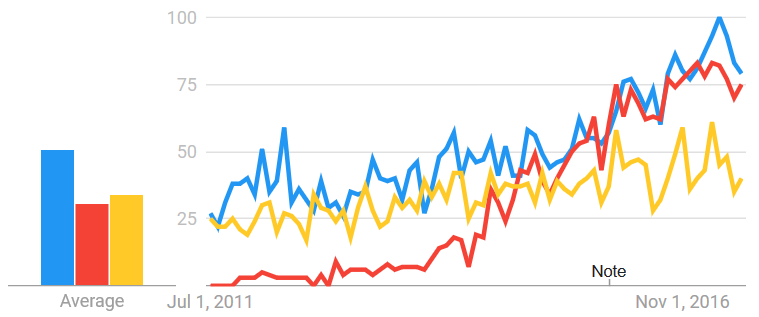
Fig 5: shows Google trend comparisons of the popularity levels of “cloud manufacturing”, “industrial
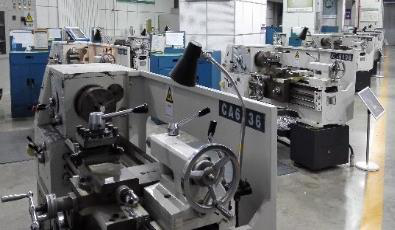
Fig 6: Cyber-physical manufacturing systems. The manufacturing enterprise is reflected in the cyber space
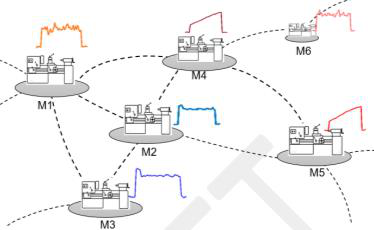
Fig 4 (page 15).
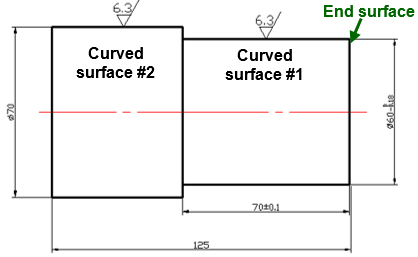
Fig 7: (a) The CAD file and power profiles from the machining operation; (b) P2P variations in current profiles
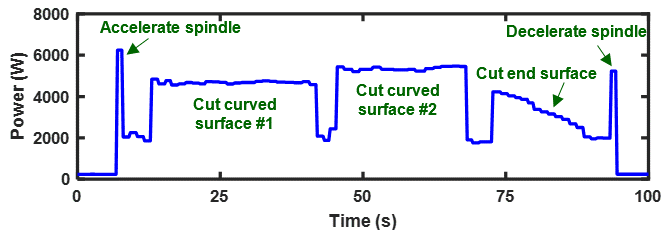
Fig 8: One-dimensional (a) and three-dimensional dynamic
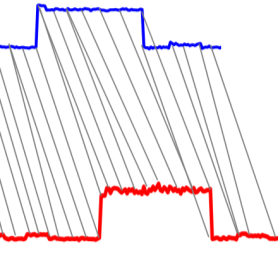
Fig 9: (a) Dissimilarity matrix of six machine profiles; (b) A network model with node-to-node distances
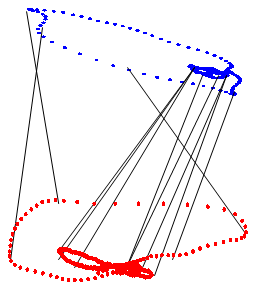
Fig 10: Map reduce and cloud computing to optimize the virtual machine network
Limitations
- Predominantly a qualitative literature review lacking quantitative benchmarking or experimental validation of the proposed virtual machine network framework.
- No detailed adversarial or penetration testing performed to assess resilience of IoMT cybersecurity strategies.
- Limited coverage of real-world deployment case studies or evaluation under dynamic distribution shifts in manufacturing environments.
- Analysis primarily focused on North American and East Asian policy frameworks; may not generalize globally.
- Lacks discussion on economic or social barriers to IoMT adoption such as workforce skills or legacy system integration.
Open questions / follow-ons
- How can IoMT systems dynamically adapt to heterogeneous data sources and variable network conditions while maintaining real-time control requirements?
- What are robust and scalable cybersecurity architectures specifically tailored to the large attack surfaces of IoMT in smart factories?
- How can machine learning approaches be integrated into IoMT platforms for predictive maintenance and anomaly detection without sacrificing security or privacy?
- What business models and incentives best drive adoption of standardized IoT frameworks like MTConnect across diverse manufacturing enterprises globally?
Why it matters for bot defense
Bot-defense and CAPTCHA practitioners developing challenges or solutions for smart manufacturing environments can leverage IoMT insights to understand the complex data and network architecture underlying industrial IoT deployments. The emphasis on heterogeneous sensor communications, protocol standardization (e.g., MTConnect), and critical cybersecurity risks stresses the need for hardened authentication and anomaly detection suited for cyber-physical systems.
Knowing the various communication protocols, their ranges, and bandwidth limitations can inform design of security measures that do not impair real-time operability. The survey of cyber-physical integration highlights attack surfaces in cloud-based control and data analytics pipelines, indicating points where bot defense systems could be deployed to detect automated or adversarial interactions. Finally, understanding governmental policy directions and IoMT challenges can guide future bot-defense research priorities tailored to industrial IoT scenarios.
Cite
@article{arxiv2607_16172,
  title={ The Internet of Things for Smart Manufacturing: A Review },
  author={ Hui Yang and Soundar Kumara and Satish Bukkapatnam and Fugee Tsung },
  journal={arXiv preprint arXiv:2607.16172},
  year={ 2026 },
  url={https://arxiv.org/abs/2607.16172}
}