
Quantum-classical crossover in fault-tolerant quantum dynamics simulation
Source: arXiv:2607.16116 · Published 2026-07-17 · By Jinzhao Sun, Bozhen Zhou, Jue Xu, Yuan Yao, Zhenyu Du, Zixu Zhang et al.
TL;DR
This paper addresses the crucial open question of when fault-tolerant quantum dynamics simulation will surpass the best classical algorithms on realistic hardware. The authors develop a full-stack framework combining a novel coherent observable estimation algorithm with an improved fault-tolerant implementation of non-Clifford rotations via direct rotation-state injection. This co-design suppresses logical error accumulation and reduces sampling overhead, critical to practical fault-tolerant simulation. Benchmarking against state-of-the-art classical methods such as MPS, PEPS, and time-dependent variational Monte Carlo (tVMC), the authors identify a concrete quantum-classical crossover point for simulating mixed-field Ising spin dynamics on up to 100 qubits. With a physical error rate of 10^-3, a 100-spin 1D system can be simulated fault-tolerantly in around 2 hours using ~3.7×10^5 physical qubits, whereas classical tensor network methods would require on the order of 100 years. For 2D systems, the quantum advantage is even more dramatic, with projected runtimes in minutes or seconds. Lowering the physical error rate to 10^-4 reduces both qubit counts and runtimes by about an order of magnitude. These results establish a practical route to demonstrating quantum advantage in dynamics simulation and set quantitative engineering targets for future hardware designs.
Key findings
- Fault-tolerant simulation of a 100-spin 1D mixed-field Ising chain requires ~2 hours and 3.7×10^5 physical qubits at physical error rate p=10^-3, versus ~100 years runtime for tensor network methods (Fig. 3 & text).
- Reducing physical error rate to p=10^-4 decreases qubit count to ~3.1×10^4 and simulation runtime to minutes for 1D and seconds for 2D systems (text, Fig. 4).
- The direct rotation-state injection approach suppresses logical error rates to O(|θ|p^2), outperforming conventional Clifford+T magic-state distillation error scaling O(p) (Fig. 2(d) and discussion).
- The Gaussian-sampled Chebyshev amplitude estimation (GCAE) algorithm balances coherent circuit depth and sampling overhead, surpassing the standard quantum limit with reduced maximum coherent depth (Fig. 2(e,f)).
- MPS classical simulation runtime grows exponentially with system size n as trun ~ e^{0.3n} at target precision ε=10^-2, requiring >10^9 years at n=100, whereas quantum runtime scales far more gently (Fig. 3(e)).
- The quantum-classical crossover for 1D dynamics appears at system sizes n≈18–22 for p=10^-3 error rates (Fig. 3(e)).
- For 2D dynamics, classical simulation time is severely limited due to rapid entanglement growth, allowing quantum advantage at modest system sizes within minutes of runtime (Fig. 4).
- The rotation-state preparation via a 1-FT (level-1 fault tolerant) RZZ(θ) gate on a rotated surface code allows logical error suppression and supports parallel RUS injection scaling as O(log n) (Fig. 2(a,b)).
Threat model
The adversary is the physical noise and errors occurring in quantum hardware, modeled as stochastic physical error rates p (10^-3 or 10^-4). The framework assumes error correction with surface codes, fault-tolerantly implemented logical gates, and residual stochastic logical errors after QEC. The adversary cannot break the fault-tolerant protocols but can cause logical errors that accumulate and limit maximum circuit depth. The model does not consider malicious adversaries or correlated noise beyond standard fault-tolerant thresholds.
Methodology — deep read
The authors begin by defining the target computational task as estimating the expectation value ⟨ψ(t)| O |ψ(t)⟩ of a quantum many-body state |ψ(t)⟩ = U(t)|0⟩ evolved under the non-integrable mixed-field Ising Hamiltonian, where U(t) = exp(-iHt). The precision ε is a critical parameter controlling sampling overhead. The threat model assumes fault-tolerant quantum hardware with physical error rates p of 10^-3 or 10^-4, reflecting current superconducting or trapped-ion technology. Residual logical errors after error correction can accumulate and limit circuit depth.
At the data/algorithm level, they apply fourth-order Trotterization to approximate the time evolution operator U(t), carefully analyzing realistic error bounds by including entanglement-informed estimates rather than worst-case operator norms. This significantly reduces required Trotter segments.
For observable estimation, they leverage a new algorithm termed Gaussian-sampled Chebyshev amplitude estimation (GCAE), which coherently queries the time evolution operator multiple times with circuit depth tradeoffs balanced via a discrete Gaussian distribution over query numbers. This approach surpasses the standard quantum limit of O(ε^-2) sampling and distributes sampling cost to reduce maximum coherent depth, improving fault tolerance.
On the fault-tolerant hardware side, two competing implementations of non-Clifford gates are considered: (1) Clifford+T synthesis via magic-state distillation (MSD) and (2) Clifford+φ synthesis via direct rotation-state injection protected by the surface code. The second approach implements small-angle Z-rotations using repeat-until-success (RUS) circuits with logical rotation states prepared fault tolerantly by dispersive coupling on a 4×5 rotated surface code with level-1 fault tolerance (1-FT). The logical error rate scales as O(|θ|p^2) due to this improved design.
The fault-tolerant circuit cost is quantified in units of quantum error correction (QEC) cycles, assumed 500 ns each. Trotter segments have layers of single and two-qubit rotations parallelized optimizing runtime. The expected number of RUS repeats scales as O(log n) for n parallel rotations. They integrate circuit costs, error accumulation, and sampling overhead to identify an optimal maximum query depth M that minimizes total resource use.
For classical baselines, they benchmark state-of-the-art tensor network methods: MPS in 1D with bond dimension χ controlling truncation error, PEPS in 2D, and time-dependent variational Monte Carlo (tVMC) with Jastrow wavefunctions (1D) or PEPS ansatz (2D). They also use restarted Krylov and exact state-vector simulations for smaller sizes. Errors and runtimes scale exponentially with system size n and bond dimension χ.
Comparison is performed at fixed target accuracies ε, carefully controlling truncation and Trotter errors for classical methods and logical error and sampling error for quantum methods. The quantum-classical crossover is identified where projected runtimes for classical simulation exceed that for fault-tolerant quantum simulation under realistic hardware parameters.
Reproducibility: The paper mentions extensive supplementary materials and detailed algorithm and hardware resource analyses, but the primary datasets and full code release status are not explicitly stated, typical for theoretical resource estimation papers. The classical simulation benchmarks use standard MPS, PEPS, and tVMC implementations. The results rely on realistic hardware parameters from recent quantum error correction literature.
Technical innovations
- Introduction of Gaussian-sampled Chebyshev amplitude estimation (GCAE), which optimally balances coherent circuit depth and sampling overhead to surpass the standard quantum limit in observable estimation.
- Development of a fault-tolerant rotation-state injection method with a 1-FT logical RZZ(θ) gate on rotated surface codes, suppressing logical errors to O(|θ|p^2), improving over conventional Clifford+T magic-state distillation.
- A co-design framework jointly optimizing quantum error correction cycles and observable-estimation protocols to minimize total runtime and error-mitigation overhead in fault-tolerant dynamics simulation.
- Tighter entanglement-informed Trotter error bounds replacing worst-case operator norms, substantially reducing the required Trotter step count for large, entangled systems.
Baselines vs proposed
- MPS at bond dimension χ=256 and system size n=64: norm loss error εnorm ≈ 0.3 at t=32, runtime exponential in n estimated ~10^9 years at n=100 vs quantum ~2 hours at p=10^-3.
- tVMC with Jastrow ansatz in 1D: simulation error εZ limited to ~0.07 and runtime exceeding classical limits at t=√n due to uncontrollable errors (Fig. 3(d)).
- PEPS and PEPS-tVMC in 2D show rapid entanglement growth limiting classical simulation timescale to t=√n, beyond which error exceeds 0.1; quantum runtime is minutes to seconds.
- Full state-vector GPU simulation runtime grows exponentially and memory usage reaches >100 GB for moderate n, outperformable by fault-tolerant quantum hardware.
- Quantum fault-tolerant runtime for 100-site 1D Ising model: ~1.8 hours at p=10^-3, reducing to ~3 minutes at p=10^-4, versus classical MPS runtime >10^9 years (Fig. 3(e)).
Figures from the paper
Figures are reproduced from the source paper for academic discussion. Original copyright: the paper authors. See arXiv:2607.16116.
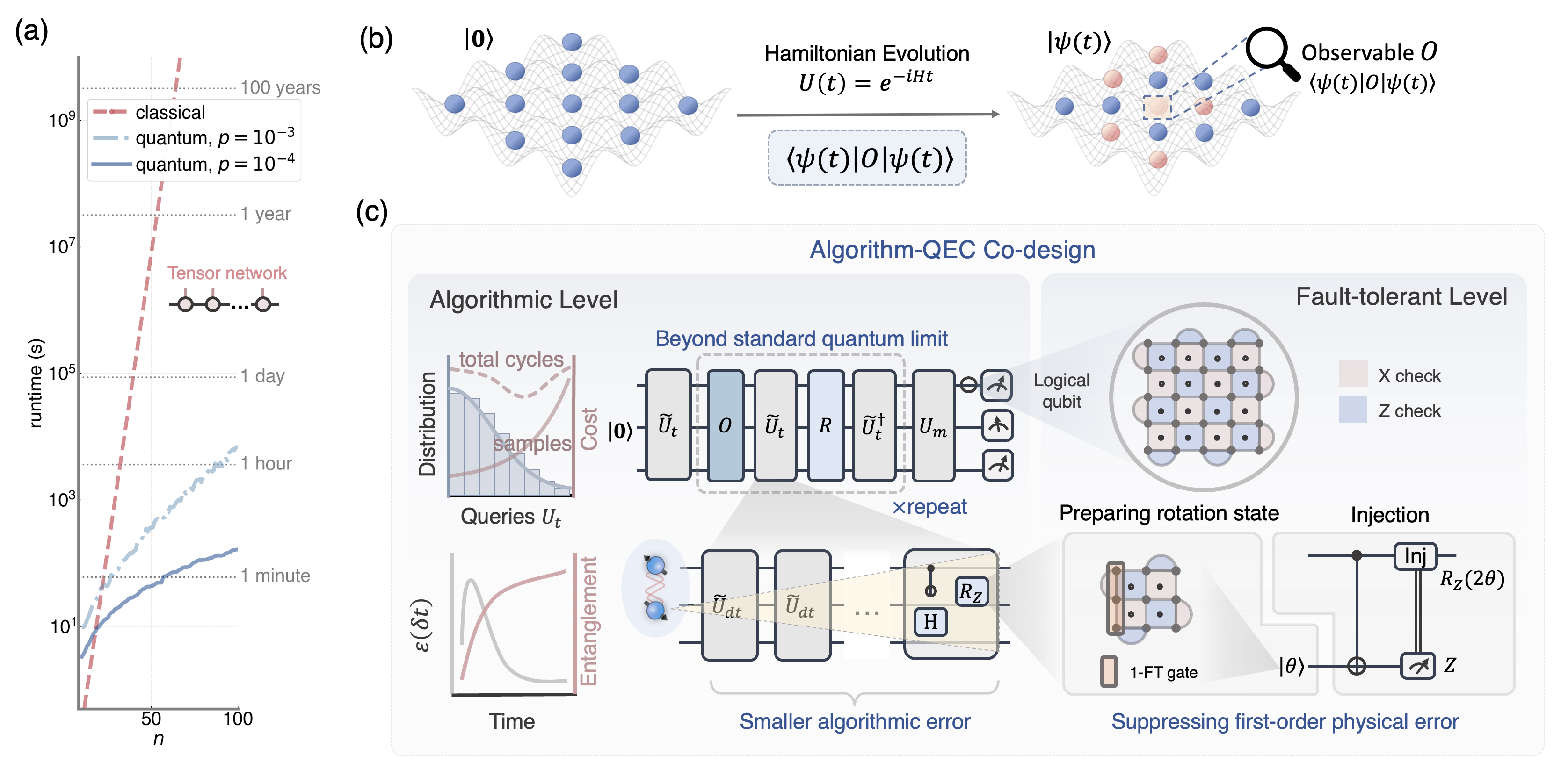
Fig 1: Full-stack framework for fault-tolerant quantum dynamics simulation and runtime comparison to
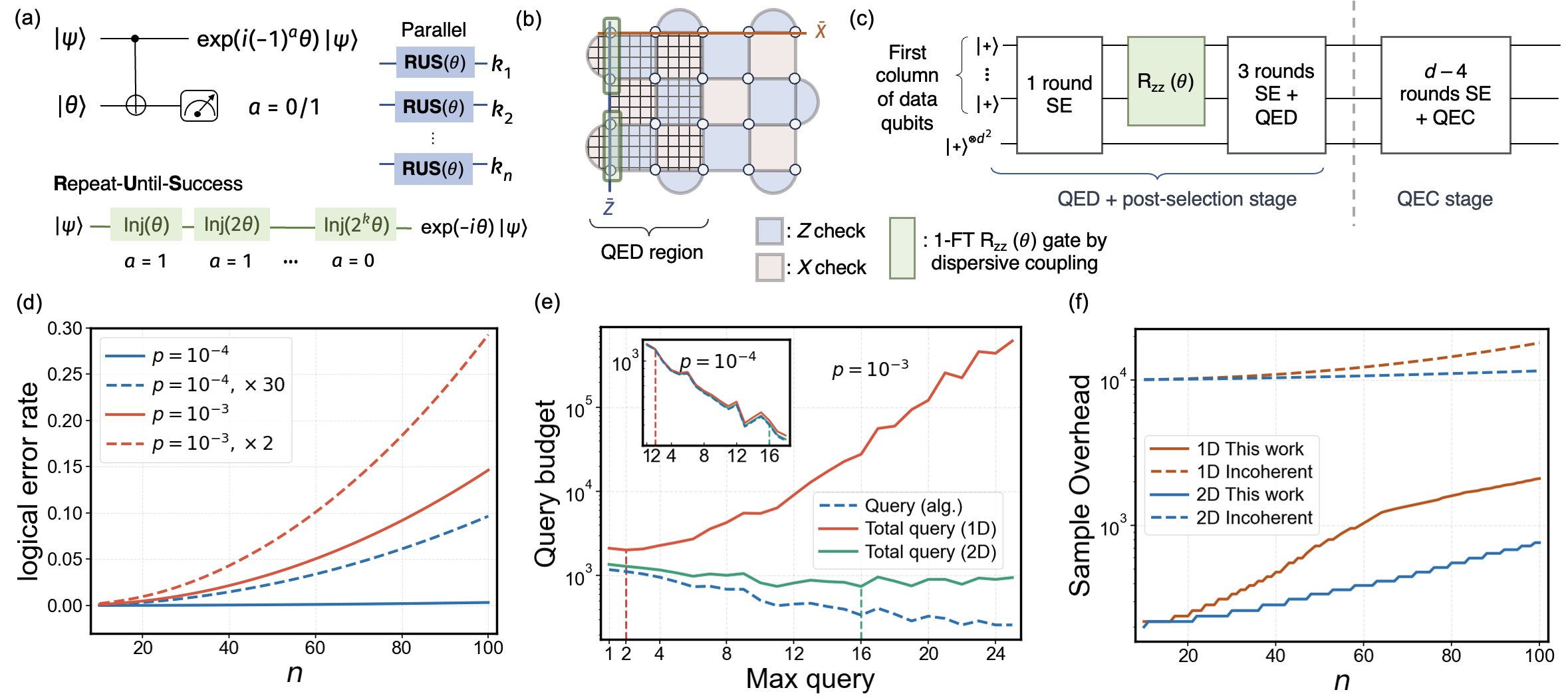
Fig 2: Fault-tolerant logical rotation states preparation and optimisation of the query complexity and sampling
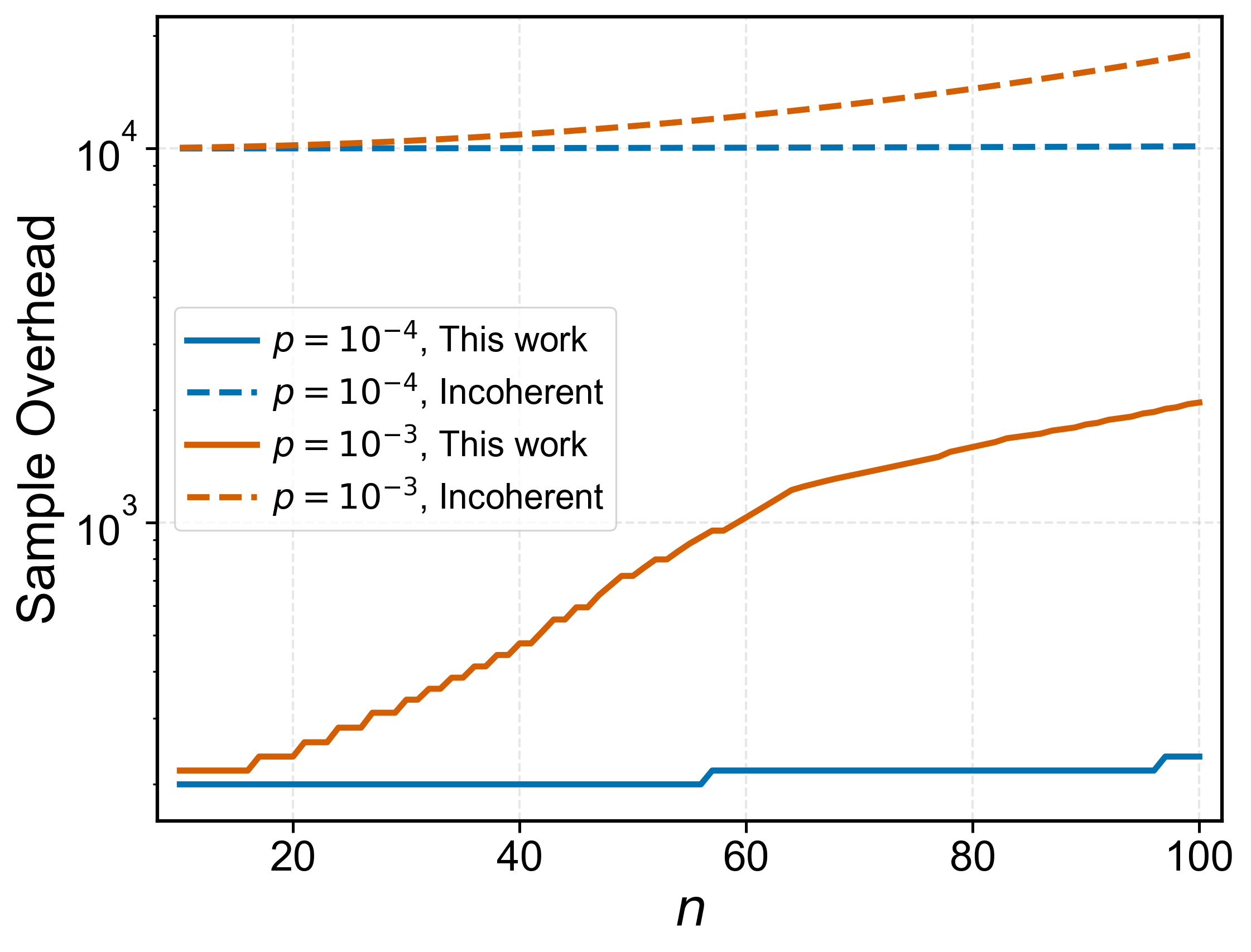
Fig 5: illustrates this error-mitigation overhead for
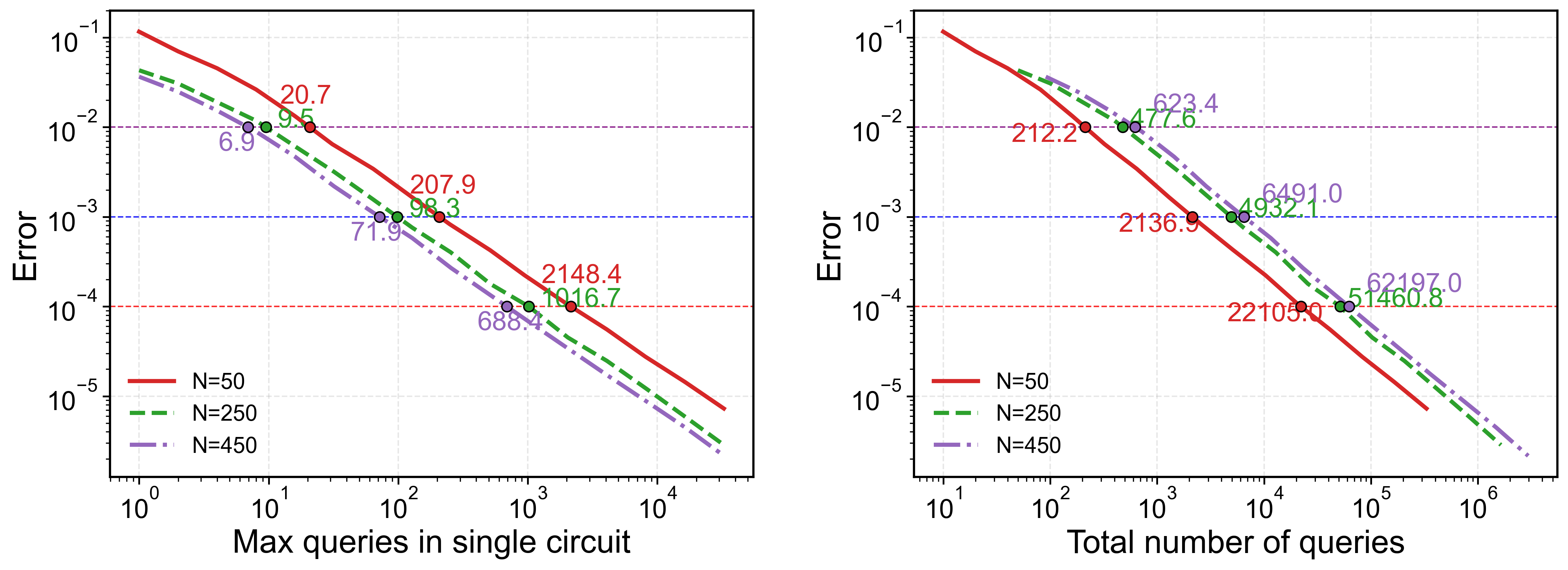
Fig 4 (page 19).
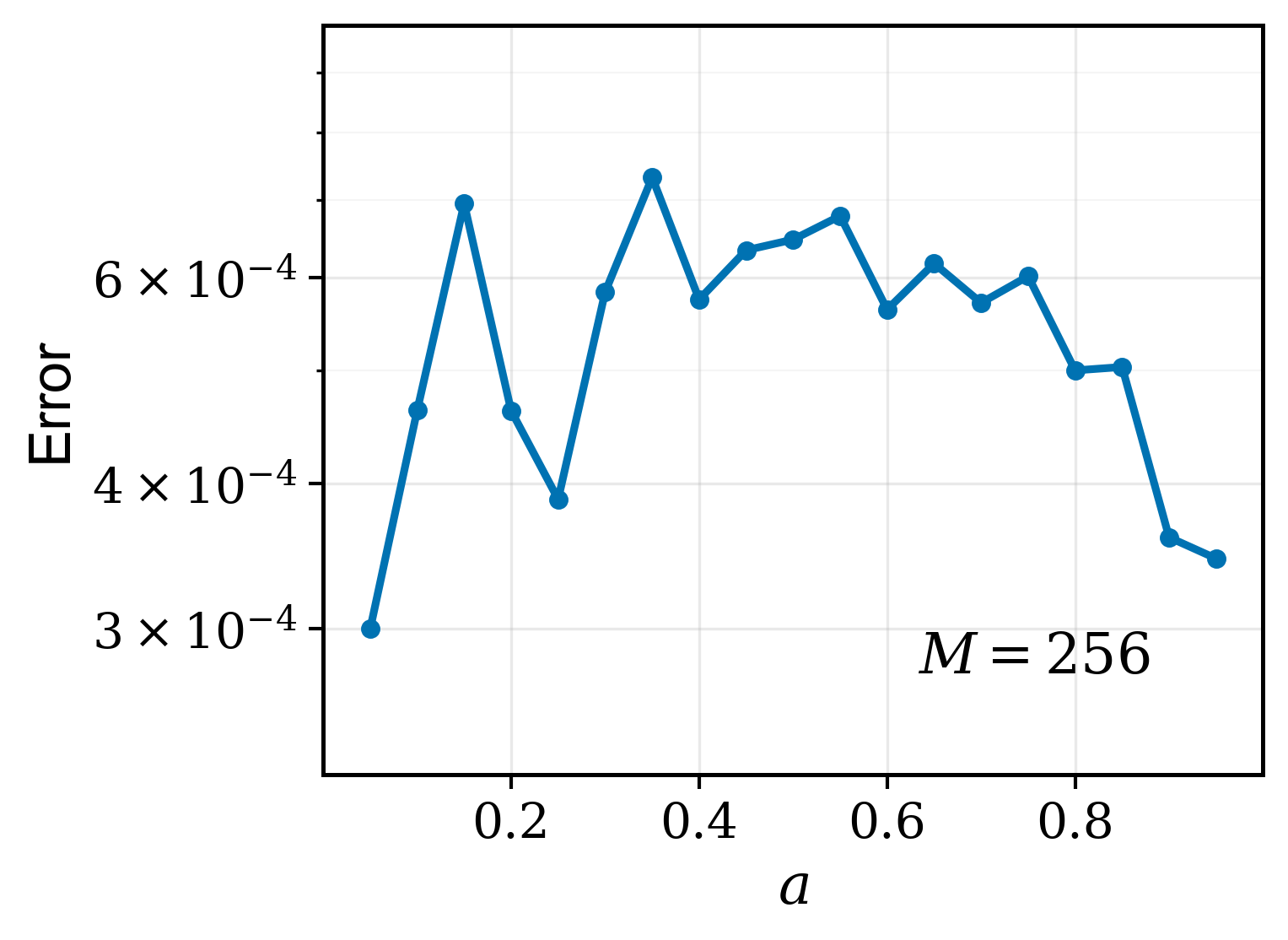
Fig 5 (page 19).
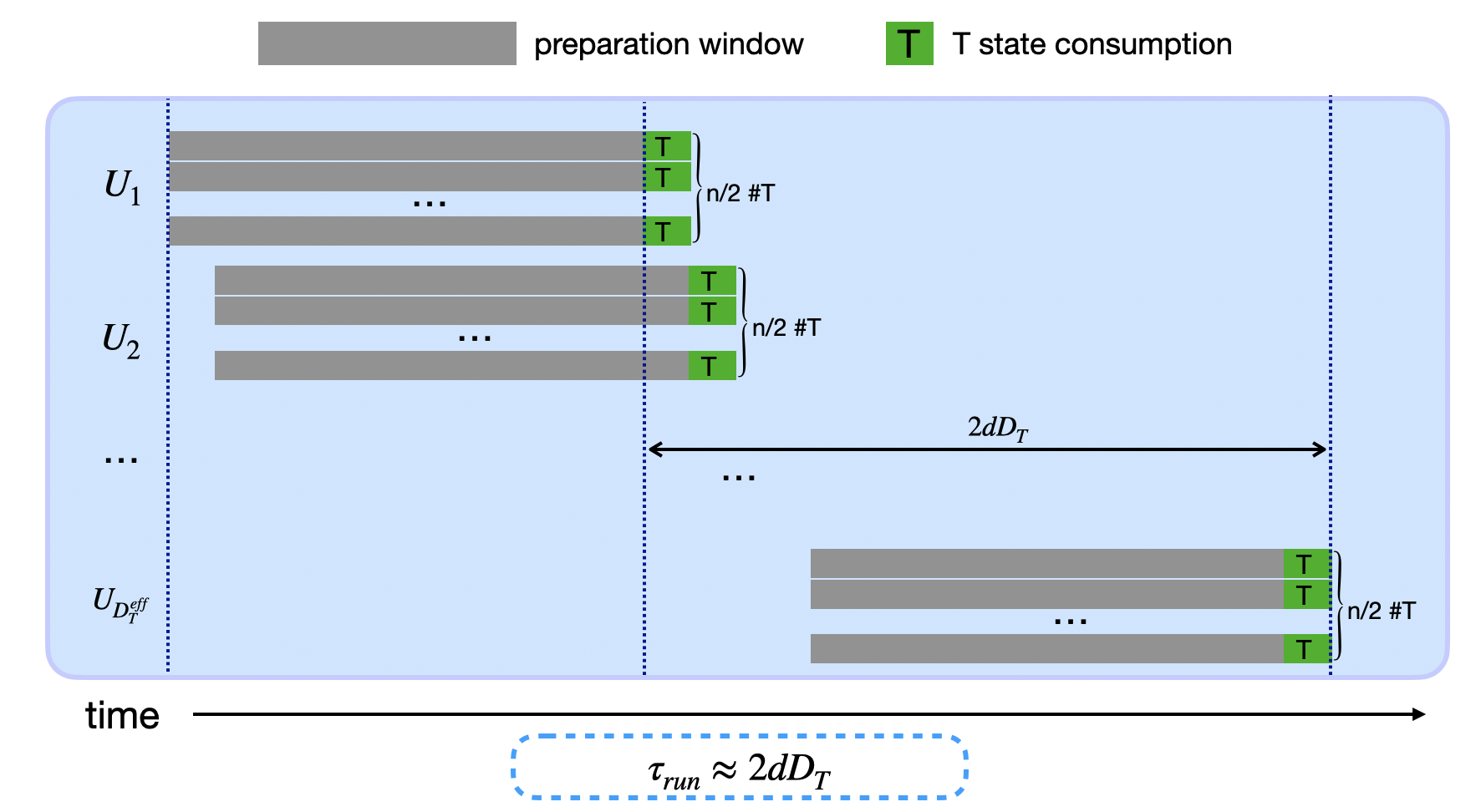
Fig 6 (page 35).
Limitations
- The resource estimates assume idealized noise models and error rates of p=10^-3 and 10^-4; real hardware may have more complex noise.
- The complexity estimates rely on fourth-order Trotterization; more advanced Hamiltonian simulation methods might improve or alter scaling.
- The classical baselines may not represent all possible algorithmic improvements or heuristic classical optimizations.
- The analysis does not include comprehensive adversarial fault models or correlated noise scenarios that may degrade quantum error correction performance.
- The scalability to 2D systems relies on projected gate times and logical error rates that remain experimentally unproven at large code distances and qubit counts.
- The co-design approach’s practical implementation and overhead for classical control, compilation, and scheduling are not fully modeled.
Open questions / follow-ons
- How does performance and resource cost scale when moving beyond Trotterization to more advanced Hamiltonian simulation algorithms like qubitization or randomized compiling?
- What are the practical impacts of correlated noise models and leakage errors on the proposed fault-tolerant schemes and rotation-state injection methods?
- Can further optimization of the co-design framework be done leveraging near-term device parameters such as qubit connectivity and gate fidelity heterogeneity?
- How do alternative quantum error correcting codes (beyond surface codes) affect the logical error suppression and resource tradeoffs in dynamics simulation?
Why it matters for bot defense
From a bot-defense or CAPTCHA perspective, this work does not directly address bot detection or CAPTCHA design. However, the demonstration of practical quantum advantage in simulating complex quantum many-body dynamics represents a concrete benchmark in quantum computational power. Future adversaries equipped with fault-tolerant quantum computers might leverage these capabilities for cryptanalysis or attacking cryptographic proofs-of-work and challenge-response systems. Understanding the quantum-classical computational boundaries, hardware requirements, and error budgets helps security practitioners anticipate and prepare defenses against eventual quantum-enabled adversaries. The co-design approach also highlights the importance of integrated algorithm and hardware error suppression—a principle applicable when assessing quantum adversaries in security-sensitive environments.
Cite
@article{arxiv2607_16116,
  title={ Quantum-classical crossover in fault-tolerant quantum dynamics simulation },
  author={ Jinzhao Sun and Bozhen Zhou and Jue Xu and Yuan Yao and Zhenyu Du and Zixu Zhang and Yuntian Gu and Junxiang Huang and Shuo Zhou and Ziruo Wang and Alexander Yosifov and Wenzheng Dong and Yiming Huang and Daniel Serrano and Xinzhao Wang and Tianfeng Feng and Shreyas Sadugol and Wenjun Yu and Zhou You and Dayue Qin and Xiao-Ming Zhang and Yantao Wu and Aditya Iyer and You Zhou and Tongyang Li and Ying Li and Xiongfeng Ma and Qi Zhao and Pei Zeng and Pan Zhang and Xiao Yuan },
  journal={arXiv preprint arXiv:2607.16116},
  year={ 2026 },
  url={https://arxiv.org/abs/2607.16116}
}