
OpenCosmo: Community Portal and Analysis Framework for Flagship Cosmological Simulations
Source: arXiv:2607.16059 · Published 2026-07-17 · By Patrick R. Wells, Michael Buelhmann, Patricia Larsen, William M. Hicks, Manpreet Dhillon, Idunnuoluwa A. Adeniji et al.
TL;DR
The OpenCosmo project addresses the critical challenge in modern cosmology of accessing and analyzing extremely large-scale, complex simulation datasets that underpin precision observational science. These datasets, produced by flagship cosmological simulations such as Frontier-E, Last Journey, Discovery, and a 64-member hydrodynamic suite, can reach trillions of particles and petabyte scales, making them computationally expensive to produce and challenging to share widely. OpenCosmo introduces a flexible, integrated platform combining a web-based portal, a Python analysis toolkit, and a multi-facility orchestration layer that leverages Globus services to provide near-real-time, scalable access to custom subsets of key data products like halo catalogs, particle data, galaxy catalogs, and lightcone maps. The toolkit seamlessly scales analysis from small laptop-sized subsets to full simulation data on leadership HPC systems without requiring changes in user code or deep computational expertise.
This platform is designed to bridge the gap between data complexity and scientific analysis by providing intuitive, high-level query interfaces and managed workflows that bring computation to data at scale. It supports multiple interaction modes, from browser-based exploration to command-line clients and AI-agent driven workflows, enabling diverse use cases from science outreach to advanced research. OpenCosmo’s architecture prioritizes generalizability, aiming to serve as a reusable framework extendable to other scientific domains that also require coupling of data sharing with HPC capabilities. Early community feedback highlights its usability for studies including dark energy, galaxy cluster dynamics, and astrophysical feedback models, while lowering technical barriers for early-career scientists.
Overall, OpenCosmo represents a significant step toward democratizing access to large cosmological simulations by harmonizing high-scale HPC resources, data management best practices, and flexible, user-friendly tools. Its first public release already hosts cutting-edge cosmological datasets and analysis capabilities, with ongoing developments toward more powerful query APIs and server-side analysis execution on petabyte datasets.
Key findings
- OpenCosmo serves simulation data from flagship projects such as the two-trillion-particle Frontier-E gravity-only run, Last Journey (10,752^3 particles), Discovery (6,720^3 particles), and a 64-member hydrodynamic simulation suite.
- The portal typically returns query results within minutes (e.g., a halo catalog query returning 1.7 × 10^7 halos completes in ≈5 minutes), enabling near real-time interactive exploration of petascale datasets.
- The Python toolkit automatically links related dataset components (e.g., halo catalogs with profiles and particle data) and scales unchanged from single-machine to HPC-scale analyses.
- Hydrodynamic simulations include variations in five subgrid astrophysical parameters sampled via a symmetric Latin hypercube design to enable systematic studies of baryonic feedback effects.
- The platform integrates Globus Compute and Transfer to orchestrate multi-facility data access and job execution without requiring users to manage HPC job scripts or software environments.
- Lightcone catalogs and maps provide observer-frame data products that facilitate direct comparison to cosmological surveys, including weak lensing studies via HEALPix maps constructed from simulation particles.
- OpenCosmo supports multiple user interfaces including a web portal, command-line client, and Model Context Protocol servers enabling AI-agent driven workflows.
- The toolkit hides distributed computing complexity, allowing users to focus on scientific analysis rather than data management or HPC operations.
Threat model
N/A — The paper focuses on scalable, user-friendly access to large astrophysical datasets rather than security threats or adversarial models. The system assumes honest scientific users and does not address malicious adversaries or data integrity attacks.
Methodology — deep read
Threat model & assumptions: The project addresses the challenge of democratizing access to massive cosmological simulation data without requiring users to have specialized HPC experience or managing complex distributed environments. The adversarial model is not explicitly a security context but assumes users without deep computational expertise but with legitimate scientific intent.
Data: The data comprises multiple large-scale cosmological simulations generated with HACC and its hydrodynamic extension CRK-HACC. Simulations include Frontier-E (trillion-particle gravity-only and hydro runs), Last Journey (10,752^3 particles), Discovery suite (6,720^3 particles, including dark energy variants), and 64 hydrodynamic simulations varying subgrid physics. Data products include halo catalogs (FoF and SOD algorithms), halo profiles, particle data for high-mass halos, synthetic galaxy catalogs (Diffsky), lightcone catalogs, and HEALPix lightcone maps. Labels correspond to astrophysical properties—halo mass, position, velocities, star formation rates, metallicity, etc.
Architecture/algorithm: OpenCosmo consists of four main components: a web portal offering parameterized queries targeting common scientific goals; a Python toolkit built on the h5py library providing programmatic data access, automatic linking of data products, and analysis primitives; a Globus Compute-based orchestration layer that dispatches queries to data-housing HPC facilities, manages job execution, monitors status, and returns results; and data storage formatted mainly in HDF5 with custom structure for efficient partial data loading. The orchestration service is agnostic to workload specifics, enabling extensibility. Novelty arises from binding a user-friendly, scalable query interface with HPC orchestration and seamless scaling from laptops to supercomputers.
Training regime: Although training in the machine learning sense is not applicable, the software development includes release of open-source Python tooling, integration with Globus for authentication and data movement, and interface design iterated through early community beta testing within the Argonne CPAC group and LSST DESC collaborators.
Evaluation protocol: Performance evaluation includes measuring query completion times for datasets on different simulations, usability feedback from early users, and scientific validation via example workflows (e.g., halo mass function computation from Frontier-E data). No formal cross-validation or adversarial testing is reported. Scalability is demonstrated by executing identical analysis code on laptop-scale subsets and full supercomputer datasets without modification.
Reproducibility: The system provides open-source code for the Python toolkit, publicly accessible web portal, and curated example notebooks. Some datasets are publicly released (such as Last Journey subsets), while others require user registration or institutional access. Full-scale datasets currently hosted on leadership computing facilities are not openly downloadable in entirety, but subsets and query responses are accessible. Certain advanced features like the full Python API for arbitrary queries are in closed beta.
Example workflow: A user logs into the OpenCosmo web portal, submits a halo catalog query targeting Frontier-E gravity-only simulation halos above 10^13 solar masses, with a 10^8 halo limit. The orchestration layer dispatches the job to the hosting HPC system, which returns a 2.6 GB HDF5 file within 5 minutes. The user loads the file in the Python toolkit, which links the halo catalog with simulation metadata. Using two lines of Python code, the user extracts halo mass and simulation box volume, computes the halo mass function bins with numpy, and plots it with matplotlib—all in under 10 minutes end-to-end, demonstrating interactive scalability.
Technical innovations
- Integration of a multi-facility orchestration layer on Globus Compute that dispatches user queries transparently to appropriate HPC resources hosting petabyte-scale cosmological simulations.
- A Python toolkit that automatically links heterogeneous data products (halo catalogs, profiles, particles, galaxies) and scales analysis workflows identically from laptops to leadership HPC systems.
- Provision of multiple interaction modes (web portal, command-line, AI-agent compatible MCP servers) enabling flexible user and automated agent access to cosmological simulation data.
- Systematic parameter variation in hydrodynamic simulations (5 subgrid astrophysical parameters via Latin hypercube sampling) tied directly to accessible, linked simulation products facilitating in-depth feedback modeling.
Datasets
- Frontier-E gravity-only simulation — 12,600^3 particles (~2 trillion) — Oak Ridge Leadership Computing Facility
- Last Journey gravity-only simulation — 10,752^3 particles — Argonne National Laboratory
- Discovery gravity-only simulations — 6,720^3 particles each — Argonne National Laboratory
- SciDAC 128 SG5 suite hydrodynamic simulations — 64 members, 2 × 512^3 particles each — Argonne National Laboratory
- Diffsky synthetic galaxy catalog — derived from Last Journey — modeled galaxy-halo connection
Baselines vs proposed
- Query response time for halo catalog: Approximately 5 minutes on Frontier-E simulation for ~1.7 × 10^7 halos
- Halo mass function computed from the query matches expected theoretical distributions consistent with Planck cosmology parameters
- Analysis scaling: Python toolkit runs unchanged on laptop-size subsets and full HPC datasets; no explicit performance degradation reported
- Hydrodynamic subgrid parameter variation enables systematic study of baryonic feedback not possible with gravity-only simulations
Figures from the paper
Figures are reproduced from the source paper for academic discussion. Original copyright: the paper authors. See arXiv:2607.16059.

Fig 1: shows a complete example workflow.
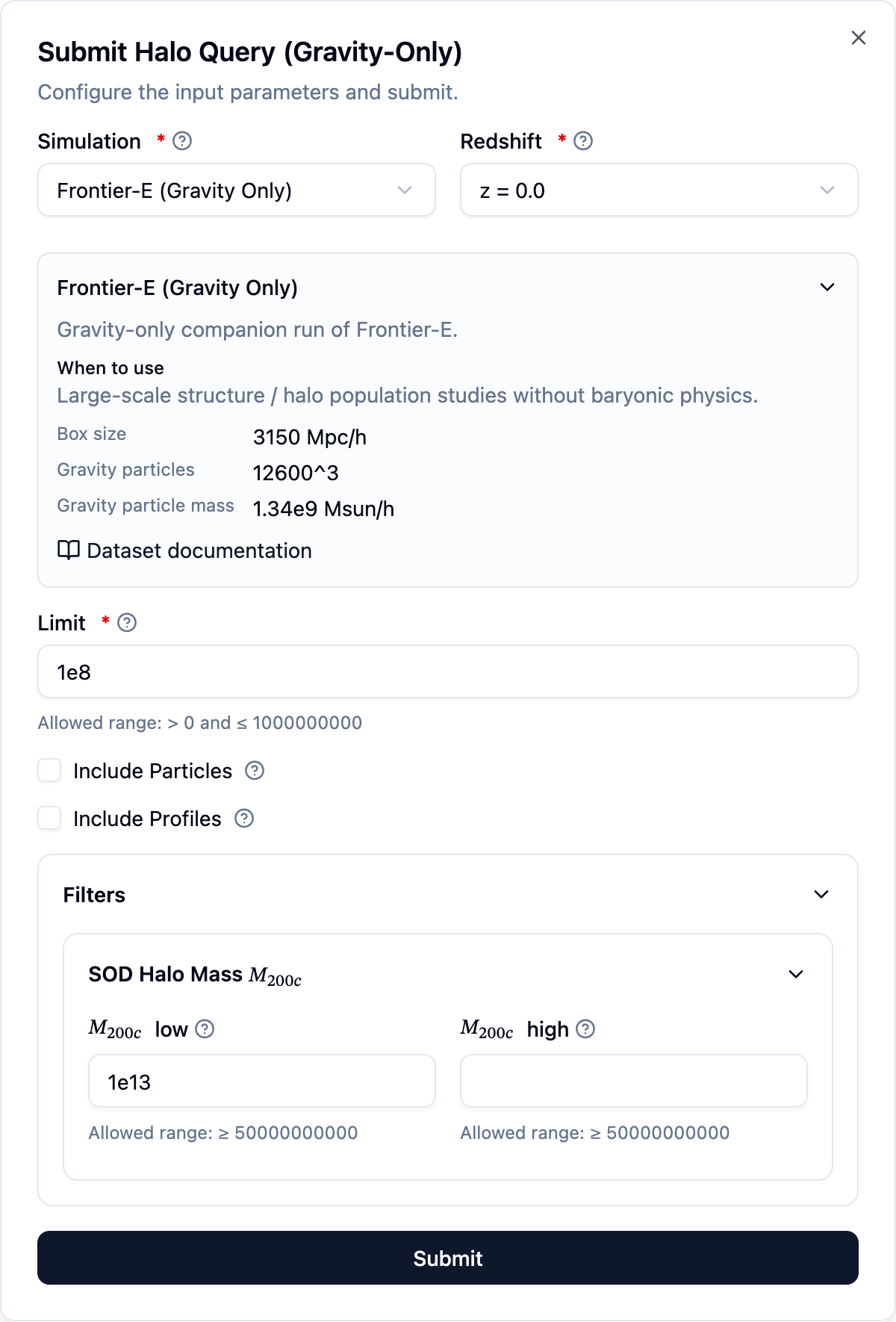
Fig 2 (page 5).
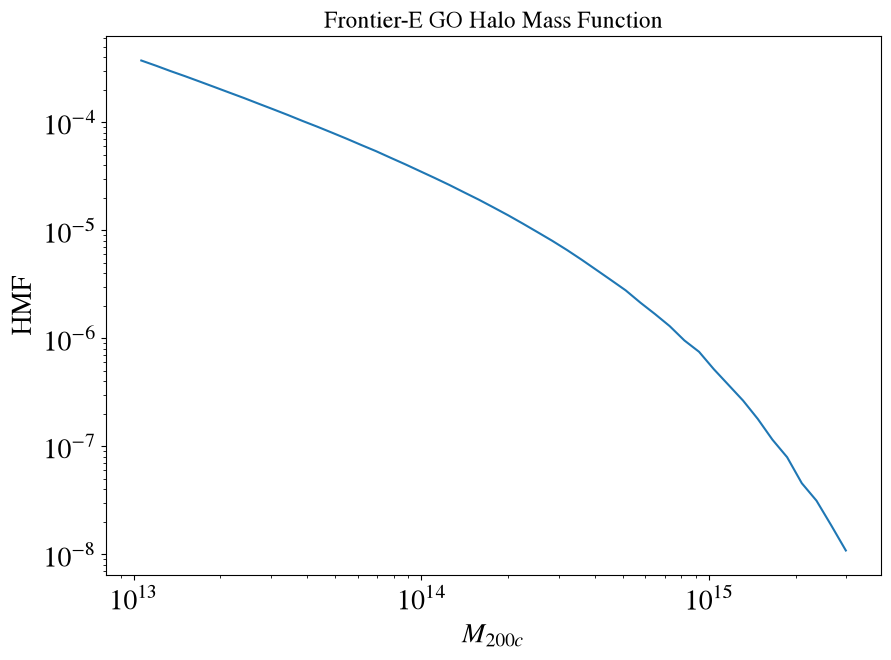
Fig 3 (page 5).
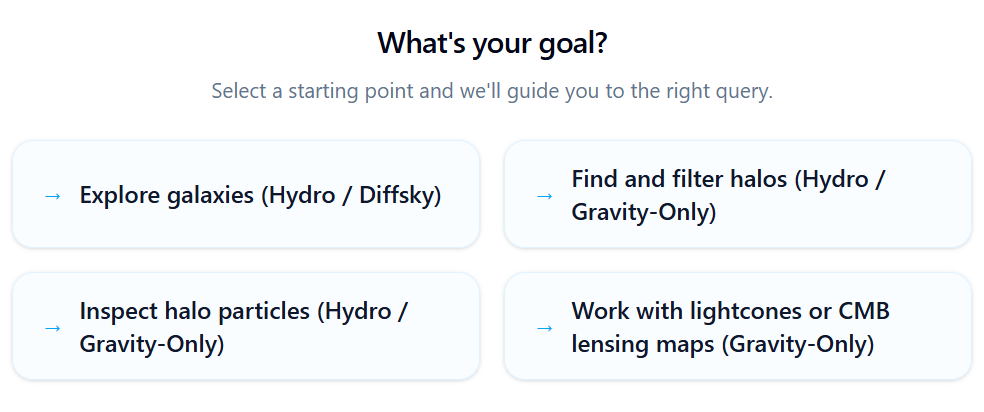
Fig 2: Top: High-level goal buttons available to the user on the OpenCosmo web portal’s homepage. Bottom: One of the
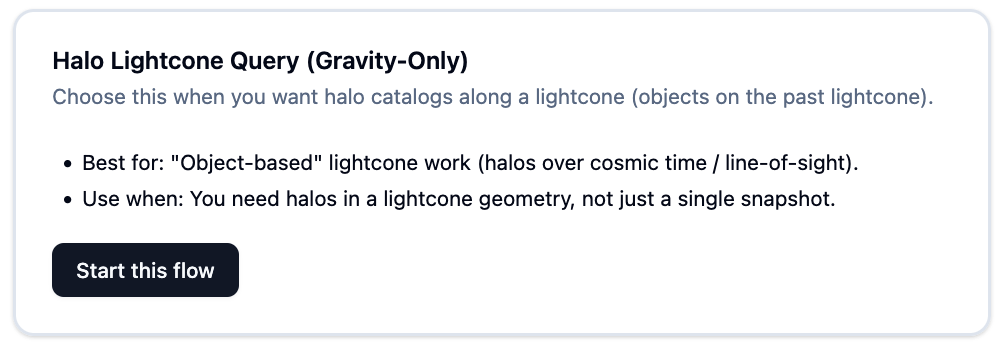
Fig 3: Screenshot of the web-based 3D viewer displaying dark matter, stars, and gas. Individual particles are colored by
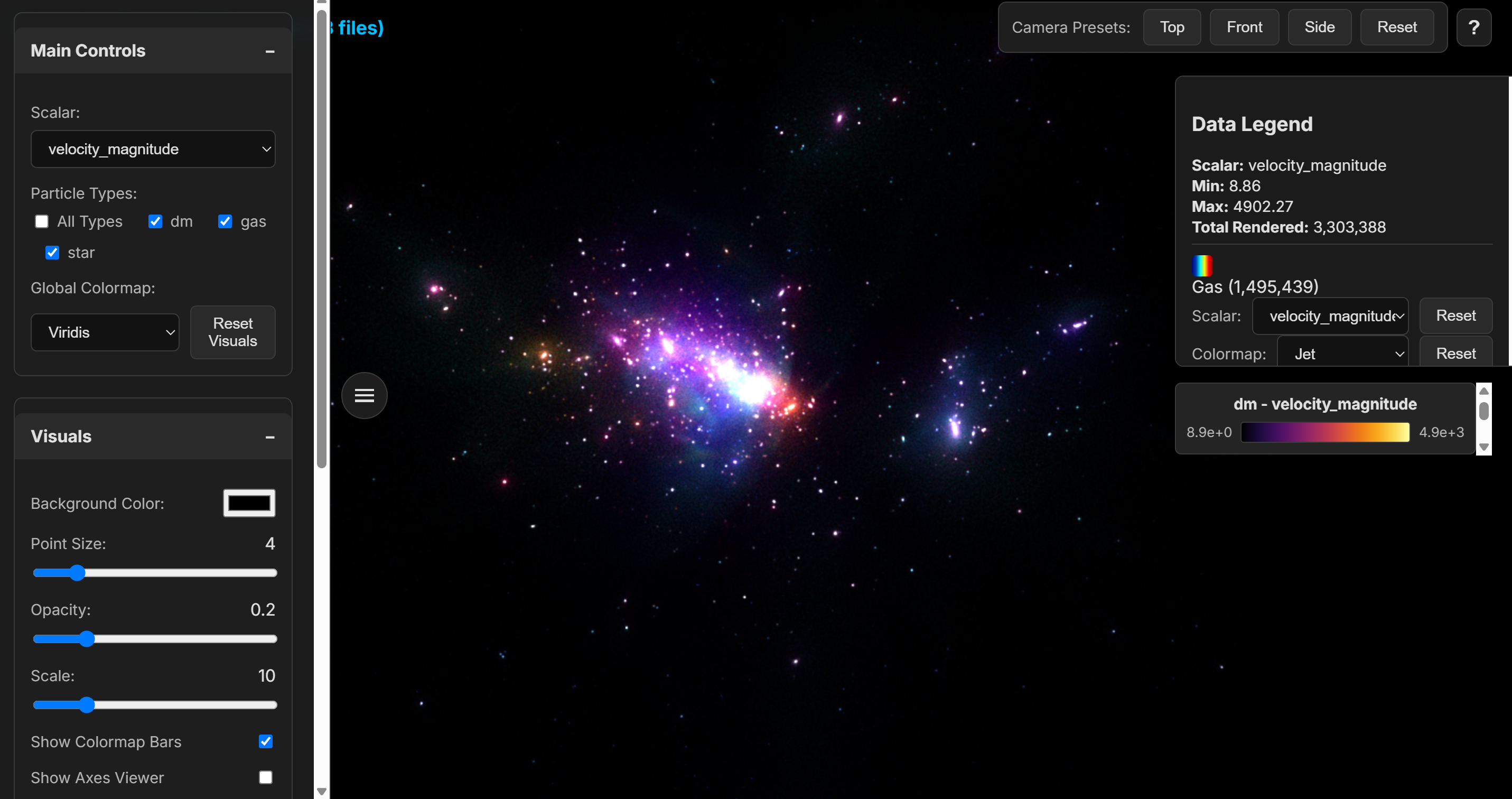
Fig 4: shows an example
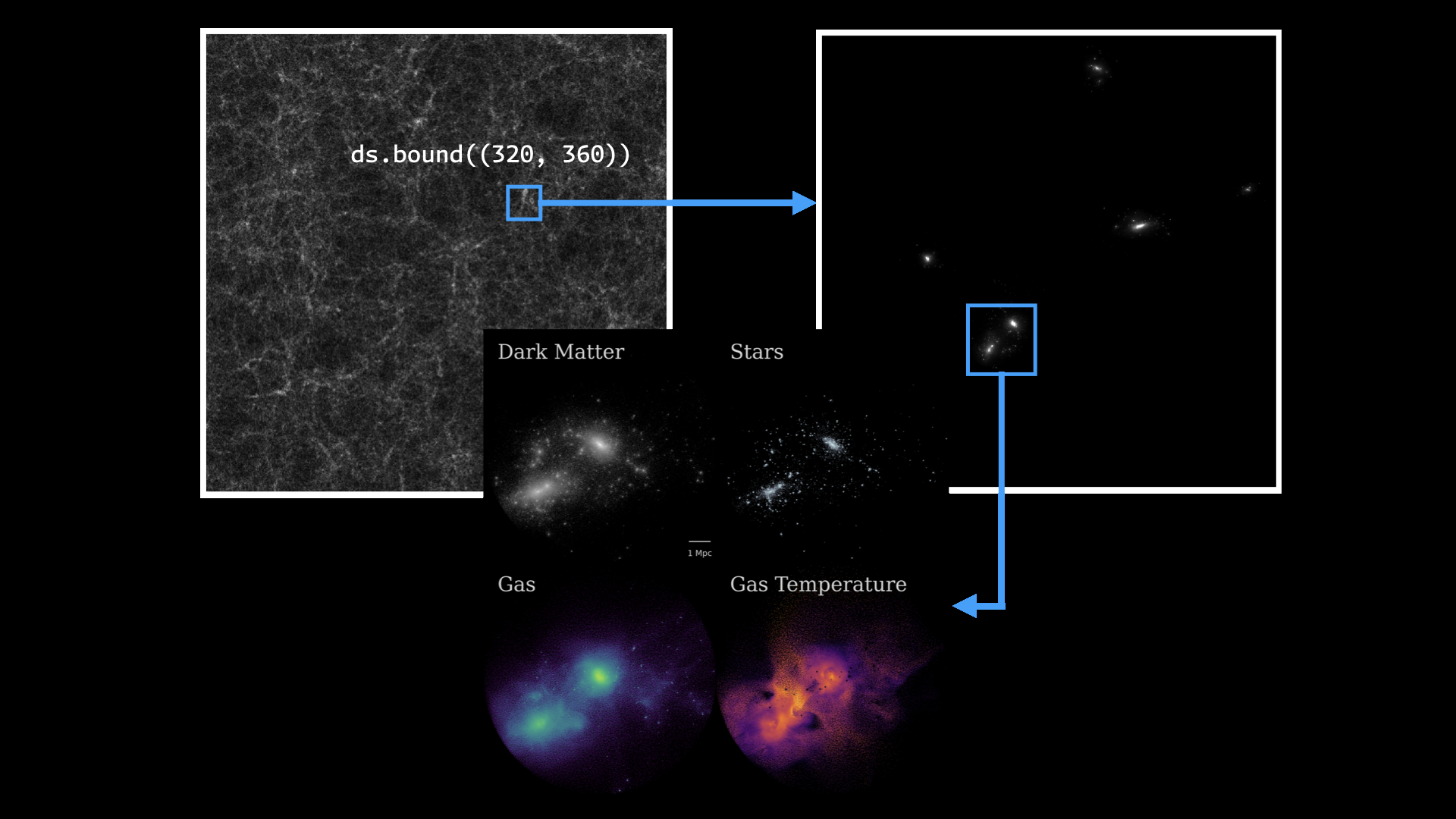
Fig 5: Demonstration of transition from a full simulation to a single structure of interest. Top left: Density field of a
Fig 6: Illustration of the OpenCosmo workflow. On the OpenCosmo portal, users authenticate through Globus with an
Limitations
- Advanced full-scale arbitrary query API currently in closed beta, limiting broad community access.
- No explicit security or adversarial threat evaluation in the system documented.
- Current portal interaction limited to specific predefined query templates; more complex, user-defined queries require API access not yet public.
- Particle-level data access restricted to high-mass halos to balance data volume and usability; full dataset particle access not available.
- Lightcone data and profiles available for some but not all simulations; e.g., Discovery simulation lightcone halo profiles and particles planned for future release.
- Subgrid physics parameter variations limited to certain ranges and models; other astrophysical processes may not be fully represented.
Open questions / follow-ons
- How to extend the API and platform to support fully arbitrary user-defined queries across all simulations, enabling more flexible science workflows?
- Exploration of server-side, large-scale analysis execution pipelines that eliminate data movement to users entirely—can this approach scale to petabyte datasets sustainably?
- Integration of additional astrophysical simulation data and subgrid models to expand science reach while maintaining usability and API consistency.
- Assessment of system robustness, security, and data provenance mechanisms to support broader open science deployments.
Why it matters for bot defense
While OpenCosmo is not directly related to bot defense or CAPTCHA, its architectural principles emphasize scalable, multi-facility orchestration of user queries across massive data resources coupled with flexible, user-friendly interfaces. Bot-defense engineers can learn from OpenCosmo’s layered approach to access control, workload delegation, and progressive levels of interaction—from browser queries to AI agent APIs—that support transparent but controlled interaction with complex backend systems. The system’s deployment of Globus authentication and managed transfers exemplifies robust identity and data handling practices in scientific portals.
Moreover, the design trade-offs in balancing rich data access against practical constraints on query size and latency reflect general challenges in building usable yet secure large-scale distributed services. OpenCosmo’s use of standardized data formats and linked multi-modal datasets also highlights strategies for modular data orchestration that could inform secure, scalable resource provisioning in bot-defense contexts, especially when dealing with large-scale telemetry or threat intelligence datasets.
Cite
@article{arxiv2607_16059,
  title={ OpenCosmo: Community Portal and Analysis Framework for Flagship Cosmological Simulations },
  author={ Patrick R. Wells and Michael Buelhmann and Patricia Larsen and William M. Hicks and Manpreet Dhillon and Idunnuoluwa A. Adeniji and Katrin Heitmann and Salman Habib and Benoit Côté and Thomas Uram and Gideon McFarland and Andrew Hearin and Ezar Shinabro and Michael E. Papka },
  journal={arXiv preprint arXiv:2607.16059},
  year={ 2026 },
  url={https://arxiv.org/abs/2607.16059}
}