
SYNAPSE: A Multi-LLM Orchestrated AI Tutor for Secure Software Development Education with Neurodivergent-First Design
Source: arXiv:2607.14601 · Published 2026-07-16 · By Giusy Ferrara, Ashkan Sami
TL;DR
SYNAPSE addresses the underexplored challenge of teaching secure software development as an integrated, adaptive educational experience, focusing on the detect–understand–remediate loop critical to real-world vulnerability maintenance rather than greenfield secure coding. It also explicitly targets neurodivergent learners, such as those with ADHD, by adopting an accessibility-first design with eighteen persistent support features and adaptive tutor behavior sensitive to cognitive load. The platform orchestrates three different large language models (Claude, GPT-4o, Gemini) via the Model Context Protocol (MCP), enforcing a novel three-stage Socratic hint policy to scaffold learning effectively and mitigate over-reliance on AI-generated direct answers.
SYNAPSE anchors hands-on practice in ShopSecure, a purpose-built vulnerable web application covering six OWASP Top 10 (2021) categories, allowing learners to apply vulnerability detection and remediation on realistic but overtly vulnerable code. A feasibility pilot with nineteen participants, including neurodivergent and neurotypical cohorts, showed promising usability (SUS 76.4), engagement (4.2/5), comparable mental workload levels across cohorts, and increased self-reported confidence in vulnerability mitigation (+1.1 overall). These results support the platform’s accessibility-first design and multi-LLM orchestration as feasible approaches for secure coding education that includes neurodiverse learners. The platform is publicly accessible with source code released for reproducibility.
Key findings
- SYNAPSE achieved a System Usability Scale (SUS) score of 76.4, exceeding the 68 benchmark for usability and within the “good” adjective range.
- Engagement rating averaged 4.2 out of 5, slightly above the 4.1 engagement reported in prior AI tutor research ([5]).
- Self-reported confidence in identifying and mitigating web vulnerabilities improved from 3.0 to 4.1 (+1.1), with beginners seeing a larger gain (+1.6) versus experienced participants (+0.2).
- Neurodivergent participants (n=7) reported slightly higher usability (76.8 vs 76.1), engagement (4.3 vs 4.2), and lower mental demand (3.1 vs 3.3) and effort (2.9 vs 3.2) than neurotypical participants (n=12), indicating comparable cognitive load across cohorts.
- All three security-pathway completers correctly selected mitigations for three research-task vulnerabilities: CWE-22 (Path Traversal), CWE-352 (CSRF), and CWE-502 (Insecure Deserialization).
- The three-stage Socratic hint policy prevented handing out direct exploit code and progressively scaffolded learner reasoning, supporting critical thinking without over-reliance on AI answers.
- Orchestration of three LLMs (Claude for Socratic explanation, GPT-4o-mini for practice exercises, Gemini 2.5 Flash for analogies) via the Model Context Protocol ensured graceful degradation and division of pedagogical labor.
- ShopSecure covers 15 vulnerability topics mapped to six OWASP Top 10 (2021) categories with overt weaknesses and integrated tutoring, contrasting with existing challenge platforms that require vulnerability discovery.
Threat model
The adversary is a learner who could misuse LLM assistance to bypass critical thinking by relying on direct exploit code or AI-provided answers. SYNAPSE assumes the adversary cannot subvert the tutoring platform itself or the underlying systems, but aims to prevent over-reliance hazards by scaffolded interaction policies. It does not consider external attackers against infrastructure or data.
Methodology — deep read
The core threat model assumes learners as mostly non-malicious users seeking to develop secure software development skills, including vulnerability detection and remediation. The adversary modeled is the learner who could over-rely on AI for direct answers, eroding critical thinking; SYNAPSE designs mitigation via a layered Socratic hint policy. No active adversarial attackers against the platform infrastructure are considered.
Data derives from a feasibility pilot conducted from Feb-Apr 2026 with 19 volunteer participants recruited informally through student networks and social media, comprising seven self-identified neurodivergent and twelve neurotypical individuals across beginner and intermediate skill levels. Participants undertook either the Java programming pathway or the ShopSecure security challenge, completed pre- and post-task questionnaires including the SUS usability scale, NASA-TLX cognitive load measures, engagement ratings, and self-reported confidence. The sample was modest and unpowered for statistical generalization.
SYNAPSE architecture integrates five main subsystems: (1) an adaptive AI tutor coordinating three LLMs through the Model Context Protocol (MCP) server, exposing seven callable AI tools linked to pedagogical intents; (2) a modular course engine with 44 structured lessons; (3) a persistent accessibility layer with 18 features aligned to the FEDIS+R cognitive load framework; (4) a dual-language code execution sandbox with resource-limited Java subprocess and restricted Python environment; and (5) a contained Docker-hosted vulnerable web app, ShopSecure, designed specifically for pedagogically scaffolded vulnerability remediation practice.
The MCP server intercepts learner prompts and routes them through a composite multi-LLM pipeline: Claude produces canonical explanatory responses under a system prompt enforcing the Socratic hint policy, GPT-4o-mini generates practice exercises when pedagogically indicated, and Gemini 2.5 Flash adds learner-friendly analogies. This orchestration partitions pedagogical functions to optimize explanation reliability, cost, and latency, with fallback logic for graceful degradation. ShopSecure tasks bypass this pipeline for vulnerability-specific calibration.
The three-stage Socratic hint policy constrains tutor responses: first providing conceptual reorientation without directives, then procedural hints, and finally partial worked examples adapted from other contexts. Complete exploit code is explicitly prohibited to maintain learner agency and critical thinking. Pre-written hints accompany course exercises to fit this scaffolded approach.
Evaluation employs the SUS for usability, NASA-TLX adapted for mental demand, effort, and frustration as cognitive load proxies, an engagement Likert scale, and confidence pre/post ratings, aggregated over neurodivergent and neurotypical groups. Qualitative thematic analysis of free-text reflections was performed by a single coder to identify user experience themes and inform iterative improvements. No control group or randomized assignment was included, and neurodivergence was self-reported rather than clinically validated.
Reproducibility is supported by the public release of SYNAPSE at https://synapse-course.com and accompanying source code archived on GitHub and Zenodo. The pilot data includes instrumented behavioural logs stored anonymously in PostgreSQL but full datasets or model weights are not public, due to proprietary LLM providers used.
Technical innovations
- Multi-LLM orchestration via the Model Context Protocol to divide pedagogical labor among different large language models with graceful degradation.
- A three-stage Socratic hint policy enforcing progressive scaffolding of learner hints while preventing over-reliance on direct AI answers or exploit code.
- A neurodivergent-first accessibility layer exposing eighteen persistent features (e.g., dyslexia fonts, focus modes, calming audio) integrated into pedagogical context adaptation.
- ShopSecure, a deliberately vulnerable Flask application designed for overt vulnerability remediation practice anchored to six OWASP Top 10 (2021) categories.
- An AI tutoring framework coordinating seven distinct pedagogical tools mapped to learner intents to flexibly support code analysis, explanation, visualisation, and remediation.
Datasets
- Pilot participant data — 19 participants — publicly not available
- ShopSecure vulnerable web app dataset — 15 vulnerabilities across 6 OWASP Top 10 (2021) categories — included within SYNAPSE platform
Baselines vs proposed
- Kestin et al. AI tutor engagement baseline: 4.1/5 vs SYNAPSE engagement: 4.2/5
- System Usability Scale benchmark: 68 vs SYNAPSE SUS: 76.4
Figures from the paper
Figures are reproduced from the source paper for academic discussion. Original copyright: the paper authors. See arXiv:2607.14601.
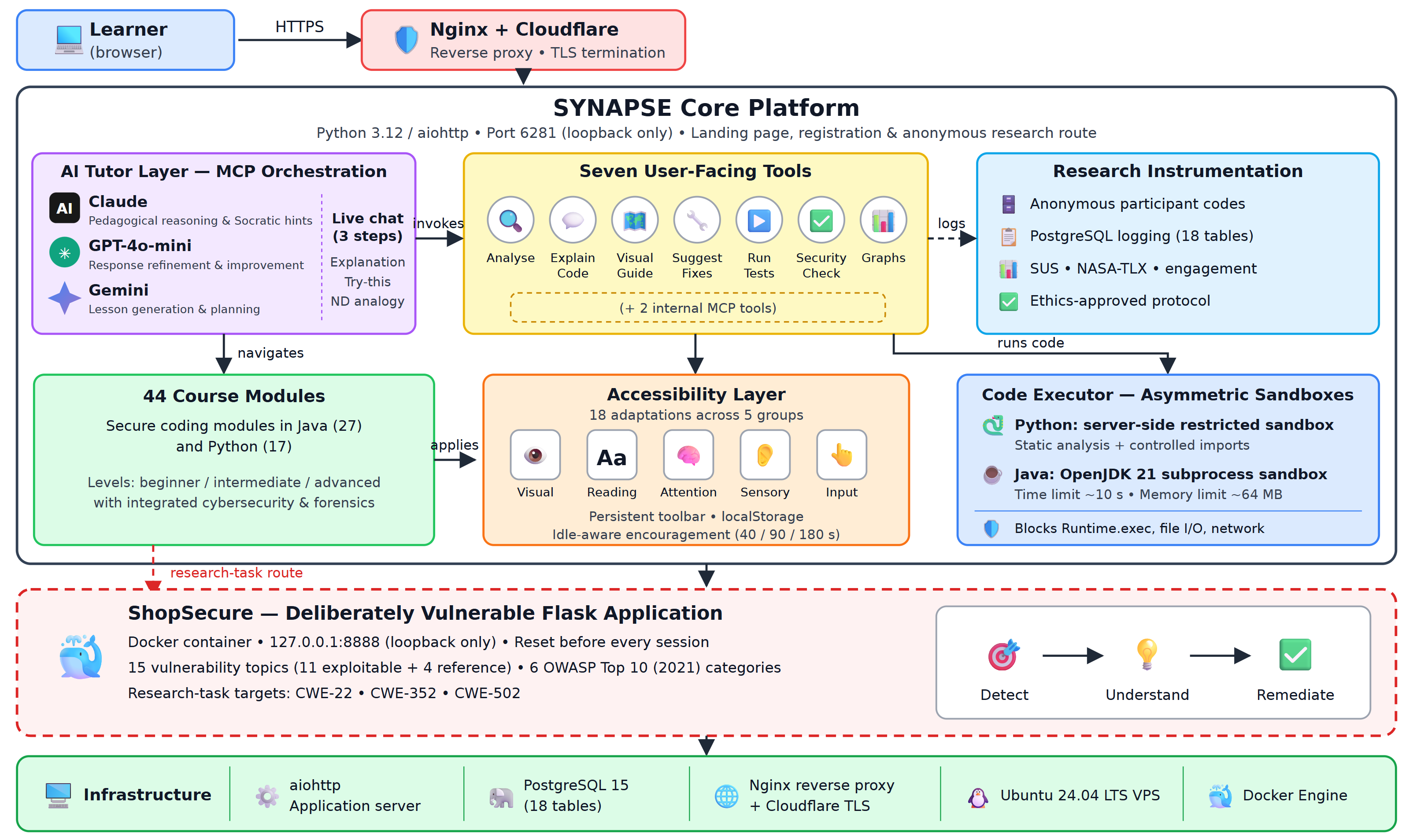
Fig 1: SYNAPSE high-level architecture. The red dashed arrow marks the research-task route to ShopSecure, which runs in an isolated Docker container.
Limitations
- Small pilot sample size (n=19) limits statistical power and generalizability of findings.
- Neurodivergence defined by self-report rather than clinical diagnosis.
- No randomized control or comparison with single-model tutoring was conducted; single-model ablation is future work.
- Qualitative thematic coding was done by a single coder, introducing potential bias.
- Pilot does not assess long-term learning retention or transfer to independent coding tasks beyond guided environment.
- No adversarial evaluation or real-world attacker simulations were performed to validate security of platform or pedagogical robustness.
Open questions / follow-ons
- Does orchestration of multiple LLMs significantly outperform single-model AI tutoring in secure coding education?
- How do neurodivergent learners engage with and benefit from AI tutors over longer durations and varied curricula?
- Can the Socratic hint policy be adapted or personalized further to optimize learner autonomy without risking under- or over-assistance?
- What are effective measures to evaluate transfer of learned vulnerability detection and remediation skills to real-world programming tasks?
Why it matters for bot defense
This research is relevant to bot-defense and CAPTCHA practitioners interested in AI-assisted education platforms that combine multi-model AI orchestration with accessibility-first design. The three-stage Socratic hint policy is a notable approach to reduce over-reliance on AI-generated answers, a concern relevant in maintaining critical judgment against automated assistance. The openly accessible ShopSecure environment provides a concrete pedagogical scenario for software maintenance vulnerabilities, illustrating how educational tools can scaffold security skills while accommodating neurodiverse learners.
For CAPTCHA or bot-defense engineers, the multi-LLM orchestration through the Model Context Protocol exemplifies how orchestrated AI systems can be constructed with role specialization and fallback mechanisms to balance pedagogical goals, response reliability, and system resilience. The neurodivergent-first accessibility layer and continuous adaptation based on cognitive load metrics provide a template for inclusive, adaptive AI-human interaction design that may inspire similar adaptations in bot-challenge interfaces to improve usability across diverse user profiles.
Cite
@article{arxiv2607_14601,
  title={ SYNAPSE: A Multi-LLM Orchestrated AI Tutor for Secure Software Development Education with Neurodivergent-First Design },
  author={ Giusy Ferrara and Ashkan Sami },
  journal={arXiv preprint arXiv:2607.14601},
  year={ 2026 },
  url={https://arxiv.org/abs/2607.14601}
}