
Rubrics on Trial: Evolving Rubrics from a Single Query via Synthetic Pairwise Evidence
Source: arXiv:2607.15092 · Published 2026-07-16 · By Haocheng Yang, Licheng Pan, Xiaoxi Li, Zhichao Chen, Zhiheng Zhang, Yuan Lu et al.
TL;DR
This paper tackles the challenge of generating reliable, query-specific rubrics for evaluating and training large language models (LLMs) without relying on external annotated data or model training. Existing methods either require costly human-written rubrics and preference data or generate rubrics in a one-pass manner without explicit quality validation, often producing rubrics that fail to discriminate answer quality or reward superficial styles. RUBRICS ON TRIAL introduces a novel query-only framework that evolves rubrics from scratch by generating synthetic response pairs conditioned on candidate rubrics and using pairwise comparisons to validate each rubric before acceptance. This approach filters out non-discriminative, over-specific, and style-only rubrics through complementary local and alternative-answer pair tests.
The method constructs two types of response pairs per candidate rubric: a local pair created by minimal edits to a strong response, and an alternative-answer pair independently generated from scratch and minimally repaired. A rubric-blind judge compares these to decide if satisfying the candidate rubric consistently improves response quality across contexts. The framework incrementally updates a tree-structured rubric set via ADD or SPLIT operations guided by these pairwise gates. Across five preference benchmark suites and seven evaluation sets, RUBRICS ON TRIAL achieves the best average accuracy (80.36%) and leads on six out of seven sets, outperforming both query-only and trained rubric generators. This demonstrates that pairwise validation using synthetically generated response pairs effectively closes the rubric-quality gap inherent in direct query-to-rubric generation without supervision.
Key findings
- RUBRICS ON TRIAL achieves the highest average pairwise preference accuracy of 80.36% across seven evaluation sets, surpassing query-only baselines TICK (75.63%) and RocketEval (76.48%), and trained baselines such as Rubric-ARM-8B (74.65%).
- It leads on six of seven individual evaluation sets, with accuracy improvements of 1.31 to 4.19 percentage points over the next best method on those sets.
- The framework’s two complementary pairwise tests—local pairs comparing minimal edits, and alternative-answer pairs comparing independently generated responses—successfully filter out over-specific and style-only rubrics.
- Starting from an empty rubric set, the method incrementally evolves rubrics through tree-structured ADD and SPLIT patches validated by pairwise response comparisons, without any external annotations or model training.
- Rubric-conditioned response generators produce four responses per candidate rubric (a+, a-, b-, b+), each verified to satisfy trial background rubrics and assigned pass/fail conditions, ensuring robust construction quality.
- The rubric-blind judge compares response pairs in both orders without seeing rubric labels; the fixed lookup rule only accepts rubrics if both local and alternative pairs prefer responses satisfying the candidate rubric.
- Rejected candidate rubrics and provenance counters serve as evolution memory, guiding future proposals away from over-specific or optional/style-only criteria.
- Direct one-pass rubric generation without pairwise validation shows substantially lower accuracy (73.45% average), highlighting the importance of candidate-level validation.
Threat model
The adversary is the rubric proposer, attempting to add rubrics that may be non-discriminative, over-specific, or style-only, which could degrade evaluation quality. The framework assumes no external annotations and counters this by testing candidate rubrics via pairwise response comparisons judged blind to rubrics, preventing acceptance of harmful or low-value rubrics.
Methodology — deep read
- Threat Model & Assumptions:
- The adversary is implicitly the rubric generator producing query-specific rubrics without external supervision.
- The framework assumes no access to annotated data, human preferences, or reference answers for training or supervision.
- The judgment about rubric quality relies solely on synthetic response pairs and black-box LLM-based pairwise comparison without exposure to rubric descriptions.
- Data:
- Input is only a single query q per evaluation.
- No external real response datasets or preference labels are used.
- Synthetic data generated on-the-fly: for each candidate rubric, four responses (a+, a-, b-, b+) are generated conditioned on q, background rubric set Bt, and the candidate rubric’s pass/fail criterion.
- Responses are either generated from scratch or minimally edited/ repaired to induce precise differences targeting the candidate rubric’s effect.
- Architecture/Algorithm:
- The framework involves three specialized LLM roles: a rubric proposer, response generators, and a rubric-blind pairwise judge.
- It maintains a tree Tt of rubric sets, evolving from empty at step 0.
- At each step t, the proposer suggests one patch: an ADD(r) to add a new atomic rubric or a SPLIT operation to replace a bundled rubric with atomic rubrics.
- For each candidate rubric r, the system constructs two complementary pairs:
- Local pair: a+ generated passing r and Bt; a- minimally edited from a+ to fail only r while passing Bt.
- Alternative-answer pair: b- independently generated to pass Bt but fail r; b+ minimally repaired from b- to satisfy r.
- Each response is verified by a rubric-aware verifier checking pass/fail against Bt and r; invalid samples are regenerated with a retry budget.
- The rubric-blind judge receives only q and both responses per pair in both orders; it compares which response is better without knowledge of rubrics or pass/fail labels.
- A fixed lookup table interprets judge outcomes (better, equal, worse) from both pairs to accept/reject the candidate rubric.
- Only if both pairs favor satisfying r is the rubric accepted and incorporated into Tt+1.
- The tree records all accepted and rejected patches with feedback and counterexamples to inform future proposals.
- Training Regime:
- No model training is performed; LLMs are used as frozen APIs.
- Temperature settings differ per role: 0.7 for proposers to enable creativity, 0.2 for alternative pair generation to stabilize quality, and 0 for verifier and baseline methods.
- The evolution proceeds until a preset interaction budget is exhausted.
- Evaluation Protocol:
- Evaluation uses seven metrics sets from five benchmark suites measuring pairwise preference accuracy: JudgeBench, RM-Bench Chat, RewardBench variants, RewardBench 2, and RubricBench.
- The metric is pairwise accuracy comparing rubric-based pair scores to ground-truth human preferences, counting ties as half credit.
- Baselines include direct query-only methods (Direct-Generate, TICK, RocketEval) and open-weight trained rubric generators (Rubric-RM-8B, Rubric-ARM-8B, Rubric-ARROW-8B).
- Controlled conditions ensure all query-only methods use the same LLM base (Gemini 3.5 Flash) and shared verifier (Gemini 3.1 Pro).
- Ablations and human evaluations are noted as future work.
- Reproducibility:
- The paper does not explicitly confirm public code or dataset release.
- The framework depends on proprietary large language models (Gemini 3.x) accessed via API.
- Synthetic response generation and deterministic evolution tree algorithms are described in full with pseudocode.
Example End-to-End:
- For a given query q, start with empty rubric set R0.
- Proposer emits ADD(r1).
- Generate a+, a-, b-, b+ conditioned on r1 and R0.
- Verify responses satisfy all rubrics.
- Judge compares a+/a- and b+/b- pairs in both orders.
- If both favor satisfying r1, accept ADD(r1), update R1 = {r1}.
- Continue iteration where next proposal could SPLIT a rubric or ADD r2, with previous rejections stored in evolution memory influencing proposals to avoid over-specific or style-only rubrics.
- Final rubric set RT contains query-specific, high-quality rubrics validated via pairwise comparison.
Technical innovations
- A query-only, annotation-free framework that evolves rubrics from scratch using synthetic rubric-conditioned response pairs, eliminating reliance on external preference data or human-written rubrics.
- Dual complementary pairwise validation: local pairs from minimal edits test discrimination, and alternative-answer pairs generated independently test over-specificity and style-dependence, improving rubric quality filtering.
- Tree-structured incremental rubric evolution with proposer and evolution memory guiding proposals, allowing gradual refinement and decomposition (split) of rubrics.
- Rubric-blind pairwise judge evaluating responses without rubric context, coupled with fixed acceptance rules ensuring acceptance only if rubric consistently improves response quality in multiple contexts.
Datasets
- JudgeBench — size unspecified — publicly referenced benchmark
- RM-Bench Chat — size unspecified — publicly referenced benchmark
- RewardBench Chat and Chat-Hard — sizes unspecified — publicly referenced benchmark
- RewardBench 2 Precise-IF and Focus — sizes unspecified — publicly referenced benchmark
- RubricBench — size unspecified — publicly referenced benchmark
Baselines vs proposed
- Direct-Generate: average accuracy = 73.45% vs RUBRICS ON TRIAL: 80.36%
- TICK: average accuracy = 75.63% vs RUBRICS ON TRIAL: 80.36%
- RocketEval: average accuracy = 76.48% vs RUBRICS ON TRIAL: 80.36%
- Rubric-RM-8B: average accuracy = 73.41% vs RUBRICS ON TRIAL: 80.36%
- Rubric-ARM-8B: average accuracy = 74.65% vs RUBRICS ON TRIAL: 80.36%
- Rubric-ARROW-8B: average accuracy = 70.86% vs RUBRICS ON TRIAL: 80.36%
Figures from the paper
Figures are reproduced from the source paper for academic discussion. Original copyright: the paper authors. See arXiv:2607.15092.
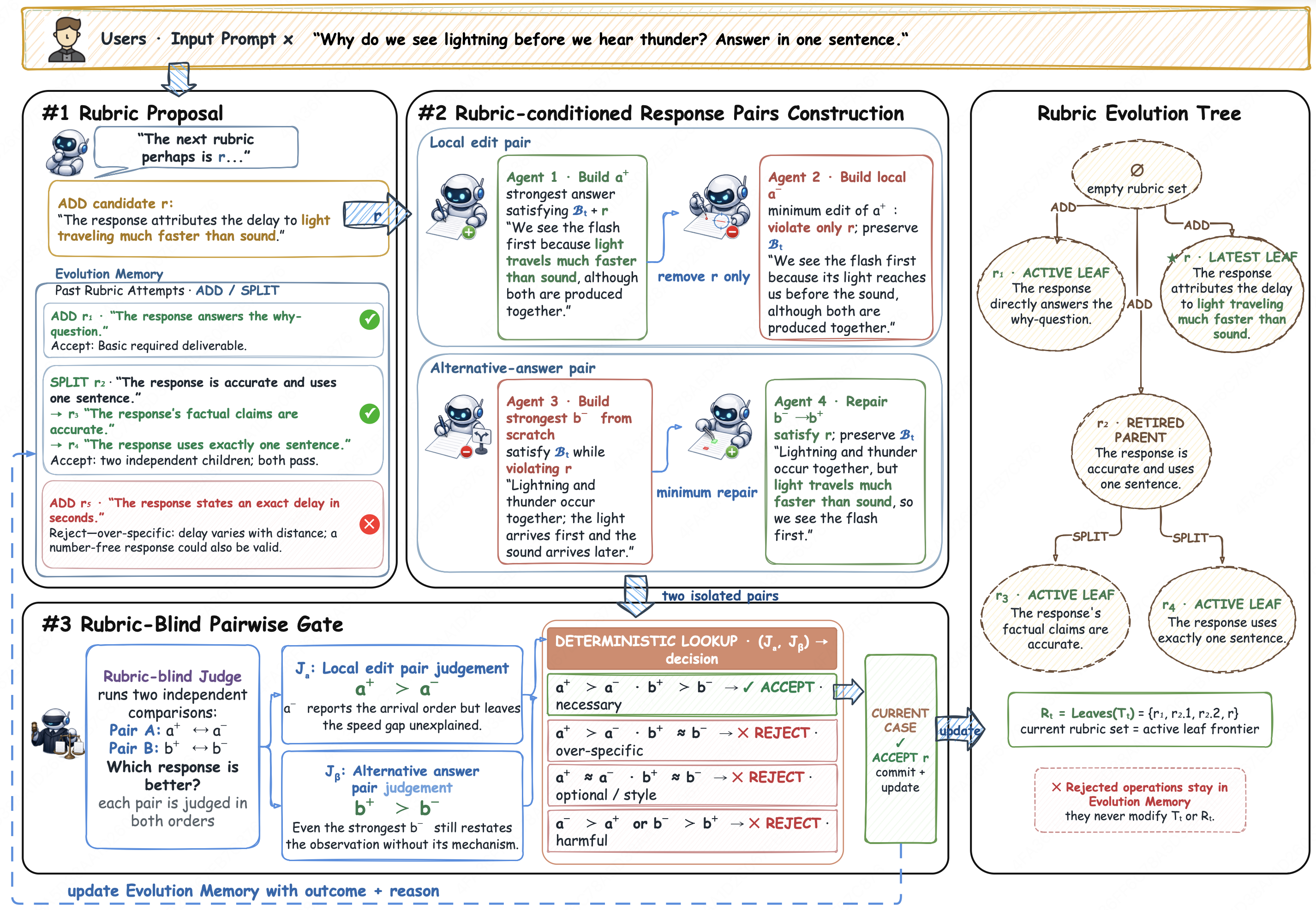
Fig 1: Overview of RUBRICS ON TRIAL. At evolution step t, a proposer suggests an ADD or
Limitations
- Evaluation focuses on preference pairwise accuracy and does not examine downstream effects on reinforcement learning or policy improvements.
- No systematic ablations or sensitivity analyses were performed to isolate the impact of components like the local pair, alternative-answer pair, or evolution memory.
- Relies on synthetic generated responses and LLM pairwise judgments; robustness to different LLM families, domains, and real human judgments remains untested.
- Dependence on proprietary large language models limits reproducibility and generalizability.
- Evolution budget and proposal heuristics could affect final rubric quality but are not fully explored.
- No direct adversarial testing against deliberately deceptive or corrupt rubrics.
Open questions / follow-ons
- How well do rubrics generated by RUBRICS ON TRIAL improve downstream reinforcement learning or policy fine-tuning performance in non-verifiable open-ended tasks?
- What is the sensitivity of the method to the evolution budget, LLM model scale, and decoding parameters for proposer and generator roles?
- How do different LLM architectures or families affect the reliability of synthetic pair constructions and rubric-blind judging?
- Can human evaluators validate or complement the rubric evolution process to further enhance rubric relevance and robustness?
Why it matters for bot defense
For bot-defense and CAPTCHA practitioners, RUBRICS ON TRIAL introduces a methodology to generate fine-grained, query-specific evaluation rubrics without reliance on expensive human annotations or existing datasets. This capability allows automated creation of discriminative quality criteria for complex tasks, which can improve the precision and interpretability of LLM-generated challenge-response evaluations often used in bot detection scenarios. The pairwise synthetic validation approach reduces spurious enforcement of superficial or stylistic criteria that could be exploited by adversarial bots. Applying such dynamic, tested rubric evolution can bolster robustness and alignment in challenge generation and scoring, mitigating reward hacking or circumvention attempts. However, deploying this framework requires reliable synthetic generation and comparison LLMs, as well as careful tuning of evolution budgets for practical cost and time constraints.
Cite
@article{arxiv2607_15092,
  title={ Rubrics on Trial: Evolving Rubrics from a Single Query via Synthetic Pairwise Evidence },
  author={ Haocheng Yang and Licheng Pan and Xiaoxi Li and Zhichao Chen and Zhiheng Zhang and Yuan Lu and Haoxuan Li and Hao Wang },
  journal={arXiv preprint arXiv:2607.15092},
  year={ 2026 },
  url={https://arxiv.org/abs/2607.15092}
}