
Explaining Process Control Optimisation Recommendations via GradientSHAP and Implicit Differentiation
Source: arXiv:2607.14970 · Published 2026-07-16 · By Paul Darm, Cem Alpturk, Kenneth Ulrich, William Duncan, Ali Anwar, Annalisa Riccardi
TL;DR
This paper addresses the challenge of explaining optimisation algorithm outputs used in industrial process control, specifically for High Pressure Grinding Roll (HPGR) operations. Operators often distrust automated parameter recommendations because of limited interpretability. The authors propose integrating the Implicit Function Theorem (IFT) for efficient sensitivity computation with GradientSHAP to generate SHAP attribution explanations for optimiser outputs. By leveraging IFT to compute exact gradients of the optimal parameters with respect to inputs (process feed properties and production targets), the method obtains SHAP attributions with vastly improved computational efficiency compared to KernelSHAP (over 40× speedup) while maintaining near-identical attributions (correlation >0.99). These attributions feed into a Large Language Model (GPT-5) to produce natural language explanations tailored for operators. The approach is evaluated on a 22-feature HPGR optimisation problem, showing strong empirical validation and positive qualitative feedback from domain experts on explanation clarity and utility. The work demonstrates a novel, practical pipeline to bridge the trust gap between optimisation engineers and process operators.
Key findings
- IFT-based computation of sensitivities ∂p*/∂x enables exact GradientSHAP attributions for optimisation outputs.
- GradientSHAP achieves >0.99 Pearson correlation with converged KernelSHAP (1000 samples) for both scalar and 20-dimensional array inputs.
- Sample efficiency: GradientSHAP requires only 2-3 integration samples to produce stable explanations, while KernelSHAP requires ~100 samples for stable results.
- Computational speed: GradientSHAP runs over 40× faster than KernelSHAP (e.g., 7.7s vs. 362.9s mean time) on the same HPGR problem.
- SHAP attribution profiles reveal mid-range particle size bins (7-10) of the feed PSD strongly influence pressure recommendations (±0.10 bar) more than speed (±0.2%).
- Qualitative expert feedback highlights that operator-friendly explanations should lead with a concise summary, use rounded units and percentages, and omit raw SHAP numerical values.
- The pipeline successfully generates actionable natural language explanations that explain parameter changes based on feed and target variations, as validated on industrial scenarios.
Threat model
n/a — The paper focuses on interpretability and explanation of optimisation recommendations rather than adversarial robustness or security. The adversary model is not addressed.
Methodology — deep read
Threat model and assumptions: The adversary is not explicitly defined, as the focus is on interpretability rather than robustness. The baseline assumption is that optimisation is unconstrained with solutions in the interior, enabling use of implicit differentiation. The process loss and model are assumed differentiable.
Data provenance: The industrial application is HPGR mineral processing control. Inputs are 20-dimensional particle size distribution features and scalar process targets (throughput, product fineness). Two operating points (baseline and instance) are compared for explanation. Confidential industrial data were used, but sizes are not explicitly stated.
Architecture/algorithm: The core component is applying the Implicit Function Theorem to differentiate through the first-order optimality conditions of the optimisation problem with loss L(p,x,t). The Hessian H = ∇²p L(p*,s) and mixed second derivatives ∂²L/(∂p∂s) (where s=[x,t]) are computed via automatic differentiation in JAX. This yields ∂p*/∂s = -H⁻¹ ∂²L/(∂p∂s).
These exact sensitivities enable GradientSHAP attribution calculation by integrating gradients along linear interpolation paths from baseline to instance (Eq 3). This replaces costly repeated optimisation solves in KernelSHAP.
Finally, SHAP attributions serve as inputs to an LLM (GPT-5), prompted with domain-specific context to generate natural language explanations summarising why optimal parameters changed.
Training regime: Not applicable; this is an optimisation plus explanation pipeline rather than a learned model. The optimisation loss uses physics-based population balance modelling implemented in JAX.
Evaluation protocol: Sample efficiency and stability of attributions compared between KernelSHAP and GradientSHAP. Correlations computed over 72 baseline-instance pairs. Timing and computational speed compared. Attribution profiles compared element-wise for array inputs. Qualitative expert feedback obtained from 3 domain specialists to assess explanation clarity and utility.
Reproducibility: Code is available by request due to industrial confidentiality. Key algorithms rely on JAX automatic differentiation and the known population balance model from cited prior work. Baselines include KernelSHAP and prior SHAP methods.
A concrete example is the scenario where the throughput target was lowered and feed PSD coarsened, leading to explained reductions in pressure and speed settings with quantifiable SHAP attributions converted into human-readable operator guidance highlighting the distinct effects of target and feed changes.
Technical innovations
- Application of Implicit Function Theorem to compute exact sensitivities ∂p*/∂s of optimiser outputs, enabling gradient-based attribution for optimisation rather than ML predictions.
- Integration of IFT-derived gradients with GradientSHAP to efficiently compute SHAP values for optimisation outputs with orders of magnitude speedup over KernelSHAP.
- Use of Large Language Models to translate numerical SHAP attributions into domain-specific, operator-friendly natural language explanations for optimised parameters.
- Demonstration of the full pipeline on a real-world industrial HPGR process control problem with interpretable explanations validated by domain experts.
Datasets
- HPGR mineral processing data — 22 feature inputs (20 PSD bins + 2 targets) — industrial proprietary data (size not disclosed)
Baselines vs proposed
- KernelSHAP (1000 samples): mean time = 362.9 s; GradientSHAP (2 samples): mean time = 7.7 s (47.1× speedup)
- GradientSHAP vs KernelSHAP: Pearson correlation > 0.99 on scalar and array inputs across 72 baseline-instance pairs
Figures from the paper
Figures are reproduced from the source paper for academic discussion. Original copyright: the paper authors. See arXiv:2607.14970.
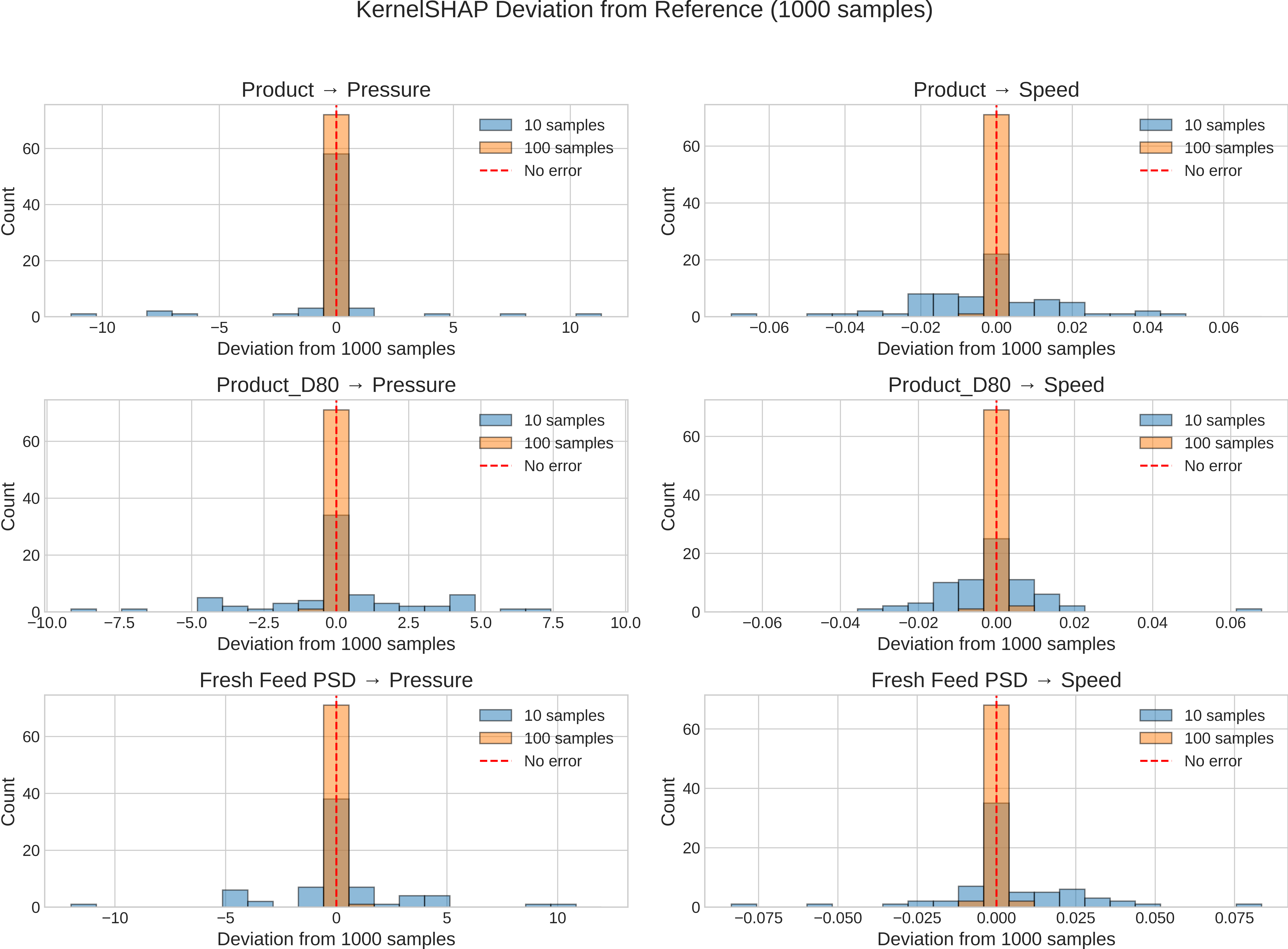
Fig 2: KernelSHAP convergence: deviation from 1000-sample reference. Blue: 10 samples (wide spread);
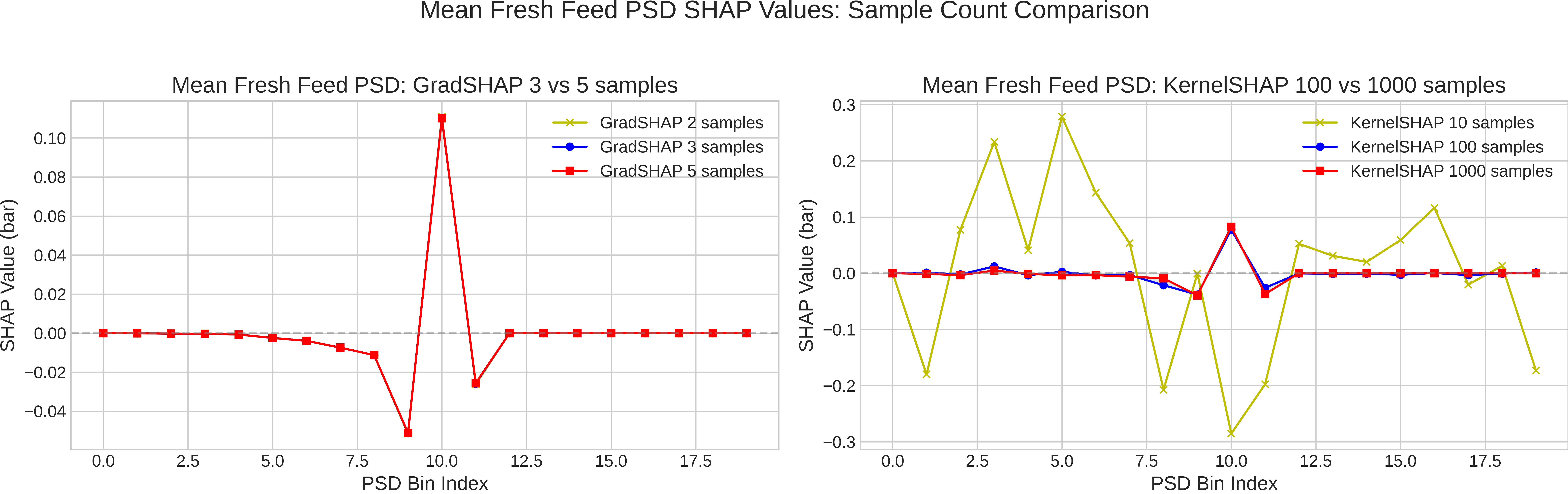
Fig 3: Sample count comparison for PSD SHAP values. Left: GradientSHAP shows rapid convergence with
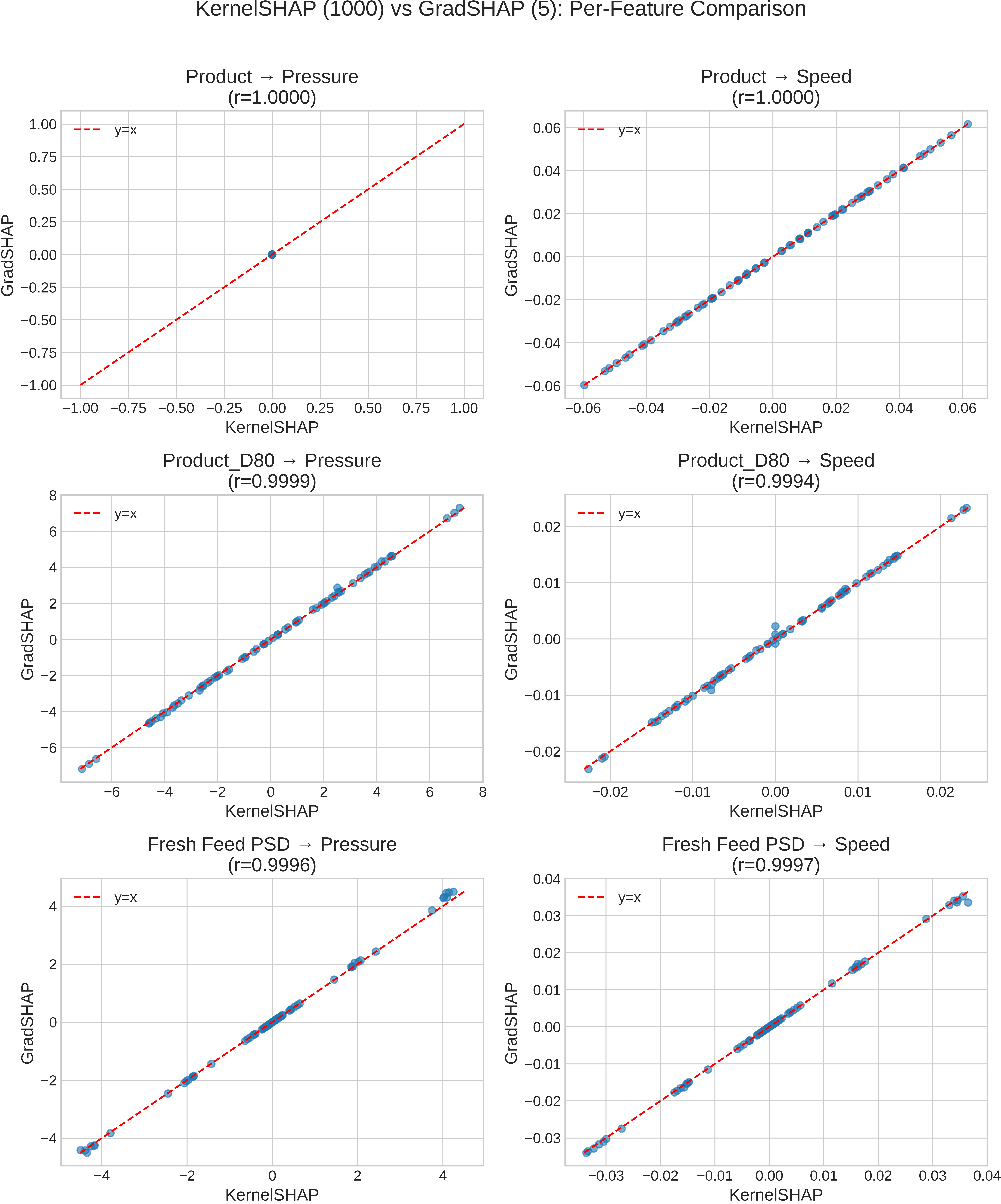
Fig 4: Correlation between converged KernelSHAP and GradientSHAP for scalar input features. Correlation
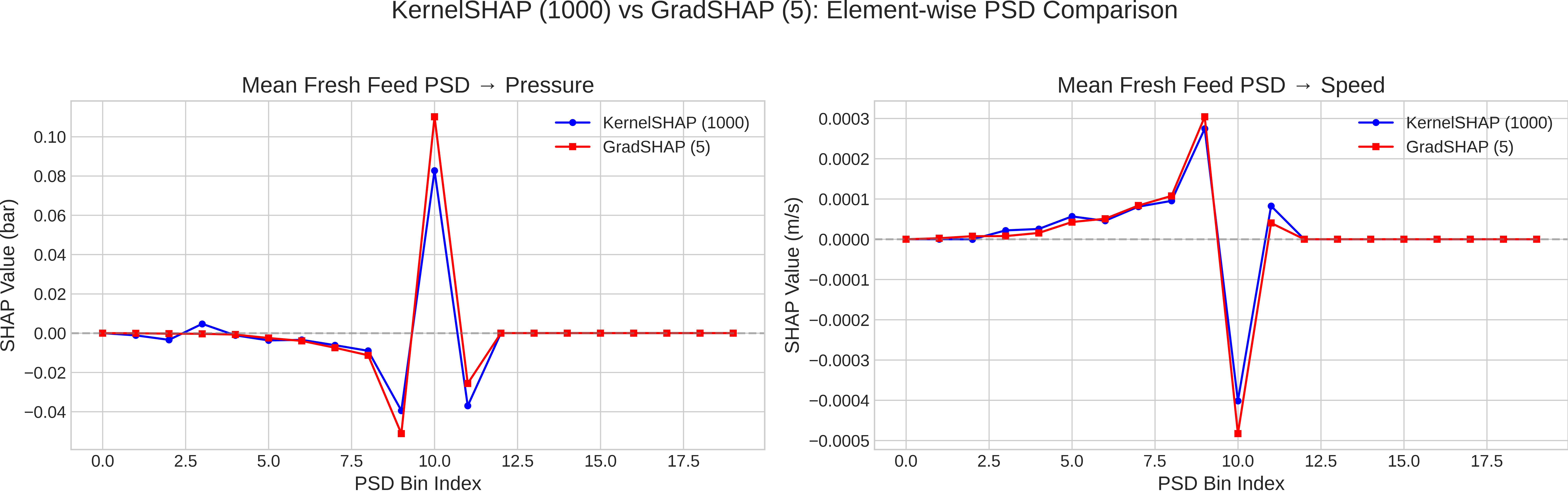
Fig 5: Mean element-wise SHAP values for fresh feed PSD, averaged over the dataset. Left: pressure output;
Limitations
- Method currently applies only to unconstrained optimisation problems with solutions lying in the interior of the feasible region.
- Extension to constrained optimisation with active-set changes (KKT conditions) is future work.
- Explanations are local, specific to baseline-instance pairs, limiting global interpretability.
- Requires differentiable loss and process models; non-differentiable or black-box optimisers are not supported.
- Limited quantitative user evaluation to date; only informal qualitative feedback from 3 domain experts.
- Code is not publicly released due to industrial confidentiality, limiting reproducibility.
Open questions / follow-ons
- How can the approach be generalized to handle constrained optimisation with active constraint set changes using differentiable KKT methods?
- What is the impact of distribution shifts or unseen input scenarios on the faithfulness and robustness of SHAP-based explanations?
- How effective are LLM-generated narratives in user comprehension and trust building in formal, controlled user studies?
- Can this method scale to higher-dimensional or more complex process control optimisation problems beyond 22 features?
Why it matters for bot defense
While this paper does not address bot defense or CAPTCHA directly, its contributions on efficiently explaining optimisation outputs via differentiable implicit sensitivity and GradientSHAP have relevance for bot-defense engineers interested in interpretable control algorithms. For CAPTCHAs or similar security-sensitive automated systems, understanding the reasons behind optimisation or classifier parameter adjustments is critical for trust and debugging. The use of implicit differentiation for sensitivity computation combined with SHAP allows generating faithful, computationally efficient explanations suitable for real-time operator feedback. Additionally, the pipeline integrating LLM-based natural language explanation generation could inspire transparent human-in-the-loop interfaces in security enforcement systems to better communicate risk or decision rationale. However, the current method assumes fully differentiable process models and unconstrained optimisation, which may limit direct applicability to many real-world bot defense mechanisms that are non-differentiable or adversarial. Nonetheless, the principle of combining implicit derivatives with attribution methods for transparent optimisation holds promise for future security and CAPTCHA-related interpretability frameworks.
Cite
@article{arxiv2607_14970,
  title={ Explaining Process Control Optimisation Recommendations via GradientSHAP and Implicit Differentiation },
  author={ Paul Darm and Cem Alpturk and Kenneth Ulrich and William Duncan and Ali Anwar and Annalisa Riccardi },
  journal={arXiv preprint arXiv:2607.14970},
  year={ 2026 },
  url={https://arxiv.org/abs/2607.14970}
}