
Enabling Cosmic Web Analysis at Gigaparsec Scales: A Multi Block Approach for DisPerSE
Source: arXiv:2607.14785 · Published 2026-07-16 · By Ankit Singh, Frazer Pearce, Meghan Gray, Gustavo Yepes
TL;DR
This paper addresses the major computational bottleneck in applying the widely used DisPerSE topological filament finder to large cosmological simulations containing tens of millions of halos. DisPerSE requires a global 3D Delaunay tessellation of the entire point set, which becomes infeasible for giga-parsec scale volumes due to enormous RAM demands (estimated 460-920 GB for 92 million halos in MDPL2). The authors propose a "frozen-core" multi-block approach that decomposes the full volume into overlapping spatial tiles with sufficient padding to preserve global topology. Each tile's Delaunay tessellation is filtered by a circumsphere radius criterion to keep only tetrahedra guaranteed valid in the global tessellation. Then the outputs are merged via core filtering, duplicate removal, and boundary stitching to reconstruct a consistent global filament network. Validation on a 300 Mpc/h MDPL2 subvolume shows excellent agreement with a monolithic DisPerSE run, recovering 99.6% of total filament length and 94.7% of individual filaments. The method enables topologically rigorous filament extraction from the full 1 Gpc/h MDPL2 box with 92 million halos, producing the first gigaparsec-scale cosmic web catalogue. Analysis of cluster connectivity over 3 decades in halo mass confirms theoretical power-law scaling. This method overcomes memory limitations that have so far prevented rigorous topological filament analysis at the largest cosmological scales, unlocking new science opportunities.
Key findings
- The frozen-core multi-block pipeline recovers 99.6% of total filament length compared to a monolithic DisPerSE run on a 300 Mpc/h MDPL2 subvolume.
- It achieves 100% recovery of density maxima and minima critical points and 94.7% matching of individual filaments; unmatched filaments tend to be short and low significance.
- A padding width of 60 Mpc/h, chosen to exceed the 99th percentile of tetrahedron circumradii, captures 99.33% of Delaunay tetrahedra ensuring topology preservation.
- Naive tiling without padding results in only ~20% recovery of filaments near tile boundaries, while 30 Mpc/h padding recovers 100%, validating the padding choice.
- Processing each padded tile requires ~10 GB RAM, making the pipeline scalable and embarrassingly parallel compared to requiring ~460-920 GB for the full volume.
- Application to the full (1 Gpc/h)^3 MDPL2 box with 92 million halos produces a giga-parsec scale filament catalogue for cosmic web mapping.
- The connectivity (κ) measured for 22,900 halos spanning M_200c = 10^12–10^15.5 h^-1 M⊙ follows a power-law mass–connectivity relation over three decades in mass, confirming theoretical predictions.
- MSE (Morse-Smale extraction) memory usage is reduced to within ~1% of the monolithic case by removing duplicate tetrahedra arising from tile overlaps.
Methodology — deep read
The authors begin from the MDPL2 halo catalogue at z=0, containing 127 million halos down to masses of 3×10^9 h^-1 M⊙. After applying a 20-particle mass cut, 92 million halos remain with a mean inter-halo spacing ~2.2 Mpc/h. These halo positions serve as input points for filament extraction.
The DisPerSE algorithm identifies cosmic filaments by constructing a 3D Delaunay tessellation of the input points, then estimating local density via the DTFE method from Voronoi cell volumes. A discrete gradient is computed on the simplicial complex to find critical points (minima, saddles, maxima) and trace filamentary arcs connecting them. Persistence pairs quantify feature significance, enabling thresholding to retain robust filaments.
The bottleneck is the memory-intensive global Delaunay tessellation and Morse-Smale complex extraction, requiring hundreds of GBs of RAM due to the large number of tetrahedra (~6 per point) and simplices (~26 per point).
To overcome this, the volume is split into cubic tiles of side length L_tile=100 Mpc/h, each padded by P=60 Mpc/h on all sides to form larger overlapping blocks. Padding is chosen based on the distribution of Delaunay tetrahedron circumradii to ensure that tetrahedra with circumspheres fully inside the padded volume are identical to those in the global tessellation (the "frozen core").
Within each padded block, the Delaunay tessellation is computed independently. A circumsphere filtering removes any tetrahedra whose circumspheres extend beyond the padded boundary, guaranteeing only globally valid elements are retained.
The outputs from all blocks are merged. Redundant tetrahedra from overlaps are removed by spatial deduplication. Boundary stitching heuristics connect broken filaments at tile edges to reconstruct continuous global filament networks.
The authors validate the method by comparing to a monolithic DisPerSE run on a 300 Mpc/h subvolume processed with 60 Mpc/h padding. Filaments are matched by centroid proximity. They measure filament length recovery, critical point recovery, and individual filament matching fraction under varying padding scenarios.
This tile-wise approach reduces peak RAM per compute node to less than ~10 GB, enabling distributed parallel processing. The Morse-Smale extraction step operates on the filtered merged complex, which is ~1% larger in tetrahedra than the monolithic case.
For scientific application, the method is run on the full 1 Gpc/h cube MDPL2 halo catalogue. Connectivity κ for clusters from The Three Hundred project and nearby halos is computed as a function of mass, verifying theoretical scaling relations.
Code used includes the "delaunay_3D" tool from the DisPerSE codebase. No new machine learning or neural network models are introduced. The study is fully empirical and algorithmic. The tile padding and filtering strategy is the key technical novelty.
Technical innovations
- Introduction of a frozen-core multi-block approach decomposing large volumes into overlapping tiles with padding to preserve global Delaunay tessellation topology.
- Use of a circumsphere radius filtering criterion to identify and retain only tetrahedra guaranteed to appear in the global tessellation within each padded tile.
- A three-stage post-processing pipeline performing core filtering, spatial deduplication, and boundary stitching to merge tiled outputs into a consistent global simplicial complex.
- Empirical determination of padding width based on the 99th percentile of tetrahedron circumradii balancing topology preservation against computational resource overhead.
Datasets
- MDPL2 halo catalogue — 127 million halos total at z=0, cut to 92 million halos with M_vir ≥ 3.0 × 10^10 h^-1 M_⊙ — publicly available via CosmoSim
- The Three Hundred project parent halos — 324 massive clusters within MDPL2 volume
Baselines vs proposed
- Monolithic DisPerSE run (full 300 Mpc/h cube): 100% reference
- Tiled frozen-core approach (300 Mpc/h cube with 60 Mpc/h padding): total filament length recovery = 99.6%, density maxima and minima recovery = 100%, filament matching fraction = 94.7%
- Tiled approach without padding near boundaries: filament recovery drops to ~20% within 5 Mpc/h of edges, demonstrating criticality of padding
- Memory usage for Delaunay tessellation: monolithic ~460–920 GB RAM vs tiled padded blocks ~10 GB RAM per block
- Post-merge simplicial complex size inflation reduced from 2.6× raw tile overlap to ~1% over monolithic size after filtering
Figures from the paper
Figures are reproduced from the source paper for academic discussion. Original copyright: the paper authors. See arXiv:2607.14785.
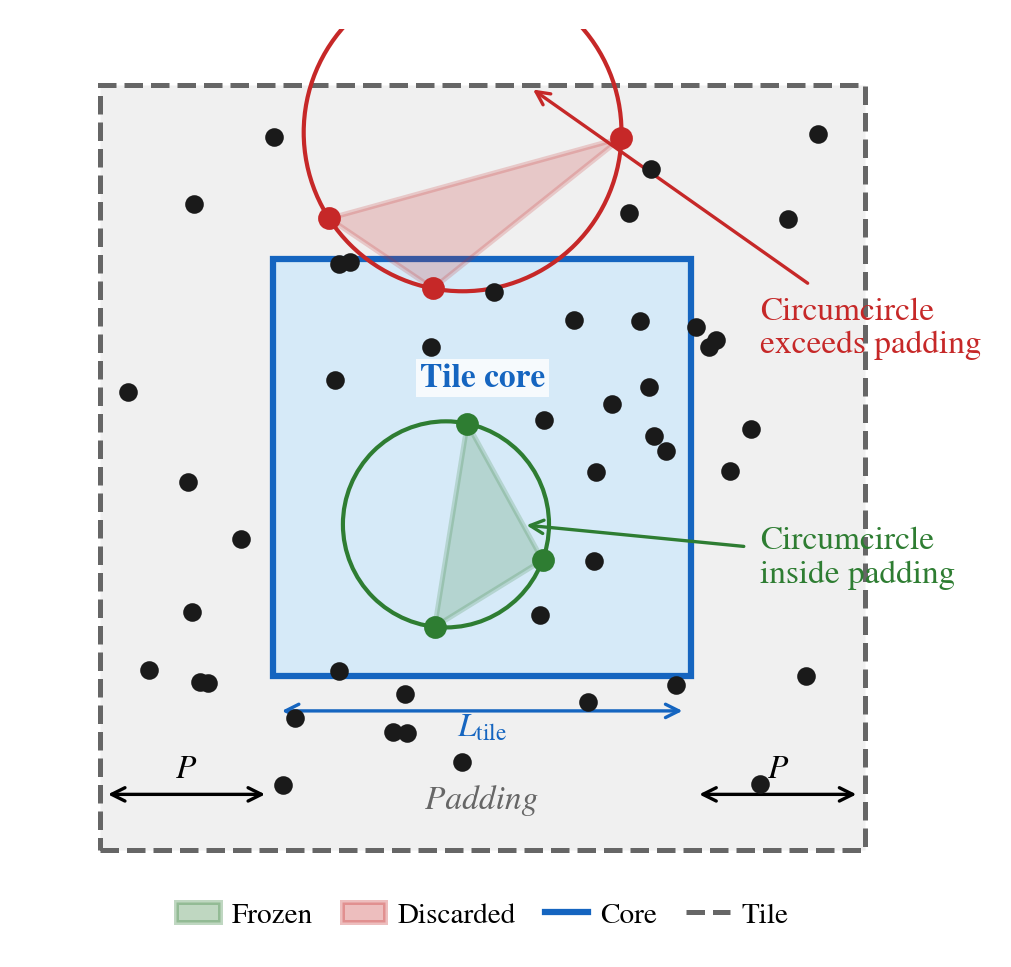
Fig 1: Schematic illustration of the frozen-core concept in 2D. The in-
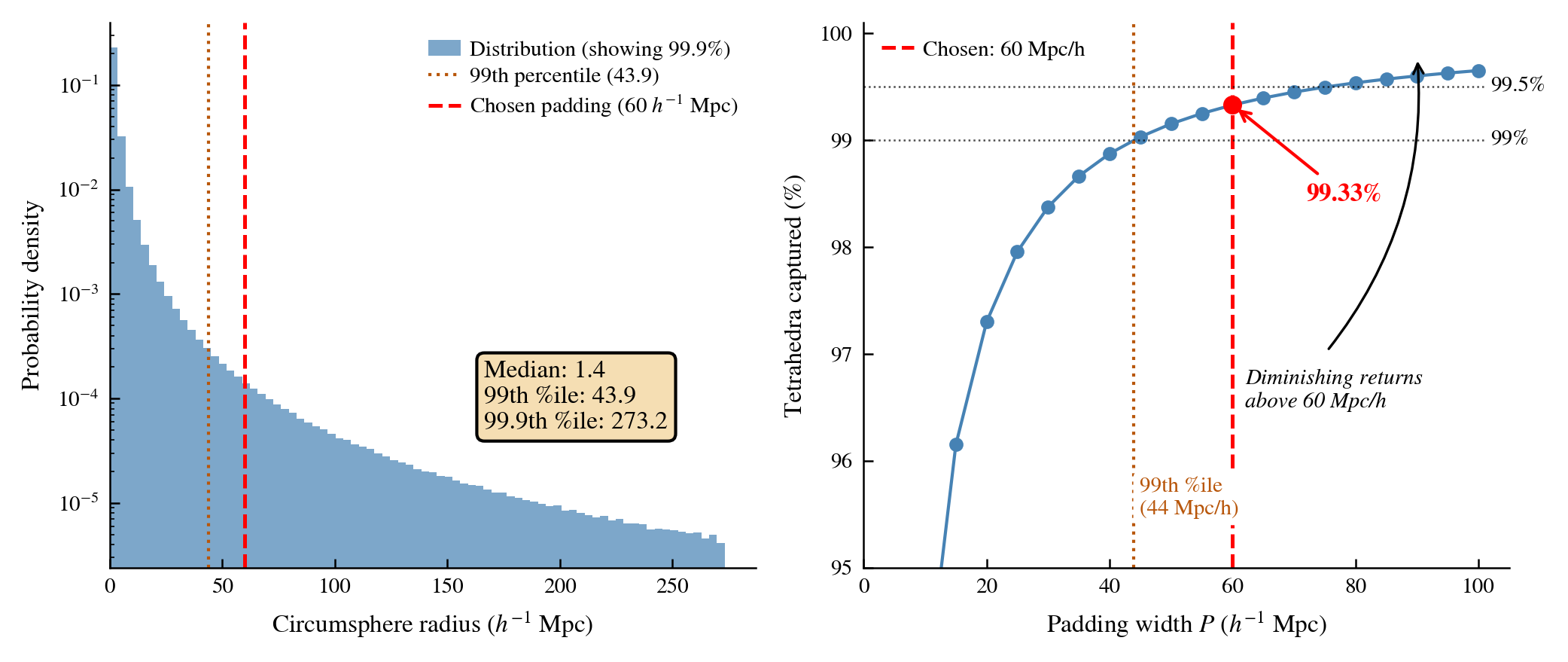
Fig 2: Circumsphere radius distribution and padding selection for Delaunay tetrahedra in the padded validation volume (300 Mpc h−1 MDPL2 sub-
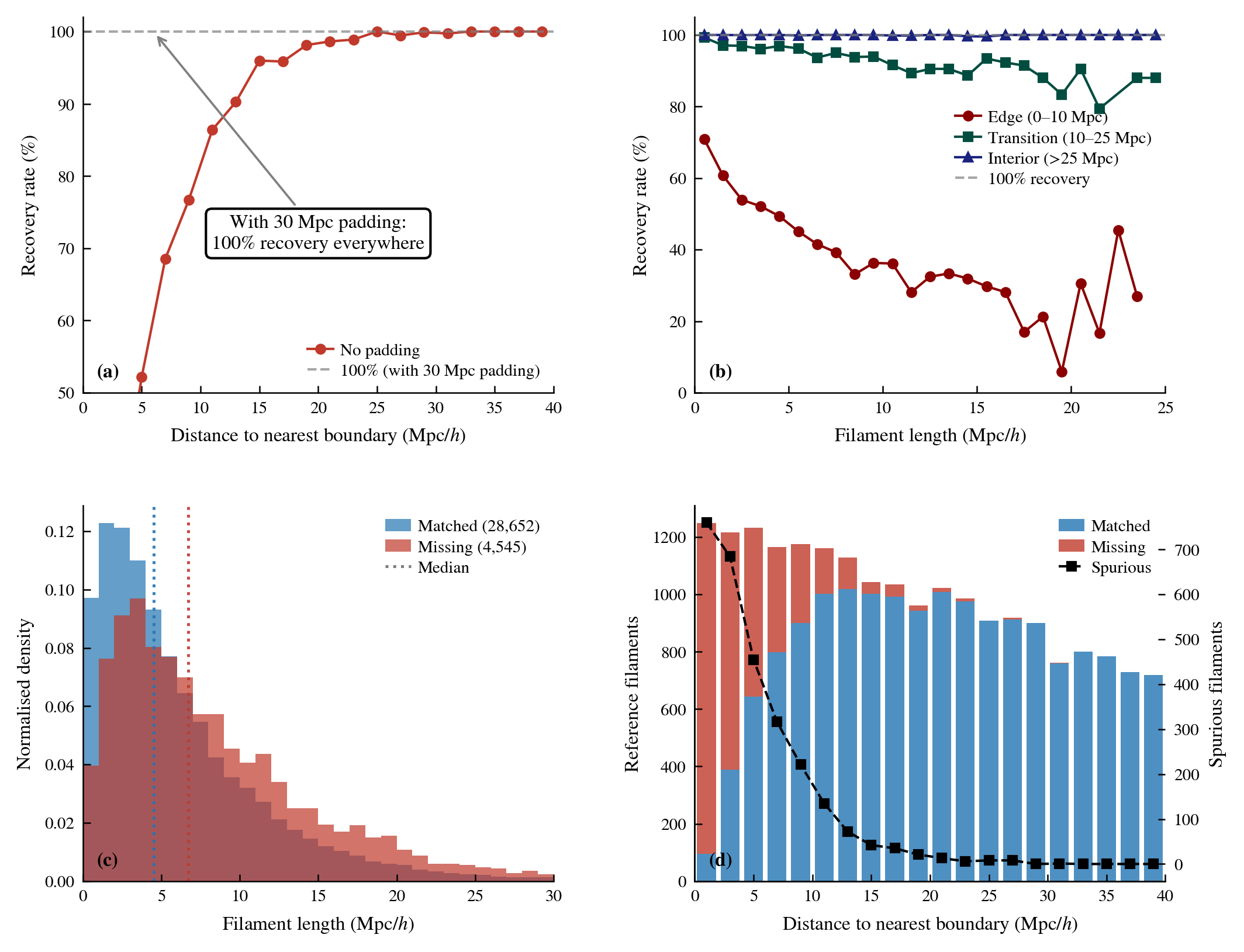
Fig 3: Boundary effects on filament detection in a 300 Mpc h−1 sub-volume without padding, compared to the fully-padded 60 Mpc h−1 reference, which
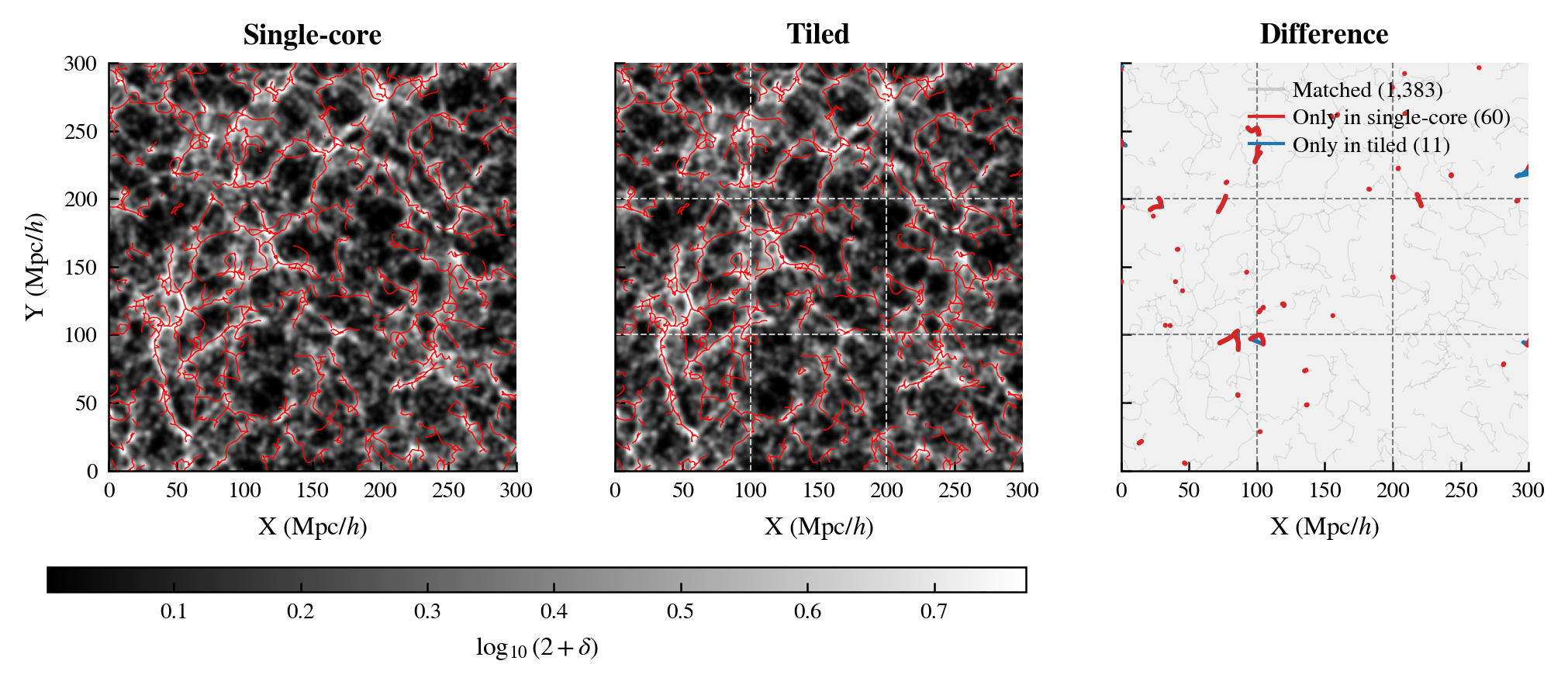
Fig 4: Visual comparison of filament detection between single-core reference and tiled approach (nσ = 7.0, smoothing = 8, 20-particle mass cut) in a
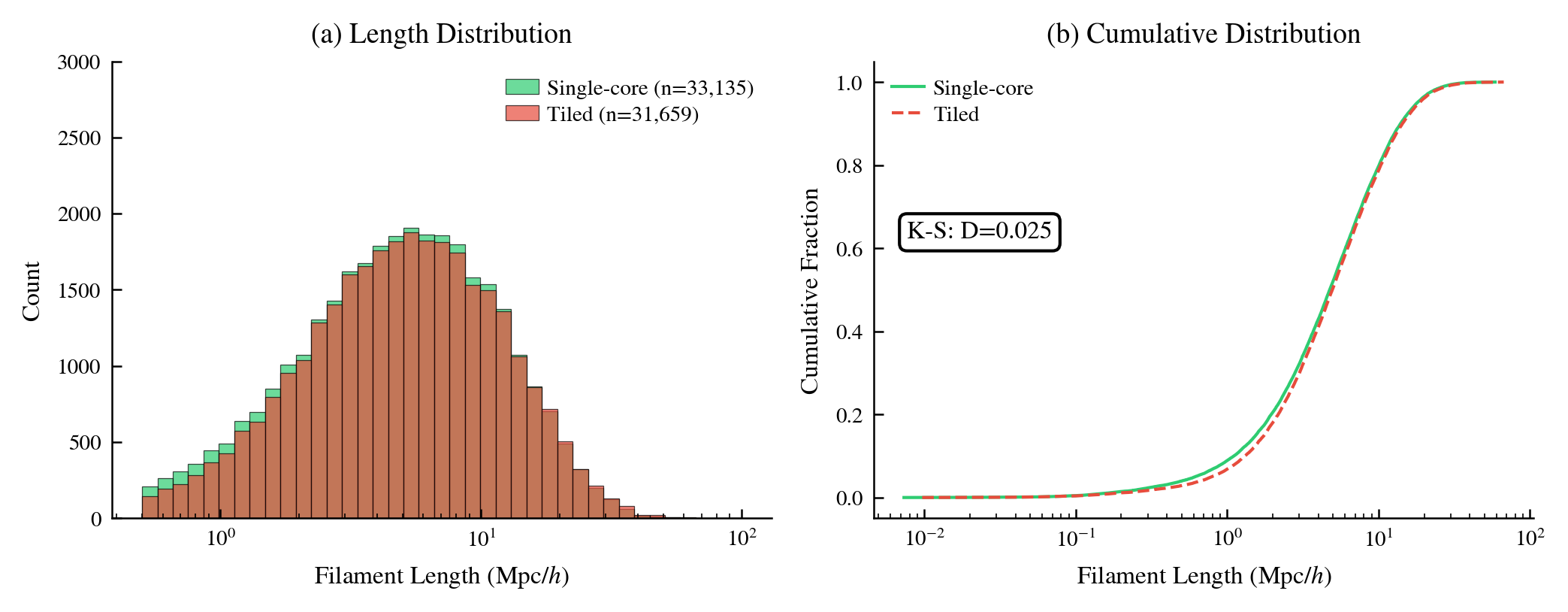
Fig 5: Filament length distribution comparison between single-core (green) and tiled (red) approaches (20-particle mass cut). Left: Histogram showing near-
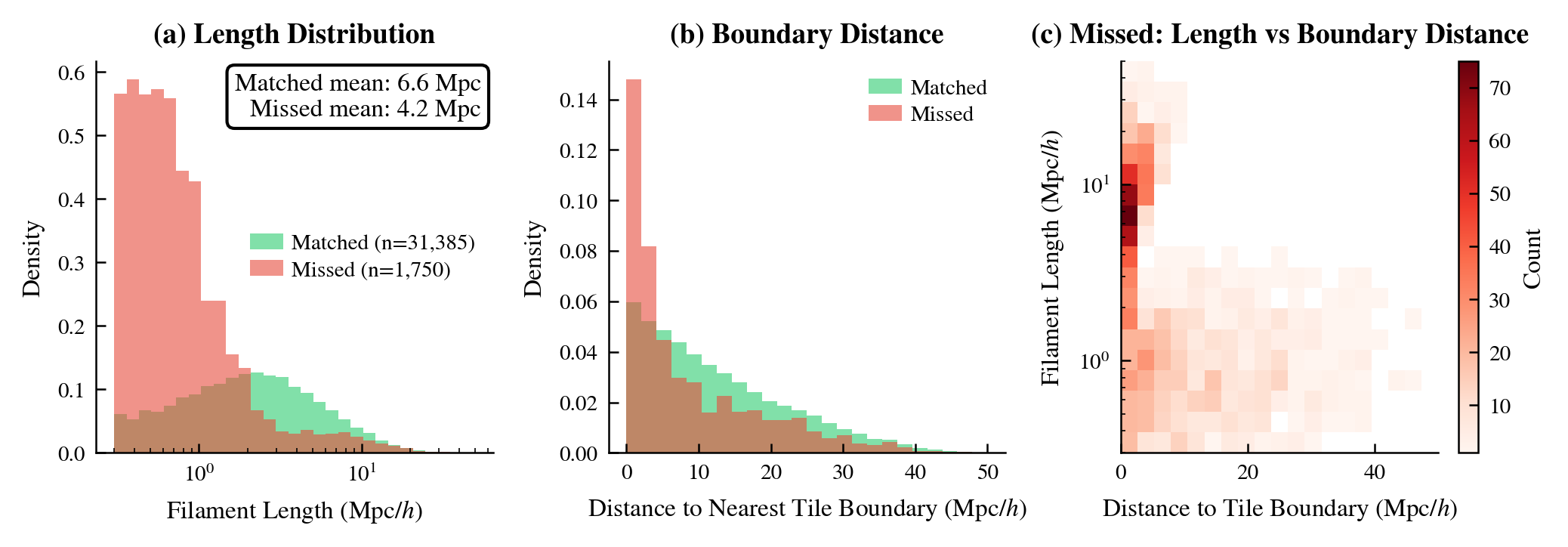
Fig 6: Unmatched filament analysis between single-core reference and tiled output (20-particle mass cut). Left: Length distribution of matched (green) vs.
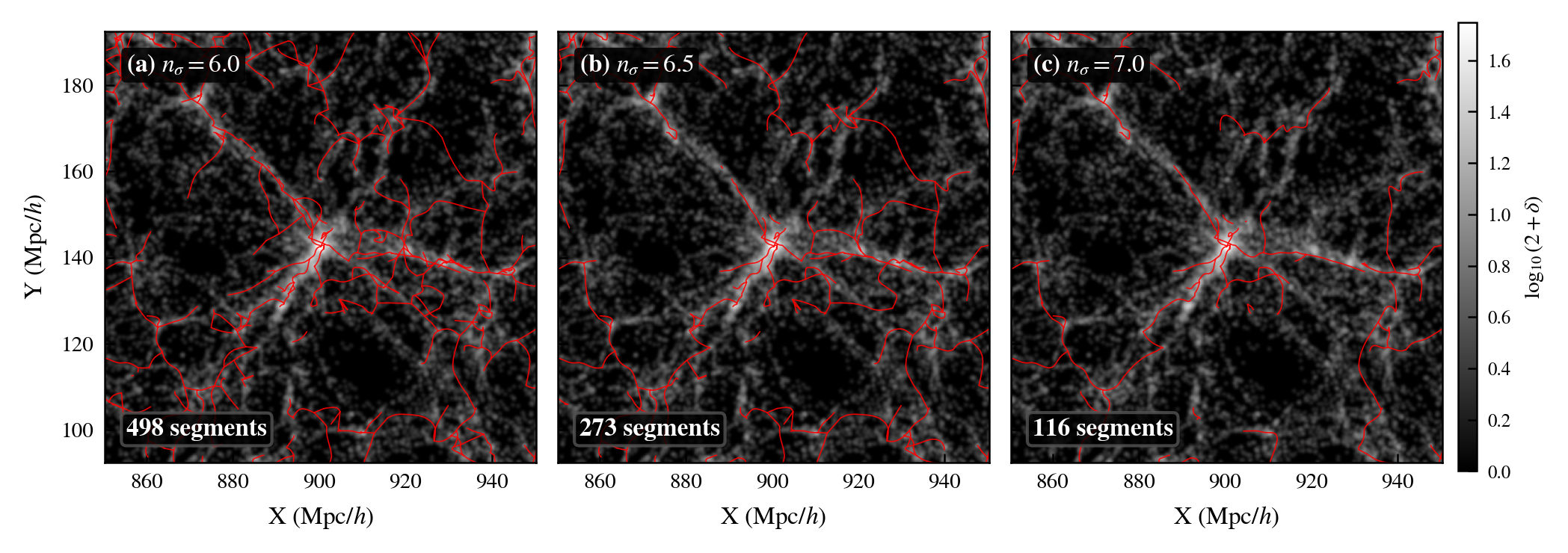
Fig 7: Overlay of the filament network at three persistence thresholds for cluster number 6 from The Three Hundred project (Cui et al. 2018, also shown
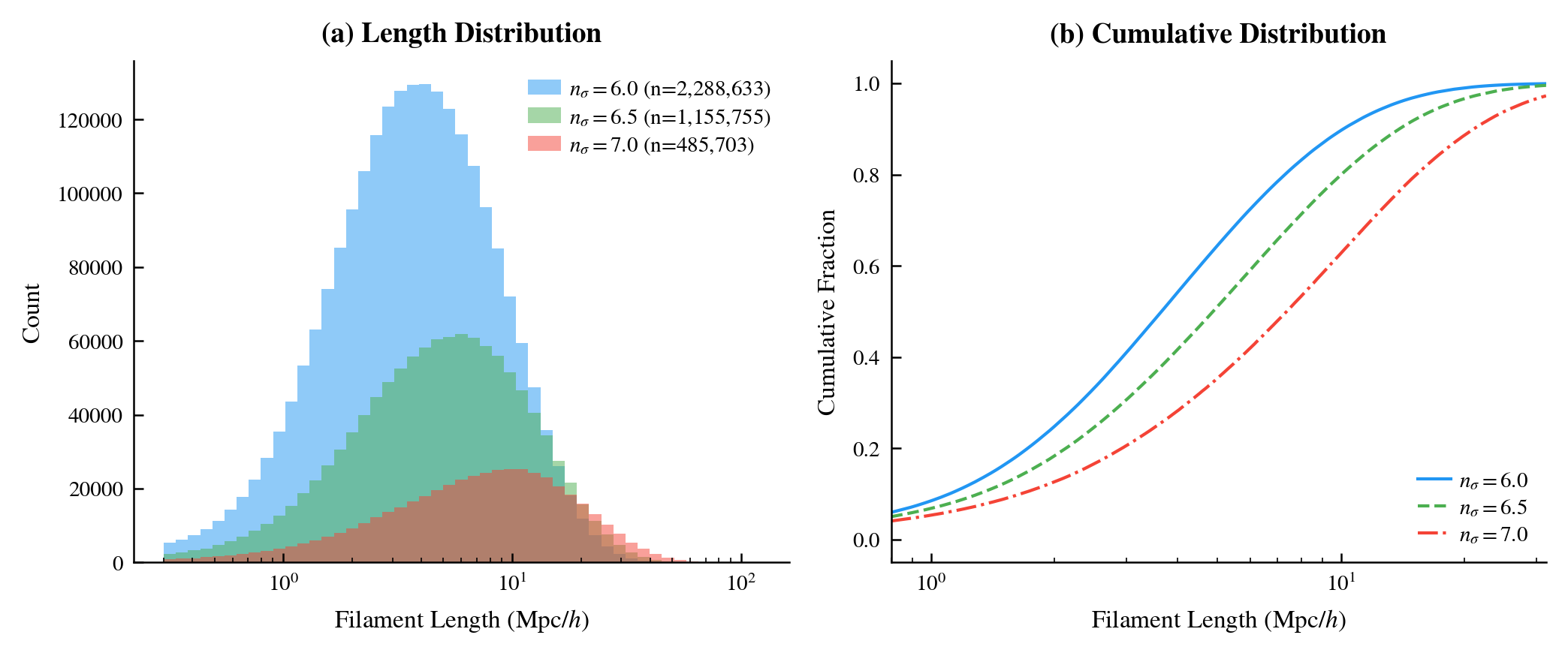
Fig 8: Filament length distributions for the three persistence thresholds. (a) Histogram showing the count distribution on a logarithmic length axis; the total
Limitations
- Validation focuses on one large subvolume (300 Mpc/h) and the full box; applicability to other simulations or observational datasets with different halo densities is untested.
- The method depends on carefully chosen padding tuned to the input tracer distribution; changes in tracer properties may require recalibration.
- Current DisPerSE implementation stages (Delaunay tessellation and Morse-Smale extraction) remain single-threaded, limiting scalability beyond embarrassingly parallel tiled runs.
- The method presumes static point sets; dynamic or time-evolving filament extraction was not addressed.
- No adversarial or uncertainty quantification analyses to probe robustness against noise or tracer incompleteness.
- Boundary stitching heuristics may miss subtle filament reconnection cases, affecting completeness of filament networks near tile edges.
Open questions / follow-ons
- How does the frozen-core approach perform on observational galaxy catalogues with survey masks and redshift-space distortions?
- Can the approach be extended or adapted to incorporate baryonic tracers or hydrodynamical simulation data with different spatial densities?
- Is it possible to accelerate the Morse–Smale extraction step via parallelization or approximate methods to further improve scalability?
- How sensitive are filament connectivity measurements to residual tiling artifacts or padding choices across different cosmological volumes and tracer populations?
Why it matters for bot defense
Although not directly related to bot detection or CAPTCHAs, the paper’s methodological innovations around decomposing large complex point clouds into tiled overlapping blocks with guarantees on topological consistency may inspire similar approaches in large-scale spatial data analyses in security contexts. For instance, bot detection tasks involving spatial-temporal clustering or graph-based analysis of user behavior might benefit from tiled graph construction preserving global connectivity. The careful empirical padding determination and duplicate removal pipelines offer a blueprint for stitching locally computed data into a consistent global structure without prohibitive memory usage. Practitioners building scalable defenses could adapt concepts here to efficiently analyze vast datasets with topological or geometric constraints, while minimizing edge effects and preserving global coherence. However, the domain and problem focus remain quite distinct.
Cite
@article{arxiv2607_14785,
  title={ Enabling Cosmic Web Analysis at Gigaparsec Scales: A Multi Block Approach for DisPerSE },
  author={ Ankit Singh and Frazer Pearce and Meghan Gray and Gustavo Yepes },
  journal={arXiv preprint arXiv:2607.14785},
  year={ 2026 },
  url={https://arxiv.org/abs/2607.14785}
}