
Infectious Disease Induces Emergent Oscillations, Extinction and Changes in Community Persistence in a Food Chain
Source: arXiv:2607.14360 · Published 2026-07-15 · By Hooman Saveh, Fakhteh Ghanbarnejad
TL;DR
This paper addresses the ecological consequences of infectious diseases within a simple three-species food chain consisting of prey, intermediate predators, and apex predators. It innovatively couples the classical generalized Lotka-Volterra model for food chain dynamics with a Susceptible-Infected-Recovered (SIR) epidemiological model applied to a single trophic level at a time. A novel parameter w encodes how infection alters trophic interactions by increasing infected individuals' vulnerability to predation and decreasing their hunting efficiency. The study finds that infection in predators leads to emergent sustained oscillations in populations and increases community persistence without causing predator extinction, a dynamic not observed in either classical SIR or Lotka-Volterra models alone. Conversely, infection in apex predators does not induce oscillations but can drive apex predator extinction in specific parameter regimes, thereby reducing overall community persistence. These results emphasize how the trophic position of the infected species modulates ecosystem dynamics and stability in distinct ways.
Key findings
- Introducing parameter w > 1 increases predation rate on infected individuals by factor w and reduces their hunting rate by 1/w, capturing infection's ecological effect.
- When predators are infected, predator extinction does not occur for any explored parameters, but sustained oscillations in predator populations emerge (Fig 2b, Fig 3b).
- Infection in apex predators leads to their possible extinction over a specific range of infection/recovery parameters without oscillations (Fig 4a,b).
- Community persistence of the ecosystem increases when predators are infected but decreases when apex predators are infected (Fig 5a,b).
- The infected predator population fails to infect the entire population at once, maintaining a constant infected-to-recovered ratio at equilibrium (Fig 3c).
- Third species (apex predator) population may undergo quasi-extinction (population dropping below a threshold) when predators are infected (Fig 3d).
- The oscillatory dynamics observed arise from the coupling of SIR and Lotka-Volterra dynamics and are absent when these models run independently.
- A phase transition in community persistence appears as the infection spreads, indicating disease-driven shifts in ecosystem stability.
Threat model
The adversary is an infectious disease pathogen capable of infecting one species at a trophic level (predator or apex predator) within a three-species food chain. The pathogen affects host individuals by increasing their vulnerability to predation and reducing their hunting efficiency but does not alter species interactions beyond these effects. The model assumes no multi-host infections, co-infections, or spatial spread beyond the fixed ecosystem. The pathogen cannot jump between species or alter the overall food web topology.
Methodology — deep read
Threat Model & Assumptions: The adversary here is conceptualized as an infectious disease infecting a single trophic level (either predators or apex predators) within a three-species food chain. It is assumed pathogens affect only one species at a time and have no direct spatial or multi-host transmission beyond this scope. The ecosystem is closed with fixed trophic structure and without immigration or emigration.
Data: The study is entirely simulation-based with no empirical dataset. Parameters are grounded in ecological literature values. The model uses baseline parameters for growth and interaction rates (e.g., d=0.12, c2=0.2, c3=0.27) and varied infection rates (β) and recovery rates (γ). Community persistence is estimated by sampling parameters from a Gaussian distribution (mean as baseline, standard deviation half the mean) for 1,000 iterations.
Architecture / Algorithm: The model integrates:
- Generalized Lotka-Volterra equations describing interaction dynamics among prey, predator, and apex predator.
- Classical SIR epidemiological model applied to a single trophic level (either predators or apex predators) splitting that species into susceptible, infected, and recovered compartments.
- A coupling parameter w modifies trophic interaction coefficients for infected individuals: predation on infected is multiplied by w, while their hunting success is divided by w. This alters interaction rates within the Lotka-Volterra terms to reflect infection-induced changes.
Training Regime: Not applicable as this is a dynamical systems simulation study, not a machine learning training setting. Numerical integration uses the fourth-order Runge-Kutta (RK4) method over time with fixed parameters.
Evaluation Protocol: Population dynamics are analyzed to identify steady states, oscillatory behavior, extinction events, and community persistence. Community persistence is quantified as the probability the ecosystem avoids extinction after infection introduction based on 1,000 stochastic parameter samples. Parameter sweeps over w and β/γ ratios examine system bifurcations and phase transitions. Results are presented graphically (e.g., Fig 2 through 5). The approach includes comparison of infected versus disease-free scenarios but no direct statistical tests or cross-validation.
Reproducibility: The paper does not explicitly mention releasing code or datasets, limiting reproducibility. The model is described in detail with full equations and parameters, enabling re-implementation.
Concrete example: When infection is introduced in the predator population with w=3.85 and β/γ=10, simulations show sustained oscillations in susceptible, infected, and recovered predator subpopulations (Fig 2b), a behavior absent when the epidemic or ecological models run alone. The infected predator subpopulation oscillates due to feedback between increased predation vulnerability and reduced hunting ability, impacting both predators and apex predators populations dynamically over time.
Technical innovations
- Integration of a classical SIR infectious disease model with a generalized Lotka-Volterra three-species food chain framework to study coupled epidemic-ecological dynamics.
- Introduction of a single infection parameter w that simultaneously modulates increased predation on infected individuals and decreased hunting efficacy, providing a unified ecological infection impact mechanism.
- Demonstration that infection in intermediate predators induces emergent population oscillations not predicted by either epidemic or ecological models in isolation.
- Identification that infection position within the trophic hierarchy (predator vs apex predator) fundamentally alters ecosystem outcomes including oscillations, extinction risk, and community persistence.
Baselines vs proposed
- Classical Lotka-Volterra model without infection: no population oscillations observed vs proposed coupled SIR-Lotka-Volterra with predator infection: sustained predator population oscillations appear.
- Disease-free food chain equilibrium vs infected predator scenario: predator extinction risk remains zero, but population dynamics shift to oscillatory regime.
- Infected apex predator scenario vs disease-free baseline: apex predator extinction occurs in a parameter-dependent manner, reducing community persistence.
Figures from the paper
Figures are reproduced from the source paper for academic discussion. Original copyright: the paper authors. See arXiv:2607.14360.
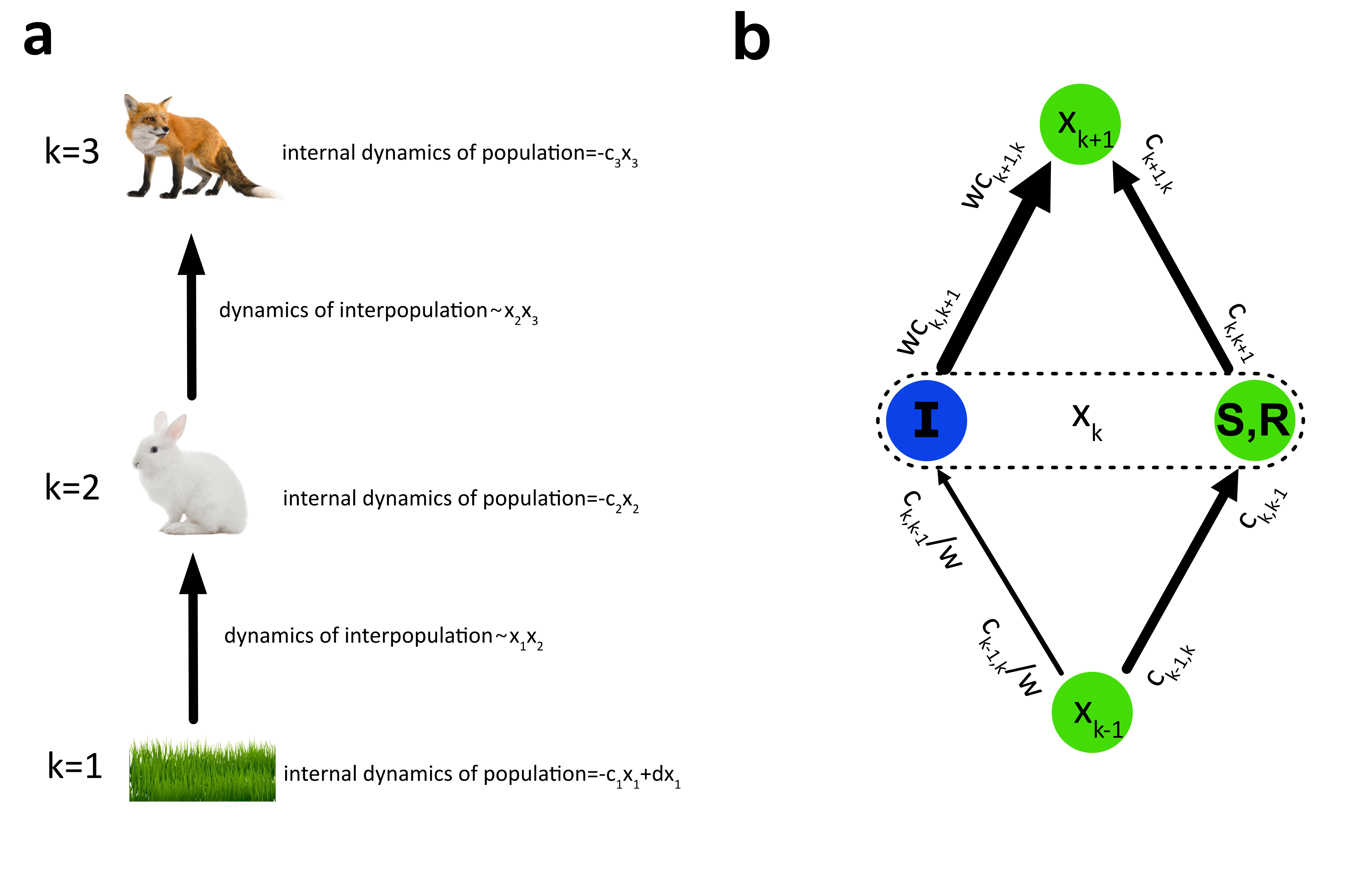
Fig 1: A schematic figure of the model. (a) indicates
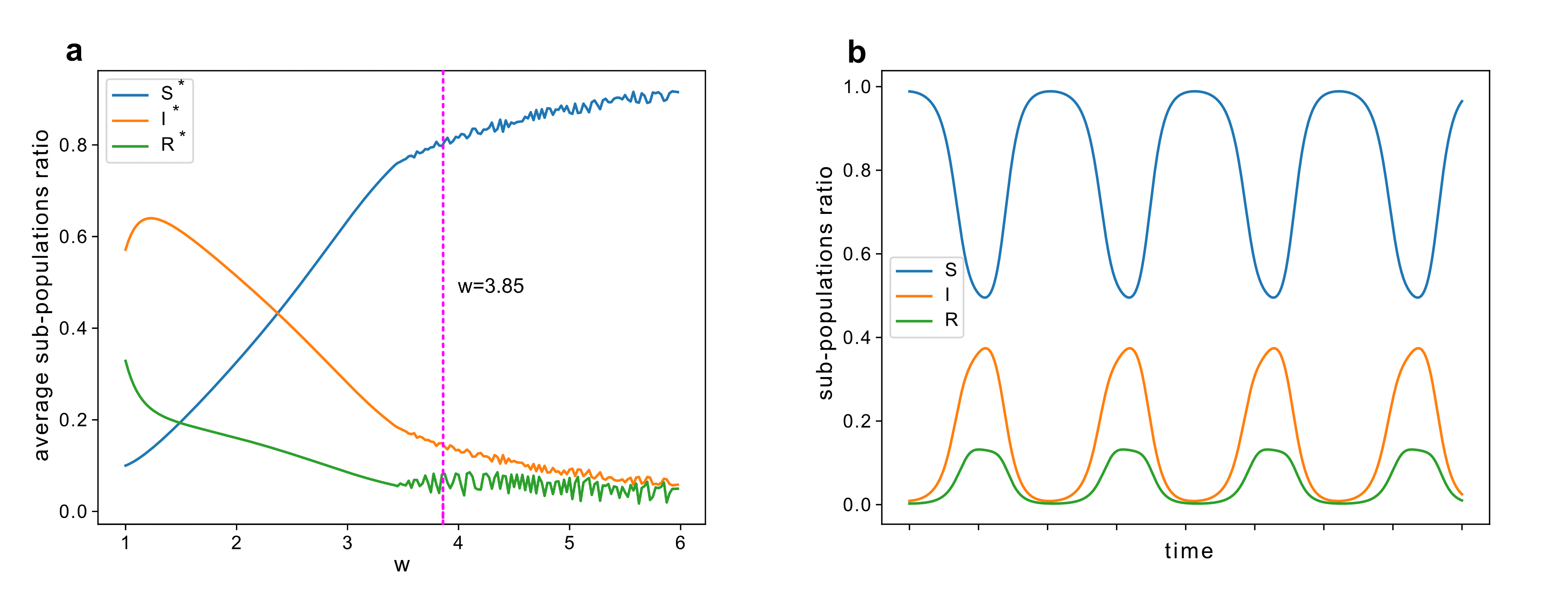
Fig 2: The subpopulations of the predator when infected. (a) shows the average ratio with respect to the overall
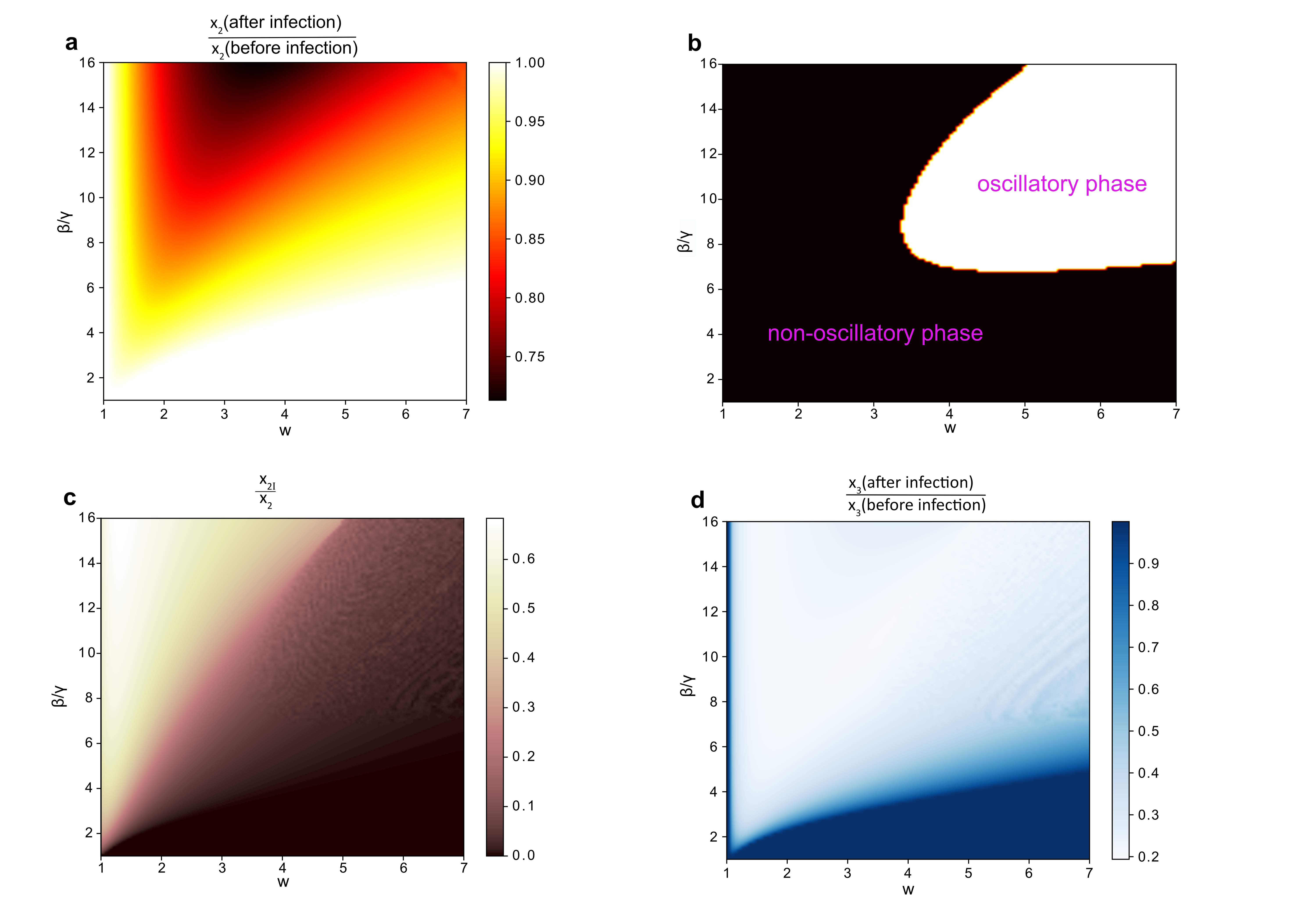
Fig 3: General behavior of SIR on predator. This panel depicts the influence of an infectious disease affecting the
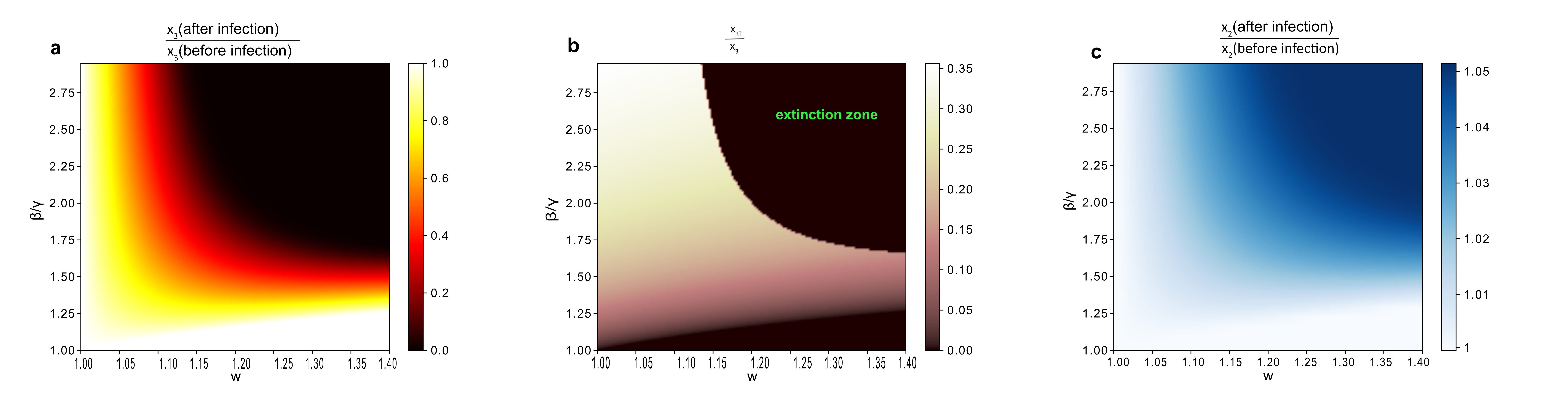
Fig 4: General behavior of SIR on apex predator. These panels depict the populations when the third species is
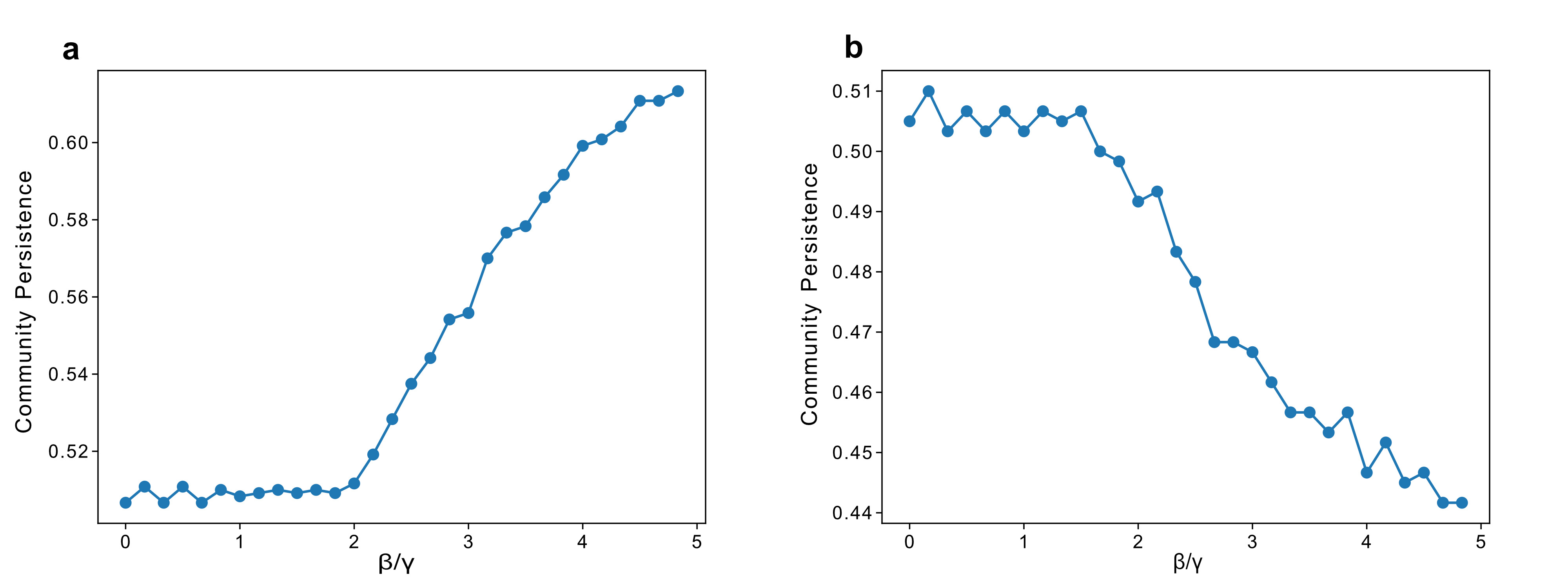
Fig 5: Community persistence change due to the disease. (a) Community persistence of the predator population
Limitations
- Model considers only a simplified, linear three-species food chain without alternative prey, omnivory, or complex food web structure.
- Pathogen infection applies only to a single trophic level at a time, excluding multi-host or co-infection dynamics.
- Infection effects represented by a single parameter w; real infections may affect multiple behavioral and physiological traits beyond predation/hunting efficiency.
- Spatial heterogeneity, seasonal effects, host movement, latency periods, and complex epidemiological mechanisms (e.g., waning immunity) are omitted.
- No empirical validation or direct comparison to ecological field data to parameterize or test model predictions.
- Reproducibility limited by no publicly available code or data releases.
Open questions / follow-ons
- How would including more complex food web structures with omnivory or multiple prey species affect infection-driven ecosystem dynamics?
- What are the effects of multi-host pathogens, latency periods, or repeated infections on coupled epidemic-ecological dynamics?
- How do spatial heterogeneity, seasonal forcing, and host movement impact the observed oscillations and extinction risks?
- Can these modeled infection-induced dynamics and persistence changes be empirically validated in natural ecosystems with documented infectious diseases?
Why it matters for bot defense
For bot-defense or CAPTCHA practitioners, the work provides a detailed example of coupling two complex dynamical systems (ecological and epidemiological) through a parsimonious parameter to capture emergent behaviors that neither system exhibits in isolation. This principle of modeling coupled dynamics with minimal but meaningful interactions may inspire analogies for detecting or anticipating complex bot behaviors that arise from the interaction of factors rather than simple independent features. The distinction between infection effects depending on trophic position analogously reminds system designers that vulnerabilities or attack impacts may differ fundamentally depending on the bot's role or level within the network or service hierarchy. However, direct application to bot defense is indirect since the paper is purely ecological. Still, the rigorous analysis of parameter-driven phase transitions, oscillations, and persistence could inform mathematical modeling and risk assessment in adversarial systems.
Cite
@article{arxiv2607_14360,
  title={ Infectious Disease Induces Emergent Oscillations, Extinction and Changes in Community Persistence in a Food Chain },
  author={ Hooman Saveh and Fakhteh Ghanbarnejad },
  journal={arXiv preprint arXiv:2607.14360},
  year={ 2026 },
  url={https://arxiv.org/abs/2607.14360}
}