
Cold Stream Penetration of Virial Shocks: Fragmentation, Coagulation, and Disruption in the Hot Circumgalactic Medium
Source: arXiv:2607.14090 · Published 2026-07-15 · By Zhiyuan Yao, Nir Mandelker, S. Peng Oh
TL;DR
This paper addresses the poorly understood physical processes that govern the penetration and evolution of cold gas streams through virial shocks in massive galactic halos, a key mechanism thought to fuel galaxy growth at high redshift. Using idealized three-dimensional hydrodynamic simulations, the authors explore how cylindrical cold streams with varying radii, Mach numbers, and initial pressure contrasts evolve as they enter a hot circumgalactic medium (CGM). They identify three distinct evolutionary regimes for the cold streams—coagulation, fragmentation, and disruption—as well as a borderline case where the stream core survives but detached fragments are disrupted.
The study shows that at modest pressure contrasts, stream survival is dictated primarily by the competition between velocity shear (triggering Kelvin–Helmholtz instabilities) and radiative cooling within turbulent mixing layers. Increasing the pressure contrast causes a transient dynamical response during pressure equilibration, which changes the cold gas mass and cold-hot interface area before settling into a shear-dominated state. At high pressure contrasts, the oblique shock evolves into a bow shock, and whether the stream survives depends on the ratio of post-shock cooling time to virial crossing time. Surviving streams follow a turbulent radiative entrainment model, increasing mass flux while approximately conserving momentum flux. They apply their results to galaxy formation scenarios and find that cold streams in massive halos at z>2 generally survive and may fragment into multiphase structures, while at z<0.5 stronger shocks and longer cooling suppress cold stream penetration.
Key findings
- Identification of three distinct cold stream evolutionary regimes—coagulation, fragmentation, and disruption—with a borderline regime separating them (Fig. 2).
- The critical stream survival radius dependent on cooling and shear is given by equation (1), scaling roughly as r_crit,surv ≃ 0.3 kpc × α × χ_f^{3/2} × M_s, demonstrating survival thresholds based on stream size and density contrast.
- Fragmentation critical radius (Eq. 2) scales as r_crit,frag ≃ 5 kpc × χ_f^{4} × ℓ_shatter, establishing size thresholds for cloudlet fragmentation to persist.
- Increasing pressure contrast transiently enhances or suppresses cold gas mass and cold-hot interface area during pressure equilibration before steady evolution sets in.
- At large pressure contrasts, the oblique shock steepens into a bow shock, and survival hinges on whether the post-shock cooling time is shorter than the virial crossing time.
- Post-equilibration evolution of surviving streams is well described by turbulent radiative entrainment: cold-gas mass flux increases, mean streamwise momentum flux conserved approximately.
- Simulation results show that at z>2 in massive halos, cold streams likely survive and fragment into multiphase structures; at z≲0.5, penetration is suppressed due to stronger shocks and longer cooling times.
- Morphological differences between regimes manifest as persistent clumps (fragmentation), rapid recombination onto the stream (coagulation), and full disruption into dispersed clouds (disruption).
Threat model
The adversary is the hot circumgalactic medium (CGM) gas exerting hydrodynamic instabilities (Kelvin–Helmholtz and Richtmyer–Meshkov) and strong pressure contrasts on the incoming cold streams, threatening to disrupt or fragment the cold gas before it can fuel the central galaxy. The cold streams must survive turbulent mixing and radiative cooling challenges while penetrating the virial shock region with non-negligible velocity shear and pressure jump. The adversary cannot create magnetic fields or cosmic ray pressure in this model, nor can it prevent radiative cooling, which mediates some instabilities.
Methodology — deep read
Threat model & assumptions: The problem is cast in the context of cold gas streams penetrating hot virial shocked halos. The adversary here is the ambient hot CGM exerting hydrodynamic instabilities (Kelvin–Helmholtz and Richtmyer–Meshkov) and pressure contrasts on the cold stream that threaten its survival and coherence. The model assumes idealized cylindrical streams under various initial density contrasts, Mach numbers, and pressure contrasts, with radiative cooling and a UV background included. Magnetic fields, self-gravity, and conduction are not included.
Data provenance & size: No observational data is used; rather, the study uses 3D hydrodynamic simulations with systematic parameter sweeps over stream radius (from 0.1 to >50 kpc), density contrast (χ_f=50, 100, 300), initial pressure contrasts (P=1–100), and stream Mach numbers (M_s=0.1–2). The final stream density is fixed at n_s,f=0.01 cm⁻³. Table 1 details over 20 simulation runs. Initial conditions are perturbed with shape and density perturbations mimicking realistic instabilities.
Architecture/algorithm: The simulations use RAMSES with adaptive mesh refinement concentrating resolution at the stream core (max cell size ~0.1 r_s,f). Radiative cooling and photoheating are included with metallicities Z_h=0.1 Z_☉ and Z_s=0.03 Z_☉. The stream is injected at an upstream boundary with time-varying radius perturbations to seed instabilities. The simulations evolve over two box crossing times to reach steady state. Clump finding and cold gas surface area quantification are done via PHEW and custom Python tools.
Training regime: Not applicable as these are simulations, not trained models, but the runs are evolved long enough (∼2 box crossing times) for a steady state of stream evolution to develop. The different parameter sets isolate the effects of varied r_s,f, P, and M_s while holding other parameters fixed to isolate causal factors.
Evaluation protocol: Outcomes are classified into regimes based on cold stream mass evolution, morphology, clump survival, and interface area. Key diagnostics include cold gas mass flux, velocity profiles, clump number and size distributions, and morphology projections. Evolutionary behavior is compared to theoretical survival and fragmentation criteria from analytical models (e.g., Eq. 1 and 2). Fig. 2 shows the parameter space division.
Reproducibility: Code used is RAMSES (public), with detailed description of physical modules and initial conditions. Simulation parameters and naming conventions are fully tabulated (Table 1). Some movie visualizations are available on a companion webpage. No publicly released frozen weights or datasets are relevant.
Example walkthrough: A fiducial run with r_s,f=1 kpc, χ_f=100, P=7, M_s=1 shows an inward propagating cylindrical shock compressing the cold stream until pressure equilibrium is restored at ~12 r_s,f downstream. A reflected shock triggers Richtmyer–Meshkov instability at the stream surface. Velocity shear excites Kelvin–Helmholtz instabilities limiting cloud fragmentation. The stream maintains a coherent cylindrical morphology with a radius ~6 r_s,f with cold gas mass approximately conserved after initial transient. This behavior matches theoretical borderline survival regime predictions.
Technical innovations
- Systematic exploration of cold stream evolution under combined effects of velocity shear and pressure contrast, identifying distinct regimes (coagulation, fragmentation, disruption).
- Introduction of a combined analytical framework linking critical stream radius for survival and fragmentation to Mach number, density contrast, and pressure contrast, validated by 3D hydro simulations.
- Demonstration that pressure contrast transiently modulates cold gas morphology during equilibration before settling into shear-driven turbulent radiative entrainment.
- Characterization of how oblique shocks steepen into bow shocks at high pressure contrasts, switching the survival criterion from shear to shock cooling timescale dominance.
Baselines vs proposed
- Comparison of cylindrical stream survival criterion (Eq. 1) vs spherical cloud criterion from Abruzzo et al. (2023) (Eq. 3), revealing cylindrical survival thresholds ~factor 2 smaller.
- Simulation results matched analytic predictions of critical stream radius for survival and fragmentation regimes, confirming theoretical framework validity.
- Varying Mach number at fixed density contrast and pressure contrast shows transition from coagulation to fragmentation to disruption consistent with survival and fragmentation criteria thresholds.
Figures from the paper
Figures are reproduced from the source paper for academic discussion. Original copyright: the paper authors. See arXiv:2607.14090.
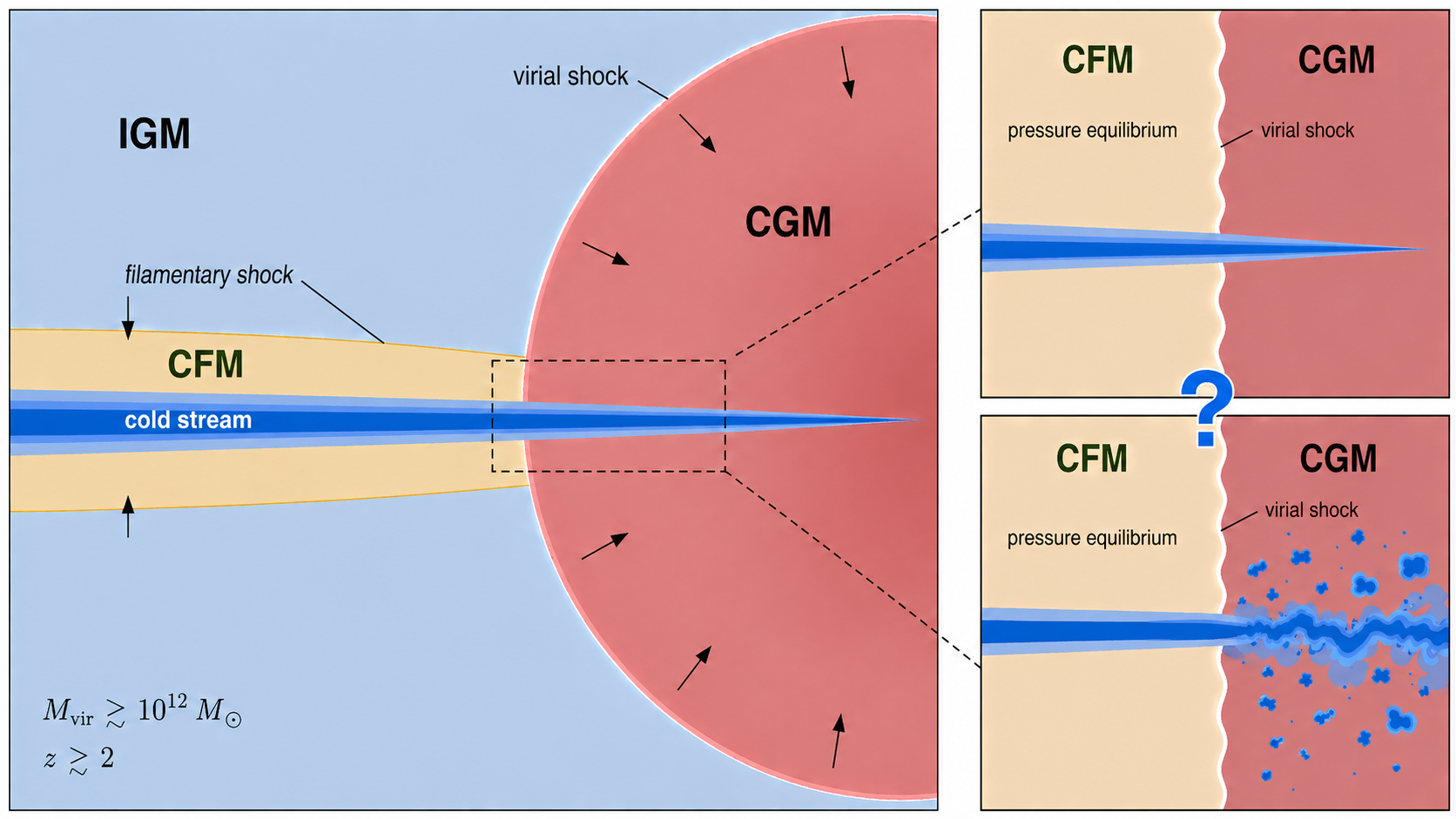
Fig 1: A schematic illustration highlighting the fate of cold gas as a cold stream penetrates the virial shock. In this example, radiative cooling allows the

Fig 2: Regimes of stream evolution in the CGM subject to shear and a

Fig 4: Similar to the number-density projection in Fig. 3, but shown here for the nine simulations highlighted in Fig. 2, spanning a range of 𝜒f and 𝑟s,f. All

Fig 5: Dynamical properties of cold-streams as a function of penetration depth in the hot background for simulations with varying final stream radii 𝑟s,f and

Fig 6: Morphological properties of cold-streams as a function of penetration depth in the hot background for simulations spanning a range of final stream

Fig 3: Projection and slice maps along the 𝑥-axis at 𝑡= 2 𝑡box for the fiducial run R1D100P7M1. From top to bottom, the panels show the hydrogen number

Fig 7 (page 8).

Fig 8 (page 8).
Limitations
- Simulations idealize the CGM as static, uniform hot medium, neglecting gravitational potentials and large-scale halo dynamics.
- Magnetic fields, cosmic rays, anisotropic conduction, and self-gravity are omitted, which may influence instability development or cloud survival.
- Resolution limits prevent study of smallest fragment scales below ~0.1 r_s,f and may artificially disrupt small clumps at large distances.
- Cooling function is fixed with metallicity assumptions; variations in metallicity or UV background might affect fragmentation or survival criteria.
- Simulations do not include feedback processes such as galactic winds or AGN, which can alter CGM conditions and stream evolution.
- Limited time evolution (~2 box crossing times) may miss longer term fragmentation-coagulation cycles or rare disruption events.
Open questions / follow-ons
- How do additional physical processes like magnetic fields, thermal conduction, and cosmic rays alter the survival and fragmentation regimes?
- What is the impact of a realistic, time-varying gravitational potential and large-scale halo dynamics on cold stream evolution?
- How does metallicity variation and UV background fluctuations influence the cooling-driven entrainment and fragmentation?
- Can observational signatures (e.g. absorption line profiles, emission morphology) distinguish between coagulation, fragmentation, and disruption regimes in real galaxy halos?
Why it matters for bot defense
While this paper does not address security or ML directly, its methodology and framing provide an example of systematically mapping complex parameter spaces to identify distinct regimes of system behavior, a strategy useful for bot-defense researchers studying multi-factor vulnerabilities or adaptive attack surfaces. The concept of competing mechanisms (shear vs cooling) determining survival versus disruption parallels balancing adversary capabilities and detection thresholds in security applications. The detailed simulation and analytical framework could inspire rigorous modeling of adaptive CAPTCHA robustness under multi-dimensional attack conditions. However, direct application requires careful domain translation.
Bot-defense engineers interested in physical modeling of system vulnerabilities might find conceptual insights in how transient phenomena (pressure equilibration) modulate long-term outcomes (stream survival or breakup). Similarly, approaches combining 3D simulation with stability criteria could be adapted to model user behavior or bot persistence in CAPTCHA challenge spaces, highlighting the importance of threshold parameters and interaction timescales.
Cite
@article{arxiv2607_14090,
  title={ Cold Stream Penetration of Virial Shocks: Fragmentation, Coagulation, and Disruption in the Hot Circumgalactic Medium },
  author={ Zhiyuan Yao and Nir Mandelker and S. Peng Oh },
  journal={arXiv preprint arXiv:2607.14090},
  year={ 2026 },
  url={https://arxiv.org/abs/2607.14090}
}