
Model Order Reduction of a Sliding Beam using a Global Basis: Formulation and Evaluation
Source: arXiv:2607.11794 · Published 2026-07-13 · By Sebastian Weyrer, Johannes Gerstmayr, Aki Mikkola, Grzegorz Orzechowski
TL;DR
This paper tackles the challenge of model order reduction (MOR) for sliding beams as found in telescopic structures, where effective beam length and boundary conditions continuously change. Classical MOR methods use fixed modal coordinates that fail to capture these evolving dynamics, while recomputing the modal basis online breaks coordinate consistency. The authors propose a global parametric model order reduction (PMOR) approach, constructing a global reduction basis from snapshots of modal matrices at different slider positions and compressing them via Proper Orthogonal Decomposition (POD). The method is integrated within a constraint multibody dynamics framework that algebraically enforces the sliding boundary condition, providing a fixed low-dimensional basis valid across the sliding range.
The approach is validated against a high-fidelity Absolute Nodal Coordinate Formulation (ANCF) benchmark on two test cases: a simple constant force with slider motion and a challenging sinusoidal frequency-varying force with slider movement. Results demonstrate that the proposed global reduction reduces computation time by about 90% compared to the full-order model, while maintaining root-mean-square displacement errors below 2%. A parameter study explores tradeoffs between number of snapshots, eigenmodes per snapshot, and final global modes. The work shows the promise of a snapshot-based global MOR strategy for efficiently simulating flexible multibody systems with evolving geometry and constraints.
Key findings
- Global reduction basis constructed from nsnap snapshots and rsnap eigenmodes per snapshot compressed to rglob modes via POD.
- The proposed global PMOR approach reduces computation time by ~90% relative to the full-order constrained Euler–Bernoulli (EB) beam model.
- Root-mean-square displacement errors introduced by global reduction remain below 2% in the challenging time-dependent loading and sliding test.
- ANCF benchmark with 20 elements and EB beam model with 50 elements show consistent absolute error convergence, validating the reduced model accuracy.
- Error maps of varying (nsnap, rsnap) reveal optimal snapshot and mode counts to achieve target accuracy within a 20 global mode budget.
- The constraint Jacobian in reduced space is dynamically updated every time step, preserving algebraic enforcement of the sliding boundary condition.
- The formulations maintain C1-continuous shape functions ensuring smooth interpolation of displacement fields as the slider moves between elements.
- Mass-normalization of embedded eigenmodes ensures physically meaningful modal coordinates across slider positions.
Methodology — deep read
- Threat Model & Assumptions: The problem concerns dynamic simulation of a planar flexible sliding beam (e.g., a telescopic boom) whose effective length and boundary conditions change continuously as a slider moves along it. The beam is modeled as an Euler–Bernoulli (EB) beam with fixed nodes and degrees of freedom (2 translational + 1 rotational DOF per node). The sliding boundary condition changes the connectivity dynamically, posing challenges to classical modal reduction which assumes fixed topology.
The objective is to reduce model order consistently across slider positions, maintaining physically interpretable modal coordinates. No active adversary is considered since this is a computational modeling study.
- Data: Provenance, Size, Labels, Splits, Preprocessing: Snapshots are collected as modal matrices Ψi computed by solving eigenproblems for constrained inner DOFs at specific slider positions. Parameters include number of snapshots nsnap and number of eigenmodes per snapshot rsnap. The snapshots embed these modal matrices into the full coordinate space with constrained DOFs zeroed and mass-normalized.
These snapshots form a "pool" matrix Ψall of size (nDOF × (nsnap × rsnap)).
- Architecture / Algorithm:
- Compute modal matrices Ψi at discretized slider positions defined by node indices I to cover the slider range.
- Each Ψi is generated by removing constraints from system matrices, solving an eigenvalue problem, embedding and mass-normalizing modes.
- Stack all Ψi snapshots into Ψall to form a data matrix.
- Apply Proper Orthogonal Decomposition (singular value decomposition) on Ψall.
- Select the first rglob left-singular vectors to form the global reduction basis Ψglob.
- Use Ψglob to map full coordinates q to reduced coordinates p: q = Ψglob p.
- The constrained multibody system is written as DAEs with mass matrix M, stiffness matrix K, binding constraint vector g, and constraint Jacobian Cq(s(t)) depending on slider position.
- Project system matrices onto the reduced subspace: Mred = Ψglob^T M Ψglob; Kred = Ψglob^T K Ψglob.
- Project constraint Jacobian and force vectors accordingly.
- The reduced DAEs are integrated over time using a generalized-α solver.
- Modal displacements p(t) transformed back to q(t) for physical interpretation.
Training Regime: Not a learning-based method; computations rely on numerical eigenvalue solves and SVD with numpy/scipy. Eigenproblems solved with dense solver for reproducibility. No mention of random seeds; deterministic numerical linear algebra.
Evaluation Protocol: Benchmarked against a nonlinear ANCF beam formulation with sliding joint from Exudyn simulation software. Two test cases analyzed:
- Simple test: slider moves from L/4 to 3L/4 with constant tip force.
- Evolved test: slider moves back and forth with sinusoidal chirp force between 1 and 10 Hz. Metrics include normalized root-mean-square (RMS) displacement errors and absolute errors. Parameters (nsnap, rsnap, rglob) varied to generate error maps. Computational speedups and displacement errors reported.
- Reproducibility: Python-based implementation available (details in data availability statement). Exudyn 1.10 used for simulations. Benchmark ANCF and reduced EB models implemented within the same framework allowing fair comparison. Full numerical parameters and discretizations clearly listed in Table 1.
Concrete Example: For nsnap=5, rsnap=3, 15 snapshots of modal matrices covering slider range are computed; these are stacked and POD gives a global basis of rglob = 20 modes. The reduced system is simulated for the evolved test case with time-dependent chirp loading and continuous slider movement. Displacement traces compared against full ANCF solution yield normalized RMS errors < 2%, with 90% reduction in solve time.
Technical innovations
- Formulation of a snapshot-based global reduction basis for sliding beams that remains fixed across continuously changing slider positions.
- Integration of global parametric model order reduction into a constraint multibody dynamics framework with algebraic enforcement of sliding boundary conditions.
- Use of Proper Orthogonal Decomposition (POD) on stacked modal matrices to compress position-dependent modes into a low-dimensional global basis.
- Demonstration that global MOR preserves physical modal coordinate meanings unlike local interpolation-based PMOR methods whose modes change semantics.
Baselines vs proposed
- ANCF benchmark model: normalized RMS displacement error baseline; used as ground truth reference.
- Non-reduced Euler–Bernoulli (EB) approach: RMS displacement error near zero but 10x higher computation time vs. proposed global reduction.
- Proposed global reduced EB approach: ~90% reduction in computation time relative to full EB while RMS displacement error remains below 2% in evolved test case.
Figures from the paper
Figures are reproduced from the source paper for academic discussion. Original copyright: the paper authors. See arXiv:2607.11794.
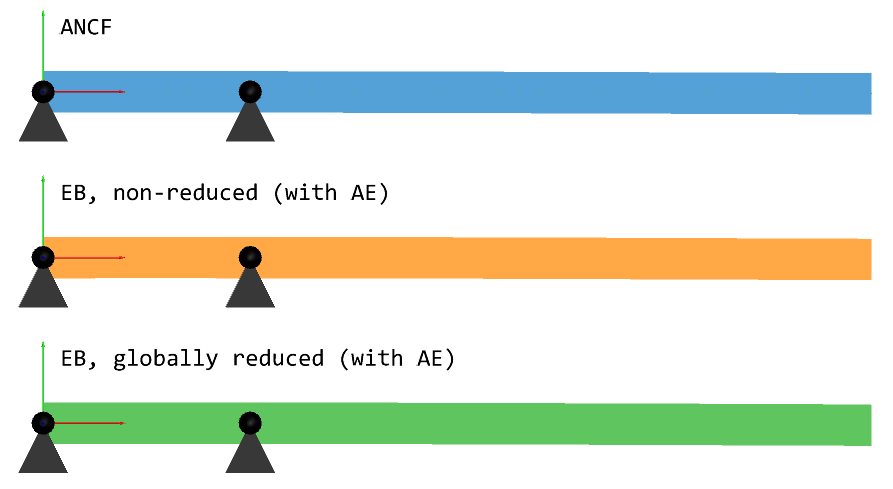
Fig 5: Simulation frame of Exudyn’s renderer showing the experimental setup with three ap-

Fig 10: Normalized RMS error of the transverse beam displacement shown for different combi-
Limitations
- Study limited to planar Euler–Bernoulli beam model neglecting shear deformation and rotary inertia; may not generalize to thick beams or 3D structures.
- Slider modeled as holonomic constraint with algebraic enforcement, no friction or wear effects considered.
- No explicit adversarial robustness testing or perturbation analysis on noise or measurement uncertainty.
- The reduced model’s accuracy depends on proper selection of snapshot count, modes per snapshot, and global modes; no automated parameter selection.
- Evaluation focuses on two dynamic test cases; broader loading scenarios or real-world experimental validation not included.
Open questions / follow-ons
- How can the approach be extended to 3D beams and structures with more complex sliding or telescoping kinematics?
- Can frictional effects or nonlinear joint behaviors be incorporated into the global reduced model within the constraint formalism?
- What automated or adaptive sampling strategies for snapshot selection optimally trade off accuracy and computational cost?
- How does the method perform under model uncertainties, parameter variations, or noisy inputs common in real-time control?
Why it matters for bot defense
Although this work is focused on efficient dynamic simulation of sliding beams in mechanical systems, its principles offer insights for bot-defense practitioners concerned with parametric variability and dimensionality reduction. The idea of constructing a globally valid low-dimensional basis from snapshots sampled across varying system conditions can inspire approaches for user behavior modeling or anomaly detection where input distributions shift continuously. The snapshot and POD approach preserves consistent coordinate semantics across parameter changes, potentially relevant for tracking evolving bot characteristics without losing interpretability. However, the application domain is more mechanical simulation than CAPTCHA or bot interaction dynamics. Practitioners might consider whether such stable global embeddings could represent bot features but would need to adapt the formalism to discrete-time data and complex user action spaces. In terms of model evaluation, the layered approach of benchmarking against high-fidelity ground truth and detailed error mapping provides a rigorous template for validating reduced-order defenses in security systems.
Cite
@article{arxiv2607_11794,
  title={ Model Order Reduction of a Sliding Beam using a Global Basis: Formulation and Evaluation },
  author={ Sebastian Weyrer and Johannes Gerstmayr and Aki Mikkola and Grzegorz Orzechowski },
  journal={arXiv preprint arXiv:2607.11794},
  year={ 2026 },
  url={https://arxiv.org/abs/2607.11794}
}