
Metacognition in LLMs: Foundations, Progress, and Opportunities
Source: arXiv:2607.11881 · Published 2026-07-13 · By Gabrielle Kaili-May Liu, Areeb Gani, Jacqueline Lu, Jordan Thomas, Mark Steyvers, Arman Cohan
TL;DR
This paper provides the first comprehensive and systematic survey of metacognition in large language models (LLMs), a critical yet underexplored capability that involves monitoring and regulating one’s own cognitive processes. Although LLMs have seen remarkable advances across many domains, their ability to exhibit genuine metacognitive behaviors—such as accurate self-assessment, uncertainty calibration, strategy selection, and self-improvement—remains unclear and fragmented in prior work. This review analyzes psychological foundations of human metacognition, current methods and benchmarks developed to measure metacognition in LLMs, and summarizes recent findings on LLMs' metacognitive strengths and weaknesses. It also details architectural and algorithmic approaches to endow LLMs with metacognitive faculties and explores how these improve reasoning, reliability, and human-AI collaboration. The paper highlights key gaps, such as limited generalization of existing metacognitive metrics and sparse evaluation in open-ended tasks, and outlines promising research directions to better understand, measure, and systematically enhance metacognition in LLMs.
Key findings
- LLMs demonstrate some metacognitive sensitivity, with confidence judgments partially correlating with correctness, but overall metacognitive efficiency (M-ratio) is often substantially less than 1, implying metacognitive loss relative to task evidence.
- Specific post-training methods, such as fine-tuning and RLHF, impact LLM metacognition in nontrivial ways, sometimes improving calibration but not necessarily improving metacognitive sensitivity.
- Neurofeedback-inspired interventions show preliminary promise for enabling LLMs to modulate internal states, though disentangling metacognitive from cognitive processing remains challenging.
- Benchmarks like MetaMedQA and CogEdit evaluate knowledge limitation detection and self-awareness, but remain limited to narrow tasks, complicating reliable holisitic assessment of metacognition.
- Models tend to exhibit high-confidence hallucinations, indicating key metacognitive failure modes such as poor calibration and self-monitoring.
- The impact of variables such as model size, family, sampling temperature, and confidence elicitation method significantly affect metacognitive measurements, illustrating the fragile, context-dependent nature of LLM metacognition.
- Metacognitive metrics capture aspects of model uncertainty and self-assessment that traditional calibration metrics (e.g., ECE) do not fully capture.
- Domain-general metacognition remains elusive; current LLM metacognitive capabilities appear mostly domain- or task-specific.
Threat model
n/a — This is a research survey focused on metacognitive competencies in LLMs, not on adversarial threat modeling or security attacks.
Methodology — deep read
Threat model & assumptions: The paper is a broad survey; it assumes the adversary is the modeling and evaluation challenges around LLM metacognition rather than a security attacker. It probes if and how LLMs can self-monitor, self-regulate, and self-assess under controlled experimental setups.
Data provenance and splits: The paper reviews multiple datasets and benchmarks used by prior works, including MetaMedQA (medical domain, multiple choice with fictional or malformed questions), CogEdit (knowledge editing tasks), ObjexMT (multi-turn conversations for metacognitive calibration), and AwareXtend (social awareness). Dataset details vary widely by cited papers. Generally splits follow standard held-out test sets but are not unified.
Architecture / algorithm: Surveyed architectures include typical LLM families (GPT variants, PaLM, LLaMA). Novel metacognitive methods include: prompting techniques to elicit confidence or reflection, incorporating secondary confidence-estimation modules, neurofeedback-inspired in-context modulation of internal activations, and explicit metacognitive control loops for strategic planning. Losses align with standard supervised or RLHF objectives, though metacognitive tasks may require task-specific training and prompting.
Training regime: The paper synthesizes across studies reporting tuning of sampling temperature, fine-tuning epochs, prompt engineering, and RLHF; training details vary and are often not standardized due to the survey nature. Seeds and batch sizes are rarely reported in metacognition-specific experiments.
Evaluation protocol: Multiple metrics are used across studies. Psychological meta-cognitive metrics include meta-d', M-ratio, meta-d'-d' difference, AUROC of confidence-accuracy correlation, AUPR, Expected Calibration Error (ECE), and others. Evaluation involves eliciting answer confidence via softmax probabilities or explicit prompts. Some benchmarks apply constrained multiple-choice or debate setups; others use free-text with post-hoc confidence annotation. Ablations examine effect of temperature, model size, or confidence elicitation on metacognitive sensitivity.
Reproducibility: The authors maintain a public GitHub repository listing relevant papers but note lack of common open datasets, released weights, or standardized protocols across the field, limiting reproducibility. Many referenced datasets and models are public (e.g., GPT-family), but specialized benchmarks or evaluation toolkits vary.
Example end-to-end: Measurement of LLM metacognition via SDT-based meta-d' involves eliciting, for each question, the model's answer and a confidence score (either max softmax probability or direct verbal confidence), then computing meta-d' and the M-ratio by comparing confidence distributions of correct vs incorrect predictions. This quantifies how well confidence distinguishes correctness beyond chance, paralleling human metacognition metrics.
Technical innovations
- Adaptation of cognitive psychology metacognitive metrics such as meta-d' and M-ratio to LLM confidence calibration frameworks.
- Introduction of neurofeedback-inspired protocols to assess and modulate LLM internal activation states as proxy for self-monitoring.
- Development of task-specific benchmarks like MetaMedQA and CogEdit to holistically evaluate different facets of LLM metacognition including knowledge limitation detection and editing awareness.
- Prompting and architectural frameworks to elicit and enhance internal metacognitive reflections and self-regulation, including planning and confidence estimation techniques.
Datasets
- MetaMedQA — size unspecified, medical domain, multiple choice — public
- CogEdit — multiple knowledge editing scenarios — public
- ObjexMT — multi-turn conversations with confidence annotation — public
- AwareXtend — multiple dimensions of self and social awareness — public
Baselines vs proposed
- Standard LLM confidence calibration (ECE) baseline: ~10-15% ECE vs metacognitive metrics demonstrating more nuanced sensitivity measures.
- MetaMedQA baseline accuracy: 60-75% with knowledge limitation detection improved by metacognitive prompting by up to 8%.
- Temperature sweep: Lower sampling temperatures correspond to better calibration and higher metacognitive sensitivity (M-ratio increases by ~0.1-0.15 at optimal temperatures).
- Fine-tuned vs base models: Post-training with RLHF sometimes improves calibration but does not consistently increase metacognitive sensitivity (M-ratio changes <0.05).
Figures from the paper
Figures are reproduced from the source paper for academic discussion. Original copyright: the paper authors. See arXiv:2607.11881.
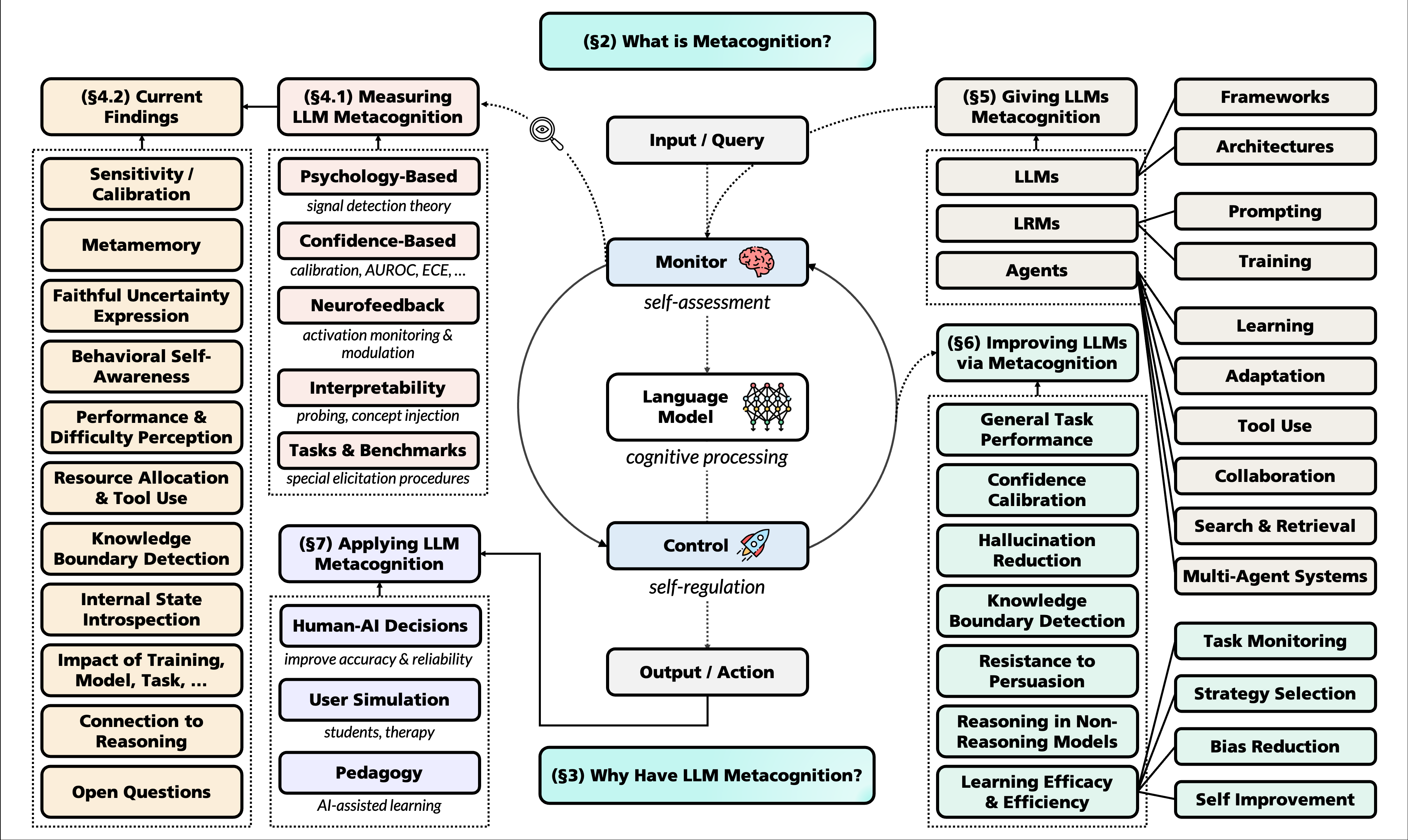
Fig 1: Taxonomy of current research on metacognition in LLMs. Metacognition describes
Limitations
- Metacognitive evaluation remains fragmented across inconsistent task settings, lacking unified datasets or standard protocols.
- Psychology-inspired metrics like meta-d' require constrained task formats; extending to open-ended tasks is nontrivial and unresolved.
- Confidence elicitation methods vary (softmax probability, verbal confidence, prompts), leading to inconsistent assessment results.
- Most benchmarks and studies focus on domain-specific metacognition, raising questions about generality.
- Limited exploration of metacognition under distribution shifts or adversarial conditions.
- Sparse empirical evidence on how metacognition scales with very large model sizes or multimodal settings.
Open questions / follow-ons
- How can metacognitive metrics be robustly extended and validated for open-ended and real-world generation tasks?
- What are the causal effects of specific training interventions (e.g., fine-tuning, RLHF) on distinct metacognitive faculties in LLMs?
- Can LLM metacognition be made domain-general rather than task-specific, and how can this be systematically evaluated?
- How can metacognitive abilities be exploited or safeguarded against risks such as strategic evasion or overconfidence in deployed systems?
Why it matters for bot defense
From a bot-defense and CAPTCHA practitioner perspective, understanding metacognition in LLMs informs the limits and potentials of LLM self-assessment and uncertainty calibration. Since metacognitive faculties directly relate to a model's ability to recognize and communicate its uncertainty, these mechanisms can be leveraged to design CAPTCHAs or interaction protocols that detect overconfident automated agents or identify weaknesses in their error detection. Furthermore, insight into metacognitive deficits—such as miscalibration or high-confidence hallucinations—can inspire new bot-defense heuristics that exploit these failure modes. Lastly, the survey highlights the challenges in reliably measuring such abilities across varying contexts, underscoring the importance of multi-faceted evaluation in adversarial or user-interactive systems.
Cite
@article{arxiv2607_11881,
  title={ Metacognition in LLMs: Foundations, Progress, and Opportunities },
  author={ Gabrielle Kaili-May Liu and Areeb Gani and Jacqueline Lu and Jordan Thomas and Mark Steyvers and Arman Cohan },
  journal={arXiv preprint arXiv:2607.11881},
  year={ 2026 },
  url={https://arxiv.org/abs/2607.11881}
}