
Designing Agent-Ready Websites for AI Web Agents: A Framework for Machine Readability, Actionability, and Decision Reliability
Source: arXiv:2607.12056 · Published 2026-07-13 · By Said Elnaffar, Farzad Rashidi
TL;DR
This paper addresses the emerging shift in e-commerce where AI web agents autonomously interact with websites to complete tasks such as product search, comparison, and purchasing. Traditional web design paradigms, optimized primarily for human users and SEO, inadequately support AI agents as they lack the integrated structure necessary for seamless programmatic interaction. To remedy this, the authors propose a conceptual framework for "agent-ready" websites centered on three core dimensions: agent interpretability, executability, and decision reliability. These dimensions emphasize machine-readable content, clear semantic labeling, reliable action pathways, and timely, verifiable information designed to facilitate AI agents' understanding and execution of complex multi-step tasks.
To validate their framework, the authors conducted a controlled experiment comparing a baseline human-focused website against an agent-ready variant with identical content but enriched with structured data, clearer labels, explicit action cues, and decision evidence. Using three advanced AI browser-agent models (GPT-4.1, Gemini-2.5 Flash, Grok-4 Fast) across 300 runs and five task categories, the agent-ready site substantially outperformed the baseline with an 89.3% strict success rate versus 49.3% on the baseline, notably reducing partial task completions and cutting average interaction steps by 30.4%. Improvements were especially pronounced on tasks involving detailed product data extraction, multi-constraint selection, and comparison. While the framework significantly enhanced AI agent reliability and efficiency, some decision-making errors persisted due to inherent model limitations rather than site design. The work highlights key website design adaptations necessary to fully support autonomous AI browsing agents in e-commerce and provides the first systematic evaluation of such an agent-ready design.
Key findings
- Agent-ready website achieved 134 PASS outcomes out of 150 runs (89.3% strict success rate) versus 74 PASS out of 150 (49.3%) for the baseline, a 40 percentage point improvement (Table 2).
- Agent-ready design reduced PARTIAL outcomes from 43 in baseline to 3, improving task completeness and reducing ambiguity.
- Average interaction steps per task decreased by 30.4%, from 9.31 steps (baseline) to 6.49 (agent-ready), indicating higher execution efficiency (Table 4).
- Tasks involving product detail extraction, multi-constraint selection, and item comparison saw the largest gains; for example, Task 2 PASS rate improved from 23.3% to 100% with agent-ready design (p < 0.001).
- All three tested AI models (GPT-4.1, Gemini-2.5 Flash, Grok-4 Fast) showed consistent performance gains under the agent-ready website condition.
- Token consumption decreased across models by 18.72%-40.47%, reflecting more efficient interaction with agent-ready features.
- Fisher’s exact tests showed significant PASS rate improvements for Tasks 1, 2, and 3 (all p < 0.05), while improvements for Tasks 4 and 5 were not statistically significant.
- Errors that persisted on agent-ready sites mainly stemmed from agent reasoning or multi-step planning failures, not from website design deficiencies.
Threat model
Adversaries are autonomous AI browser agents with capabilities to parse web pages, extract data, interpret UI elements, and perform sequential actions within multi-step workflows. They rely on the website’s structure and metadata for navigation and decision-making. They cannot circumvent website auth mechanisms or perform security breaches but may fail due to ambiguity, incomplete data, or unclear interaction pathways. The model does not consider hostile or adversarial agents aiming to subvert the site.
Methodology — deep read
The study’s threat model assumes AI web agents acting autonomously within e-commerce sites, tasked to complete complex online shopping workflows. The adversary context here is the agent’s capability to interpret, navigate, and interact with the website, with performance dependent on site design, but the framework does not address malicious adversaries or security attacks.
Data used consisted of two functional versions of an e-commerce website prototype identical in products, inventory, pricing, and task flows, differing only in agent-ready design features. The baseline site presented product data primarily embedded in JavaScript, with minimal semantic labeling and standard visible UI elements. The agent-ready variant additionally exposed product data via JSON and JSON-LD files, incorporated enhanced semantic labeling (aria-labels, data-* attributes), provided explicit action identifiers, and included supplemental evidence pages and temporal validity metadata.
Architecturally, the websites relied on standard HTML with added structured data for agent-readiness. The AI agents tested were three browser-based models: GPT-4.1, Gemini-2.5 Flash, and Grok-4 Fast, all run with a temperature of 0 and top-p set to 1 to minimize stochasticity. The models autonomously executed tasks in the browser environment using the open-source browser-use framework.
Training was not applicable as the study evaluated pretrained AI agents. Each agent model performed five defined shopping-related tasks (information retrieval, product comparison, multi-constraint filtering, etc.) ten times each on both website versions, totaling 300 independent runs. Each run had a 30-step limit and permitted up to 3 errors before termination.
Evaluation metrics included labeling runs as PASS (complete success), PARTIAL (task mostly complete with minor issues), or FAIL. These binary success metrics were further split into strict success (PASS only) and functional success (PASS + PARTIAL). Additional metrics captured included step count per run and prompt token consumption. Two independent annotators reviewed output logs and JSON action traces to assign outcome labels.
Results were statistically analyzed using chi-square and Fisher’s exact tests to verify significance of performance improvements between websites. Model-level, task-level, and error-type breakdowns were conducted. Reproducibility was supported by publishing code, website versions, task definitions, and annotations on GitHub. However, datasets and models remain closed/pretrained.
A single run example follows: For Task 2 (product detail extraction), an AI agent loaded the agent-ready website, parsed enhanced JSON-LD structured data and explicit aria-label tags, successfully extracted complete product attributes, verified stock status from temporally valid metadata, and selected the correct product. The agent completed the task in 5 steps with no errors, passing the strict success criteria. In contrast, the baseline site’s embedded JavaScript data was less accessible, requiring more extraction steps and resulting in partial success or failure in many runs.
Technical innovations
- Introduction of a unified three-dimensional agent-ready website framework addressing agent interpretability, executability, and decision reliability, unlike traditional human-focused web design paradigms.
- Integration of explicit structured data (JSON-LD, aria-labels, data-* attributes) and temporal validity indicators to enhance machine readability and support autonomous agent navigation and decision-making.
- Comprehensive empirical evaluation methodology employing multiple state-of-the-art AI browser agents and standardized multi-step task protocols to assess agent readiness impact quantitatively.
- Demonstration that enhanced website structural clarity and actionability reduces interaction steps and token usage, thus increasing AI agent efficiency and reliability.
Datasets
- Agent-ready and baseline e-commerce website prototypes — identical catalogs, pricing, stock, and workflows — used internally for controlled experiments.
Baselines vs proposed
- Baseline website: Strict success rate = 49.3%, Functional success rate = 78% vs Agent-ready website: Strict success rate = 89.3%, Functional success rate = 91.3% (Table 2).
- Task 2 baseline PASS rate = 23.3% vs Agent-ready PASS rate = 100% (p < 0.001) (Table 3).
- Task 3 baseline PASS rate = 16.7% vs Agent-ready PASS rate = 93.3% (p < 0.001) (Table 3).
- Average steps for Gemini-2.5 Flash baseline = 15.02, agent-ready = 11.56 (23% reduction) (Table 4).
- Token consumption GPT-4.1 baseline = 2,829,720 tokens vs agent-ready = 1,770,532 (37.43% reduction) (Table 4).
Figures from the paper
Figures are reproduced from the source paper for academic discussion. Original copyright: the paper authors. See arXiv:2607.12056.
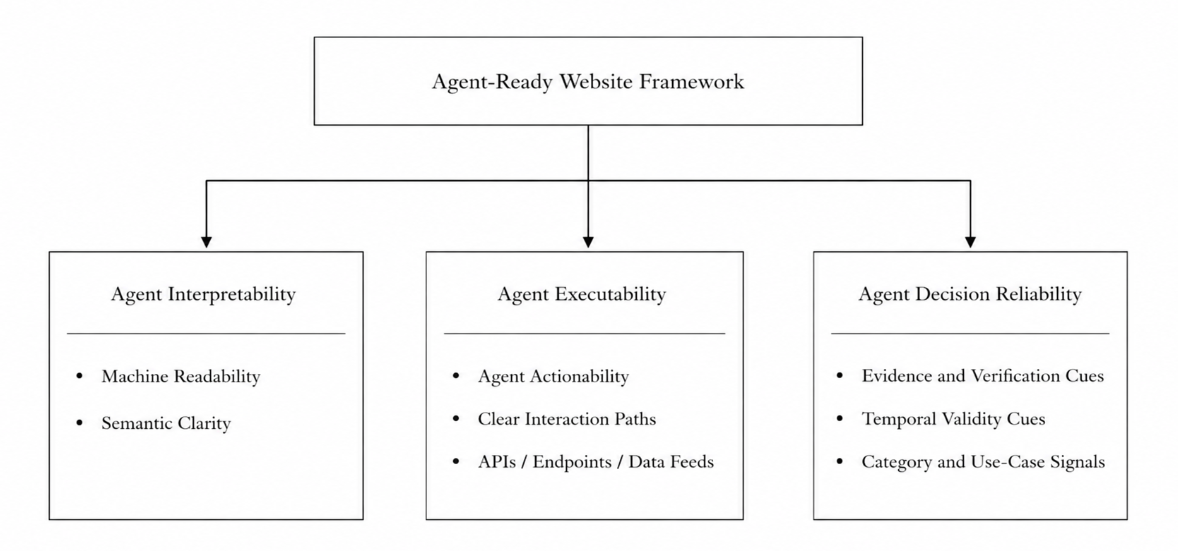
Fig 1: Conceptual structure of the agent-ready website framework
Limitations
- Controlled experiment used a custom e-commerce prototype, limiting generalizability to real-world, complex websites.
- Only three AI browser models evaluated; broader agent architectures and settings remain untested.
- Did not isolate individual framework components in ablation studies; thus, relative impact of each agent-readiness feature is unclear.
- No long-term evaluation across varied web domains beyond e-commerce shopping tasks.
- Framework improvements cannot fully compensate for intrinsic agent reasoning and multi-step planning failures.
- No adversarial or malicious agent scenarios considered; focus is strictly on cooperative agent usability.
Open questions / follow-ons
- How does agent-ready design perform on diverse, real-world commercial websites with varying complexity and dynamic content?
- What is the individual contribution and necessity of each agent-ready feature (e.g., JSON-LD, aria-labels, temporal metadata) via ablation studies?
- How can agent-readiness be extended beyond e-commerce to other classes of web applications requiring autonomous agent interaction?
- What additional mechanisms can mitigate persistent multi-step reasoning failures encountered by AI agents despite agent-ready web design?
Why it matters for bot defense
This paper is highly relevant to bot-defense and CAPTCHA practitioners designing for environments where AI agents mediate user interactions autonomously. As AI agents increasingly execute complex online tasks, understanding how website structural and semantic design impacts agent interpretability and executability is crucial for anticipating automated behaviors. Insights from this work can guide platform architects to create layouts that encourage transparent, reliable agent engagement while potentially exposing interface cues useful for differentiating legitimate agent behavior from malicious bots. Additionally, the framework’s emphasis on machine readability and temporal evidence signals may aid development of CAPTCHA and bot-defense mechanisms focused on verification of decision integrity and up-to-date information consumption by agents. However, bot-defense teams should note that improved agent-readiness also increases agent efficiency and success rates, possibly raising stealth and efficacy of well-behaved agents, thus demanding complementary detection strategies.
Cite
@article{arxiv2607_12056,
  title={ Designing Agent-Ready Websites for AI Web Agents: A Framework for Machine Readability, Actionability, and Decision Reliability },
  author={ Said Elnaffar and Farzad Rashidi },
  journal={arXiv preprint arXiv:2607.12056},
  year={ 2026 },
  url={https://arxiv.org/abs/2607.12056}
}