
Coherence as Thermodynamic Organization: Toward a Non-Equilibrium Turbulence Theory
Source: arXiv:2607.11817 · Published 2026-07-13 · By Sharath S. Girimaji
TL;DR
This paper addresses the longstanding challenge of understanding and modeling fluid turbulence, focusing on the emergence of macroscopic coherent structures in non-equilibrium turbulent flows. Traditional turbulence theories rooted in equilibrium assumptions fail to capture the organized motions that dominate many real flows where energy is continuously injected and dissipated. The author develops a unified theoretical framework that connects non-equilibrium statistical physics and turbulence by formulating coarse-grained Navier–Stokes (CGNS) equations as non-equilibrium steady states (NESS). This approach introduces a computable thermodynamic order parameter (Π) capturing the degree of turbulence coherence driven by energy throughput imbalances. The framework rigorously distinguishes two classes of coherent structures—near-equilibrium transient fluctuations and far-from-equilibrium transformative dissipative structures—drawing analogies to classical thermodynamic phenomena described by Kubo and Prigogine. The paper demonstrates how these structural regimes emerge from renormalized mesoscale energy transfer and links them to topological bifurcations in the flow dynamics, addressing historic conceptual objections related to coherence persistence, irreversibility, and mathematical formalism in turbulence theory. This paradigm offers a physics-based criterion for determining the necessary flow resolution and closure modeling intensity in turbulence simulations, thereby bridging fundamental theory and practical computational modeling.
Key findings
- Turbulent coherent structures arise universally as thermodynamic responses mandated by macroscopic energy throughput imbalances, classifiable into two regimes: near-equilibrium transient (Class I) and far-from-equilibrium transformative (Class II) structures.
- The coarse-grained Navier–Stokes (CGNS) equations provide a rigorous non-equilibrium steady state formulation capturing mesoscale resolved fields and unresolved turbulent baths, enabling explicit modeling of energy transfer rates such as unresolved production (Pu) and dissipation (εu).
- Class I structures correspond to accommodative transient responses governed by linear response theory and Fluctuation–Dissipation Theorem (FDT), lacking discrete bifurcations and exhibiting ephemeral, regression-like behavior.
- Class II structures emerge via symmetry-breaking bifurcations when strong forcing exceeds dissipative capacity, creating persistent macroscopic reorganizations analogous to Prigogine's dissipative structures, reorganizing flow topology and transport.
- The renormalized CGNS framework unifies RANS, LES, and DNS as limiting cases of flow resolution, allowing a continuous operator hierarchy where the scale partition adapts to forcing-driven structural scales.
- The Partially-Averaged Navier–Stokes (PANS) model satisfies the mathematical and thermodynamic closure criteria to serve as a computable CGNS operator preserving non-Markovian memory required for coherent structure dynamics.
- This approach overcomes historical objections concerning turbulence coherence persistence by classifying structural types and clarifying that irreversibility emerges at the mesoscopic coarse-grained level rather than microscopic dynamics.
- Energy throughput metrics derived from the unresolved stress tensor provide an objective thermodynamic order parameter (Π) that identifies the necessary flow scales to resolve or model for accurate turbulence predictions.
Methodology — deep read
Threat Model & Assumptions: The study treats turbulence as an open, continuously forced nonequilibrium system with external energy injection (e.g., shear, pressure gradients). The adversary in the conceptual framing is the physical system's energy throughput imbalance that drives coherence emergence. The coarse-graining approach assumes that microscopic fluid dynamics (Euler or Navier-Stokes equations) are time-reversible and deterministic, but macroscopic irreversibility and coherent organization emerge through scale separation and statistical projection (analogous to Prigogine's thermodynamic approach). The unresolved turbulent bath acts as a dissipative reservoir absorbing energy cascaded from resolved mesoscale coherent fields.
Data & Preprocessing: The paper is primarily theoretical and analytical, and does not rely on large-scale empirical datasets. It references canonical benchmark problems such as Rayleigh–Bénard convection near and beyond critical temperature gradients, Taylor–Couette flow sub- and super-critical regimes, and cylinder wake flows. These examples serve as conceptual analogs rather than quantitative datasets. Mathematical derivations start from exact coarse-graining of Navier–Stokes equations (CGNS) using spatial filtering and central moments for subgrid stress tensors.
Architecture / Algorithms: The core mathematical framework involves deriving the CGNS equations by spatially filtering velocity and pressure fields, decomposing velocity into resolved (Ui) and unresolved (ui') components, and defining residual stress tensors τij = u_iu_j - U_iU_j. The subgrid stress is closed via the Boussinesq hypothesis, linking τij to resolved strain rates through a turbulent eddy viscosity νu(x). The effective viscosity νeff = ν + νu renormalizes the nonlinear cascade into macroscopic diffusion. The framework treats the turbulent bath as an autonomous subsystem evolving its own memory-containing dynamics, requiring at least a two-equation closure to represent unresolved production Pu and dissipation εu rates, enabling computation of irreversible energy transfer associated with thermodynamic imbalance.
Training Regime: Since this is a theoretical framework, no training per se is done. However, for numerical simulation verification such as PANS LES or cylinder wake flows, appropriate resolution, filtering scale, and closure parameters would be set to separate resolved and unresolved scales. The paper emphasizes adaptability of coarse-graining scale depending on forcing strength and flow topology.
Evaluation Protocol: The approach is evaluated conceptually and through illustrative examples analyzing flow bifurcation topology, energy production-dissipation balance, and coherent structure persistence in canonical flows. Metrics like the unresolved production Pu and dissipation εu quantify the irreversible entropy production as a proxy for thermodynamic stress. The formulation permits classification of coherent structures and identification of necessary resolution for capturing them. The framework is consistent with classical turbulence statistical mechanics and thermodynamics approaches from Onsager to Prigogine.
Reproducibility: The work is primarily a theoretical and mathematical contribution, with no specific computational code or datasets released. The theoretical derivations and formulations rely on publicly known classical turbulence and thermodynamics models and closure approaches such as PANS, which are available in literature. Empirical validation and practical implementation details are suggested for future work but not provided here.
Example Walkthrough: Consider a turbulent shear flow with persistent energy input causing local production-dissipation imbalance. The CGNS framework spatially filters the velocity field into a resolved coherent manifold (Ui) and unresolved bath (ui'). The unresolved stress τij, computed as the velocity fluctuation covariance, mediates energy transfer rate Pu from resolved scales into unresolved dissipation εu. Near equilibrium, the flow shows transient accommodation of excess energy via short-lived vortices (Class I), modeled as linear responses within FDT. For stronger forcing surpassing a bifurcation threshold, the system undergoes symmetry-breaking creating stable, transformative large-scale vortices (Class II dissipative structures). The computable Pu, εu, and effective turbulent viscosity νu identify the critical flow scales requiring explicit resolution to accurately simulate the coherent structures maintaining non-equilibrium steady state.
Technical innovations
- Formulation of the coarse-grained Navier–Stokes (CGNS) equations as a non-equilibrium steady state (NESS) framework capturing mesoscale resolved coherent structures and the unresolved turbulent bath.
- Classification of turbulent coherent structures into two universal thermodynamic regimes—Class I accommodative transient fluctuations governed by Kubo linear response and Fluctuation–Dissipation Theorem, and Class II transformative dissipative structures arising from symmetry-breaking bifurcations per Prigogine theory.
- Introduction of computable energy throughput metrics—unresolved production (Pu) and dissipation (εu)—derived from the residual subgrid stress tensor to quantify the thermodynamic order parameter (Π) indicating non-equilibrium coherence.
- Demonstration that the Partially-Averaged Navier–Stokes (PANS) closure satisfies the necessary autonomous memory and energetic consistency requirements to serve as a controllable CGNS operator bridging RANS, LES, and DNS resolutions.
- Resolution of historical objections concerning turbulence coherence persistence and irreversibility through a scale-hierarchical, renormalized thermodynamic framework rooted in statistical mechanics and coarse-graining.
Figures from the paper
Figures are reproduced from the source paper for academic discussion. Original copyright: the paper authors. See arXiv:2607.11817.
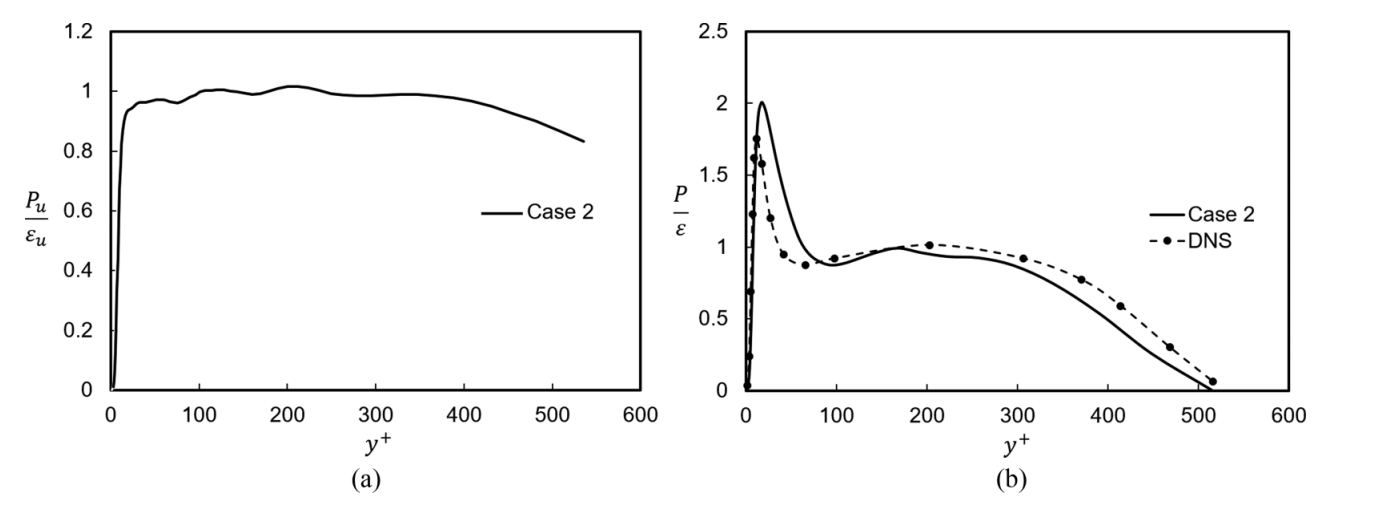
Fig 2: Production–dissipation balance in equilibrium wall-bounded turbulence. (a) PANS
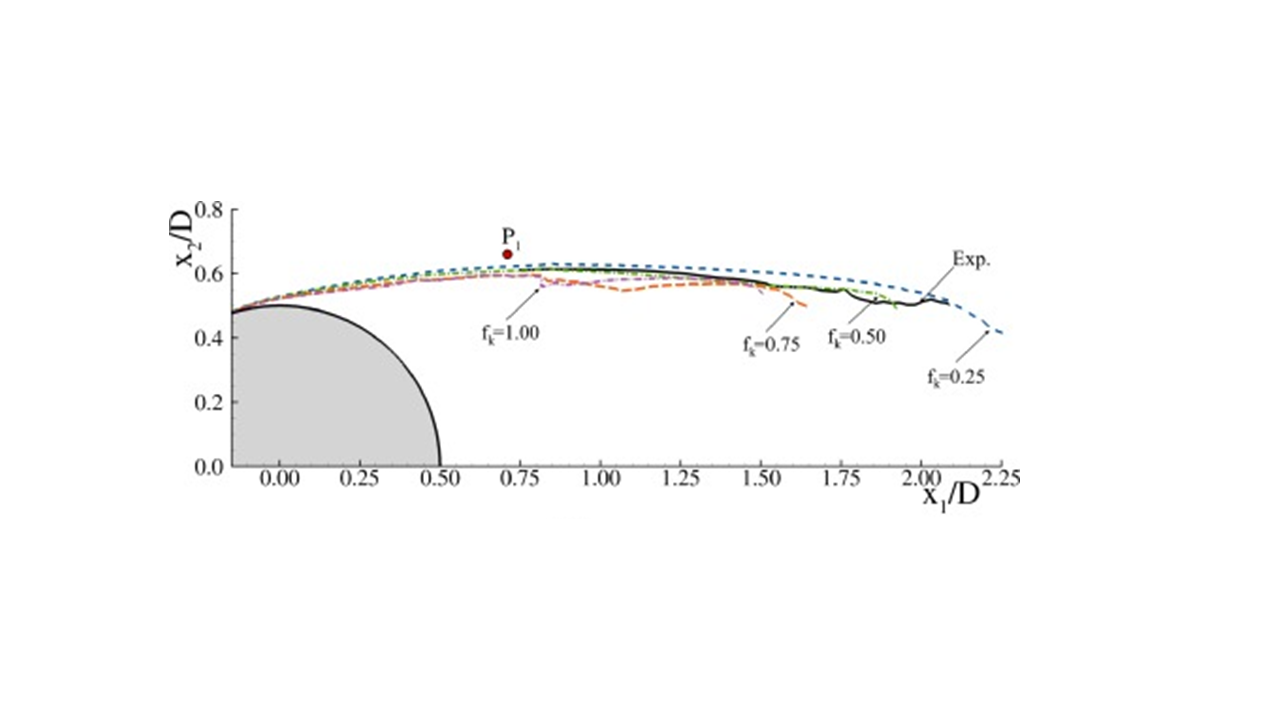
Fig 3: Mean-flow inflection line in the wake of a circular cylinder at 𝑅𝑒= 3, 900. Results
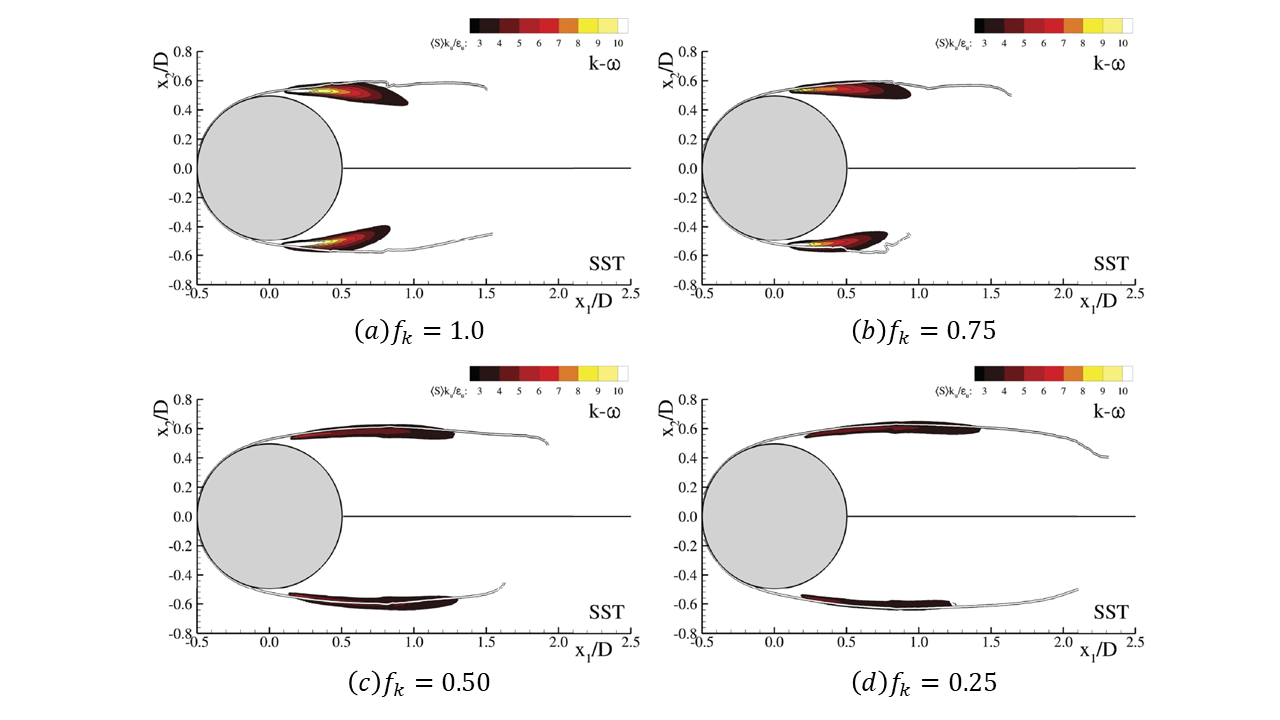
Fig 4: The mechanics of coherent structure emergence in cylinder-wake PANS simulations.
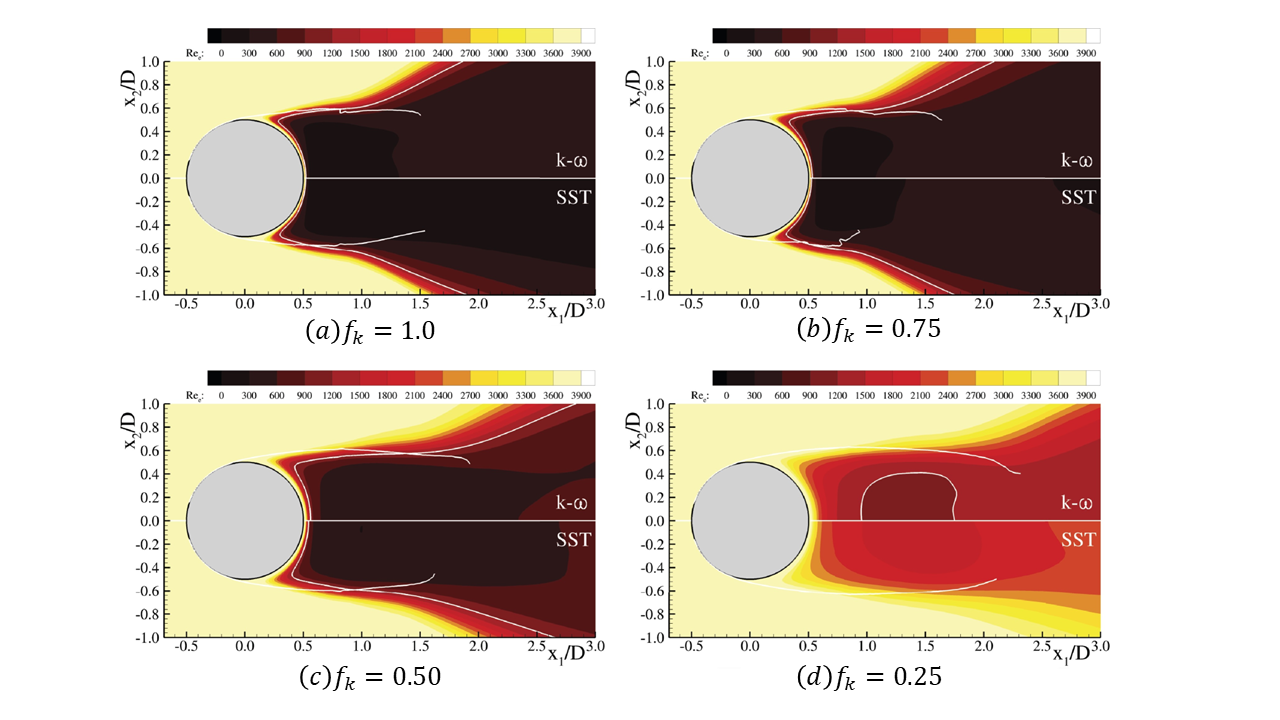
Fig 4 (page 31).
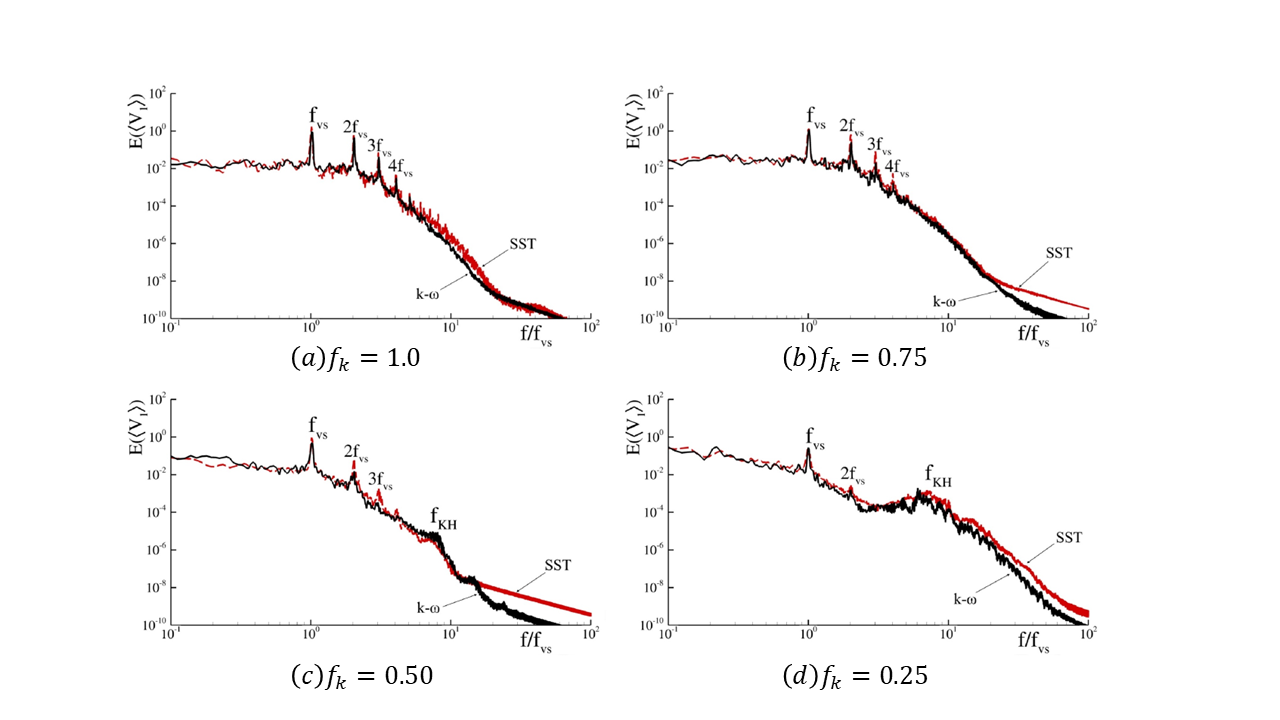
Fig 5 (page 31).
Limitations
- The framework is primarily theoretical and conceptual, with limited empirical or numerical validation presented within the paper.
- No specific large-scale turbulence datasets or benchmarks are used to quantitatively evaluate the proposed thermodynamic order parameter in practical flow simulations.
- The universality of the CGNS framework and classification into Class I and II structures requires further testing across a wider range of complex turbulent flows and forcing regimes.
- The exact form and parameterization of subgrid closures beyond the canonical PANS model remain open, potentially affecting quantitative predictions of energy throughput and coherence.
- The approach does not yet incorporate detailed stochastic or machine-learning-based closure refinements that might improve unresolved scale modeling.
Open questions / follow-ons
- How can the thermodynamic order parameter (Π) be quantitatively validated and calibrated in high-fidelity turbulent flow simulations or experiments across diverse physical regimes?
- What are the optimal closure modeling strategies and parameter choices to accurately represent the unresolved turbulent bath's memory and energy transfer dynamics within the CGNS framework beyond the PANS approach?
- How do complex flow geometries, multiscale forcing, and flow anisotropy affect the classification and stability of Class I versus Class II coherent structures?
- Can this thermodynamic organization framework be extended to incorporate stochastic or data-driven turbulence closures for improved predictive capabilities in engineering applications?
Why it matters for bot defense
For bot-defense and CAPTCHA practitioners looking for analogies from physics or complex system modeling, this work provides an in-depth theoretical framework for understanding how complex, non-equilibrium structures self-organize to process energy flow imbalances. Translating to bot detection, the notion that macroscopic patterns emerge necessarily from underlying throughput imbalances suggests criteria for isolating meaningful coherent behaviors versus random noise or transient fluctuations in usage patterns. The classification of coherence into accommodative (transient) and transformative (persistent) regimes offers a conceptual analogy for distinguishing ephemeral bot-like actions from persistent, autonomous malicious behaviors. Moreover, the idea of coarse-grained resolution and scale-adaptivity in detecting structures can inspire hierarchical or multi-scale monitoring frameworks in CAPTCHA systems, prioritizing resolution where irreversible throughput imbalances manifest. While not directly applicable to CAPTCHA algorithm design, the rigorous grounding in energy transfer and irreversibility could inspire principled approaches to model and quantify organized traffic anomalies amid background noise.
Cite
@article{arxiv2607_11817,
  title={ Coherence as Thermodynamic Organization: Toward a Non-Equilibrium Turbulence Theory },
  author={ Sharath S. Girimaji },
  journal={arXiv preprint arXiv:2607.11817},
  year={ 2026 },
  url={https://arxiv.org/abs/2607.11817}
}