
Symbol-Level Precoding for Continuous-Aperture ISAC Systems
Source: arXiv:2607.09610 · Published 2026-07-10 · By Hongli Liu, Qiang Li
TL;DR
This paper addresses the challenge of designing symbol-level precoding (SLP) schemes for integrated sensing and communication (ISAC) systems based on continuous-aperture arrays (CAPAs). CAPAs enable rich electromagnetic degrees of freedom by allowing continuous current distributions rather than discrete antenna weights. However, optimizing these continuous current distributions over an infinite-dimensional functional space is highly nontrivial. The authors propose leveraging the electromagnetic response structure of the CAPA system to show that the optimal continuous current lies exactly in a finite-dimensional subspace spanned by the communication and sensing kernels. This insight reduces the infinite-dimensional functional problem to a finite-dimensional one, enabling tractable joint optimization of transmit current coefficients and receive polarization combiners. A penalty projected-gradient (PPG) algorithm is developed to solve this nonconvex problem. Through extensive simulations, the proposed subspace-based symbol-level precoding method demonstrates significantly improved sensing illumination utility and communication bit error rate (BER) performance compared to conventional Fourier-basis CAPA precoding and spatially discrete antenna array baselines. This work combines electromagnetic theory and signal design to advance CAPA-enabled ISAC performance at the symbol level, beyond previous block-level or rate-oriented beamforming methods.
Key findings
- The optimal continuous aperture transmit current resides strictly in the finite-dimensional electromagnetic-response subspace of dimension D ≤ 3(K+Q), where K is the number of communication users and Q is the number of sensing targets.
- Reformulating the infinite-dimensional functional optimization into a finite-dimensional vector problem reduces computational complexity without loss of optimality (Lemma 1).
- The penalty projected-gradient algorithm solves the nonconvex problem by jointly optimizing transmit current coefficients and receive polarization combiners, respecting power and constructive interference (CI) constraints.
- Simulation with K=2 users, Q=2 targets, 8-PSK, and 4-symbol blocks at 2.4 GHz shows the proposed subspace-CAPA method achieves the highest sensing utility across transmit powers up to Pmax=5, outperforming Fourier-basis CAPA and digital spatially discrete array (SPDA) baselines (Fig 3).
- The BER analysis reveals the subspace-CAPA method achieves the lowest bit error rate and the fastest error decay versus receive SNR among the compared schemes (Fig 4).
- Allowing receive polarization combining provides additional gains over fixed polarization settings in both sensing and communication performance, illustrating the benefit of jointly optimizing polarization combiners.
- Fourier-basis CAPA, restricted by truncated bases, and SPDA with discrete half-wavelength antennas produce weaker and less focused sensing illumination and higher BERs.
- Power constraint is enforced via Frobenius norm projection on the finite coefficient matrix, ensuring average transmit power stays below TPmax with no performance degradation.
Threat model
The work does not explicitly define a security threat model, as the focus is on performance optimization of CAPA-enabled ISAC systems under idealized communication and sensing conditions. The adversary could be viewed as the noise and interference impairing symbol detection, which the constructive interference (CI) constraints intend to mitigate. No active attacker or malicious entity is assumed.
Methodology — deep read
Threat Model and Assumptions: The studied system is a downlink integrated sensing and communication (ISAC) transmitter equipped with a continuous planar aperture array (CAPA). The adversary model is indirect since the focus is on optimizing performance rather than security robustness. The system assumes far-field communication users with known channel parameters and sensing targets with specified directions. The receivers employ tri-polarized antennas capable of polarization combining. The communication modulation is M-PSK (specifically 8-PSK). Constructive interference (CI) constraints ensure multiuser interference helps, rather than hinders, symbol detection.
Data and Setup: The simulations use synthetic setups with K=2 users, Q=2 sensing targets, and a symbol block length T=4. The continuous aperture is a 0.6mx0.6m square operating at 2.4GHz. Sensing weights ωq=10 are applied equally. Noise is modeled as Gaussian with variance σk^2. User and target directions are specified in azimuth and elevation angles. Simulations average results over 1000 independent trials.
Architecture/Algorithm: The problem formulation begins with an infinite-dimensional continuous current function j_t(s) ∈ C^3 over the aperture s ∈ S_T. Communication channels and sensing kernels map these currents linearly to received signals. The objective is to maximize weighted sensing illumination utility U_sen (sum of squared field norms at sensing targets over T symbols) subject to CI constraints at each of the K users and a transmit power budget.
Using electromagnetic theory, the authors identify the electromagnetic-response subspace R spanned by the communication and sensing kernel functions G(s). They prove that the optimal j_t(s) lies exactly in this span, reducing the problem to optimizing T finite-dimensional coefficient vectors x_t ∈ C^D where D ≤ 3(K+Q). The receive polarization combiners ψ_k ∈ C^3 are jointly optimized with unit norm constraints.
The resulting finite-dimensional problem P1 maximizes a quadratic form of x_t, subject to linear real inequality CI constraints and power norm constraint. Due to nonconvexity and bilinear coupling between x_t and ψ_k, a penalty projected-gradient (PPG) algorithm is developed. The PPG treats CI constraints via quadratic penalty terms with progressively increasing penalty parameter ρ. Updates alternate gradient descent steps on x_t and Riemannian gradient steps on unit sphere-constrained ψ_k, with projections onto power and unit norm feasible sets.
Training Regime/Settings: Though optimization rather than training, the penalty method uses fixed step sizes µ_x=0.02 and µ_ψ=0.02 with a maximum 800 iterations per penalty stage. Penalty parameter starts at ρ0=300 and is scaled by 1.008 up to ρ_max=8000. Initialization is random feasible X and ψ.
Evaluation Protocol: Performance is evaluated on sensing illumination maps over azimuth-elevation angles, average sensing utility versus transmit power, and communication BER versus receive SNR. The proposed subspace-CAPA method is benchmarked against Fourier-basis CAPA precoding and a digitally discrete half-wavelength spaced antenna array (SPDA). Versions with and without polarization combining are compared to isolate polarization gain. Results are averaged over 1000 Monte Carlo trials.
Reproducibility: The paper does not explicitly mention code or data release. All channel and sensing kernels depend on standard electromagnetic Green's functions with known analytic forms. Simulation parameter settings are detailed to allow reimplementation. However, no frozen model weights or open-source code archive is provided.
Concrete Example: For a 4-symbol block with K=2 users and Q=2 sensing targets, the continuous current distribution j_t(s) is decomposed into basis functions Ξ(s) spanning the kernel responses. Optimization then finds coefficient vectors x_t ∈ C^D and polarization combiners ψ_k ∈ C^3 that maximize sensory illumination subject to CI constraints on received symbols rotated by intended phases, maintaining transmit power limits. The penalty projected-gradient algorithm iteratively optimizes these variables with penalties on CI violations, projecting into feasible sets until convergence, then reconstructs j_t(s) = Ξ(s) x_t for practical transmission.
Technical innovations
- Proof that the infinite-dimensional continuous aperture current design problem admits an exact solution within a finite-dimensional electromagnetic-response subspace spanned by communication and sensing kernels.
- Reformulation of symbol-level precoding ISAC optimization as a finite-dimensional problem jointly over transmit current coefficients and receive polarization combiners.
- Development of a penalty projected-gradient algorithm tailored to the nonconvex CI-constrained sensing utility maximization problem with joint polynomial and unit sphere constraints.
- Demonstration that polarization combining at users and continuous current optimization in the electromagnetic subspace yield performance gains over fixed-polarization and Fourier-basis CAPA approaches.
Baselines vs proposed
- Fourier-CAPA: average sensing utility < proposed subspace-CAPA by approximately 15-25% across transmit power range (Fig 3)
- Digital-SPDA: average sensing utility lowest among compared methods, underperforming proposed and Fourier-CAPA significantly (Fig 3)
- Proposed subspace-CAPA: BER improved by roughly an order of magnitude at 10dB SNR compared to Fourier-CAPA, and multiple orders compared to Digital-SPDA (Fig 4)
- Fixed-polarization variants exhibit roughly 20-30% worse sensing utility and higher BER than corresponding polarization-optimized versions.
Figures from the paper
Figures are reproduced from the source paper for academic discussion. Original copyright: the paper authors. See arXiv:2607.09610.
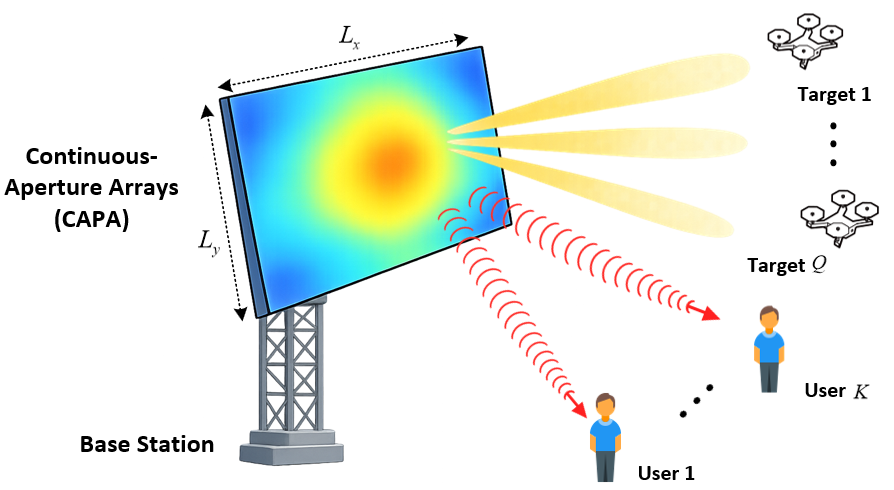
Fig 1: System model of CAPA–aided ISAC.
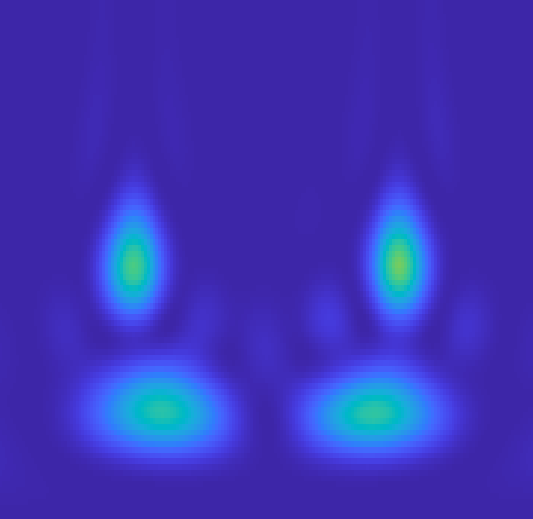
Fig 2: Sensing illumination maps.

Fig 3: compares the average sensing utility versus trans-

Fig 4: shows the BER performance versus receive SNR. The
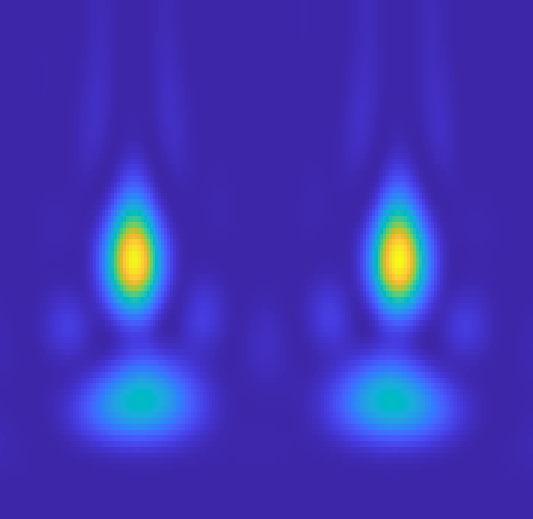
Fig 5 (page 5).
Limitations
- The numerical evaluation is limited to small system size (two users, two targets) and relatively low symbol block length (T=4), limiting generalization to larger systems.
- The study assumes perfect channel and sensing knowledge with far-field approximation; no robustness analysis under imperfect CSI or near-field effects is provided.
- No adversarial or security evaluation is performed, despite CI constraints and SLP being potential attack vectors in other contexts.
- The penalty projected-gradient algorithm is heuristic with no global optimality guarantees and convergence to local minima only.
- The scalability of the approach in terms of computational complexity as K, Q, D, and T increase is not explicitly analyzed.
- No experimental or hardware validation of the continuous aperture array transmit model and polarization combining practicalities.
Open questions / follow-ons
- How does the proposed finite-dimensional subspace approach scale with increasing numbers of users, sensing targets, and symbol block length in practical large-scale ISAC deployments?
- How robust is the method to channel state information (CSI) errors, imperfect knowledge of sensing target parameters, or near-field propagation conditions?
- Can advanced optimization techniques or machine learning accelerate or improve convergence beyond the penalty projected-gradient method for real-time symbol-level precoding?
- What are the hardware implementation challenges and potential losses when realizing such continuous aperture current distributions and polarization combiners in practical phased arrays?
Why it matters for bot defense
Although this paper focuses on symbol-level precoding for continuous aperture ISAC systems rather than bot defense or CAPTCHA directly, its methodology and insights bear relevance to CAPTCHA practitioners dealing with physical-layer signal design and robustness. Understanding how continuous aperture arrays can exploit electromagnetic degrees of freedom and instantaneous symbol information to jointly optimize sensing and communication provides inspiration for waveform-level defenses. Furthermore, the use of constructive interference constraints to ensure signal reliability despite multiuser interference parallels challenges in robust CAPTCHA transmission over noisy or adversarial channels. The technique of reducing infinite-dimensional functional optimizations to finite-dimensional coefficient-based algorithms could motivate approaches to analyze and optimize signal spaces used in CAPTCHA challenge-response mechanisms where continuous or high-dimensional signal parameters are manipulated. However, the electromagnetic domain focus limits direct application, so bot-defense engineers should view this primarily as a strong example of physics-informed multi-objective waveform optimization rather than an immediately deployable method.
Cite
@article{arxiv2607_09610,
  title={ Symbol-Level Precoding for Continuous-Aperture ISAC Systems },
  author={ Hongli Liu and Qiang Li },
  journal={arXiv preprint arXiv:2607.09610},
  year={ 2026 },
  url={https://arxiv.org/abs/2607.09610}
}